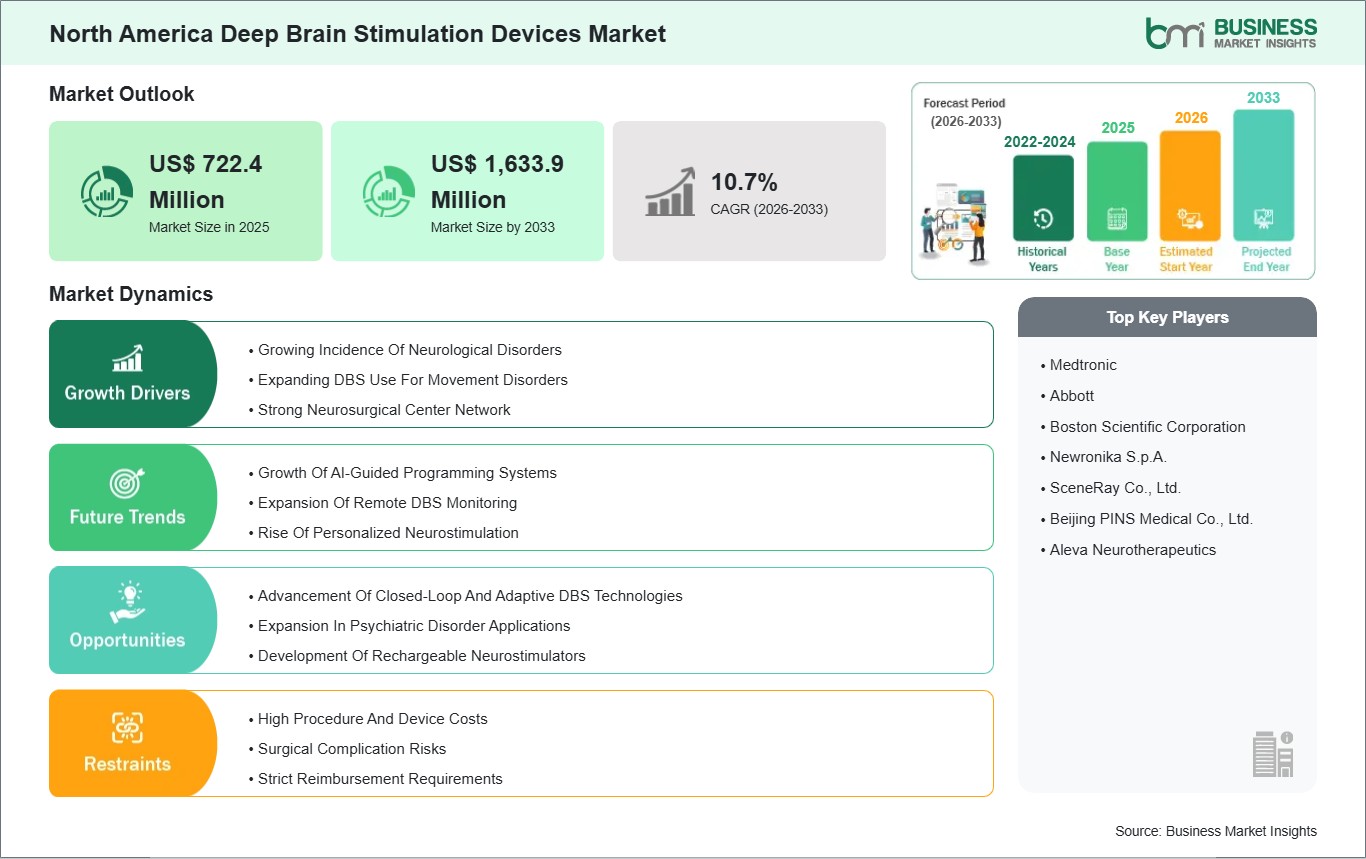
The North America deep brain stimulation devices market size is expected to reach US$ 1,633.9 million by 2033 from US$ 722.4 million in 2025. The market is estimated to record a CAGR of 10.7% from 2026 to 2033.
The DBS devices market in North America is highly favored with widespread clinical acceptance and a highly developed neuromodulation environment. This market has an advantage in having highly sophisticated healthcare systems, high awareness regarding movement disorder treatments, and early adoption of modern neurosurgery technology. DBS is widely utilized in the management of neurological disorders like Parkinson's disease, essential tremors, dystonia, and even some psychiatric disorders that do not respond to medications. One major driving factor behind the growth in this market is the increase in the number of neurodegenerative disorders due to the aging population in North America.
Another critical factor that aids in market growth is the presence of a good reimbursement structure along with widespread insurance coverage for indicated conditions, which increases patient access to expensive implantable devices. With ongoing technological innovations like closed-loop stimulation systems, directional leads, and rechargeable implantable pulse generators, the effectiveness of the procedures is being enhanced. The high procedural difficulty involved in the implantation of DBS is what restricts it to special facilities only, and not all patients are candidates for DBS because of the risks associated with surgery, as well as clinical assessment requirements. However, even with this, North America represents a mature and innovative DBS devices market.

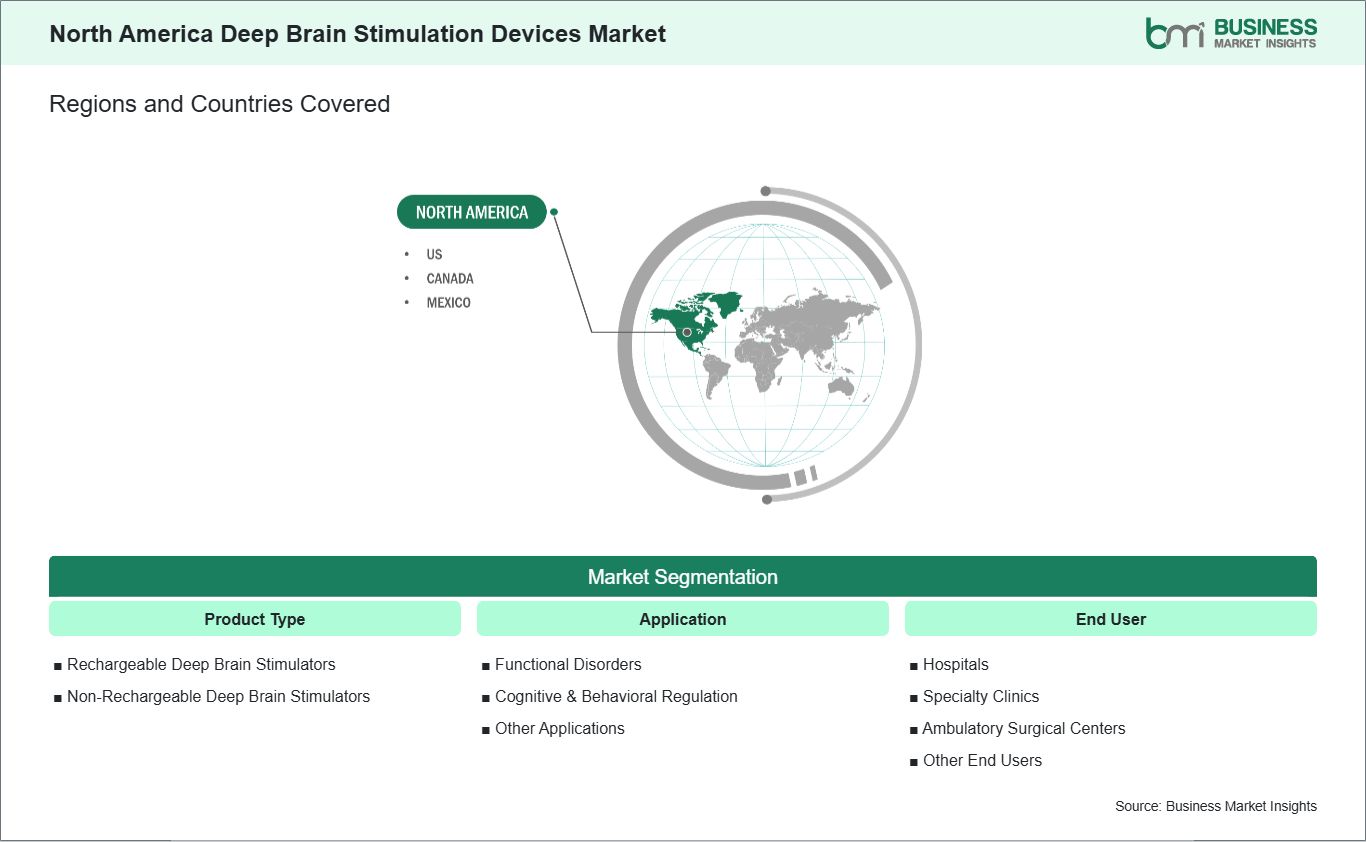
Key segments that contributed to the derivation of the North America deep brain stimulation devices market analysis are product type, application, and end user.
North America continues to see a rising burden of neurological disorders such as Parkinson's disease, essential tremor, dystonia, epilepsy, and treatment-resistant psychiatric conditions, which is steadily increasing the demand for deep brain stimulation (DBS) devices. The region's aging population, particularly in the United States and Canada, is a major contributing factor, as neurodegenerative diseases become more prevalent with advancing age. Large urban healthcare systems in cities like New York, Toronto, and Los Angeles are increasingly managing complex movement disorder cases that progress beyond medication-based control.
Improved awareness and early diagnosis are also expanding the eligible patient pool for DBS therapy. Neurology networks across North America are highly structured, with multidisciplinary movement disorder clinics integrating neurologists, neurosurgeons, and rehabilitation specialists. This coordinated approach allows earlier identification of patients who are no longer responding effectively to pharmacological therapies, making them candidates for surgical intervention.
Additionally, lifestyle-related chronic conditions such as diabetes, cardiovascular disease, and stroke are contributing indirectly to neurological complications. These comorbidities often worsen motor symptoms or accelerate disease progression, increasing dependence on advanced therapeutic options. As a result, DBS is increasingly being considered not only for severe Parkinson's disease but also for broader neurological indications requiring long-term symptom control.
In North America, the development of closed-loop and adaptive stimulation technology plays a crucial role in driving the DBS market. Such advanced devices provide electrical stimulation depending on the changes occurring within the brain, which allows for the provision of customized treatment. This approach is highly beneficial in cases such as Parkinson's disease, where the symptoms are characterized by fluctuation during the day.
Neurosurgical and educational institutions in the United States and Canada are at the forefront of adopting the new DBS platforms. The use of directional leads, rechargeable pulse generators, and MRI compatibility is common among hospitals. The collaboration between clinical researchers and device manufacturers is fostering innovation in the field as well as widening the spectrum of diseases that can be managed via DBS.
Technology integration has been transforming the administration of DBS therapy in the region. The ability to perform remote tuning of the DBS implant via software applications means that patients do not have to visit the hospital every time an adjustment needs to be made. This becomes particularly significant in North America due to the distance of many patients from specialized centers.

The North America deep brain stimulation devices market is experiencing steady growth, with market size and share analysis reflecting evolving treatment preferences and competitive dynamics among key players. The report evaluates important subsegments categorized within product type, application, and end user, highlighting their respective contributions to overall market performance.
By product type, the rechargeable deep brain stimulators subsegment dominated the market in 2025, driven by the growing preference for long-lasting and patient-friendly neurostimulation solutions. These devices offer extended battery life, reduced frequency of replacement surgeries, and improved convenience for patients, making them the preferred choice for the management of chronic neurological disorders.
Based on application, the functional disorders subsegment dominated the market in 2025, propelled by the rising prevalence of neurological conditions such as Parkinson's disease, essential tremor, and dystonia, along with increasing adoption of deep brain stimulation therapy for effective symptom management and improved quality of life.
In terms of end user, the hospitals subsegment dominated the market in 2025 due to their advanced neurology and neurosurgery departments, availability of skilled healthcare professionals, and access to technologically advanced deep brain stimulation devices and surgical infrastructure.
| Report Attribute | Details |
|---|---|
| Market size in 2025 | US$ 722.4 Million |
| Market Size by 2033 | US$ 1,633.9 Million |
| CAGR (2026 - 2033) | 10.7% |
| Historical Data | 2022-2024 |
| Forecast period | 2026-2033 |
| Segments Covered | By Product Type
|
|
Regions and Countries Covered
| |
| North America | US, Canada, Mexico |
| Market leaders and key company profiles |
|
The "North America Deep Brain Stimulation Devices Market Size and Forecast (2022-2033)" report provides a detailed analysis of the market covering below areas:
The geographical scope of the North America Deep Brain Stimulation Devices market report is divided into: The US, Canada, and Mexico. The US held the largest share in 2025.
The United States is considered the leader in the North America DBS devices market due to the presence of a well-developed neurosurgery medical infrastructure and tight connections between neurologists in tertiary healthcare facilities. The US is home to many state-of-the-art movement disorders centers and medical academies actively engaged in DBS implantations and clinical studies.
One of the major advantages of the US market is the strong regulatory framework, which ensures early adoption of the next generation of DBS technologies through clinical trials and approval. Another important strength of the market is the strong expertise of physicians in combination with the multidisciplinary approach used by neurologists, neurosurgeons, and psychiatrists, which ensures correct patient selection and optimal treatment results. Moreover, the availability of health insurance programs for neurological conditions provides an additional benefit and decreases the financial burden of patients who meet all the criteria. Patient organizations are quite active in raising awareness about the diseases and stimulating patients to undergo treatment. However, one of the main weaknesses of the market is related to the inequity of access between urban and rural areas, as DBS procedures can be performed only in urban medical centers.

The North America Deep Brain Stimulation Devices market is evaluated by gathering qualitative and quantitative data post primary and secondary research, which includes important corporate publications, association data, and databases. A few of the key developments in the North America Deep Brain Stimulation Devices market are:
The North America Deep Brain Stimulation Devices Market is valued at US$ 722.4 Million in 2025, it is projected to reach US$ 1,633.9 Million by 2033.
As per our report North America Deep Brain Stimulation Devices Market, the market size is valued at US$ 722.4 Million in 2025, projecting it to reach US$ 1,633.9 Million by 2033. This translates to a CAGR of approximately 10.7% during the forecast period.
The North America Deep Brain Stimulation Devices Market report typically cover these key segments-
The historic period, base year, and forecast period can vary slightly depending on the specific market research report. However, for the North America Deep Brain Stimulation Devices Market report:
The North America Deep Brain Stimulation Devices Market is populated by several key players, each contributing to its growth and innovation. Some of the major players include:
The North America Deep Brain Stimulation Devices Market report is valuable for diverse stakeholders, including:
Essentially, anyone involved in or considering involvement in the North America Deep Brain Stimulation Devices Market value chain can benefit from the information contained in a comprehensive market report.
Please tell us your area of interest
(Market Segments/ Regions and Countries/ Companies)