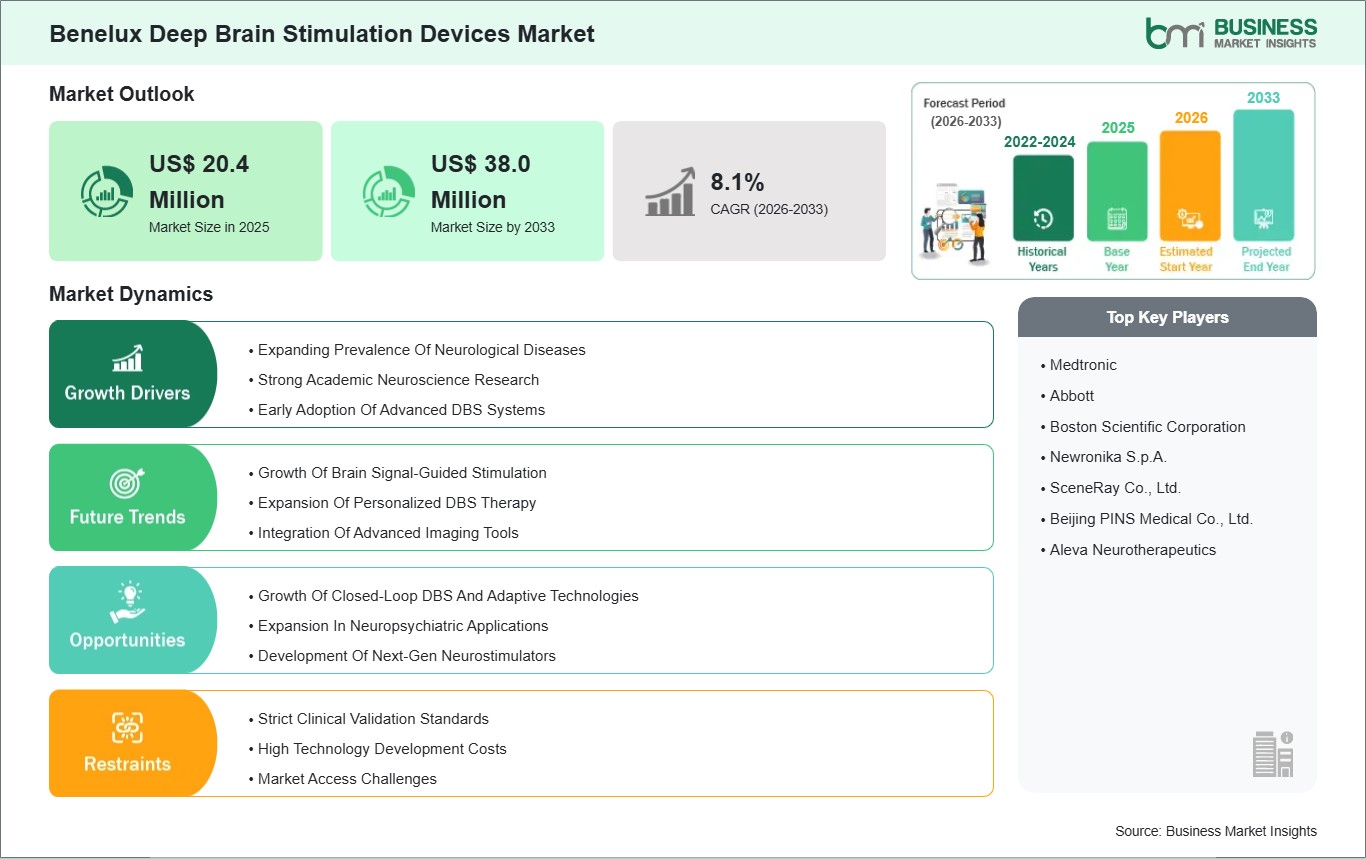
The Benelux deep brain stimulation devices market size is expected to reach US$ 38.0 million by 2033 from US$ $20.4 million in 2025. The market is estimated to record a CAGR of 8.1% from 2026 to 2033.
Benelux is one of the most specialized and innovative markets for DBS Devices. It has already set up an excellent neurological care structure, uses modern medical technology, and maintains an integrated healthcare system that facilitates the timely diagnosis of neurological disorders. The need for DBS devices arises mainly because of the rising cases of movement disorders like Parkinson's disease and the adoption of neuromodulation treatments for other difficult-to-treat diseases such as dystonia and essential tremors.
One of the driving factors behind the growth in this region is the availability of state-of-the-art neurosurgery centers and hospitals that engage in clinical research and technological development. Such institutions facilitate the quicker adoption of the latest generation DBS devices, which include adaptive stimulation and MRI-compatibility options. The cooperation between medical universities and international companies producing innovative devices enhances the quality of procedures and training, leading to better results. Nonetheless, the market faces limitations posed by the complexity of procedures and stringent regulations under the European framework for medical devices, resulting in prolonged periods of approval for innovations. Furthermore, reimbursement policies vary between healthcare systems in the region, making it difficult to implement new DBS devices. Despite these obstacles, the Benelux region maintains steady growth prospects due to its robust healthcare system and continuous medical advancements.

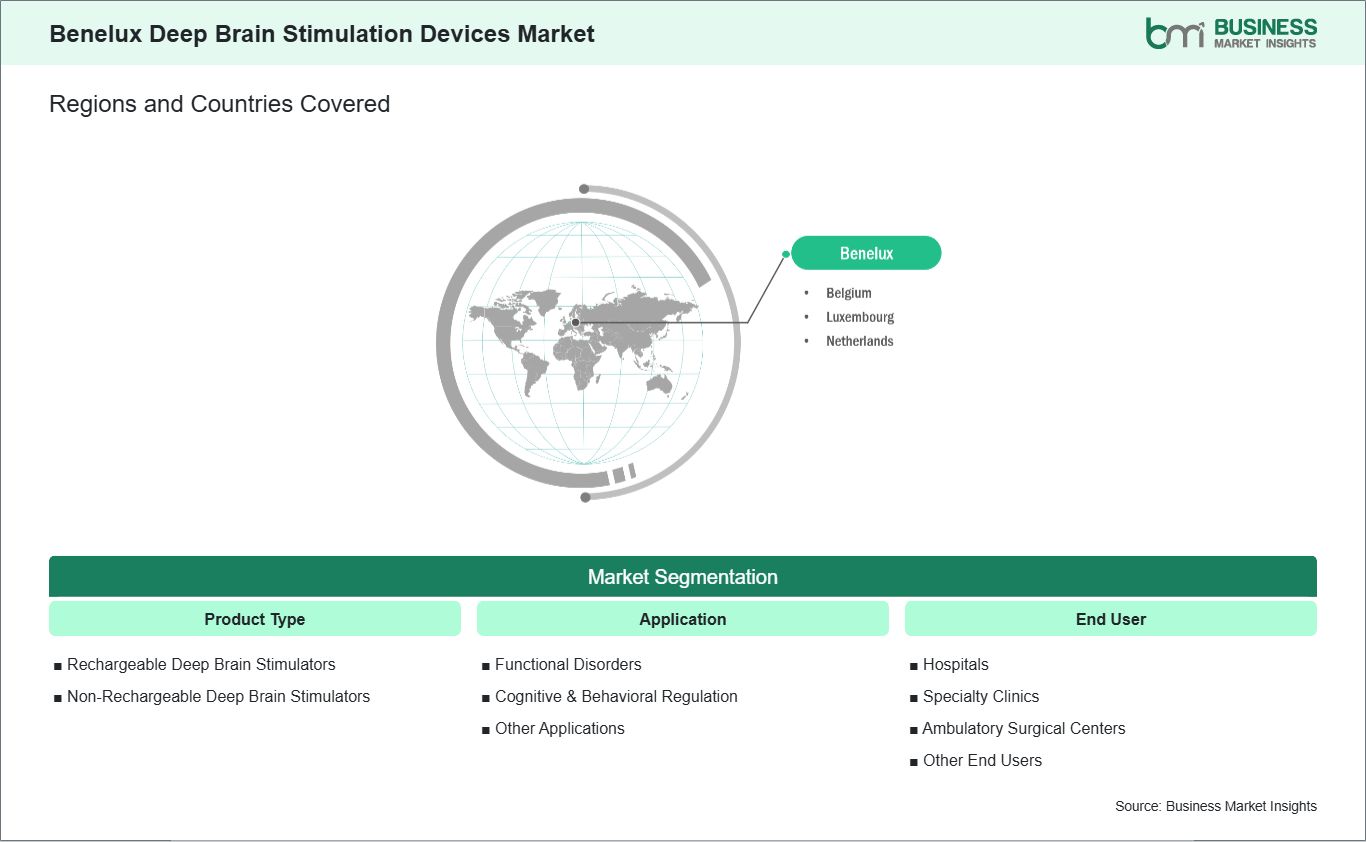
Key segments that contributed to the derivation of the Benelux deep brain stimulation devices market analysis are product type, application, and end user.
The deep brain stimulation (DBS) implants in the Benelux region are steadily growing on the back of an increasing prevalence of neurological disorders, including Parkinson's disease, essential tremor, dystonia, epilepsy, and obsessive-compulsive disorder in the three countries. In addition, the growing geriatric population in Belgium and the Netherlands is also driving market growth because of a rising number of cases of patients suffering from neurodegenerative disorders due to increased life expectancy.
Benelux countries have very structured healthcare sectors that allow for early neurological evaluation and treatment in movement disorder clinics, where patients can be referred for further treatment options. Specifically, the Netherlands has a highly-developed network of movement disorder clinics within university hospitals, whereas Belgium has been expanding functional neurosurgical units in major university hospitals. Growing numbers of such patients suffering from Parkinson's disease and not responding well to medication are being identified in these specialized hospitals.
In addition, strong collaboration between neurologists, neurosurgeons, and rehabilitation specialists supports a multidisciplinary approach to managing chronic neurological diseases in the region. DBS is increasingly considered for patients with severe motor fluctuations and treatment-resistant tremor, especially in urban populations with access to tertiary care hospitals. However, access outside major cities remains more limited, particularly in Luxembourg, where patients are often referred to neighboring countries for specialized neurosurgical interventions.
Innovations in adaptive DBS are emerging in the Benelux market as the uptake of cutting-edge neuromodulation technologies, including closed loop and adaptive DBS, increases. The adoption of these innovations can be noted in premier neurological hospitals in the Netherlands and Belgium, where academic hospitals engaged in the study of neuromodulation systems are currently investigating the latest advancements in DBS. The purpose of these innovations is to enhance symptom control, lower side effects, and increase battery life.
Research hospitals in the region play an important role in the clinical assessment of adaptive DBS technology. These new developments have a particular bearing on the management of fluctuating symptoms in Parkinson's disease. As the cities mentioned above feature prominent centers of medical research, their emergence in these regions can be attributed to the existence of a robust medical research ecosystem.
Furthermore, the Benelux region benefits from close collaboration with European medical device manufacturers and international neurology networks, which accelerates the introduction of innovative DBS technologies. Physicians are increasingly exposed to directional leads, rechargeable implantable pulse generators, and AI-assisted programming tools that enhance treatment precision. As healthcare digitization progresses, remote monitoring and personalized stimulation adjustments are expected to become more integrated into clinical practice, supporting the gradual expansion of adaptive DBS adoption across the region.

The Benelux deep brain stimulation devices market is experiencing steady growth, with market size and share analysis reflecting evolving treatment preferences and competitive dynamics among key players. The report evaluates important subsegments categorized within product type, application, and end user, highlighting their respective contributions to overall market performance.
By product type, the rechargeable deep brain stimulators subsegment dominated the market in 2025, driven by the growing preference for long-lasting and patient-friendly neurostimulation solutions. These devices offer extended battery life, reduced frequency of replacement surgeries, and improved convenience for patients, making them the preferred choice for the management of chronic neurological disorders.
Based on application, the functional disorders subsegment dominated the market in 2025, propelled by the rising prevalence of neurological conditions such as Parkinson's disease, essential tremor, and dystonia, along with increasing adoption of deep brain stimulation therapy for effective symptom management and improved quality of life.
In terms of end user, the hospitals subsegment dominated the market in 2025 due to their advanced neurology and neurosurgery departments, availability of skilled healthcare professionals, and access to technologically advanced deep brain stimulation devices and surgical infrastructure.
| Report Attribute | Details |
|---|---|
| Market size in 2025 | US$ 20.4 Million |
| Market Size by 2033 | US$ 38.0 Million |
| CAGR (2026 - 2033) | 8.1% |
| Historical Data | 2022-2024 |
| Forecast period | 2026-2033 |
| Segments Covered | By Product Type
|
|
Regions and Countries Covered
| |
| Benelux | Belgium, Netherlands, Luxembourg |
| Market leaders and key company profiles |
|
The "Benelux Deep Brain Stimulation Devices Market Size and Forecast (2022-2033)" report provides a detailed analysis of the market covering below areas:
The geographical scope of the Benelux Deep Brain Stimulation Devices market report is divided into: Belgium, the Netherlands, and Luxembourg. The Netherlands held the largest share in 2025.
The Netherlands plays a dominant role in the Benelux DBS Device market owing to its highly centralized and efficient healthcare infrastructure, a flourishing neurological research environment, and the use of sophisticated neurosurgery technology. The country boasts of having a very advanced network of clinics specializing in movement disorders that actively identify and treat patients suffering from Parkinson's disease, thereby increasing the requirement for DBS treatment procedures.
Another important aspect that makes the Netherlands a prominent country in this field is its focus on the synergy between academia and medicine with regard to neurosurgery procedures like neuromodulation and brain circuitry. For example, several renowned university medical centers carry out extensive research into these types of surgeries and contribute significantly to the development of DBS surgical technique, optimal patient selection, and DBS programming. Hence, the country is one of the pioneers when it comes to the implementation of next-generation DBS solutions on the European market. The reimbursement opportunities provided by the Dutch healthcare system are another favorable condition for those patients who can undergo the surgery, as long as the criteria are rather demanding, and the surgery should be used to treat only the most severe conditions unresponsive to other treatments. At the same time, some of the challenges include the high price tag attached to DBS, as well as the necessity to have highly qualified and experienced neurosurgeons in each hospital performing DBS surgery.

The Benelux Deep Brain Stimulation Devices market is evaluated by gathering qualitative and quantitative data post primary and secondary research, which includes important corporate publications, association data, and databases. A few of the key developments in the Benelux Deep Brain Stimulation Devices market are:
The Benelux Deep Brain Stimulation Devices Market is valued at US$ 20.4 Million in 2025, it is projected to reach US$ 38.0 Million by 2033.
As per our report Benelux Deep Brain Stimulation Devices Market, the market size is valued at US$ 20.4 Million in 2025, projecting it to reach US$ 38.0 Million by 2033. This translates to a CAGR of approximately 8.1% during the forecast period.
The Benelux Deep Brain Stimulation Devices Market report typically cover these key segments-
The historic period, base year, and forecast period can vary slightly depending on the specific market research report. However, for the Benelux Deep Brain Stimulation Devices Market report:
The Benelux Deep Brain Stimulation Devices Market is populated by several key players, each contributing to its growth and innovation. Some of the major players include:
The Benelux Deep Brain Stimulation Devices Market report is valuable for diverse stakeholders, including:
Essentially, anyone involved in or considering involvement in the Benelux Deep Brain Stimulation Devices Market value chain can benefit from the information contained in a comprehensive market report.
Please tell us your area of interest
(Market Segments/ Regions and Countries/ Companies)