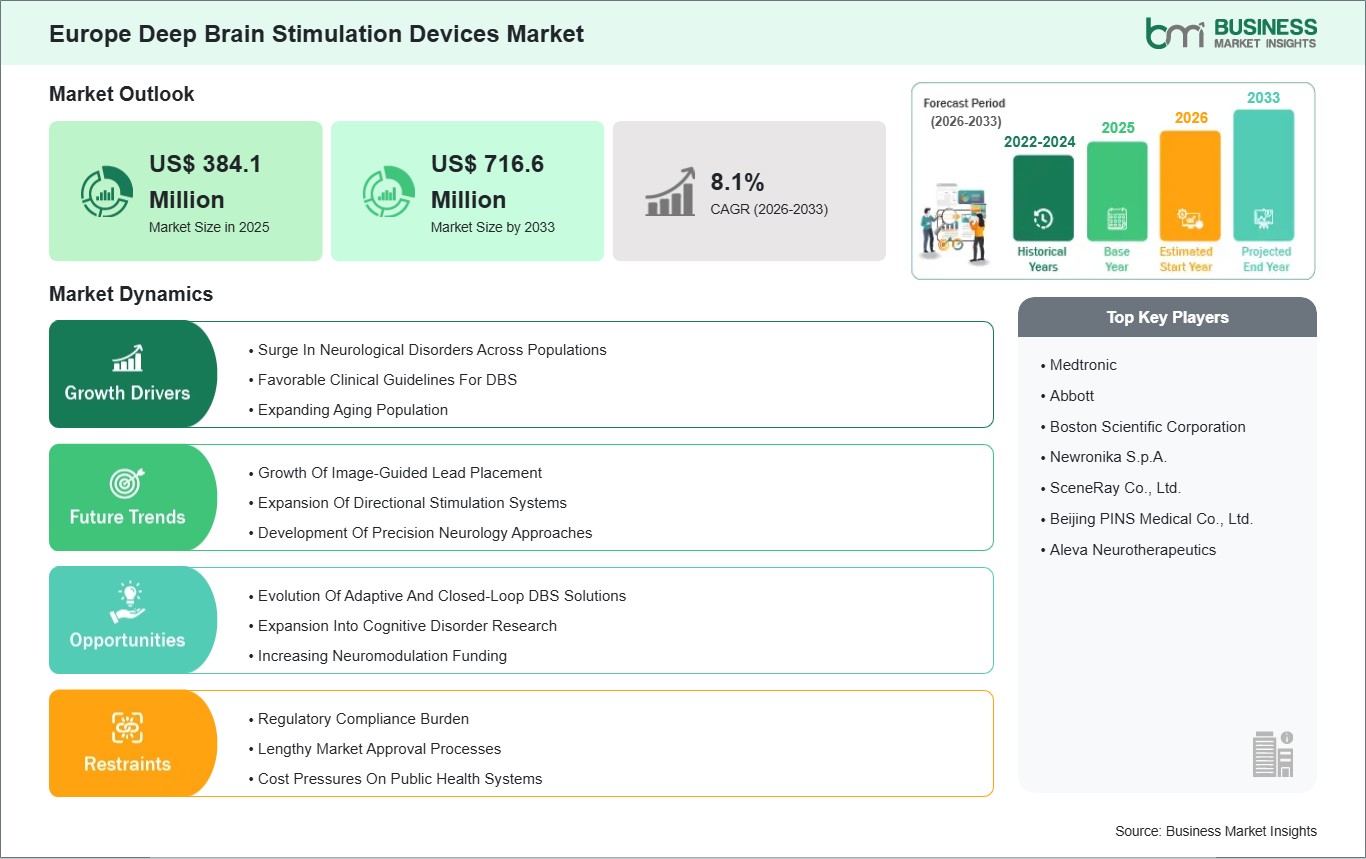
The Europe deep brain stimulation devices market size is expected to reach US$ 716.6 million by 2033 from US$ 384.1 million in 2025. The market is estimated to record a CAGR of 8.1% from 2026 to 2033.
The DBS market in Europe is highly influenced by clinical acceptance because of the presence of advanced neurological care infrastructure, along with high rates of movement disorders like Parkinson's disease, essential tremors, and dystonias. Neurosurgery infrastructure is very well established within leading health care facilities in Europe, especially in Western Europe. Increasing incorporation of DBS treatment within treatment plans for patients resistant to medication therapy is driving demand within the European DBS market.
The availability of publicly reimbursed healthcare systems in the region that offer financial assistance in acquiring expensive neurostimulation devices contributes significantly to the growth of this segment. Technological innovations have also played a critical role in the growth of DBS in this market due to the increased effectiveness of treatment through the introduction of directional leads, adaptive stimulation, and rechargeable IPGs. Nevertheless, factors such as regulatory requirements and differences in reimbursement strategies from country to country hinder the adoption of this therapy. The high cost of treatment procedures and specialized neurosurgery skills are among the major factors hindering the adoption of DBS therapy in small-sized hospitals. Despite these limitations, more clinical evidence supporting wider indications, such as the treatment of psychiatric and epilepsy disorders, has contributed immensely towards growth.

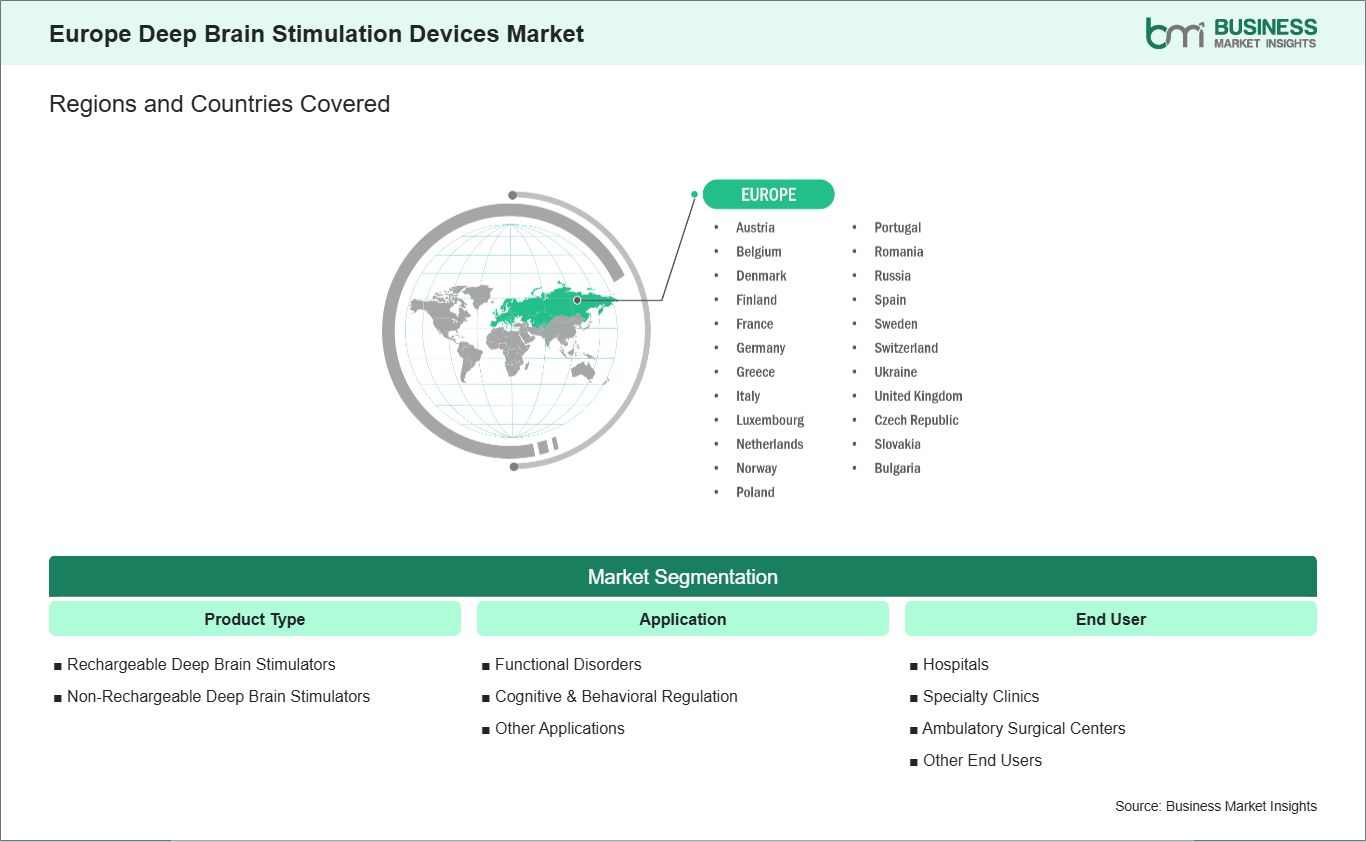
Key segments that contributed to the derivation of the Europe deep brain stimulation devices market analysis are product type, application, and end user.
The Europe deep brain stimulation (DBS) devices market is expanding steadily due to the rising prevalence of neurological disorders such as Parkinson's disease, essential tremor, dystonia, epilepsy, and treatment-resistant psychiatric conditions across major economies including Germany, France, Italy, Spain, and the United Kingdom. The region's rapidly aging population is a key factor, particularly in Western Europe, where a growing proportion of elderly citizens is contributing to higher diagnosis rates of neurodegenerative diseases that require long-term management.
The healthcare systems in all of the European nations are very advanced, which allows for early detection of movement disorders through advanced neurological centers and access to specialists. Nations such as Germany and the Netherlands have already set up movement disorder centers in university hospitals, whereas France and the Nordic nations are favored by their strong healthcare system and can refer complicated neurological conditions systematically. The environment will result in more and more patients with late-stage disorders being identified and requiring DBS therapy.
In addition, Europe has a strong culture of neurological research and clinical collaboration, which is improving disease awareness and treatment adoption across the region. DBS is increasingly being used for patients with severe motor fluctuations and medication-resistant symptoms, especially in urban centers with access to tertiary neurosurgical care. However, disparities still exist between Western and Eastern Europe, with countries like Bulgaria and Romania facing slower access to specialized neurosurgical services compared to Germany or Switzerland.
The development of technology has greatly influenced the market for DBS devices in Europe, especially with the increasing use of adaptive and closed-loop stimulation devices. Such new-age devices make adjustments to their stimulation levels based on feedback from the neurons, thereby offering better symptom management in patients of Parkinson's disease without any adverse effects or unnecessary energy expenditure.
Leading neurological and neurosurgical centers in countries such as Germany, Switzerland, France, and the United Kingdom are actively involved in clinical research and early adoption of advanced DBS technologies. University hospitals in cities like Berlin, Paris, Zurich, and London are increasingly integrating directional leads, rechargeable pulse generators, and AI-assisted programming tools into specialized movement disorder programs. These advancements allow clinicians to fine-tune therapy for patients with complex and fluctuating symptoms.
Moreover, collaboration between European research institutions and global medical device manufacturers is accelerating innovation diffusion across the region. Multinational clinical trials and EU-supported research initiatives are supporting the evaluation of adaptive DBS systems for broader neurological applications beyond Parkinson's disease. As healthcare digitization continues and neuromodulation expertise expands, closed-loop DBS systems are expected to become more widely integrated into standard neurological care pathways across Europe.

The Europe deep brain stimulation devices market is experiencing steady growth, with market size and share analysis reflecting evolving treatment preferences and competitive dynamics among key players. The report evaluates important subsegments categorized within product type, application, and end user, highlighting their respective contributions to overall market performance.
By product type, the rechargeable deep brain stimulators subsegment dominated the market in 2025, driven by the growing preference for long-lasting and patient-friendly neurostimulation solutions. These devices offer extended battery life, reduced frequency of replacement surgeries, and improved convenience for patients, making them the preferred choice for the management of chronic neurological disorders.
Based on application, the functional disorders subsegment dominated the market in 2025, propelled by the rising prevalence of neurological conditions such as Parkinson's disease, essential tremor, and dystonia, along with increasing adoption of deep brain stimulation therapy for effective symptom management and improved quality of life.
In terms of end user, the hospitals subsegment dominated the market in 2025 due to their advanced neurology and neurosurgery departments, availability of skilled healthcare professionals, and access to technologically advanced deep brain stimulation devices and surgical infrastructure.
| Report Attribute | Details |
|---|---|
| Market size in 2025 | US$ 384.1 Million |
| Market Size by 2033 | US$ 716.6 Million |
| CAGR (2026 - 2033) | 8.1% |
| Historical Data | 2022-2024 |
| Forecast period | 2026-2033 |
| Segments Covered | By Product Type
|
|
Regions and Countries Covered
| |
| Europe | Germany, Italy, France, U.K., Spain, Belgium, Netherlands, Luxembourg, Norway, Finland, Denmark, Sweden, Switzerland, Austria, Greece, Portugal, Russia, Poland, Romania, Czech Republic, Ukraine, Slovakia, Bulgaria |
| Market leaders and key company profiles |
|
The "Europe Deep Brain Stimulation Devices Market Size and Forecast (2022-2033)" report provides a detailed analysis of the market covering below areas:
The geographical scope of the Europe Deep Brain Stimulation Devices market report is divided into: Germany, Italy, France, the UK, Spain, Belgium, the Netherlands, Luxembourg, Norway, Finland, Denmark, Sweden, Austria, Switzerland, Russia, Romania, Greece, the Czech Republic, Portugal, Ukraine, Poland, Slovakia, and Bulgaria. Germany held the largest share in 2025.
German DBS devices have a dominating position in the European market because of the high level of development of their neurological healthcare services. They have an efficient healthcare infrastructure and many specialized neurological clinics to perform such procedures. Their health care system pays special attention to the early detection and treatment of movement disorders. In addition, German hospitals are among the first to apply innovations to the treatment of Parkinson's disease with the help of such devices.
One of the main strengths of the German market is the availability of well-trained neurosurgeons and specialists in movement disorders, allowing for regular volumes of procedures with quality results of surgery. Moreover, the strong reimbursement system of statutory health insurance in Germany allows patients to access DBS treatment, especially with regards to patients suffering from Parkinson's Disease for whom pharmaceutical treatment is no longer an option. Germany is also the place where hospitals and manufacturers collaborate with each other on clinical research projects, constantly advancing technologies of DBS programming and devices. However, cost control issues and tight regulatory restrictions can affect the speed of adoption of new generations of devices. Nevertheless, Germany remains the key driving force of DBS adoption in Europe.

The Europe Deep Brain Stimulation Devices market is evaluated by gathering qualitative and quantitative data post primary and secondary research, which includes important corporate publications, association data, and databases. A few of the key developments in the Europe Deep Brain Stimulation Devices market are:
The Europe Deep Brain Stimulation Devices Market is valued at US$ 384.1 Million in 2025, it is projected to reach US$ 716.6 Million by 2033.
As per our report Europe Deep Brain Stimulation Devices Market, the market size is valued at US$ 384.1 Million in 2025, projecting it to reach US$ 716.6 Million by 2033. This translates to a CAGR of approximately 8.1% during the forecast period.
The Europe Deep Brain Stimulation Devices Market report typically cover these key segments-
The historic period, base year, and forecast period can vary slightly depending on the specific market research report. However, for the Europe Deep Brain Stimulation Devices Market report:
The Europe Deep Brain Stimulation Devices Market is populated by several key players, each contributing to its growth and innovation. Some of the major players include:
The Europe Deep Brain Stimulation Devices Market report is valuable for diverse stakeholders, including:
Essentially, anyone involved in or considering involvement in the Europe Deep Brain Stimulation Devices Market value chain can benefit from the information contained in a comprehensive market report.
Please tell us your area of interest
(Market Segments/ Regions and Countries/ Companies)