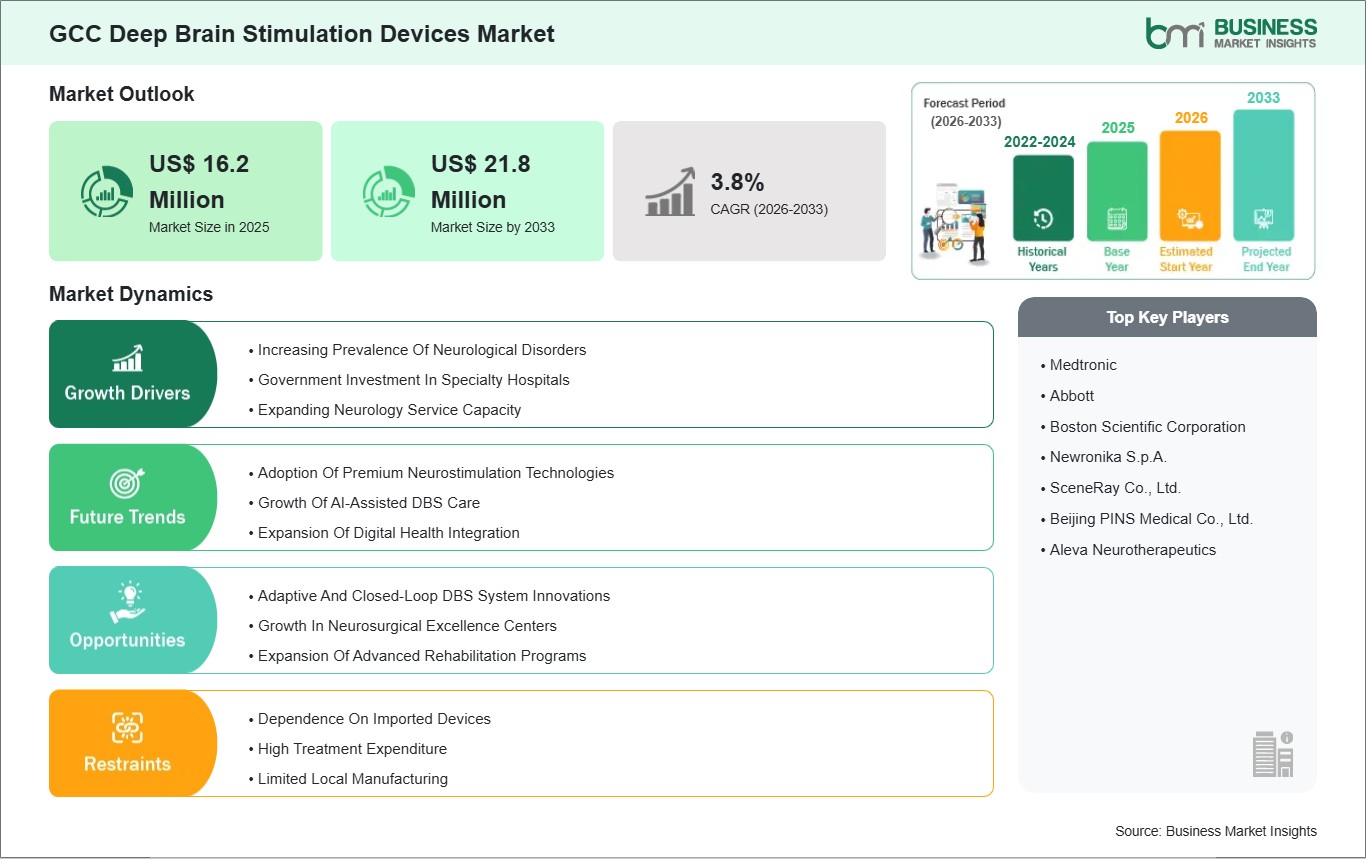
The GCC deep brain stimulation devices market size is expected to reach US$ 21.8 million by 2033 from US$ 16.2 million in 2025. The market is estimated to record a CAGR of 3.8% from 2026 to 2033.
The GCC market for DBS devices appears to be developing into a relatively niche yet growing area within the sophisticated neurology environment of the region. This development can be attributed to increasing cases of movement disorder diseases such as Parkinson's, essential tremors, and dystonia, coupled with an increasing awareness of the role played by surgical neuromodulation as an effective treatment option once medications prove ineffective. With investments by the healthcare systems of GCC nations in tertiary medical facilities and neurology facilities, there has been an improvement in the accessibility of neurostimulation procedures.
The major factor that will fuel growth includes the emphasis placed by the government on improving its neurological care infrastructure through collaborations with foreign medical equipment providers and academic medical institutions. Furthermore, the increasing inclination among patients to seek minimally invasive and permanent treatment methods will help drive procedures. However, the complexity involved in the procedure and the requirement of specialist neurosurgeons hinder its wide acceptance across all GCC nations. Moreover, the costly nature of DBS surgery and the follow-up maintenance of the system post-surgery restricts its availability beyond elite hospitals.

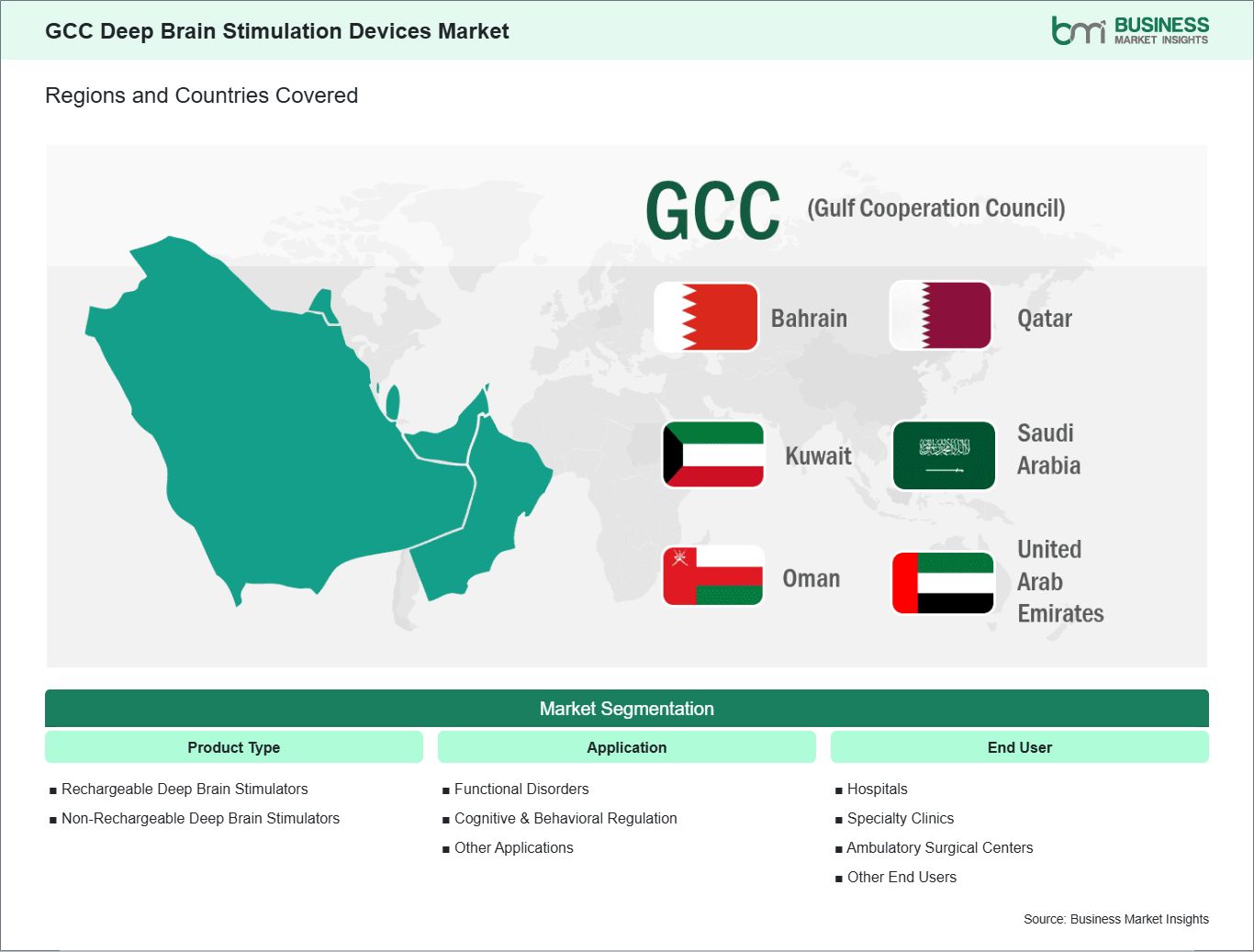
Key segments that contributed to the derivation of the GCC deep brain stimulation devices market analysis are product type, application, and end user.
The GCC region is currently experiencing a slow but continuous increase in the incidence of neurological conditions, including Parkinson's, epilepsy, dystonia, and essential tremor, due to factors such as higher life expectancies and improved access to health care services. With aging populations in countries such as Saudi Arabia, the United Arab Emirates, and Kuwait, neurodegenerative diseases are becoming more prevalent, and cases are now being reported more often compared to previous times. This trend is resulting in an increase in the number of patients qualifying for DBS therapy.
Additionally, other health problems that arise from lifestyles, like diabetes, high blood pressure, and obesity, are also playing their part in causing neurological complications. This has added another layer of difficulty in treating diseases. The efficacy of traditional medicines used to treat diseases has declined over time due to the above-mentioned health disorders. Patients and doctors have started recognizing the potential of DBS therapy.
Healthcare infrastructure expansion across the GCC is further supporting this trend. The development of specialized neurology departments and advanced neurosurgical units in tertiary hospitals is improving diagnosis rates and treatment referrals. As a result, more patients with treatment-resistant movement disorders are being evaluated for DBS therapy, strengthening overall market demand in the region.
The GCC deep brain stimulation devices market is increasingly influenced by technological advancements, particularly the transition from traditional constant-stimulation systems to adaptive and closed-loop DBS technologies. These next-generation systems adjust stimulation parameters in real time based on neural feedback, offering more precise symptom control while minimizing side effects and battery consumption. This evolution is aligning well with the region's preference for high-tech, premium healthcare solutions.
Hospitals and neuroscience clinics in the GCC are slowly moving towards the adoption of state-of-the-art DBS systems incorporating directional leads, rechargeable pulse generators, and advanced programming software. This technology makes it possible to customize treatment according to specific patient requirements, particularly those suffering from complicated neurological conditions that differ in terms of severity and progression rates.
There is also growing integration of digital health tools with DBS systems, including remote monitoring capabilities and AI-assisted programming support. These innovations enable physicians to adjust stimulation settings without requiring frequent hospital visits, improving convenience for patients across geographically dispersed populations. As healthcare systems in the GCC continue investing in smart hospital infrastructure, adoption of these advanced DBS technologies is expected to accelerate steadily.

The GCC deep brain stimulation devices market is experiencing steady growth, with market size and share analysis reflecting evolving treatment preferences and competitive dynamics among key players. The report evaluates important subsegments categorized within product type, application, and end user, highlighting their respective contributions to overall market performance.
By product type, the rechargeable deep brain stimulators subsegment dominated the market in 2025, driven by the growing preference for long-lasting and patient-friendly neurostimulation solutions. These devices offer extended battery life, reduced frequency of replacement surgeries, and improved convenience for patients, making them the preferred choice for the management of chronic neurological disorders.
Based on application, the functional disorders subsegment dominated the market in 2025, propelled by the rising prevalence of neurological conditions such as Parkinson's disease, essential tremor, and dystonia, along with increasing adoption of deep brain stimulation therapy for effective symptom management and improved quality of life.
In terms of end user, the hospitals subsegment dominated the market in 2025 due to their advanced neurology and neurosurgery departments, availability of skilled healthcare professionals, and access to technologically advanced deep brain stimulation devices and surgical infrastructure.
| Report Attribute | Details |
|---|---|
| Market size in 2025 | US$ 16.2 Million |
| Market Size by 2033 | US$ 21.8 Million |
| CAGR (2026 - 2033) | 3.8% |
| Historical Data | 2022-2024 |
| Forecast period | 2026-2033 |
| Segments Covered | By Product Type
|
|
Regions and Countries Covered
| |
| GCC | UAE, Bahrain, Saudi Arabia, Oman, Qatar, Kuwait |
| Market leaders and key company profiles |
|
The "GCC Deep Brain Stimulation Devices Market Size and Forecast (2022-2033)" report provides a detailed analysis of the market covering below areas:
The geographical scope of the GCC Deep Brain Stimulation Devices market report is divided into: Saudi Arabia, the United Arab Emirates (UAE), Qatar, Kuwait, Bahrain, and Oman. Saudi Arabia held the largest share in 2025.
Saudi Arabia constitutes the main market for DBS implants in GCC, due to their comprehensive approach towards healthcare modernization and heavy investments in specialized neuroscience care services. Indeed, Saudi Arabia has been developing state-of-the-art neuroscience clinics at large tertiary hospitals that have become competent enough to conduct complicated neurosurgeries, including DBS surgery, due to growing concern about improving medical excellence and lowering medical tourism abroad.
The demand in Saudi Arabia is fueled by a rising number of patients with Parkinson's disease or other intractable movement disorders, coupled with increased diagnosis capability to identify potential patients. The partnership between leading public hospitals and foreign medical device corporations has enabled the deployment of state-of-the-art DBS systems in terms of surgery accuracy and effectiveness. Although the sector is gaining traction, some obstacles exist, such as the scarcity of professionals and the dominance of DBS surgery performed in a handful of prominent urban hospitals. Nevertheless, Saudi Arabia plays a pivotal role in determining regional adoption trends in that its healthcare system serves as the main entry point for DBS technology in the GCC region.

The GCC Deep Brain Stimulation Devices market is evaluated by gathering qualitative and quantitative data post primary and secondary research, which includes important corporate publications, association data, and databases. A few of the key developments in the GCC Deep Brain Stimulation Devices market are:
The GCC Deep Brain Stimulation Devices Market is valued at US$ 16.2 Million in 2025, it is projected to reach US$ 21.8 Million by 2033.
As per our report GCC Deep Brain Stimulation Devices Market, the market size is valued at US$ 16.2 Million in 2025, projecting it to reach US$ 21.8 Million by 2033. This translates to a CAGR of approximately 3.8% during the forecast period.
The GCC Deep Brain Stimulation Devices Market report typically cover these key segments-
The historic period, base year, and forecast period can vary slightly depending on the specific market research report. However, for the GCC Deep Brain Stimulation Devices Market report:
The GCC Deep Brain Stimulation Devices Market is populated by several key players, each contributing to its growth and innovation. Some of the major players include:
The GCC Deep Brain Stimulation Devices Market report is valuable for diverse stakeholders, including:
Essentially, anyone involved in or considering involvement in the GCC Deep Brain Stimulation Devices Market value chain can benefit from the information contained in a comprehensive market report.
Please tell us your area of interest
(Market Segments/ Regions and Countries/ Companies)