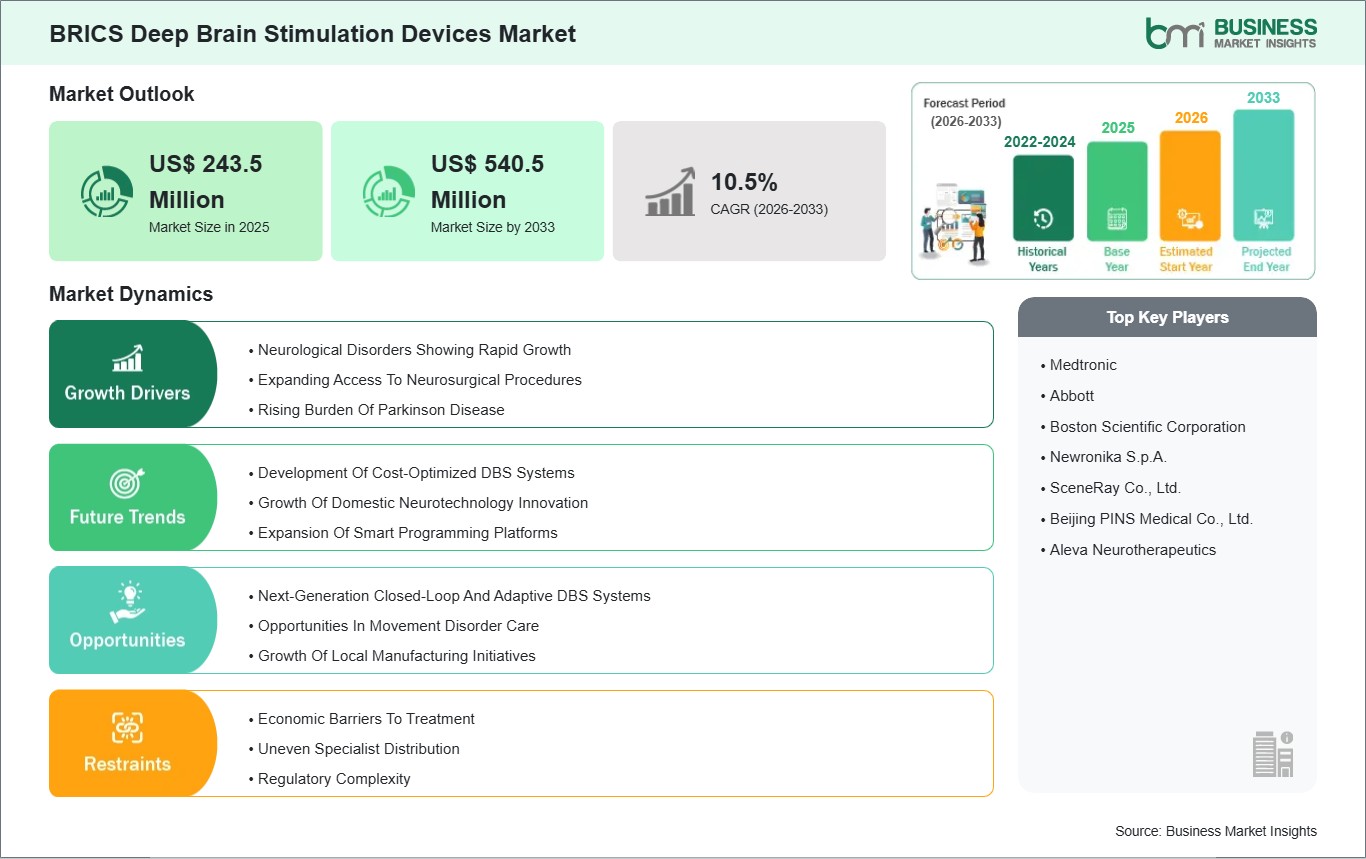
The BRICS deep brain stimulation devices market size is expected to reach US$ 540.5 million by 2033 from US$ 243.5 million in 2025. The market is estimated to record a CAGR of 10.5% from 2026 to 2033.
The BRICS region, which includes Brazil, Russia, India, China, and South Africa, forms a highly heterogeneous market for DBS Devices, owing to rapid increases in the demand for neurological interventions and increasing access to neurosurgical equipment. The main reason behind increased demand stems from higher prevalence rates of movement disorders and neurodegenerative diseases like Parkinson's, coupled with the growing recognition that DBS is an effective therapy in patients resistant to medication-based treatments.
One of the important factors driving growth in the BRICS nations is the development of tertiary healthcare facilities, especially in metropolitan areas where neurology and neurosurgery services are increasingly being enhanced. With greater government emphasis on non-communicable neurological disorders and improvements in the coverage and reimbursements provided by medical insurance companies, more patients can now afford Deep Brain Stimulation surgeries. Moreover, increased collaboration between foreign medical device manufacturers and domestic hospitals is boosting technological adoption and training.
Moreover, wide variations in healthcare access in urban versus rural areas, higher costs related to procedures and equipment, and fewer numbers of highly qualified functional neurosurgeons. The variability in regulations in BRICS countries contributes to disparities in terms of approvals for devices and the commercialization of advanced DBS technologies. Nevertheless, the BRICS area maintains strong long-term growth due to its potential, which is fueled by an untapped market, neurology specialization growth, and gradual advancement in surgical procedures.

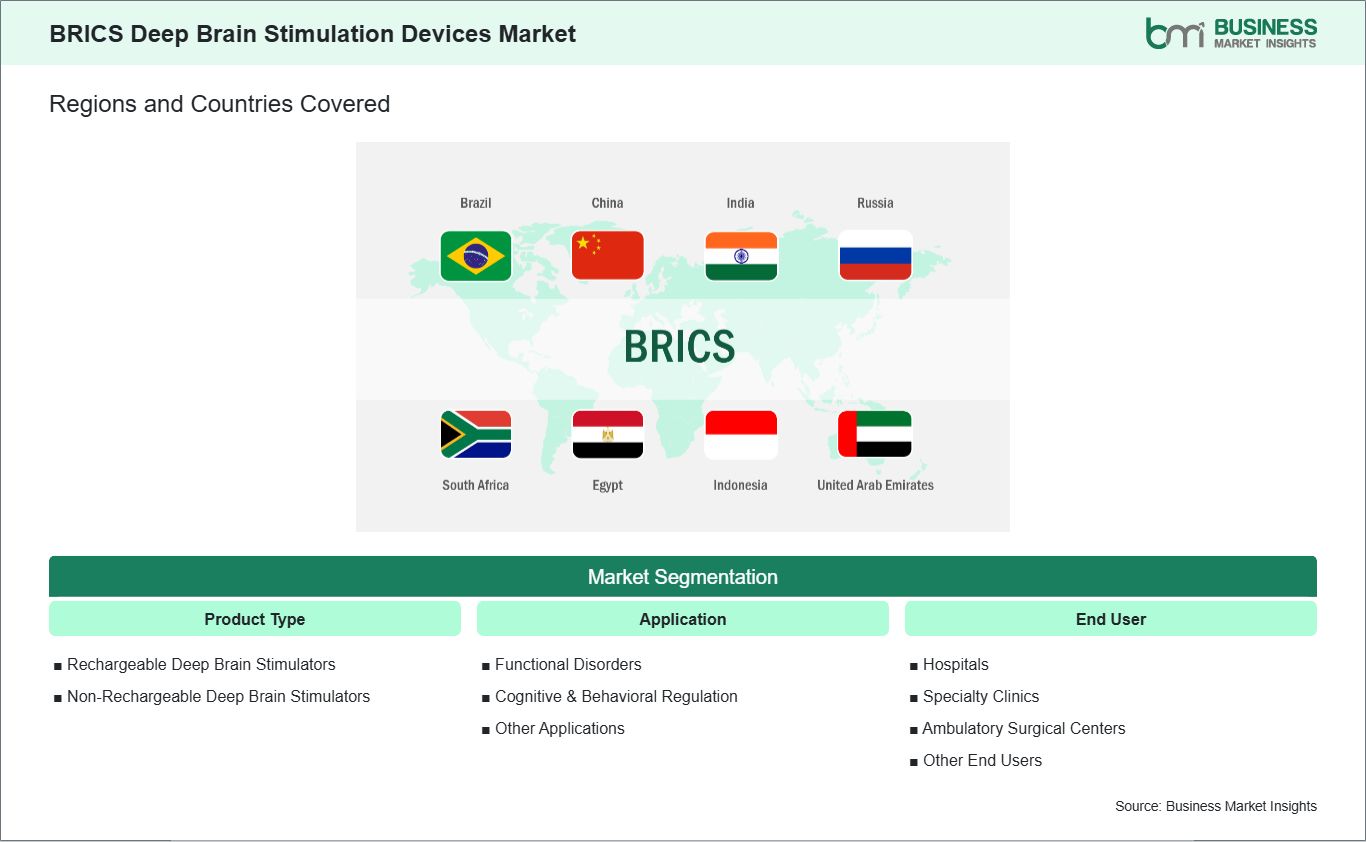
Key segments that contributed to the derivation of the BRICS deep brain stimulation devices market analysis are product type, application, and end user.
The BRICS deep brain stimulation (DBS) devices market is expanding as neurological disorders such as Parkinson's disease, epilepsy, dystonia, essential tremor, and treatment-resistant psychiatric conditions continue to rise across Brazil, Russia, India, China, and South Africa. Rapid urbanization, longer life expectancy, and increasing survival rates for chronic diseases are contributing to a larger patient population requiring long-term neurological care. In countries like China and India, growing aging populations are particularly increasing the number of Parkinson's disease cases, placing pressure on neurology services in major urban hospitals.
Healthcare infrastructure development across BRICS nations is improving diagnostic capabilities, leading to earlier and more accurate identification of movement disorders. In China, expanding neurology departments in tier-1 and tier-2 cities such as Beijing, Shanghai, and Guangzhou are enabling more consistent detection of DBS-eligible patients. Similarly, in Brazil and South Africa, private hospital networks are increasingly managing advanced neurological cases, where patients with severe motor fluctuations are being referred for surgical intervention when medication therapy becomes insufficient.
However, access to advanced neuromodulation therapies remains uneven across BRICS countries due to disparities in healthcare funding and specialist availability. While urban centers in Russia and China offer relatively advanced functional neurosurgery services, rural regions across India and Brazil still face delays in diagnosis and referral. Despite these limitations, growing awareness among neurologists and increasing patient advocacy are gradually supporting wider consideration of DBS as a viable treatment option for advanced neurological disorders.
Innovations in technology have been instrumental in influencing the growth of the market for BRICS DBS devices through their implementation in closed-loop and adaptive stimulation techniques. Such high-end DBS systems are able to vary the electrical stimulation in response to the brain activity, making the process more precise for the treatment of illnesses like Parkinson's. This factor proves important when considering that in BRICS nations there is a variety of disease progression and continuous medical supervision might be difficult to obtain.
China is emerging as a major hub for neuromodulation innovation within the BRICS group, with increasing integration of AI-driven programming tools and domestically developed DBS systems in leading hospitals. In India, leading neurology centers in cities like Mumbai, Delhi, and Bengaluru are gradually adopting next-generation DBS technologies, supported by expanding private healthcare investments. Meanwhile, Brazil and South Africa are witnessing early-stage introduction of rechargeable and directional DBS systems in specialized neurosurgical centers.
In addition, international collaborations and technology transfer agreements are accelerating exposure to adaptive DBS technologies across BRICS nations. Russia is increasingly participating in neurotechnology research initiatives that explore brain-computer interface integration with stimulation systems. As healthcare infrastructure modernizes and more neurosurgeons receive specialized training, the adoption of closed-loop DBS systems is expected to grow, enabling more personalized and efficient treatment approaches for complex neurological disorders across the BRICS region.

The BRICS deep brain stimulation devices market is experiencing steady growth, with market size and share analysis reflecting evolving treatment preferences and competitive dynamics among key players. The report evaluates important subsegments categorized within product type, application, and end user, highlighting their respective contributions to overall market performance.
By product type, the rechargeable deep brain stimulators subsegment dominated the market in 2025, driven by the growing preference for long-lasting and patient-friendly neurostimulation solutions. These devices offer extended battery life, reduced frequency of replacement surgeries, and improved convenience for patients, making them the preferred choice for the management of chronic neurological disorders.
Based on application, the functional disorders subsegment dominated the market in 2025, propelled by the rising prevalence of neurological conditions such as Parkinson's disease, essential tremor, and dystonia, along with increasing adoption of deep brain stimulation therapy for effective symptom management and improved quality of life.
In terms of end user, the hospitals subsegment dominated the market in 2025 due to their advanced neurology and neurosurgery departments, availability of skilled healthcare professionals, and access to technologically advanced deep brain stimulation devices and surgical infrastructure.
| Report Attribute | Details |
|---|---|
| Market size in 2025 | US$ 243.5 Million |
| Market Size by 2033 | US$ 540.5 Million |
| CAGR (2026 - 2033) | 10.5% |
| Historical Data | 2022-2024 |
| Forecast period | 2026-2033 |
| Segments Covered | By Product Type
|
|
Regions and Countries Covered
| |
| BRICS | Russia, Brazil, South Africa, India, China, Egypt, Indonesia, Saudi Arabia, United Arab Emirates |
| Market leaders and key company profiles |
|
The "BRICS Deep Brain Stimulation Devices Market Size and Forecast (2022-2033)" report provides a detailed analysis of the market covering below areas:
The geographical scope of the BRICS Deep Brain Stimulation Devices market report is divided into: Russia, Brazil, South Africa, India, China, Egypt, Indonesia, Saudi Arabia, and the UAE. China held the largest share in 2025.
China has emerged as the leading country in the BRICS Deep Brain Stimulation Devices market, aided by the country's huge population base, highly developed neurosurgery infrastructure, and commitment to adopting state-of-the-art medical technology. The rising prevalence of neurological diseases, such as Parkinson's disease, in the country has boosted the need for advanced treatment options among patients residing in cities that have facilities specializing in movement disorders and tertiary hospitals.
The existence of an elaborate network of hospitals that can offer sophisticated neuromodulation treatments, along with constant investment in surgical robots, imaging equipment, and navigation systems, has further propelled the country into the leading position. Academic centers have played a vital role in boosting the proficiency of procedures and have helped in increasing the number of DBS-trained neurosurgeons.
The regulatory climate in China has also favored innovation in implantable technology through streamlined approval processes and promotion of localized production of neuro-modulation implants. This has been instrumental in attracting foreign as well as local firms into this market segment. Nonetheless, some of the drawbacks that still exist include unequal distribution in rural health facilities and the high costs incurred during the advanced procedures. The reforms in the healthcare industry are bound to strengthen China's dominant position in the emerging market for DBS devices among the BRICS nations.

The BRICS Deep Brain Stimulation Devices market is evaluated by gathering qualitative and quantitative data post primary and secondary research, which includes important corporate publications, association data, and databases. A few of the key developments in the BRICS Deep Brain Stimulation Devices market are:
The BRICS Deep Brain Stimulation Devices Market is valued at US$ 243.5 Million in 2025, it is projected to reach US$ 540.5 Million by 2033.
As per our report BRICS Deep Brain Stimulation Devices Market, the market size is valued at US$ 243.5 Million in 2025, projecting it to reach US$ 540.5 Million by 2033. This translates to a CAGR of approximately 10.5% during the forecast period.
The BRICS Deep Brain Stimulation Devices Market report typically cover these key segments-
The historic period, base year, and forecast period can vary slightly depending on the specific market research report. However, for the BRICS Deep Brain Stimulation Devices Market report:
The BRICS Deep Brain Stimulation Devices Market is populated by several key players, each contributing to its growth and innovation. Some of the major players include:
The BRICS Deep Brain Stimulation Devices Market report is valuable for diverse stakeholders, including:
Essentially, anyone involved in or considering involvement in the BRICS Deep Brain Stimulation Devices Market value chain can benefit from the information contained in a comprehensive market report.
Please tell us your area of interest
(Market Segments/ Regions and Countries/ Companies)