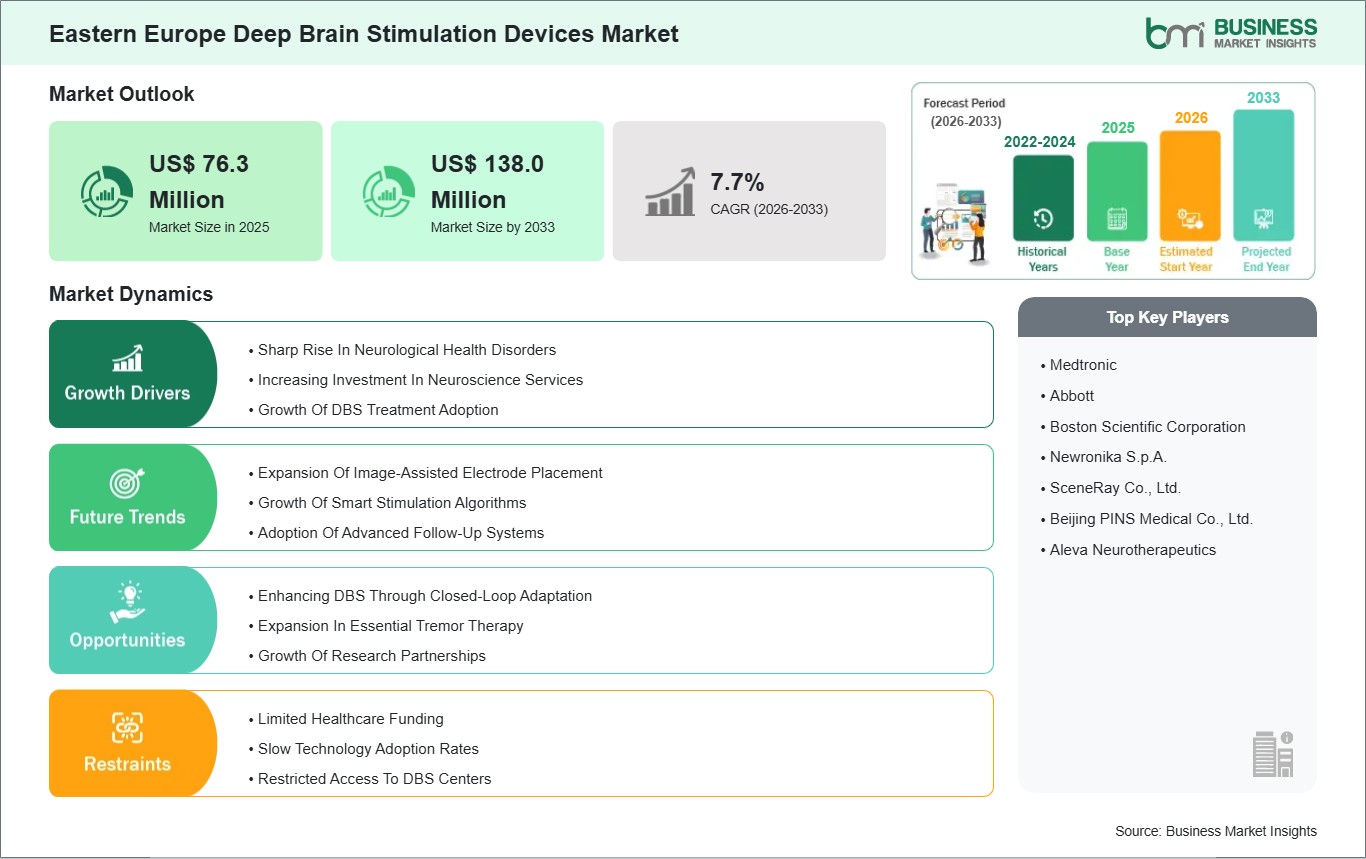
The Eastern Europe deep brain stimulation devices market size is expected to reach US$ 138.0 million by 2033 from US$ 76.3 million in 2025. The market is estimated to record a CAGR of 7.7% from 2026 to 2033.
In the Eastern Europe DBS Device market, the current trends depict that the market operates in an environment of the gradual modernization of the healthcare infrastructure for neurology conditions, where the key demand comes from the high prevalence of neurological diseases such as Parkinson's and the recognition of the need for neuromodulation therapy in tertiary care. Although the region is in a more transitional stage than Western Europe in terms of the adoption of new technologies, there is a clear trend towards the implementation of surgical procedures among those who cannot be effectively treated with traditional medications.
One of the important factors driving growth in this region is the establishment of dedicated neurological centers, along with the growing focus of the government to provide improved care for patients suffering from chronic neurological disorders. Collaboration between countries in the medical sector with Western European healthcare facilities will also be instrumental in transferring knowledge, providing improved surgical training, and gradually incorporating DBS systems. Increasing awareness among patients in urban regions will also aid in increased detection and referral for surgical intervention. Nevertheless, issues such as varying healthcare infrastructure in different nations, lack of reimbursement for expensive neurostimulation treatments, and absence of highly skilled functional neurosurgeons pose certain challenges to the market. Economic limitations in some Eastern European nations also hinder the adoption of advanced implants in the country.

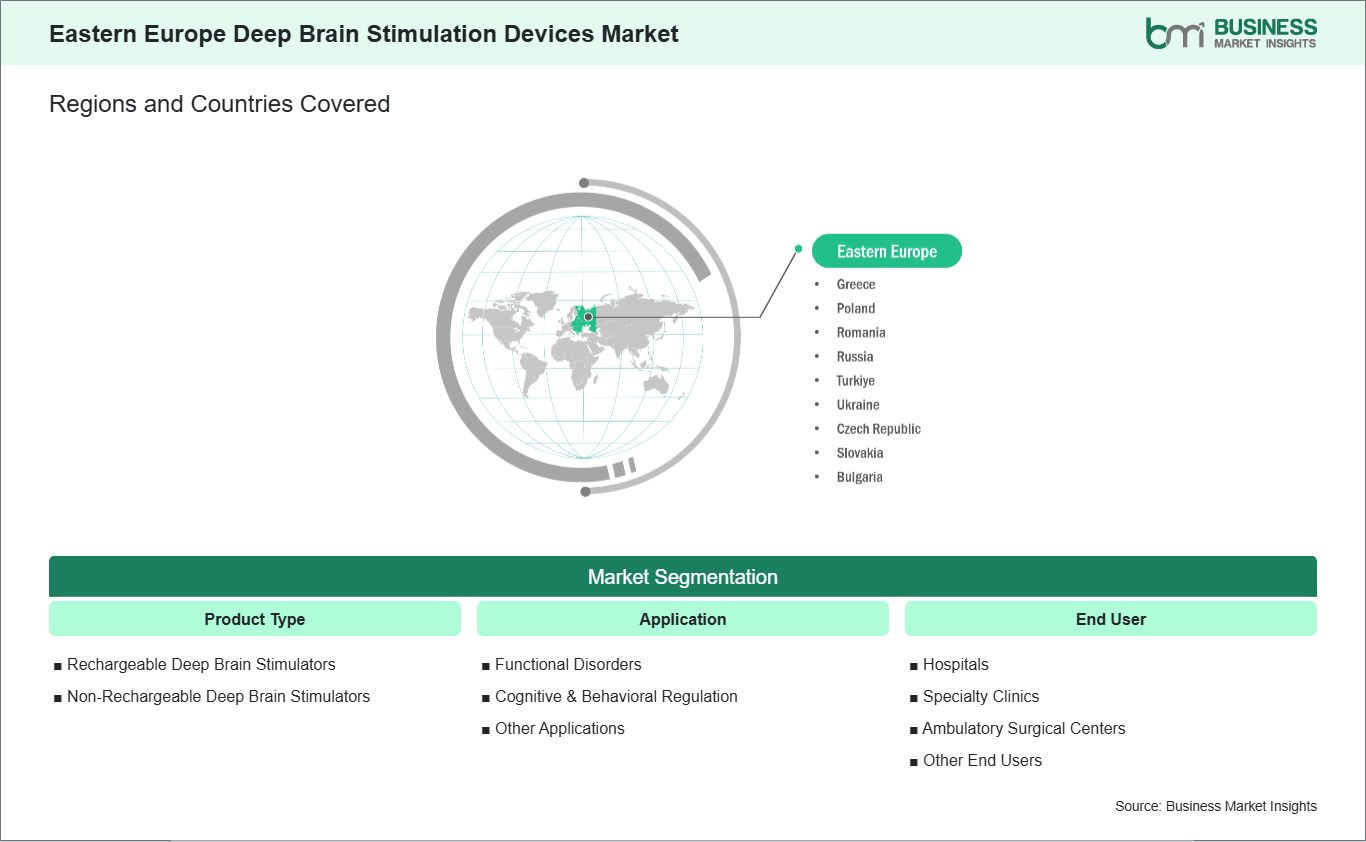
Key segments that contributed to the derivation of the Eastern Europe deep brain stimulation devices market analysis are product type, application, and end user.
The market for deep brain stimulation (DBS) devices in Eastern Europe is experiencing constant growth because of the high incidence rate of neurological diseases, including Parkinson's disease, epilepsy, dystonia, essential tremors, and drug-resistant psychiatric illnesses. The growing elderly population within the region is one of the most important factors contributing to the rising demand for DBS devices within countries like Poland, Russia, the Czech Republic, Hungary, and Romania. Due to longer life expectancies and therefore the greater likelihood of having neurological problems, the number of diagnosed cases is continuously growing in Central and Eastern European countries.
The healthcare systems in Eastern Europe are gradually upgrading their neurological facilities, particularly in city tertiary hospitals and university-affiliated hospitals. Nations such as Poland and the Czech Republic have established special neurological and neurosurgical departments that can now undertake complicated brain surgery operations. The Russian Federation is also extending its treatment capabilities for movement disorders, specifically at federal institutions based in cities like Moscow and St. Petersburg. On the other hand, Romania and Bulgaria are upgrading their referral system for patients suffering from Parkinson's disease, where drug therapies have been ineffective.
Despite these advancements, access to DBS therapy remains uneven across the region due to disparities in healthcare funding and specialist availability. Rural areas in countries such as Ukraine and Romania still face delays in neurological diagnosis and limited access to advanced neurosurgical care. However, growing awareness campaigns, expanding private healthcare participation, and increased collaboration with European neurological research networks are gradually improving patient identification and referral rates, strengthening the long-term outlook for DBS adoption in Eastern Europe.
Technological advancements continue to impact the market for DBS devices in Eastern Europe, especially with the emergence of closed-loop and adaptive stimulation techniques. The emerging DBS devices provide for the real-time adjustment of electrical stimulation with feedback from the neurons, allowing greater accuracy in the treatment of symptoms associated with diseases such as Parkinson's disease. The development of adaptive technology is especially important in Eastern Europe due to the uneven availability of continuous follow-up treatment in this region.
Leading medical centers in countries such as Poland, the Czech Republic, and Russia are beginning to adopt more advanced neuromodulation platforms as part of specialized neurological programs. University hospitals and research institutions are increasingly involved in evaluating directional leads, rechargeable implantable pulse generators, and programming systems that allow more refined control of stimulation parameters. These developments are helping clinicians tailor therapy more effectively for patients with complex motor fluctuations and advanced-stage neurological disease.
In addition, international collaboration with Western European neurotechnology firms and participation in multinational clinical studies are accelerating the introduction of innovative DBS systems across Eastern Europe. Training programs for neurosurgeons and neurologists are also improving technical expertise in device programming and patient selection. As healthcare infrastructure continues to modernize, adaptive and closed-loop DBS systems are expected to gain wider acceptance, supporting more personalized and efficient treatment approaches for neurological disorders across the region.

The Eastern Europe deep brain stimulation devices market is experiencing steady growth, with market size and share analysis reflecting evolving treatment preferences and competitive dynamics among key players. The report evaluates important subsegments categorized within product type, application, and end user, highlighting their respective contributions to overall market performance.
By product type, the rechargeable deep brain stimulators subsegment dominated the market in 2025, driven by the growing preference for long-lasting and patient-friendly neurostimulation solutions. These devices offer extended battery life, reduced frequency of replacement surgeries, and improved convenience for patients, making them the preferred choice for the management of chronic neurological disorders.
Based on application, the functional disorders subsegment dominated the market in 2025, propelled by the rising prevalence of neurological conditions such as Parkinson's disease, essential tremor, and dystonia, along with increasing adoption of deep brain stimulation therapy for effective symptom management and improved quality of life.
In terms of end user, the hospitals subsegment dominated the market in 2025 due to their advanced neurology and neurosurgery departments, availability of skilled healthcare professionals, and access to technologically advanced deep brain stimulation devices and surgical infrastructure.
| Report Attribute | Details |
|---|---|
| Market size in 2025 | US$ 76.3 Million |
| Market Size by 2033 | US$ 138.0 Million |
| CAGR (2026 - 2033) | 7.7% |
| Historical Data | 2022-2024 |
| Forecast period | 2026-2033 |
| Segments Covered | By Product Type
|
|
Regions and Countries Covered
| |
| Eastern Europe | Russia, Poland, Romania, Czech Republic, Greece, Ukraine, Slovakia, Bulgaria |
| Market leaders and key company profiles |
|
The "Eastern Europe Deep Brain Stimulation Devices Market Size and Forecast (2022-2033)" report provides a detailed analysis of the market covering below areas:
The geographical scope of the Eastern Europe Deep Brain Stimulation Devices market report is divided into: Russia, Poland, Romania, the Czech Republic, Ukraine, Romania, Greece, Slovakia, and Bulgaria. Russia held the largest share in 2025.
Russia is the leading country in terms of the Eastern Europe Deep Brain Stimulation Devices market, as far as the neurosurgery facilities in the country are concerned, as well as the presence of a wide array of medical centers that engage in federally funded research in this field. There has been an increase in the number of cases with movement disorders and the need for Deep Brain Stimulation surgeries as a result.
The main strength contributing to Russia's dominant status is the existing system of high-end Russian federal hospitals and scientific research institutes that have the capacity to implement complicated DBS surgery. These facilities are engaged in the development of new neurosurgical techniques, patient selection criteria, and programming of brain stimulators after implantation. Besides, clinical proficiency in the field of functional neurosurgery has been consistently growing due to professional training of local doctors as well as cooperation with foreign neuromodulation specialists. The increase in the level of local medical devices production allows Russia to partially localize its production of neuromodulation technology. At the same time, limited access to DBS treatment among patients living in the countryside and remote areas is an evident weakness. Besides, the high costs of brain stimulation devices limit their availability in light of the financial constraints of the national healthcare system. Nevertheless, further emphasis on developing neurological services in cities and investing in specialized medical institutions will allow Russia to strengthen its leading position in the Eastern Europe DBS market.

The Eastern Europe Deep Brain Stimulation Devices market is evaluated by gathering qualitative and quantitative data post primary and secondary research, which includes important corporate publications, association data, and databases. A few of the key developments in the Eastern Europe Deep Brain Stimulation Devices market are:
The Eastern Europe Deep Brain Stimulation Devices Market is valued at US$ 76.3 Million in 2025, it is projected to reach US$ 138.0 Million by 2033.
As per our report Eastern Europe Deep Brain Stimulation Devices Market, the market size is valued at US$ 76.3 Million in 2025, projecting it to reach US$ 138.0 Million by 2033. This translates to a CAGR of approximately 7.7% during the forecast period.
The Eastern Europe Deep Brain Stimulation Devices Market report typically cover these key segments-
The historic period, base year, and forecast period can vary slightly depending on the specific market research report. However, for the Eastern Europe Deep Brain Stimulation Devices Market report:
The Eastern Europe Deep Brain Stimulation Devices Market is populated by several key players, each contributing to its growth and innovation. Some of the major players include:
The Eastern Europe Deep Brain Stimulation Devices Market report is valuable for diverse stakeholders, including:
Essentially, anyone involved in or considering involvement in the Eastern Europe Deep Brain Stimulation Devices Market value chain can benefit from the information contained in a comprehensive market report.
Please tell us your area of interest
(Market Segments/ Regions and Countries/ Companies)