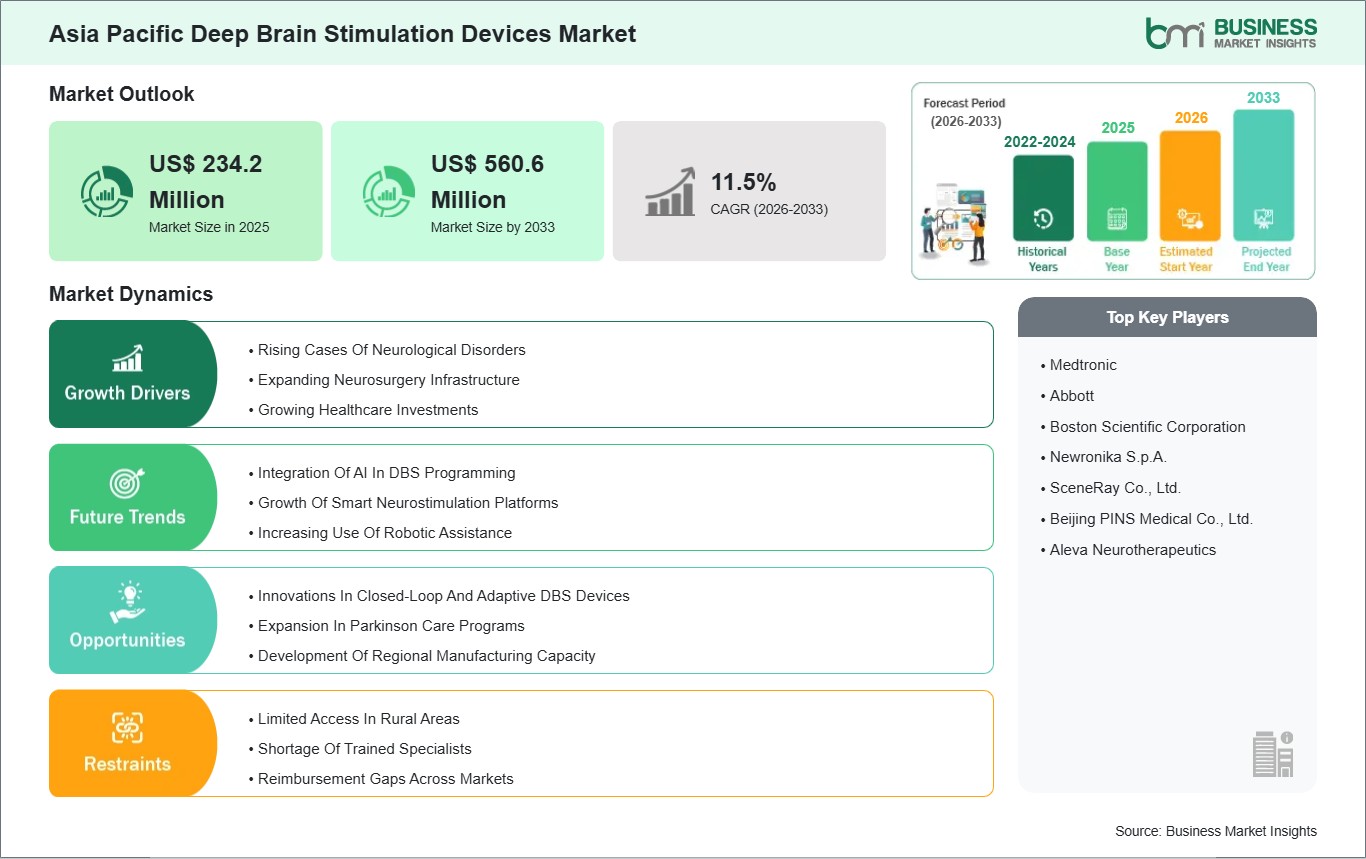
The Asia Pacific deep brain stimulation devices market size is expected to reach US$ 560.6 million by 2033 from US$ 234.2 million in 2025. The market is estimated to record a CAGR of 11.5% from 2026 to 2033.
Asia Pacific is an emerging hub for DBS devices on account of the growing burden of neurologic disorders, increased availability of advanced neurosurgery facilities, and higher adoption rates of implantable devices for neurostimulation therapy. The demand for DBS devices in the region is significantly propelled by the growing prevalence of movement disorders such as Parkinson's disease and essential tremors, along with difficult-to-treat mental illnesses. Investments in facilities that specialize in neurology, mainly at tertiary-care hospital settings, have helped improve accessibility to the procedure in countries within the region.
The growth in demand for DBS can be attributed to an increased understanding amongst doctors and patients about the long-term advantages of DBS as opposed to other treatment options that employ pharmacological drugs. Furthermore, changing reimbursement structures for certain countries in the Asia Pacific has resulted in improved affordability and greater uptake. The existence of a sizable population along with improved diagnosis rates is another factor that supports market growth. However, the high cost of procedures, unavailability of experienced neurosurgeons in the field, and lack of availability of neuro-modulating technology in semi-urban and rural parts of the region pose barriers to growth. Variability of regulatory laws across countries also hinders standardization. Nevertheless, the region holds considerable growth potential due to the advancements made in minimally invasive neurosurgery equipment.

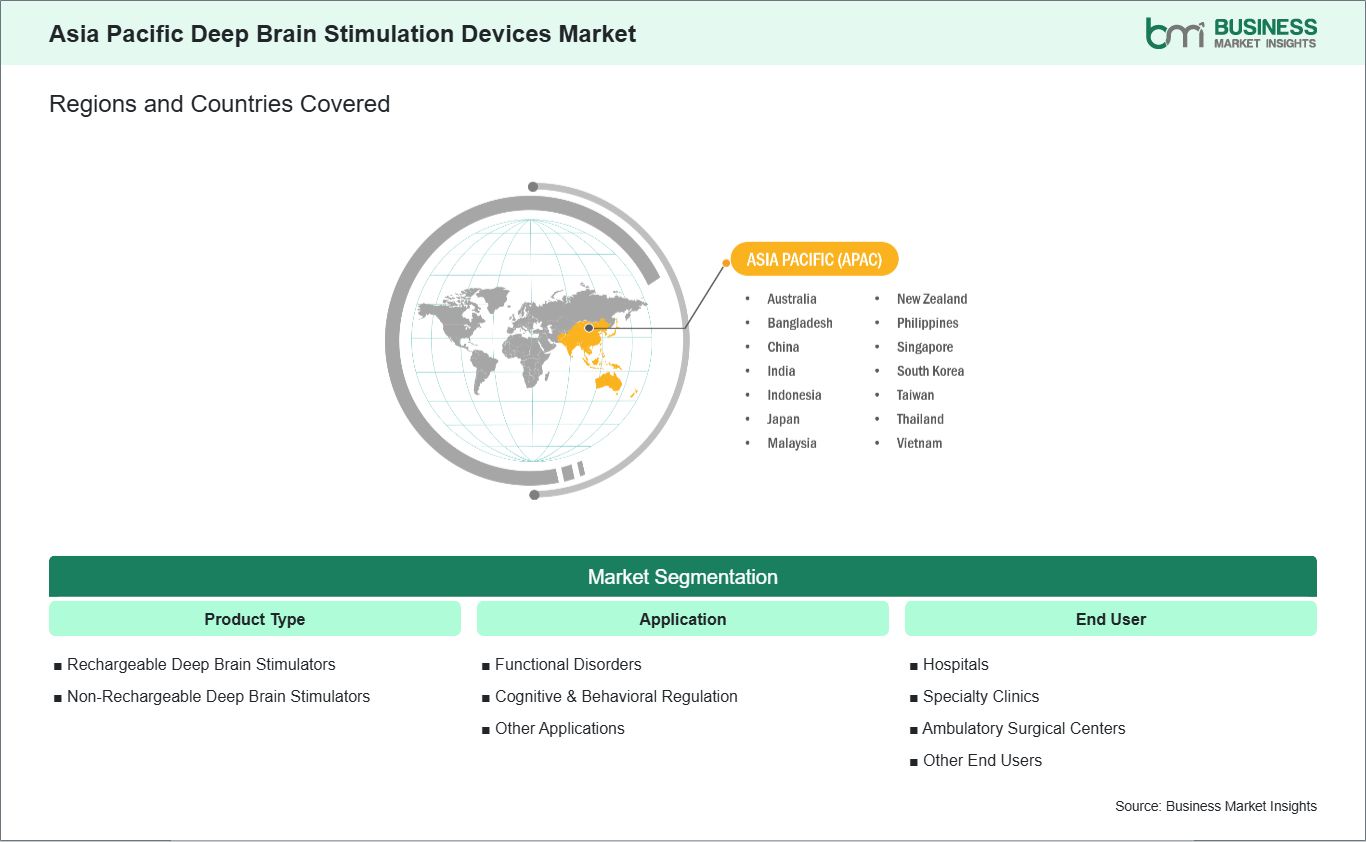
Key segments that contributed to the derivation of the Asia Pacific deep brain stimulation devices market analysis are product type, application, and end user.
The Asia Pacific deep brain stimulation (DBS) devices market is expanding due to a rising burden of neurological disorders such as Parkinson's disease, epilepsy, dystonia, and essential tremor across the region. Rapid demographic aging in countries like Japan, South Korea, China, and Australia is increasing the number of patients with neurodegenerative conditions, creating stronger demand for advanced neurosurgical treatment options. At the same time, improved survival rates and better long-term management of chronic illnesses are contributing to a larger population living with progressive neurological impairment.
More awareness in the clinical community and improved diagnostic tools have also contributed to an earlier detection of movement disorders in the Asia Pacific regions that are experiencing economic growth. In India, Thailand, and Indonesia, where there is increased availability of neurology services at major hospitals, there is also greater recognition of those patients whose condition no longer responds well to drug-based treatment. This situation has encouraged neurologists to explore DBS as an effective alternative to advanced symptoms of movement disorders.
Despite this progress, access to DBS therapy remains concentrated in major metropolitan healthcare centers, especially in technologically advanced systems such as Japan and Singapore. Many developing healthcare systems across South and Southeast Asia still face limitations in neurosurgical infrastructure and specialist availability. However, growing investment in tertiary care hospitals and rising referrals to specialized neurology centers are gradually improving access to advanced neurostimulation therapies across the region.
Technological advancements act as a key factor in boosting the growth of the Asia Pacific DBS devices market, especially with the introduction of closed loop and adaptive stimulations. Advanced technologies have enabled devices to modify the level of electrical stimulation in response to neurological activities, which ensures that treatment becomes more individualized for patients suffering from Parkinson's disease or other movement disorders.
Healthcare systems in countries such as Japan, China, and Australia are increasingly adopting next-generation neuromodulation technologies within specialized neuroscience and research hospitals. These centers are integrating advanced DBS programming techniques that allow clinicians to fine-tune therapy based on patient-specific brain activity patterns. This is especially relevant in Asia Pacific, where diverse genetic, environmental, and clinical profiles often lead to variable disease progression and treatment response.
In addition, the region is seeing growing integration of digital health tools, remote monitoring systems, and AI-assisted programming in neuromodulation therapy. International collaborations and technology transfer initiatives are helping clinicians in countries such as India, Malaysia, and South Korea gain exposure to adaptive DBS systems. As healthcare infrastructure continues to modernize, these innovations are expected to support broader adoption of precision-based DBS therapy across Asia Pacific.

The Asia Pacific deep brain stimulation devices market is experiencing steady growth, with market size and share analysis reflecting evolving treatment preferences and competitive dynamics among key players. The report evaluates important subsegments categorized within product type, application, and end user, highlighting their respective contributions to overall market performance.
By product type, the rechargeable deep brain stimulators subsegment dominated the market in 2025, driven by the growing preference for long-lasting and patient-friendly neurostimulation solutions. These devices offer extended battery life, reduced frequency of replacement surgeries, and improved convenience for patients, making them the preferred choice for the management of chronic neurological disorders.
Based on application, the functional disorders subsegment dominated the market in 2025, propelled by the rising prevalence of neurological conditions such as Parkinson's disease, essential tremor, and dystonia, along with increasing adoption of deep brain stimulation therapy for effective symptom management and improved quality of life.
In terms of end user, the hospitals subsegment dominated the market in 2025 due to their advanced neurology and neurosurgery departments, availability of skilled healthcare professionals, and access to technologically advanced deep brain stimulation devices and surgical infrastructure.
| Report Attribute | Details |
|---|---|
| Market size in 2025 | US$ 234.2 Million |
| Market Size by 2033 | US$ 560.6 Million |
| CAGR (2026 - 2033) | 11.5% |
| Historical Data | 2022-2024 |
| Forecast period | 2026-2033 |
| Segments Covered | By Product Type
|
|
Regions and Countries Covered
| |
| Asia Pacific | China, Japan, South Korea, India, Australia, New Zealand, Indonesia, Malaysia, Philippines, Singapore, Thailand, Vietnam, Taiwan, Bangladesh |
| Market leaders and key company profiles |
|
The "Asia Pacific Deep Brain Stimulation Devices Market Size and Forecast (2022-2033)" report provides a detailed analysis of the market covering below areas:
The geographical scope of the Asia Pacific Deep Brain Stimulation Devices market report is divided into: China, Japan, South Korea, India, Australia, New Zealand, Indonesia, Malaysia, the Philippines, Singapore, Thailand, Vietnam, Taiwan, Bangladesh, and Rest of Asia. China held the largest share in 2025.
China is the leading consumer of DBS devices in the Asia Pacific region owing to the presence of a high number of patients with neurological diseases, modern healthcare facilities, and active involvement of the government in promoting advanced technologies. Rising incidences of Parkinson's disease, amongst others, have contributed immensely to an increase in the number of patients seeking surgical procedures, particularly deep brain stimulation.
The growth of neurology and neurosurgery departments in leading hospitals is one of the major factors contributing to China's leadership in this industry. These organizations now have modern imaging systems, as well as surgery navigation tools that make possible the safe and accurate insertion of electrodes into specific parts of the brain. The growing medical knowledge and increased awareness of deep brain stimulation therapy contribute to earlier diagnostics and subsequent patient referral to a specialized hospital. The regulatory climate in China is relatively favorable, as advanced implantable devices receive quick approvals from the authorities, while domestic production of neuromodulators receives government support. Chinese businesses are progressively entering the DBS market, thereby intensifying competition and making this therapy more accessible. In China, there are significant differences in healthcare accessibility in urban and rural areas, as DBS surgery is now performed exclusively in large city hospitals. Moreover, high costs associated with this procedure hinder its widespread use.

The Asia Pacific Deep Brain Stimulation Devices market is evaluated by gathering qualitative and quantitative data post primary and secondary research, which includes important corporate publications, association data, and databases. A few of the key developments in the Asia Pacific Deep Brain Stimulation Devices market are:
The Asia Pacific Deep Brain Stimulation Devices Market is valued at US$ 234.2 Million in 2025, it is projected to reach US$ 560.6 Million by 2033.
As per our report Asia Pacific Deep Brain Stimulation Devices Market, the market size is valued at US$ 234.2 Million in 2025, projecting it to reach US$ 560.6 Million by 2033. This translates to a CAGR of approximately 11.5% during the forecast period.
The Asia Pacific Deep Brain Stimulation Devices Market report typically cover these key segments-
The historic period, base year, and forecast period can vary slightly depending on the specific market research report. However, for the Asia Pacific Deep Brain Stimulation Devices Market report:
The Asia Pacific Deep Brain Stimulation Devices Market is populated by several key players, each contributing to its growth and innovation. Some of the major players include:
The Asia Pacific Deep Brain Stimulation Devices Market report is valuable for diverse stakeholders, including:
Essentially, anyone involved in or considering involvement in the Asia Pacific Deep Brain Stimulation Devices Market value chain can benefit from the information contained in a comprehensive market report.
Please tell us your area of interest
(Market Segments/ Regions and Countries/ Companies)