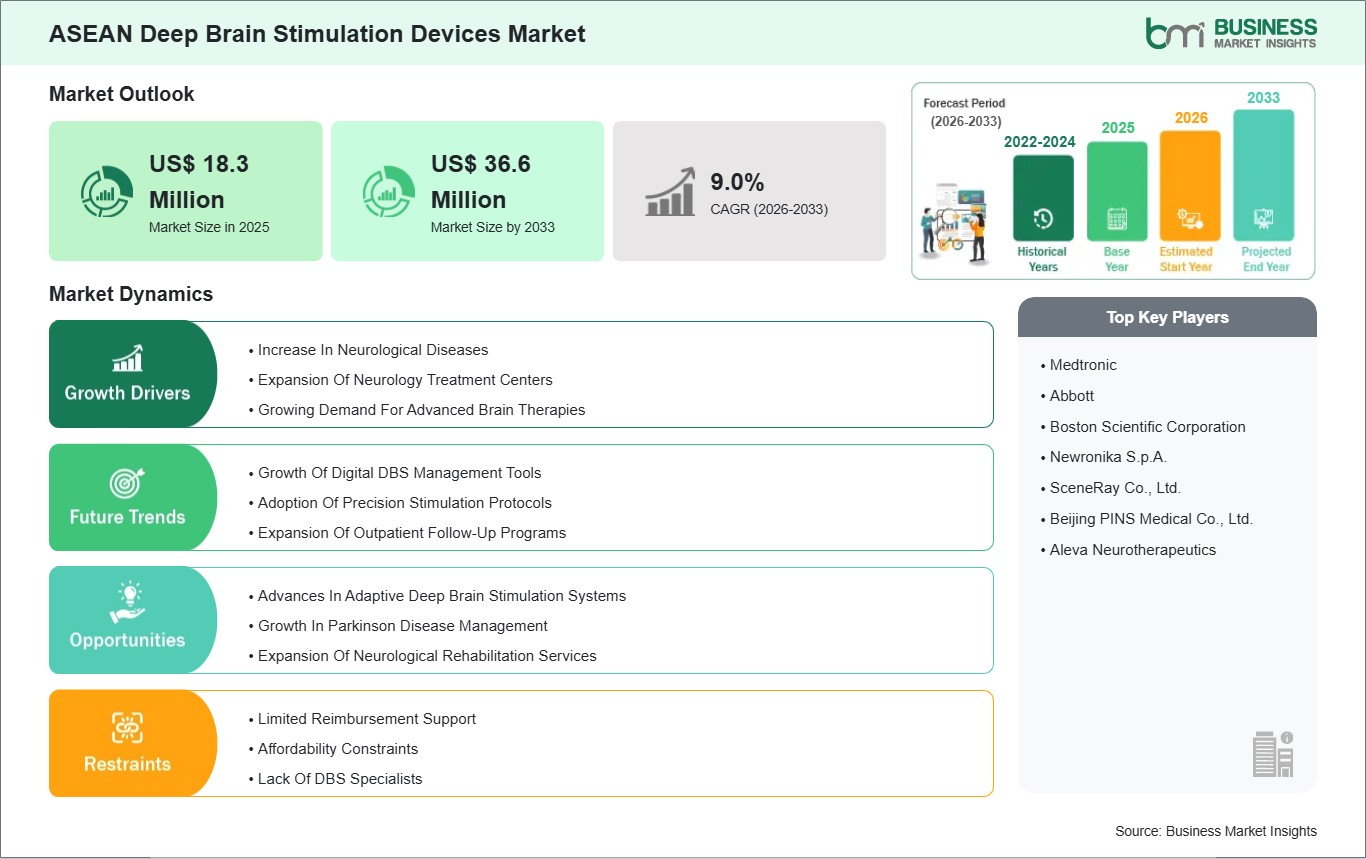
The ASEAN Deep Brain Stimulation Devices market size is expected to reach US$ 36.6 million by 2033 from US$ 18.3 million in 2025. The market is estimated to record a CAGR of 9.0% from 2026 to 2033.
The ASEAN DBS Device market is in its developmental phase, influenced by incremental developments in neurology care facilities and increasing awareness regarding innovative methods of treating neurological movement disorders. The increasing prevalence of Parkinson's disease, epilepsy, and dystonia in the elderly urban population of ASEAN countries is leading to the increased importance of DBS technology in the region. The healthcare providers in important ASEAN economies are beginning to move away from conventional drug-based therapy towards neuromodulation methods.
One of the major growth drivers for the industry is the increased specialization of neurology and neurosurgery units within urban hospitals due to enhanced investments in healthcare, along with improved availability of experts. In addition, the rise of medical tourism in countries like Thailand and Singapore is aiding the development of DBS through increased capacity for neurological treatments. On another note, the collaboration between global companies offering DBS products and hospitals in the region is increasing awareness for DBS technology. However, one of the major drawbacks facing the DBS market is the cost associated with performing the procedure, along with poor reimbursement schemes, which limit patient access. The prioritization of essential care over specialized procedures by healthcare institutions continues to hamper the growth of the market. Shortage of functional neurosurgeons and diagnostics in poor ASEAN countries also pose as major hindrance.

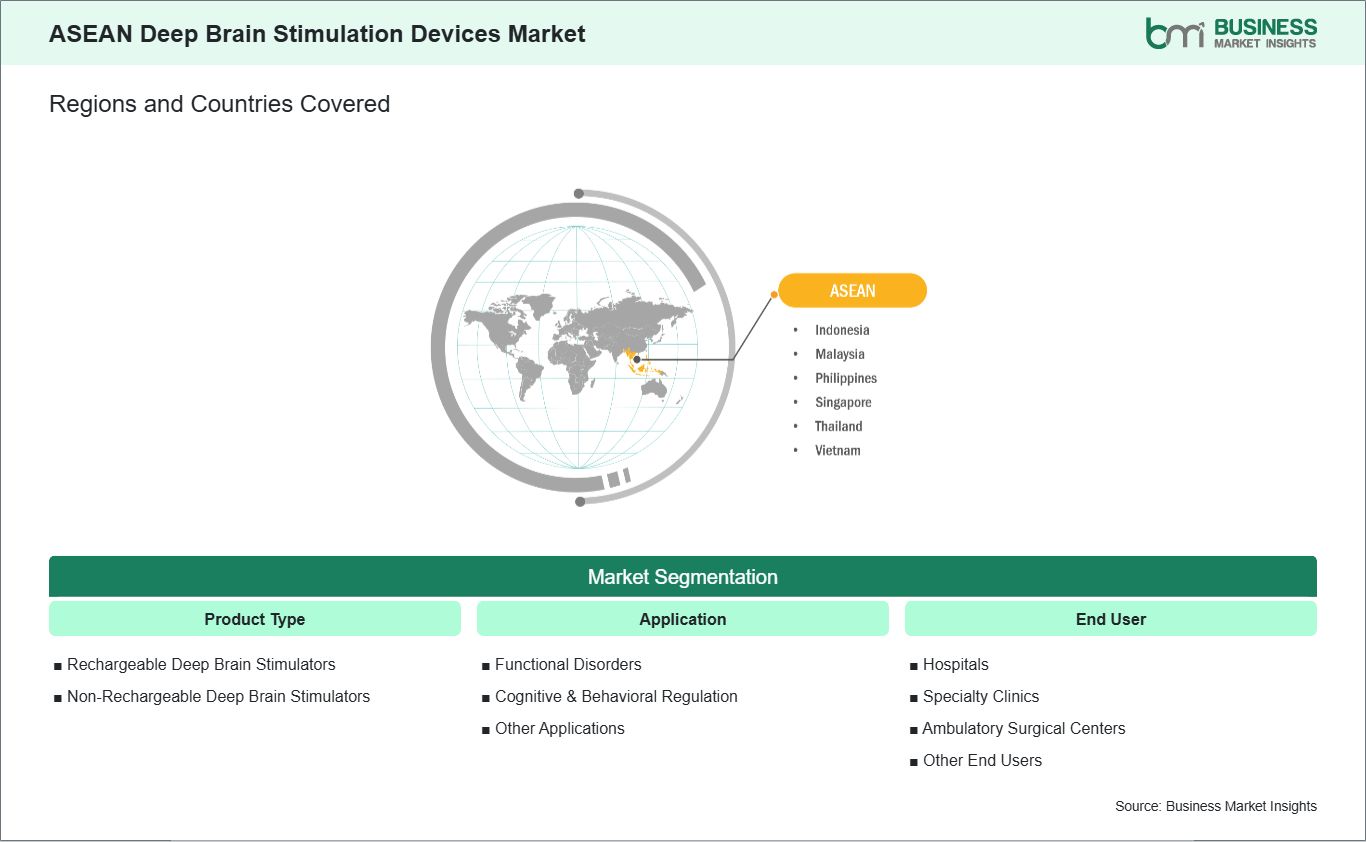
Key segments that contributed to the derivation of the ASEAN deep brain stimulation devices market analysis are product type, application, and end user.
The ASEAN deep brain stimulation (DBS) devices market is being shaped by a growing burden of neurological disorders such as Parkinson's disease, epilepsy, dystonia, and essential tremor across Southeast Asia. Population aging in countries like Thailand, Singapore, and Vietnam is gradually increasing the number of patients experiencing neurodegenerative conditions. At the same time, lifestyle changes, improved survival rates, and better recognition of chronic neurological illnesses are contributing to a higher number of diagnosed cases in urban healthcare centers.
Increasing health consciousness in ASEAN nations has resulted in an increase in the recognition of movement disorders that were not diagnosed previously due to a lack of medical awareness. In nations like Malaysia and Indonesia, neurological units of big hospitals are currently taking care of cases involving chronic Parkinson's disease patients who are unresponsive to existing medicines. The current trend has inspired doctors to explore further avenues for treatment, such as deep brain stimulation. However, inequalities in access to neurological care remain a challenge in the region. While Singapore and Thailand are highly developed in terms of neurosurgery and clinics specialized in movement disorders, the impoverished nations like Cambodia, Laos, and Myanmar continue to experience difficulties in accessing equipment and doctors. However, rising awareness and improvements in hospital facilities due to medical missions are leading to better referrals and more recognition of the DBS treatment approach.
Technology innovations have a dominant factor in the ASEAN DBS device market, with the advent of adaptive and closed-loop stimulation systems. These systems provide adaptive real-time adjustment in response to brain signals, thus delivering tailor-made treatment options for people suffering from motor disorders. In ASEAN nations, there is considerable diversity in the pattern of disease manifestation among patients requiring lifelong treatment.
The more advanced ASEAN healthcare institutions, like those in Singapore, as well as in some other Thai and Malaysian cities, have started experimenting with future generations of DBS devices, which are being used in neurological clinics where multidisciplinary healthcare professionals work with complicated cases of neurological disorders and adjust the parameters of treatment, with the patients being more comfortable.
However, increased familiarity with digital health applications and telemedicine is driving the adoption of intelligent DBS systems. International cooperation is also educating clinicians from nations such as Indonesia and Vietnam on how to use these systems to optimize and manage advanced neurostimulation systems. With healthcare facilities in the region becoming increasingly modernized, adaptive DBS systems will continue to be instrumental in providing personalized therapy to patients suffering from neurodegenerative disorders.

The ASEAN deep brain stimulation devices market is experiencing steady growth, with market size and share analysis reflecting evolving treatment preferences and competitive dynamics among key players. The report evaluates important subsegments categorized within product type, application, and end user, highlighting their respective contributions to overall market performance.
By product type, the rechargeable deep brain stimulators subsegment dominated the market in 2025, driven by the growing preference for long-lasting and patient-friendly neurostimulation solutions. These devices offer extended battery life, reduced frequency of replacement surgeries, and improved convenience for patients, making them the preferred choice for the management of chronic neurological disorders.
Based on application, the functional disorders subsegment dominated the market in 2025, propelled by the rising prevalence of neurological conditions such as Parkinson's disease, essential tremor, and dystonia, along with increasing adoption of deep brain stimulation therapy for effective symptom management and improved quality of life.
In terms of end user, the hospitals subsegment dominated the market in 2025 due to their advanced neurology and neurosurgery departments, availability of skilled healthcare professionals, and access to technologically advanced deep brain stimulation devices and surgical infrastructure.
| Report Attribute | Details |
|---|---|
| Market size in 2025 | US$ 18.3 Million |
| Market Size by 2033 | US$ 36.6 Million |
| CAGR (2026 - 2033) | 9.0% |
| Historical Data | 2022-2024 |
| Forecast period | 2026-2033 |
| Segments Covered | By Product Type
|
|
Regions and Countries Covered
| |
| ASEAN | Indonesia, Malaysia, Philippines, Singapore, Thailand, Vietnam |
| Market leaders and key company profiles |
|
The "ASEAN Deep Brain Stimulation Devices Market Size and Forecast (2022-2033)" report provides a detailed analysis of the market covering below areas:
The geographical scope of the ASEAN Deep Brain Stimulation Devices market report is divided into: Indonesia, Malaysia, the Philippines, Singapore, Thailand, and Vietnam. Indonesia held the largest share in 2025.
Indonesia holds the largest market share in the ASEAN Deep Brain Stimulation Devices industry, owing to its substantial patient population base and growing neurological treatment expertise in urban health facilities. There is an increasing trend in the number of cases being attended to in Indonesia for movement disorders, and neurologists' awareness about these diseases is gradually improving. Urban areas such as Jakarta and Surabaya are becoming the hubs for sophisticated neurology treatments, and private as well as public sector hospitals are upgrading their neurosurgery facilities.
Private hospitals in Indonesia are vital players in the early adoption of DBS technologies due to the more flexible access to medical devices and cooperation with foreign companies. Moreover, increasing training courses and international collaboration are facilitating the development of skills in functional neurosurgery that are needed for the implementation of DBS therapy. Medical tourism in the region is motivating Indonesian health facilities to develop their capabilities in the field of neurology; however, DBS technology is mostly used in premium medical centers. In spite of these achievements, the exorbitant price for DBS treatment and technology limits its adoption to wealthy patients only. Furthermore, the lack of public insurance coverage for innovative neuromodulation procedures is also impeding DBS technology adoption in Indonesia. Besides, the unequal distribution of neurosurgeon specialists across the country is limiting the widespread use of the procedure.

The ASEAN Deep Brain Stimulation Devices market is evaluated by gathering qualitative and quantitative data post primary and secondary research, which includes important corporate publications, association data, and databases. A few of the key developments in the ASEAN Deep Brain Stimulation Devices market are:
The ASEAN Deep Brain Stimulation Devices Market is valued at US$ 18.3 Million in 2025, it is projected to reach US$ 36.6 Million by 2033.
As per our report ASEAN Deep Brain Stimulation Devices Market, the market size is valued at US$ 18.3 Million in 2025, projecting it to reach US$ 36.6 Million by 2033. This translates to a CAGR of approximately 9.0% during the forecast period.
The ASEAN Deep Brain Stimulation Devices Market report typically cover these key segments-
The historic period, base year, and forecast period can vary slightly depending on the specific market research report. However, for the ASEAN Deep Brain Stimulation Devices Market report:
The ASEAN Deep Brain Stimulation Devices Market is populated by several key players, each contributing to its growth and innovation. Some of the major players include:
The ASEAN Deep Brain Stimulation Devices Market report is valuable for diverse stakeholders, including:
Essentially, anyone involved in or considering involvement in the ASEAN Deep Brain Stimulation Devices Market value chain can benefit from the information contained in a comprehensive market report.
Please tell us your area of interest
(Market Segments/ Regions and Countries/ Companies)