Market Summary
Executive Summary and Market Analysis
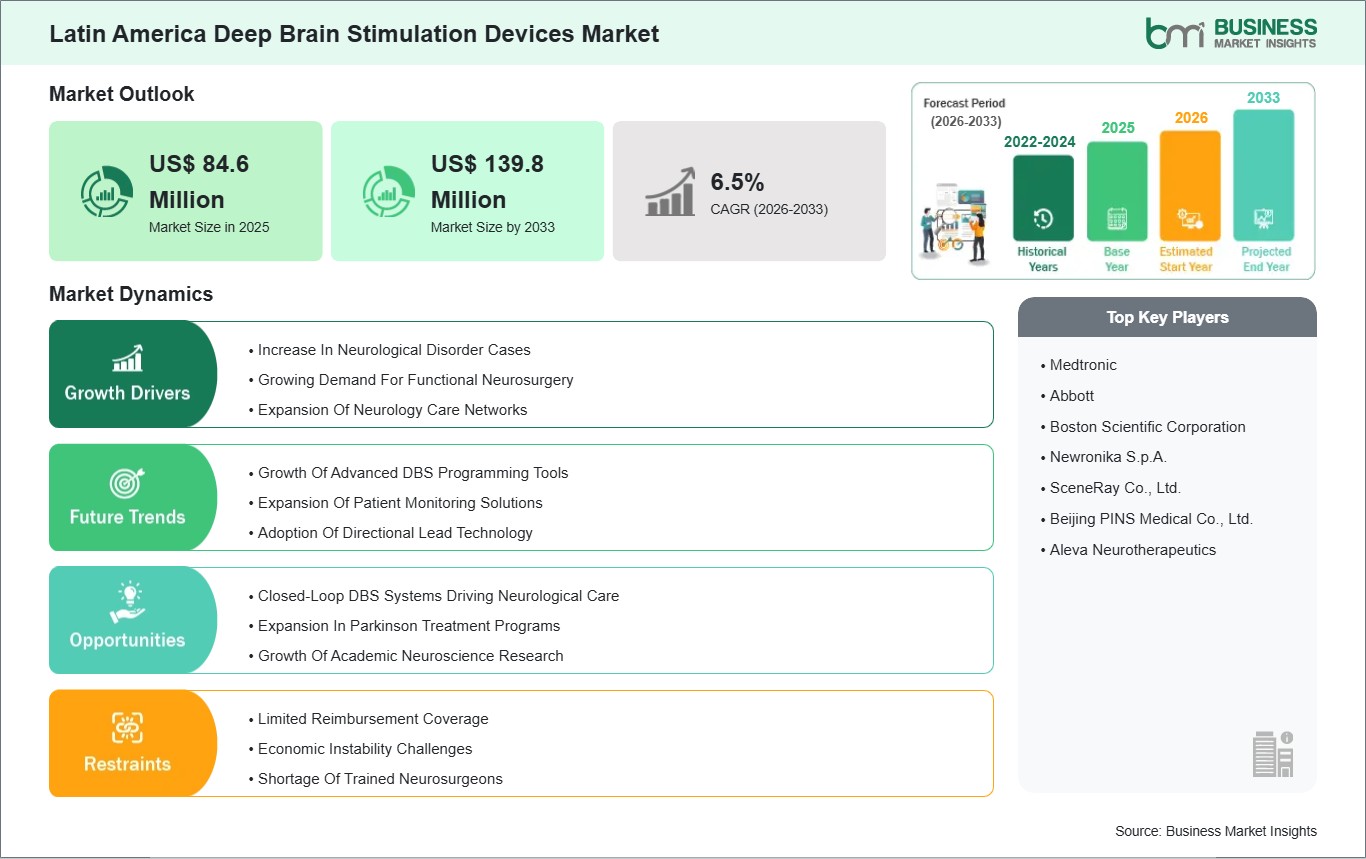
The Latin America Deep Brain Stimulation (DBS) devices market is gradually developing as the neurological care infrastructure strengthens across key urban healthcare hubs. The region is witnessing rising clinical attention toward advanced neuromodulation therapies, particularly for managing Parkinson's disease, essential tremor, and treatment-resistant movement disorders. Growing awareness among neurologists and patients about DBS as a long-term therapeutic solution is encouraging its adoption, especially in private and high-tier public hospitals.
The growing number of cases involving neurodegenerative diseases caused by aging populations in urban centers, as well as improving diagnostic techniques, has led to market growth. Another factor behind the rising patient numbers is the expanding number of neurological surgery and neurology departments in large hospitals, which will allow for proper assessment of the procedure candidacy in such cases. Furthermore, there has been an increase in collaboration between medical device firms based abroad and the region to help with training and improve surgical expertise in the region. However, the high costs of the procedure still remain a considerable limitation due to the lack of consistent reimbursement policies for neurostimulation procedures. Limited access to specialized surgeons in non-urbanized regions further constrains treatment.
Segment Analysis
Latin America Deep Brain Stimulation Devices Market Segmentation
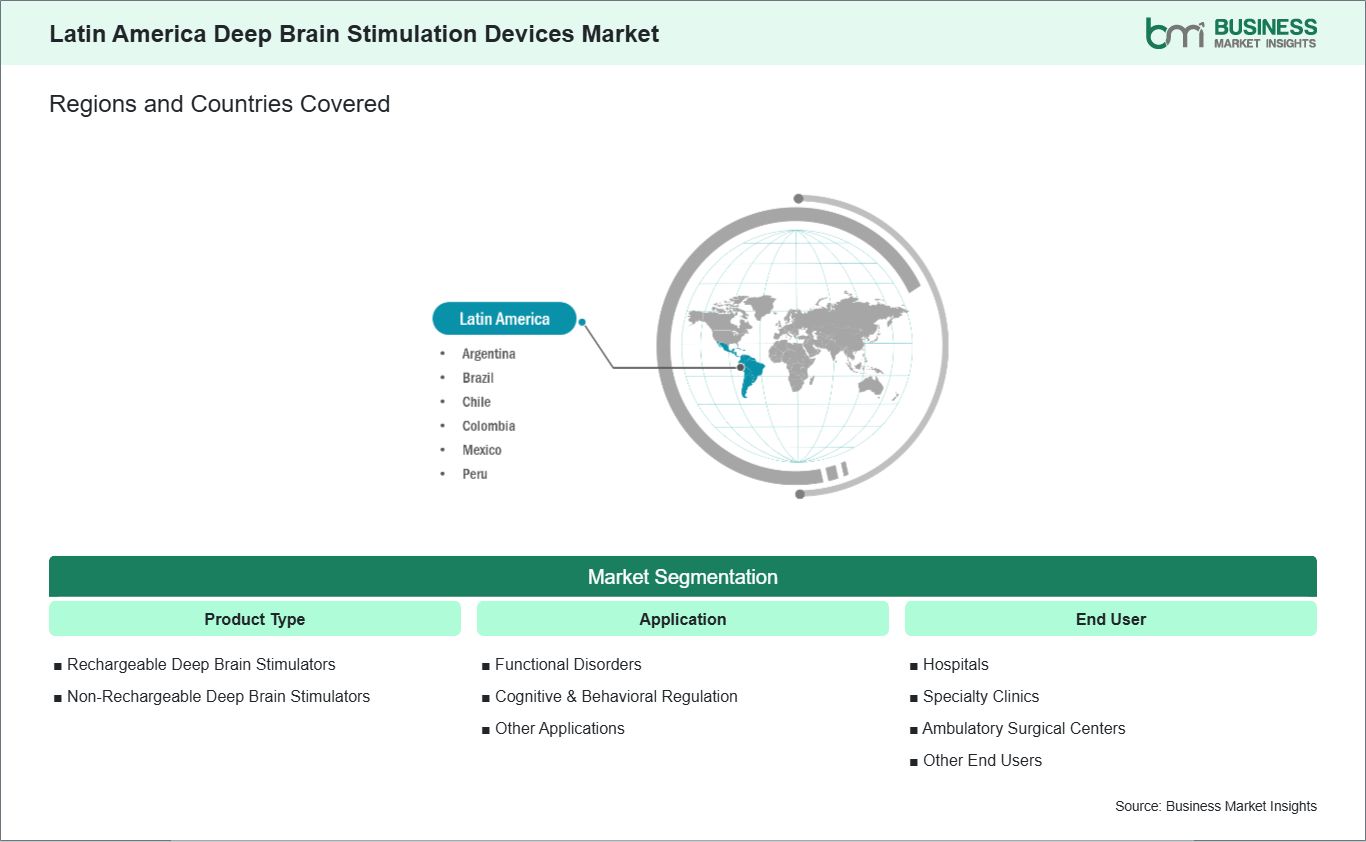
Key segments that contributed to the derivation of the Latin America deep brain stimulation devices market analysis are product type, application, and end user.
- By product type, the deep brain stimulation devices market is segmented into rechargeable deep brain stimulators and non-rechargeable deep brain stimulators. The rechargeable deep brain stimulators segment dominated the market in 2025.
- Based on application, the deep brain stimulation devices market is classified into functional disorders, cognitive & behavioral regulation, and other applications. The functional disorders segment dominated the market in 2025.
- In terms of end user, the deep brain stimulation devices market is categorized into hospitals, specialty clinics, ambulatory surgical centers, and other end users. The hospitals segment dominated the market in 2025.
Market Forces
Latin America Deep Brain Stimulation Devices Market Drivers and Opportunities
Increase in Neurological Disorder Cases
Neurological diseases such as Parkinson's, epilepsy, dystonia, and essential tremors have become common among Latin Americans in recent times. There is an increased need for state-of-the-art medical technologies such as DBS in order to address the problems caused by neurological ailments. This is because the aging population in countries like Brazil, Mexico, and Argentina has led to the occurrence of neurological diseases.
Urbanization and other factors that cause lifestyle diseases are also playing a role in the trends in neurological diseases in the region. The growing number of patients with diabetes, heart diseases, and obesity indirectly contributes to neurologic complications and problems with movement. While medications do not effectively help patients with neurological problems, there is a need for the DBS treatment.
Healthcare infrastructure development in major Latin American economies is further supporting market growth. Expansion of specialized neurology clinics, movement disorder centers, and neurosurgical departments is improving patient access to advanced neurological care. In addition, greater physician training and increasing availability of minimally invasive neurosurgical procedures are strengthening the adoption of DBS systems across both public and private healthcare facilities in the region.
Closed-Loop DBS Systems Driving Neurological Care
The development of technology is now becoming an increasingly critical part of the Latin America deep brain stimulation devices market due to the increased use of adaptive and closed-loop DBS technologies. Such innovative solutions are created in order to detect changes in brain activity and regulate stimulation automatically. This will not only help to control the symptoms better but also reduce unwanted stimulation and side effects. This creates increasing demand for such treatment from neurologists and neurosurgeons.
Hospitals and neuroscience centers across Latin America are gradually integrating advanced DBS platforms equipped with directional leads, rechargeable pulse generators, and enhanced programming software. These innovations allow physicians to customize stimulation settings more precisely according to patient-specific neurological conditions. As healthcare providers continue focusing on precision medicine and minimally invasive treatment approaches, demand for next-generation DBS systems is steadily increasing across the region.
Digital healthcare integration is also more prominent within neurological care in Latin America. Remote monitoring features and telemedicine-supported DBS programming are helping physicians manage patient therapy more efficiently, particularly in geographically large countries where access to specialized neurological centers may be limited. These capabilities are improving follow-up care, reducing the need for repeated hospital visits, and supporting broader adoption of technologically advanced DBS devices throughout the region.
Size and Share Analysis
Latin America Deep Brain Stimulation Devices Market Size and Share Analysis
The Latin America deep brain stimulation devices market is experiencing steady growth, with market size and share analysis reflecting evolving treatment preferences and competitive dynamics among key players. The report evaluates important subsegments categorized within product type, application, and end user, highlighting their respective contributions to overall market performance.
By product type, the rechargeable deep brain stimulators subsegment dominated the market in 2025, driven by the growing preference for long-lasting and patient-friendly neurostimulation solutions. These devices offer extended battery life, reduced frequency of replacement surgeries, and improved convenience for patients, making them the preferred choice for the management of chronic neurological disorders.
Based on application, the functional disorders subsegment dominated the market in 2025, propelled by the rising prevalence of neurological conditions such as Parkinson's disease, essential tremor, and dystonia, along with increasing adoption of deep brain stimulation therapy for effective symptom management and improved quality of life.
In terms of end user, the hospitals subsegment dominated the market in 2025 due to their advanced neurology and neurosurgery departments, availability of skilled healthcare professionals, and access to technologically advanced deep brain stimulation devices and surgical infrastructure.
Report Coverage
Latin America Deep Brain Stimulation Devices Market Report Coverage and Deliverables
The "Latin America Deep Brain Stimulation Devices Market Size and Forecast (2022-2033)" report provides a detailed analysis of the market covering below areas:
- Market size and forecast at global, regional, and country levels for all the key market segments covered under the scope
- Market trends, as well as drivers, restraints, and opportunities
- Market analysis covering key trends, global and regional framework, major players, regulations, and recent developments
- Market concentration, heat map analysis, prominent players, and recent developments for the Market
- Detailed company profiles, including SWOT analysis
Geographic Insights
Latin America Deep Brain Stimulation Devices Market Geographic Insights
The geographical scope of the Latin America Deep Brain Stimulation Devices market report is divided into: Brazil, Mexico, Argentina, Colombia, Chile, and Peru. Mexico held the largest share in 2025.
Mexico is considered the top country in Latin America with regards to demand for DBS products, given the relatively sophisticated level of private health care facilities and increasing presence of specialty neurological treatment centers in urban areas like Mexico City and Monterrey. Mexico has shown greater willingness to embrace cutting-edge neurosurgery solutions than some of its neighboring countries, owing to closer links with international providers of medical technology equipment.
Factors contributing to the demand include more diagnoses of movement disorders, as well as the increased use of referral networks between neurologists and neurosurgeons. Private hospitals serve as important factors for DBS adoption, since these hospitals have more infrastructure and finances necessary to undertake such operations. Medical tourism also accounts for the demand for DBS as people travel from surrounding areas in order to receive treatment in some of the most advanced hospitals in Mexico.
However, despite the aforementioned factors promoting DBS technology, its implementation is limited by geography - that is, it occurs mainly in urban and private hospitals only. This factor makes public health care slow to adopt DBS technology, since public hospitals lack sufficient funds. Mexico currently serves as the major source of introduction of DBS to Latin American countries.
Industry Activity
Recent Developments
The Latin America Deep Brain Stimulation Devices market is evaluated by gathering qualitative and quantitative data post primary and secondary research, which includes important corporate publications, association data, and databases. A few of the key developments in the Latin America Deep Brain Stimulation Devices market are:
- In February 2025, Medtronic, announced that it had received U.S. FDA approval for its BrainSense Adaptive Deep Brain Stimulation (aDBS) system, a real-time closed-loop DBS technology for Parkinson's disease, with the company continuing commercialization activities across international markets including Latin America.
- In January 2024, Medtronic, announced FDA approval for its rechargeable Percept RC neurostimulator with BrainSense technology, strengthening its advanced DBS portfolio that supports broader deployment in emerging markets including Latin America for movement disorder treatment.
Trust & Transparency
Research Methodology
The market analysis combines proprietary research with secondary data from government agencies, company disclosures, regulatory filings, industry databases and expert interviews. Market estimates are validated through data triangulation, cross-market benchmarking and analyst
review.
View Full Research Methodology
Key Sources Referred:
The World BankWorld Health Organization (WHO)Center for Disease Control and Prevention (CDC)Food and Drug Administration (FDA)European Database on Medical Devices (EUDAMED)American Association of Neurological Surgeons (AANS)American Academy of Neurology (AAN)Company WebsitesCompany Annual ReportsCompany Investor Presentations