Market Summary
Executive Summary and Market Analysis
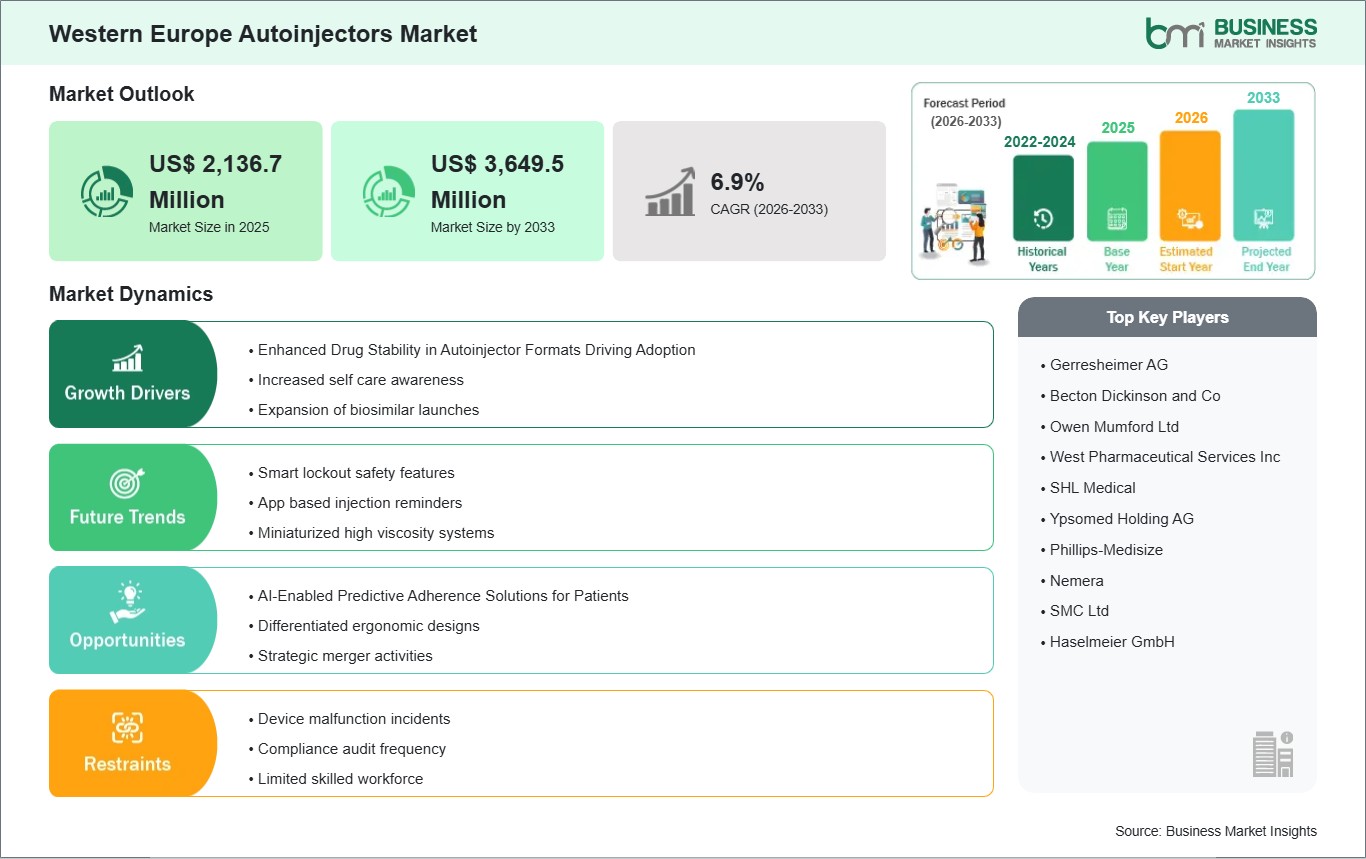
The Western Europe autoinjectors market is characterized by high technological adoption and advanced regulatory frameworks, fostering a robust environment for combination drug-device therapies. The increasing prevalence of chronic autoimmune disorders, severe allergic reactions, and neurologic conditions is driving demand for self-administration solutions that improve treatment adherence and patient independence. The market benefits from strong integration between pharmaceutical companies and specialized medical device manufacturers, emphasizing ergonomic designs, safety features, and dose accuracy. Regional regulatory bodies, including the European Medicines Agency, enforce stringent quality and performance standards, encouraging innovation while ensuring patient safety. Health systems are increasingly incentivizing home-based care programs, resulting in a shift away from hospital-centric treatment models. Market competition is intensifying as manufacturers focus on differentiation through patient-friendly features, including audible/visual injection cues, reduced injection force, and connectivity for monitoring adherence. Strategic partnerships, licensing agreements, and co-development initiatives are common, enabling companies to accelerate commercialization while addressing complex formulation challenges associated with biologics. Sustainability is emerging as a factor in procurement, with buyers increasingly favoring reusable or recyclable devices to align with corporate social responsibility initiatives. Additionally, healthcare professional education and patient awareness programs are influencing adoption rates, highlighting the importance of ease of use and safety in clinical decision-making.
Segment Analysis
Western Europe Autoinjectors Market Segmentation
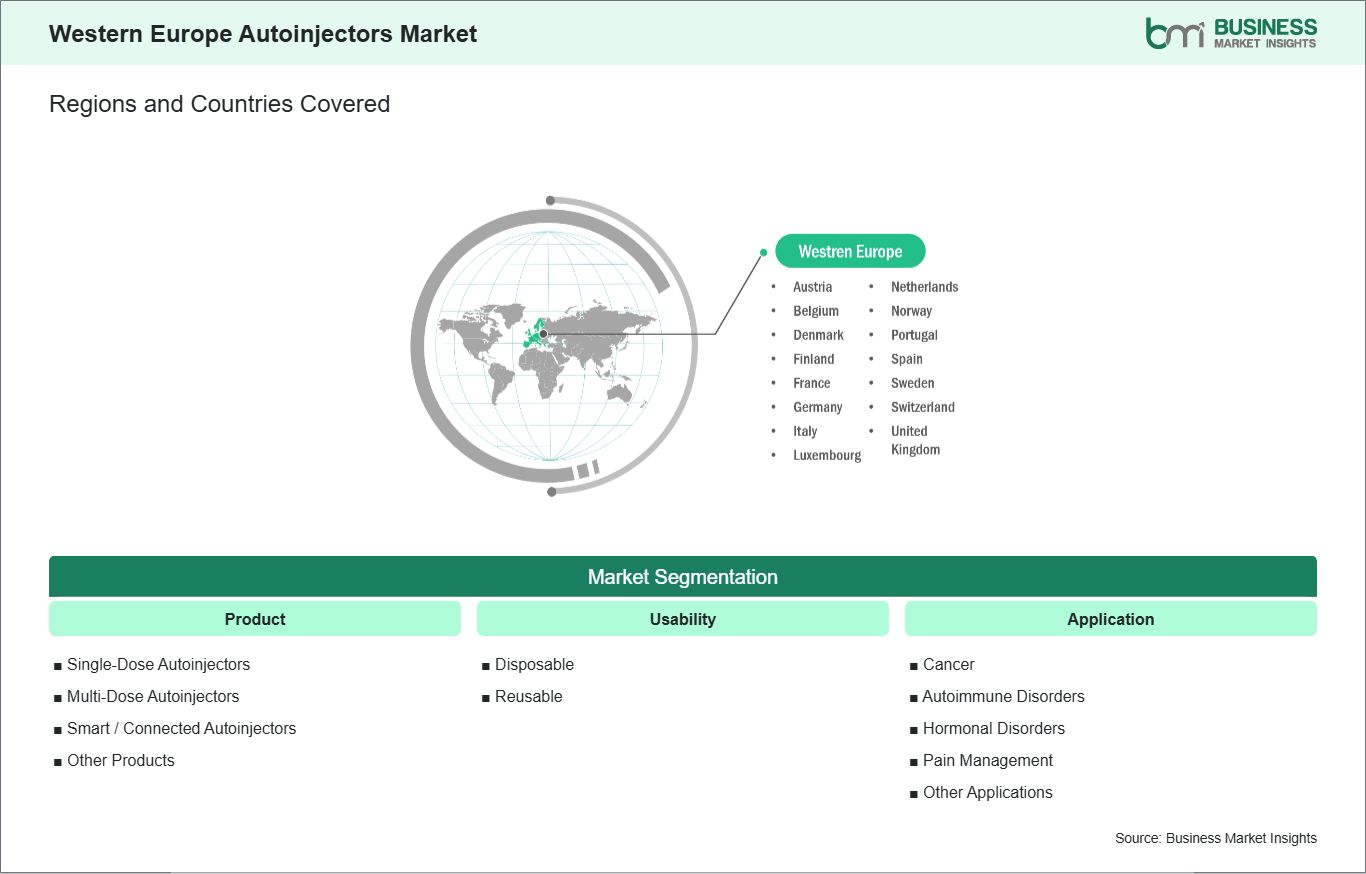
Key segments that contributed to the derivation of the Western Europe autoinjectors market analysis are product, usability, and application.
- By product, the autoinjectors market is segmented into single-dose autoinjectors, multi-dose autoinjectors, smart/connected autoinjectors, and others. The Single-Dose Autoinjectors segment dominated the market in 2025.
- Based on usability, the autoinjectors market is categorized into disposable and reusable. The disposable segment dominated the market in 2025.
- In terms of application, the market is classified into cancer, autoimmune disorders, hormonal disorders, pain management, and other applications. The autoimmune disorders segment dominated the market in 2025.
Market Forces
Western Europe Autoinjectors Market Drivers and Opportunities
Enhanced Drug Stability in Autoinjector Formats Driving Adoption
In Western Europe, the autoinjector market is gaining momentum as healthcare systems increasingly recognize the value of drug stability in self‑administration formats. Autoinjectors are designed to protect sensitive therapies from environmental factors, ensuring that patients receive consistent quality with every dose. This reliability is particularly important in a region where biologics and advanced therapies are widely prescribed, and where regulators emphasize strict standards for product safety and performance. The adoption of autoinjectors is also supported by the region's strong focus on patient convenience and healthcare efficiency. By maintaining drug stability over longer periods, autoinjectors reduce the need for frequent replacements and minimize the risk of treatment interruptions. This aligns well with Western Europe's broader healthcare priorities, which include lowering costs, improving patient adherence, and reducing hospital dependency. The ability to store and use therapies safely at home is reshaping treatment pathways across multiple therapeutic areas. Furthermore, the emphasis on drug stability is driving innovation among manufacturers operating in Western Europe. Companies are investing in advanced materials, coatings, and packaging solutions that extend shelf life and protect formulations during transport and storage. These improvements not only enhance patient confidence but also support healthcare providers in delivering more reliable treatment options.
AI-Enabled Predictive Adherence Solutions for Patients
Western Europe is also emerging as a leader in the integration of AI‑enabled adherence solutions within autoinjector platforms. These technologies are designed to monitor patient behavior, predict potential lapses, and provide timely interventions that improve treatment consistency. In a region where chronic conditions are prevalent and healthcare systems are under pressure to optimize resources, predictive adherence tools are becoming a critical component of patient care. The use of AI in autoinjectors supports a more personalized approach to treatment. By analyzing usage patterns, these systems can generate tailored reminders, coaching prompts, and alerts that help patients stay on track with their therapy. This proactive model reduces the likelihood of missed doses and enhances long‑term outcomes, which is particularly valuable in Western Europe's aging population, where self‑management of complex therapies is increasingly common. The integration of digital health platforms further strengthens this ecosystem, creating seamless communication between patients and providers. For healthcare organizations, predictive adherence solutions offer significant operational benefits. They enable clinicians to identify at‑risk patients early, adjust treatment plans more effectively, and reduce the burden of avoidable hospital visits. This aligns with Western Europe's strategic focus on preventive care and digital transformation in healthcare delivery. As adoption grows, AI‑enabled autoinjectors are expected to play a central role in supporting patient empowerment, improving efficiency, and advancing the region's vision of a more connected and resilient healthcare system.
Size and Share Analysis
Western Europe Autoinjectors Market Size and Share Analysis
The Western Europe Autoinjectors Market demonstrates steady growth, with size and share analysis highlighting evolving trends and competitive dynamics among key players. The report examines subsegments categorized within product, usability, and application, offering insights into their contribution to overall market performance.
By product, the single-dose autoinjectors subsegment dominated the market in 2025, driven by ease of use and reduced risk of dosing errors in self‑administration.
Based on usability, the disposable subsegment dominated the market in 2025, driven by patient preference for convenience and hygiene in home‑based treatments.
In terms of application, the autoimmune disorders subsegment dominated the market in 2025, driven by the high prevalence of chronic conditions requiring regular biologic therapies across Western Europe.
Report Coverage
Western Europe Autoinjectors Market Report Coverage and Deliverables
The "Western Europe Autoinjectors Market Size and Forecast (2022–2033)" report provides a detailed analysis of the market covering below areas:
- Western Europe Autoinjectors Market size and forecast at regional and country levels for all market segments covered under the scope
- Western Europe Autoinjectors Market trends, as well as drivers, restraints, and opportunities
- Western Europe Autoinjectors Market analysis covering key trends, regional framework, major players, regulations, and recent developments
- Industry landscape and competition analysis covering market concentration, heat map analysis, prominent players, and recent developments for the Western Europe Autoinjectors Market
- Detailed company profiles, including SWOT analysis
Geographic Insights
Western Europe Autoinjectors Market Geographic Insights
The geographical scope of the Western Europe Autoinjectors Market report is divided into Belgium, the Netherlands, Luxembourg, Germany, France, Italy, Spain, Switzerland, Sweden, Austria, the UK, Denmark, Portugal, Norway, and Finland. Germany held the largest share in 2025.
Country-specific dynamics within Western Europe highlight diverse adoption patterns, regulatory environments, and market priorities. Germany is a mature market with strong insurance coverage and a well-established biologics infrastructure, where emphasis on patient safety, device reliability, and HTA-driven reimbursement dominates procurement decisions. France demonstrates a high adoption rate of autoinjectors in hospital and outpatient settings, with public health policies supporting early access to innovative therapies. The UK leverages robust home care networks and telemedicine programs to increase accessibility, while regulatory oversight by the Medicines and Healthcare products Regulatory Agency ensures strict compliance with device and combination product standards. Italy and Spain exhibit growing demand within private and public healthcare systems, driven by rising awareness and patient education campaigns, though budget constraints influence formulary decisions. Smaller markets, including the Netherlands, Belgium, and Scandinavia, are notable for early adoption of digitalized autoinjector solutions and integration with electronic health record systems. Cross-border supply chains and harmonized EU regulations facilitate consistent product availability and operational efficiency. Collectively, these country-specific variations necessitate targeted commercialization strategies, tailored pricing models, and localized patient support programs to optimize market penetration and sustain long-term growth across Western Europe.
Industry Activity
Recent Developments
The Western Europe Autoinjectors Market is evaluated by gathering qualitative and quantitative data post primary and secondary research, which includes important corporate publications, association data, and databases. A few of the key developments in the Western Europe autoinjectors market are:
- In December 2025, the European Medicines Agency's (EMA) Committee for Medicinal Products for Human Use (CHMP) issued a positive opinion for the SteQeyma (ustekinumab biosimilar) autoinjector by Celltrion. This approval covers multiple indications, including psoriatic arthritis and Crohn's disease, providing a simple two-step administration process with clear visual and audible indicators for the user.
- In October 2025, Ypsomed officially launched YpsoLoop, the world's first autoinjector platform designed specifically for circularity and environmental sustainability. The device features a design that allows for automated disassembly and efficient material recovery, addressing the growing regulatory and consumer pressure in Western Europe to reduce medical plastic waste. This launch signals a transition in the industry from purely functional single-use devices to eco-friendly, high-volume manufacturing solutions.
Trust & Transparency
Research Methodology
The market analysis combines proprietary research with secondary data from government agencies, company disclosures, regulatory filings, industry databases and expert interviews. Market estimates are validated through data triangulation, cross-market benchmarking and analyst
review.
View Full Research Methodology
Key Sources Referred:
World Health Organization (WHO) Organisation for Economic Cooperation and Development (OECD) The World Bank Group Worldometer The Lancet International Bar Association International Trade Administration