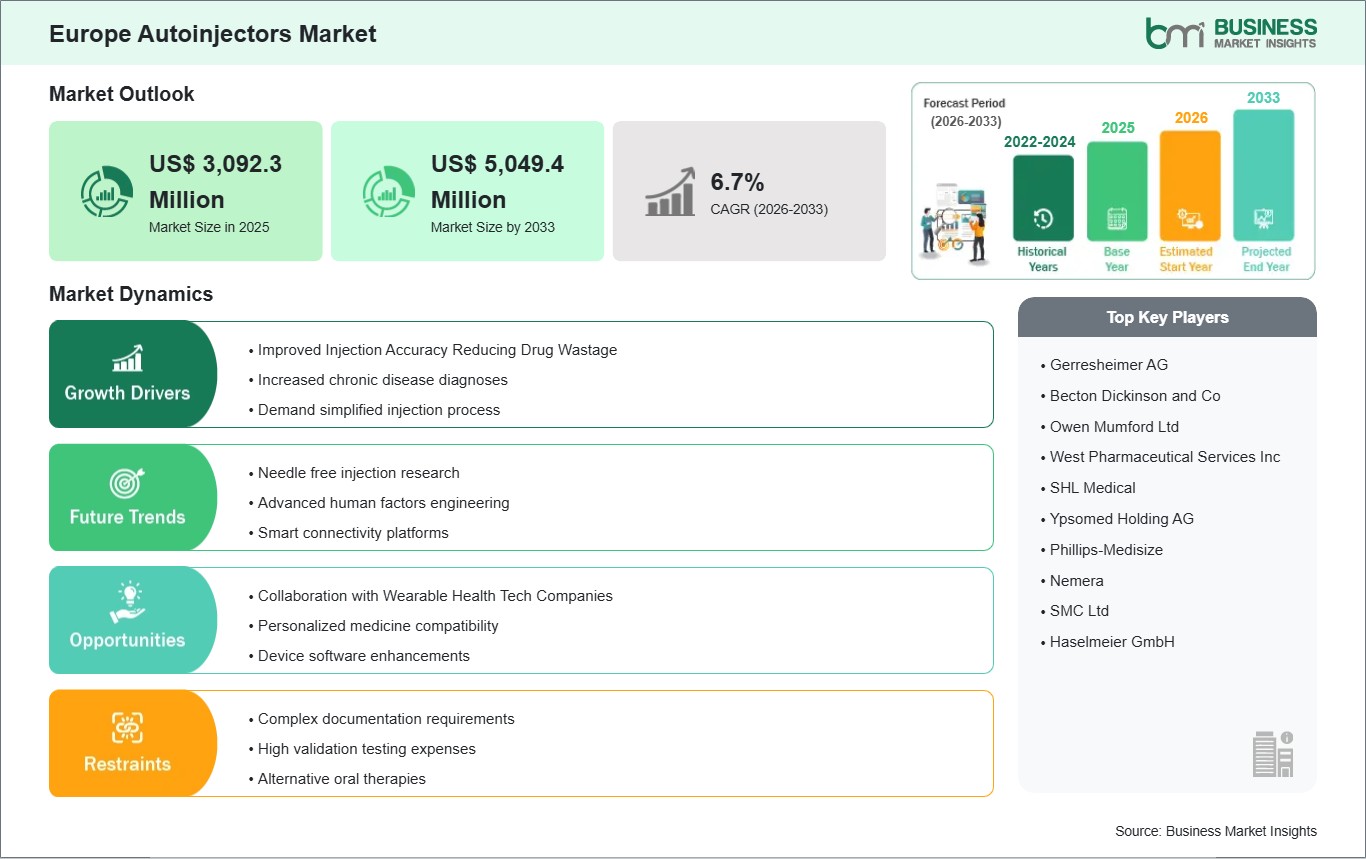
The Europe Autoinjectors Market size is expected to reach US$ 5,049.4 million by 2033 from US$ 3,092.3 million in 2025. The market is estimated to record a CAGR of 6.7% from 2026 to 2033.
The Europe autoinjectors market is experiencing steady growth, underpinned by the region’s advanced healthcare infrastructure, high patient awareness, and strong reimbursement frameworks. The market spans Western, Central, and Eastern Europe, with countries such as Germany, France, Italy, and the UK, alongside emerging Eastern European nations, collectively driving adoption. Increasing prevalence of chronic diseases, autoimmune disorders, severe allergies, and the widespread use of biologics has accentuated the need for convenient and accurate drug delivery systems. Autoinjectors are increasingly preferred due to their ability to enhance patient adherence, reduce injection errors, and offer the convenience of self-administration in homecare settings. The competitive landscape is dominated by global medical device manufacturers, though regional players are entering through licensing, co-development, or localized assembly partnerships. Product innovation remains a key differentiator, with focus areas including ergonomic designs, dual-chamber systems, prefilled formulations, and connected devices enabling digital adherence monitoring. Regulatory compliance under the European Union’s Medical Device Regulation (MDR) ensures high safety and quality standards, although market entry requires robust clinical validation and extensive documentation, particularly for novel devices. Distribution channels are shifting from hospital-centric models toward a more diversified approach, incorporating retail pharmacies, specialty clinics, and digital platforms. Health insurers and national reimbursement programs play a pivotal role in accelerating adoption, particularly for high-cost biologics requiring autoinjector delivery. In addition, patient education and training initiatives have strengthened acceptance, allowing a wider demographic—including pediatric and geriatric populations—to adopt self-injection therapies. Overall, the Europe autoinjectors market demonstrates a strong alignment between technological innovation, regulatory rigor, and patient-centric care, creating a conducive environment for sustainable growth across multiple therapeutic areas.

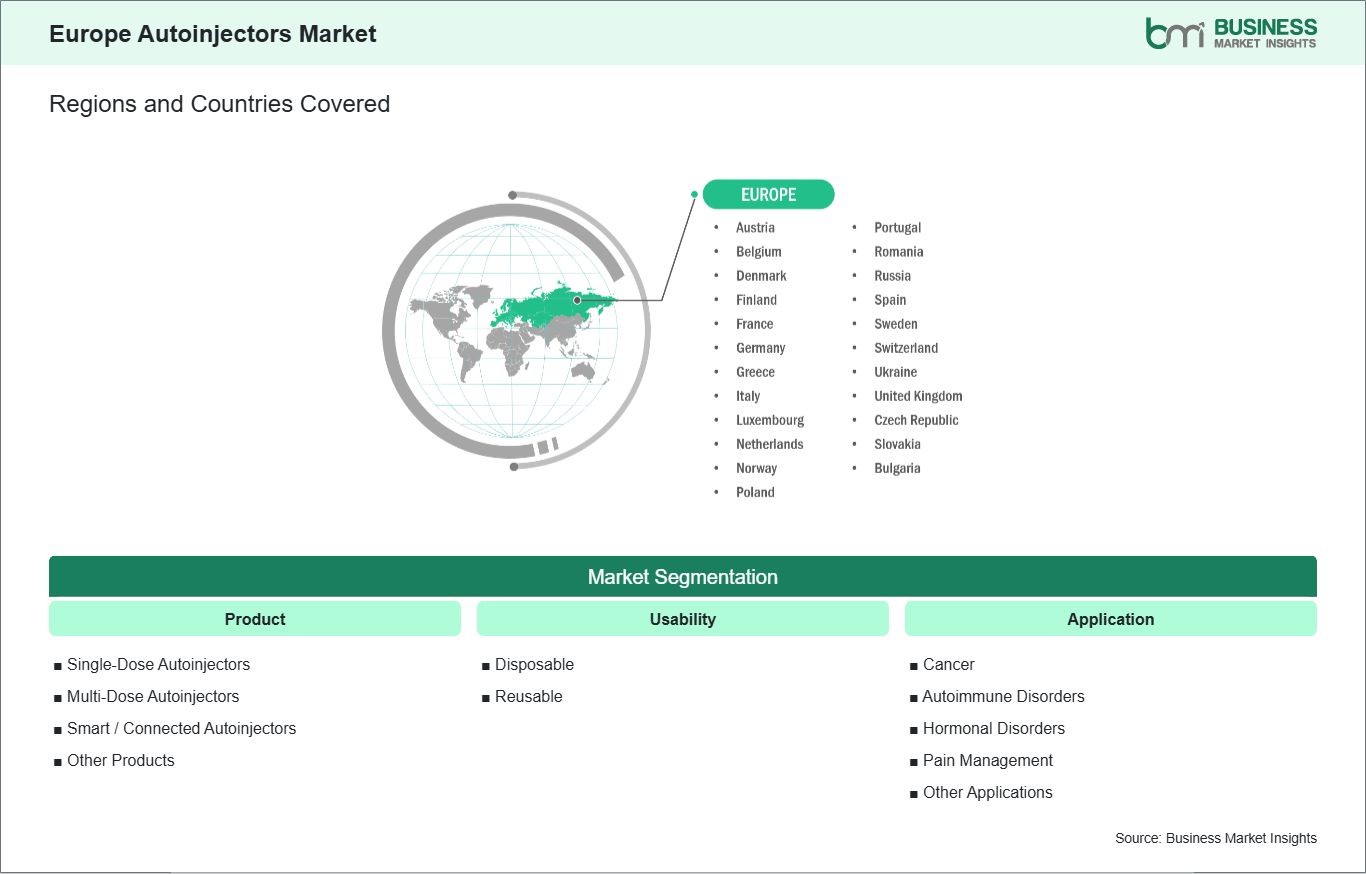
Key segments that contributed to the derivation of the Europe autoinjectors market analysis are product, usability, and application.
Across Europe, rising pharmaceutical costs and tighter reimbursement frameworks are driving demand for autoinjector technologies that improve injection accuracy and minimize drug wastage. In high‑cost healthcare systems such as those in Western Europe, biologic therapies for conditions like rheumatoid arthritis, multiple sclerosis, and Crohn’s disease represent substantial per‑dose expenditure. Clinics in major metropolitan centers from Paris to Frankfurt increasingly prefer autoinjectors with precise dose delivery mechanisms because they ensure the full therapeutic load is administered, reducing waste and lowering both payer and patient costs. This trend aligns closely with hospital pharmacy initiatives aimed at optimizing drug utilization and lowering overall supply spend without compromising outcomes. In Northern European countries where stringent hospital budgeting frameworks are common, improved accuracy features — such as spring‑assisted delivery and integrated dose confirmation — are helping healthcare providers meet both economic and clinical objectives. Pharmacies in cities like Stockholm and Copenhagen report that devices with audible or visual delivery indicators reduce accidental partial doses, which historically have led to reduced efficacy and increased repeat visits. As reimbursement authorities increasingly tie coverage to demonstrable cost‑effectiveness, the ability of autoinjectors to mitigate wastage strengthens their value proposition in formulary decisions. Central European markets are also recognizing the economic impact of accurate delivery systems. Clinics in Vienna and Munich are transitioning away from manual syringe systems toward engineered autoinjectors for high‑price biologics, citing lower liability risk and fewer adverse events linked to dosing errors. Educational programs for nurse specialists emphasize how consistent dose administration drives better long‑term management of chronic diseases and aligns with broader EU health policy goals of resource optimization. Together, these dynamics indicate that enhanced injection accuracy — and the associated reduction in drug wastage is a growing decision criterion shaping autoinjector procurement across Europe.
In Europe’s increasingly digital health ecosystem, collaboration between autoinjector manufacturers and wearable health technology companies is gaining momentum as stakeholders seek to integrate medication delivery with real‑time monitoring and data analytics. Multi‑disciplinary pilot programs in cities like Amsterdam and Barcelona are linking autoinjectors to smartphone applications and wearable sensors that track activity, vitals, and dosing history. These combined systems provide clinicians with a comprehensive view of patient adherence and therapeutic response, enabling more informed treatment adjustments and improving chronic disease management outcomes. Healthcare providers in Scandinavia are early adopters of these integrated solutions. Through partnerships with local wearable health tech companies, Danish and Finnish health networks are offering autoinjector users companion devices that sync injection events with biometric data such as heart rate variability and sleep patterns. Patients managing autoimmune conditions have responded positively to platforms that contextualize dosing within their broader health profile, reducing uncertainty and enhancing engagement. These developments are also supported by national health registries that promote interoperability and standardized data sharing across digital health tools. Central and Eastern European healthcare systems are beginning to pilot connected autoinjector ecosystems that link wearable devices with electronic medical records (EMRs). Clinics in Prague and Warsaw are exploring solutions where data from wearable patches and autoinjector logs are automatically uploaded to EMRs, enabling multidisciplinary care teams to review adherence trends during routine consultations. Integration with telehealth platforms further allows remote monitoring, a capability that has proven valuable in regions with dispersed populations. As European healthcare funders increasingly emphasize digital health as a pathway to improved efficiency and patient outcomes, collaboration between autoinjector providers and wearable tech companies is poised to become a defining feature of the continent’s evolving autoinjector market.
The Europe Autoinjectors Market demonstrates steady growth, with size and share analysis highlighting evolving trends and competitive dynamics among key players. The report examines subsegments categorized within product, usability, and application, offering insights into their contribution to overall market performance.
By product, the single-dose autoinjectors subsegment dominated the market in 2025, driven by preference for ready‑to‑use, pre‑filled devices that reduce contamination risks and improve dosing accuracy for patients and healthcare providers.
Based on usability, the disposable subsegment dominated the market in 2025, driven by strong demand for simple, single‑use delivery systems that enhance safety, eliminate maintenance, and support home‑based treatment models.
In terms of application, the autoimmune disorders subsegment dominated the market in 2025, driven by rising prevalence of chronic immune‑mediated conditions (e.g., rheumatoid arthritis, multiple sclerosis) requiring long‑term biologic therapies optimally administered via autoinjectors.
| Report Attribute | Details |
|---|---|
| Market size in 2025 | US$ 3,092.3 Million |
| Market Size by 2033 | US$ 5,049.4 Million |
| CAGR (2026 - 2033) | 6.7% |
| Historical Data | 2022-2024 |
| Forecast period | 2026-2033 |
| Segments Covered | By Product
|
|
Regions and Countries Covered
| |
| Europe | Belgium, Austria, Finland, Denmark, Greece, Poland, Romania, Russia, Ukraine, Czech Republic, Slovakia, Bulgaria, Italy, Luxembourg, Germany, Switzerland, France, Netherlands, Norway, Portugal, Spain, Sweden, United Kingdom |
| Market leaders and key company profiles |
|
The "Europe Autoinjectors Market Size and Forecast (2022–2033)" report provides a detailed analysis of the market covering below areas:
The geographical scope of the Europe Autoinjectors Market report is divided into Belgium, Austria, Finland, Denmark, Greece, Poland, Romania, Russia, Ukraine, the Czech Republic, Slovakia, Bulgaria, Italy, Luxembourg, Germany, Switzerland, France, the Netherlands, Norway, Portugal, Spain, Sweden, and the UK. Germany held the largest share in 2025.
Country-specific dynamics across Europe reveal diverse adoption patterns and strategic opportunities. Germany is a mature, innovation-driven market with strong hospital networks, high insurance coverage, and early adoption of smart autoinjectors for chronic disease management. The market is characterized by rigorous regulatory oversight, which ensures high-quality standards for both local and imported devices. In France, patient-centric care models and government-supported reimbursement schemes drive the adoption of self-administered biologics, with hospitals and specialty clinics serving as primary distribution points. Italy demonstrates a similar trend, with growing urban adoption of autoinjectors complemented by private healthcare expansion and patient training programs. Emerging Eastern European markets, including Poland, Czech Republic, and Romania, are characterized by gradual uptake influenced by public reimbursement policies, urban-rural healthcare disparities, and increasing private sector involvement. Pricing sensitivity remains a key factor, requiring affordable, user-friendly devices alongside patient education campaigns. Spain reflects a mixed market where private hospital adoption of advanced autoinjectors coexists with cost-conscious public sector procurement, highlighting opportunities for both premium and economy product segments. Collectively, these country-specific insights emphasize the need for differentiated strategies, adaptive pricing frameworks, and digital integration to effectively capture growth opportunities across the European autoinjectors market.

The Europe Autoinjectors Market is evaluated by gathering qualitative and quantitative data post primary and secondary research, which includes important corporate publications, association data, and databases. A few of the key developments in the Europe autoinjectors market are:
The Europe Autoinjectors Market is valued at US$ 3,092.3 Million in 2025, it is projected to reach US$ 5,049.4 Million by 2033.
As per our report Europe Autoinjectors Market, the market size is valued at US$ 3,092.3 Million in 2025, projecting it to reach US$ 5,049.4 Million by 2033. This translates to a CAGR of approximately 6.7% during the forecast period.
The Europe Autoinjectors Market report typically cover these key segments-
The historic period, base year, and forecast period can vary slightly depending on the specific market research report. However, for the Europe Autoinjectors Market report:
The Europe Autoinjectors Market is populated by several key players, each contributing to its growth and innovation. Some of the major players include:
The Europe Autoinjectors Market report is valuable for diverse stakeholders, including:
Essentially, anyone involved in or considering involvement in the Europe Autoinjectors Market value chain can benefit from the information contained in a comprehensive market report.
Please tell us your area of interest
(Market Segments/ Regions and Countries/ Companies)