Market Summary
Executive Summary and Global Market Analysis
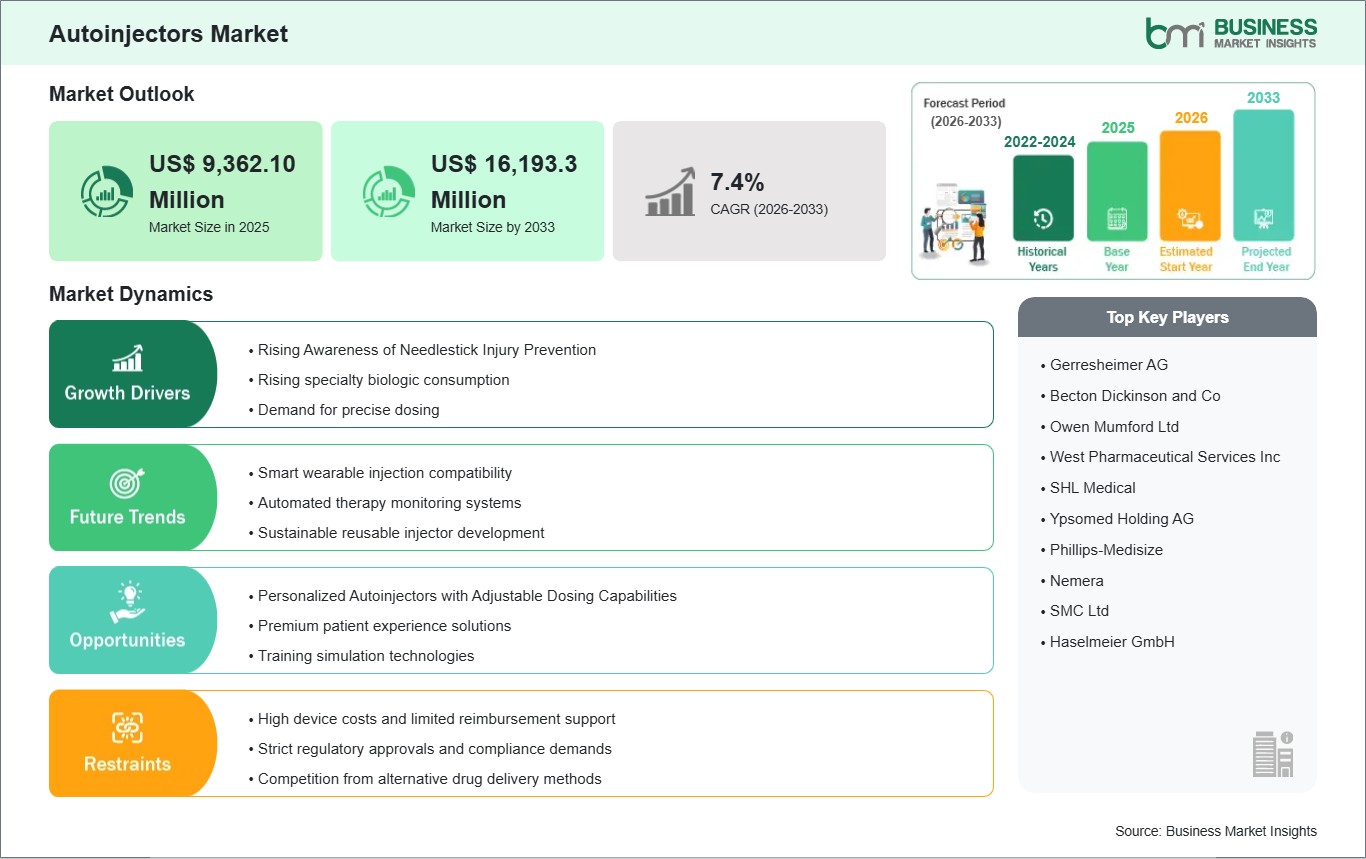
The global autoinjectors market is shaped by the growing demand for simplified drug delivery, heightened emphasis on patient self‑management, and pharmaceutical strategies to enhance therapy adherence. Autoinjectors, mechanical spring‑driven devices that automatically deliver a pre‑measured dose of medication, are increasingly preferred in chronic disease settings such as autoimmune conditions, diabetes, and anaphylaxis due to ease of use, reduced administration errors, and enhanced patient confidence. A rising prevalence of chronic conditions, combined with aging demographics, is exerting consistent pressure on healthcare systems to transition from clinician‑dependent injections to self‑administered options.
From a competitive standpoint, product differentiation centers on device ergonomics, safety features such as concealed needles and two‑step activation, and compatibility with biologic therapeutics with complex formulation profiles. Collaboration between biopharmaceutical companies and device manufacturers has become a strategic imperative, as co‑development enables alignment of drug properties with optimal delivery mechanisms. Regulatory authorities across major markets have tightened human factors standards, requiring extensive usability testing that influences product development cycles and time‑to‑approval. Meanwhile, procurement strategies among payers and large health systems increasingly emphasize total cost of care, evaluating devices based on impact on adherence, reduced needlestick injuries, and potential to shift care settings from in‑clinic to home.
Emerging trends illustrate a growing emphasis on sustainable device design to meet environmental and disposal regulations. Operational investments in manufacturing and quality systems reflect heightened scrutiny over device reliability, particularly for high‑injection‑volume therapies. Thus, patient expectations, pharmaceutical strategy, regulatory evolution, and payer value frameworks shape the global autoinjector market.
Segment Analysis
Autoinjectors Market Segmentation
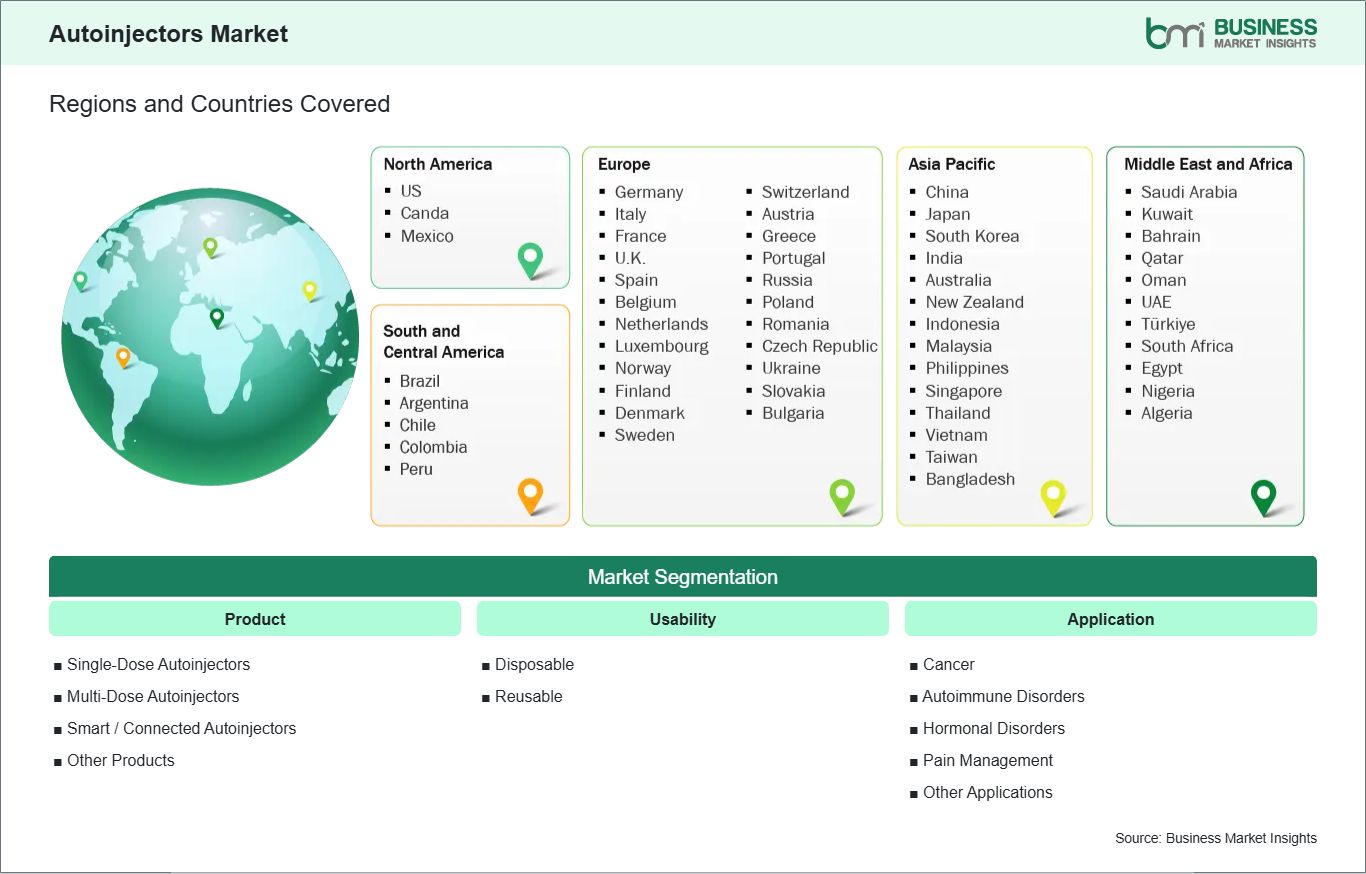
Key segments that contributed to the derivation of the autoinjectors market analysis are product, usability, and application.
- By product, the autoinjectors market is segmented into single-dose autoinjectors, multi-dose autoinjectors, smart/connected autoinjectors, and others. The single-dose autoinjectors segment dominated the market in 2025.
- Based on usability, the autoinjectors market is categorized into disposable and reusable. The disposable segment dominated the market in 2025.
- In terms of application, the market is classified into cancer, autoimmune disorders, hormonal disorders, pain management, and other applications. The autoimmune disorders segment dominated the market in 2025.
Market Forces
Autoinjectors Market Drivers and Opportunities
Growing Preference for Pain-Free Self-Administration Devices
Patients managing chronic conditions such as diabetes, autoimmune disorders, and long-term therapies increasingly prefer autoinjectors over conventional syringes due to their ease of use and reduced discomfort. Autoinjectors allow patients to administer medications independently, improving convenience and encouraging adherence to prescribed treatment regimens. The ergonomic designs and prefilled mechanisms reduce the effort and anxiety associated with repeated injections. Self-administration with autoinjectors enhances treatment outcomes by ensuring accurate and consistent dosing. These devices minimize the risk of dosing errors and reduce dependence on healthcare professionals for routine injections, allowing patients to manage their therapy with greater control. This independence improves patient confidence and reduces the burden on healthcare facilities. Innovation in device design continues to strengthen market growth by improving comfort, usability, and safety. Modern autoinjectors incorporate features such as hidden needles, spring-assisted mechanisms, and automatic dosing, making self-injection simpler and less intimidating. With rising awareness of pain-free administration, autoinjectors are set to remain a preferred method for self-administered therapies worldwide.
Technological Advancements Enabling Smart and Connected Autoinjectors
Modern devices integrate digital features such as dose tracking, reminders, and smartphone connectivity, allowing patients to monitor their therapy in real time. Healthcare providers can also access injection data remotely, enabling timely interventions, improving compliance, and optimizing long-term therapy outcomes. The combination of smart technology and self-administration is transforming how chronic diseases are managed. Integration with digital health platforms and telemedicine is further expanding the utility of connected autoinjectors. These devices enable patients to maintain therapy schedules efficiently while allowing healthcare providers to track adherence and respond proactively.
Features such as automated dose logging, alerts, and remote monitoring provide a seamless self-care experience that encourages consistent use, reduces errors, and builds patient confidence in self-injection practices. Continuous improvements in ergonomics, usability, and connectivity are supporting the adoption of smart autoinjectors globally. Devices are being designed to accommodate patients with varying dexterity levels, reduce injection pain, and provide real-time feedback on dosage. As patient-centric care models and home healthcare continue to grow, connected autoinjectors are expected to become an essential tool for managing long-term therapies.
Size and Share Analysis
Autoinjectors Market Size and Share Analysis
The Autoinjectors Market demonstrates steady growth, with size and share analysis highlighting evolving trends and competitive dynamics among key players. The report examines subsegments categorized within product, usability, and application, offering insights into their contribution to overall market performance.
By product, the single-dose autoinjectors subsegment dominated the market in 2025, driven by their convenience, accuracy, and ease of use for self-administration.
Based on usability, the disposable subsegment dominated the market in 2025, driven by the need for hygiene, safety, and the elimination of sterilization requirements.
In terms of application, the autoimmune disorders subsegment dominated the market in 2025, driven by the rising use of self-administered biologic therapies requiring frequent, long-term injections.
Report Coverage
Autoinjectors Market Report Coverage and Deliverables
The "Autoinjectors Market Size and Forecast (2022–2033)" report provides a detailed analysis of the market covering below areas:
- Market size and forecast at global, regional, and country levels for all the key market segments covered under the scope
- Market trends, as well as drivers, restraints, and opportunities
- Market analysis covering key trends, global and regional framework, major players, regulations, and recent developments
- Industry landscape and competition analysis covering market concentration, heat map analysis, prominent players, and recent developments for the Market
- Detailed company profiles, including SWOT analysis
Geographic Insights
Autoinjectors Market Geographic Insights
The geographical scope of the Autoinjectors Market report is divided into North America, Asia Pacific, Europe, Middle East & Africa, and South & Central America. North America held the largest share in 2025.
Country‑level dynamics in the global autoinjectors market demonstrate significant variability influenced by healthcare infrastructure maturity, regulatory frameworks, payer systems, and population health priorities. North America remains at the forefront of adoption, driven by high awareness of self‑administration benefits, robust healthcare reimbursement models, and strong collaboration between device manufacturers and pharmaceutical companies. The US regulatory environment also tends to expedite approvals for devices with compelling safety and human‑factors data, enabling rapid product introductions and iterative design improvements. Europe presents a diversified landscape where adoption rates vary across Western and Eastern regions, influenced by centralized health technology assessments and varying national procurement strategies.
Countries such as Germany, the UK, and France emphasize cost‑effectiveness and standardized clinical protocols when integrating autoinjectors into chronic care pathways. In Asia Pacific, markets such as Japan and South Korea demonstrate advanced uptake driven by aging populations and high prevalence of chronic diseases, while emerging economies such as India and Southeast Asian nations focus on accessibility and affordability of autoinjector solutions. Regulatory mechanisms are concurrently evolving to align with international safety and usability benchmarks, accelerating local approvals.
Urban healthcare networks in Latin America are integrating autoinjector‑aided therapies in specialty clinics, supported by public health efforts targeting diabetes and immunization coverage. Meanwhile, Middle East & Africa are nascent but gaining traction; investment in healthcare infrastructure and partnerships with global device suppliers are expanding availability. Country-specific reimbursement, clinician training, and patient education drive autoinjector adoption, requiring tailored commercialization strategies.
Industry Activity
Recent Developments
The Autoinjectors Market is evaluated by gathering qualitative and quantitative data post primary and secondary research, which includes important corporate publications, association data, and databases. A few of the key developments in the autoinjectors market are:
- In October 2025, SHL Medical showcased plans at Pharmapack Europe 2026 to reveal a new multifixed‑dose autoinjector set for launch, designed to enhance patient safety and experience for higher‑volume delivery and targeted therapeutic applications, expanding beyond existing Maggie and Molly platforms.
- In May 2025, Amneal Pharmaceuticals received FDA approval for the Brekiya (dihydroergotamine mesylate) autoinjector, the first ready‑to‑use DHE autoinjector for the acute treatment of migraine and cluster headaches in adults, allowing patients to self‑administer the medication subcutaneously without professional settings.
Trust & Transparency
Research Methodology
The market analysis combines proprietary research with secondary data from government agencies, company disclosures, regulatory filings, industry databases and expert interviews. Market estimates are validated through data triangulation, cross-market benchmarking and analyst
review.
View Full Research Methodology
Key Sources Referred:
World Health Organization (WHO) Organisation for Economic Cooperation and Development (OECD) The World Bank Group Worldometer The Lancet International Bar Association International Trade Administration