Market Summary
Executive Summary and Market Analysis
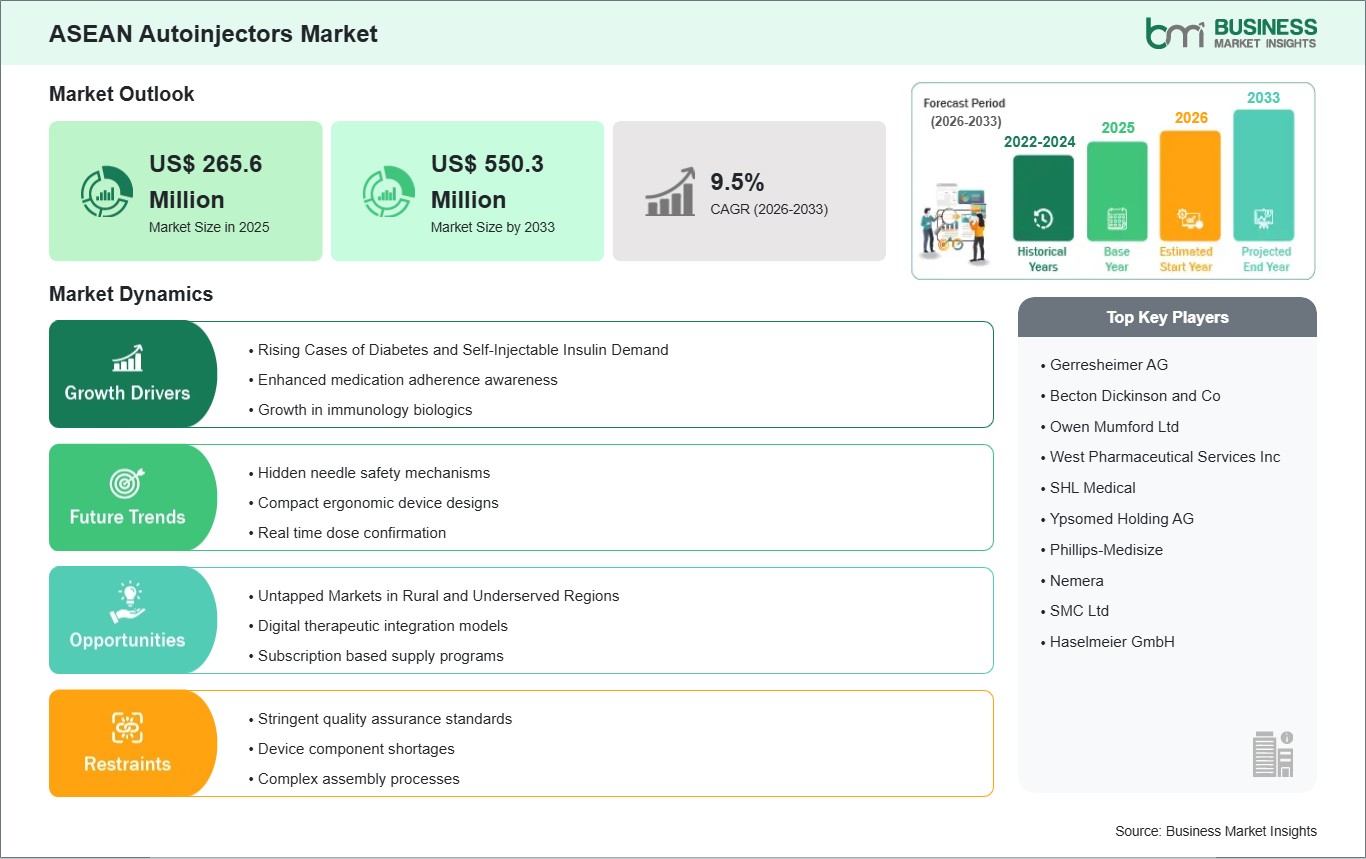
The ASEAN autoinjectors market is undergoing a structural transformation driven by the increasing prevalence of chronic diseases such as diabetes, rheumatoid arthritis, multiple sclerosis, and severe allergies. Healthcare systems in countries such as Singapore, Malaysia, Thailand, Indonesia, and Vietnam are progressively shifting toward patient-centric drug delivery models, fostering demand for self-administration devices. Autoinjectors are increasingly favored for biologics and specialty therapeutics due to their precision dosing, reduced needle anxiety, and improved adherence outcomes. From a competitive standpoint, the market is characterized by a blend of multinational device manufacturers and regional pharmaceutical firms seeking to expand biologics portfolios. Strategic alliances between drug developers and device engineering companies are accelerating the commercialization of combination products. Regulatory harmonization efforts under ASEAN medical device directives are gradually improving cross-border trade efficiencies, although localized approval pathways still require tailored market entry strategies. Technological innovation remains a defining feature, with emphasis on ergonomic design, safety-lock mechanisms, dual-chamber systems, and connectivity-enabled smart injectors. Distribution dynamics are evolving, with hospital procurement and specialty clinics maintaining dominance, while retail pharmacies and e-commerce channels are emerging as complementary avenues in urban centers. Pricing sensitivity across developing ASEAN economies presents margin management challenges; however, rising private healthcare expenditure and insurance penetration are offsetting cost pressures.
Segment Analysis
ASEAN Autoinjectors Market Segmentation
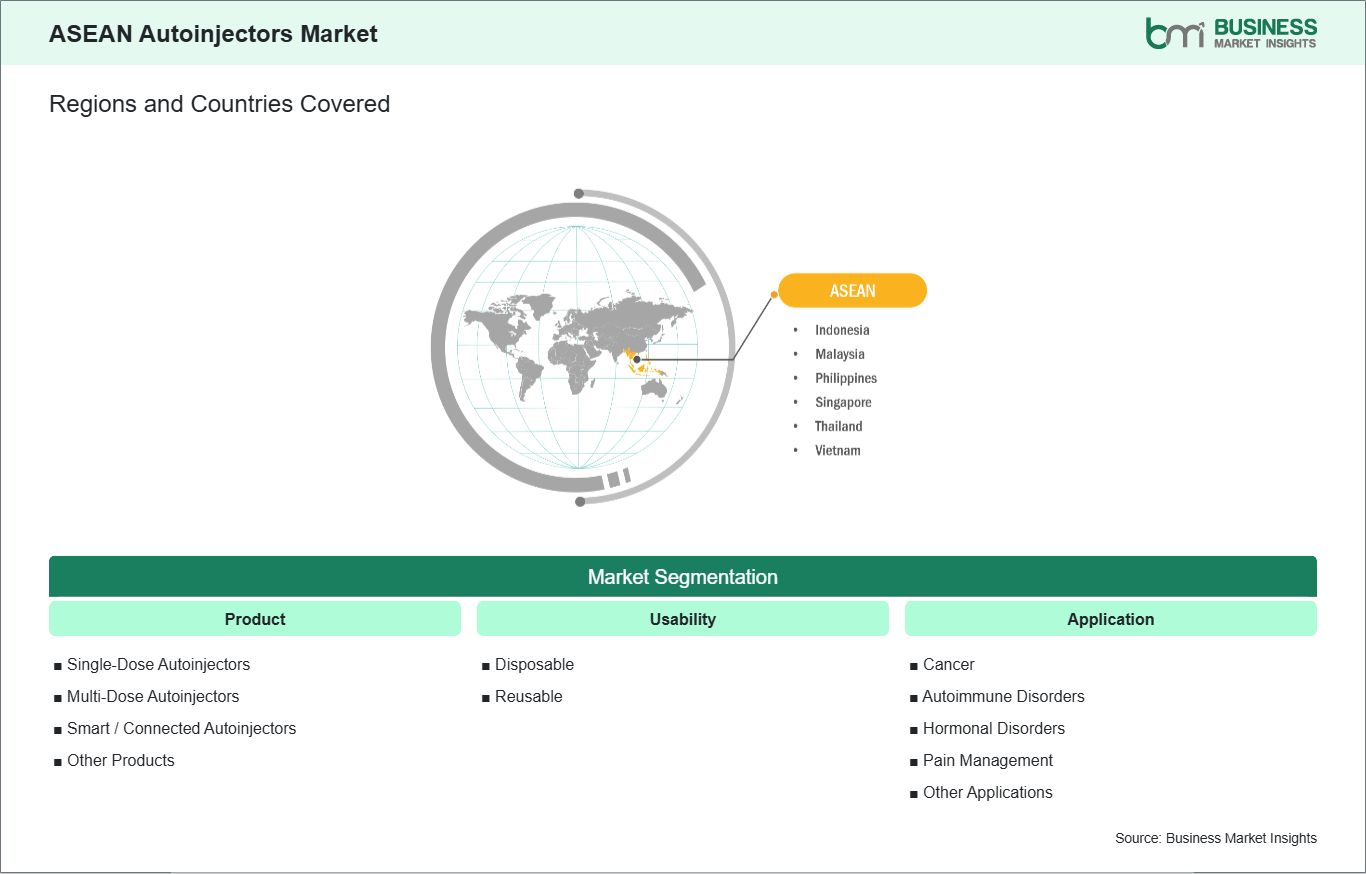
Key segments that contributed to the derivation of the ASEAN autoinjectors market analysis are product, usability, and application.
- By product, the autoinjectors market is segmented into single-dose autoinjectors, multi-dose autoinjectors, smart/connected autoinjectors, and others. The single-dose autoinjectors segment dominated the market in 2025.
- Based on usability, the autoinjectors market is categorized into disposable and reusable. The disposable segment dominated the market in 2025.
- In terms of application, the market is classified into cancer, autoimmune disorders, hormonal disorders, pain management, and other applications. The autoimmune disorders segment dominated the market in 2025.
Market Forces
ASEAN Autoinjectors Market Drivers and Opportunities
Rising Cases of Diabetes and Self-Injectable Insulin Demand
Across ASEAN, increasing prevalence of diabetes is reshaping demand for self‑injectable insulin devices. Rapid urbanization and lifestyle changes in metropolitan healthcare catchments have driven a consistent rise in diagnosed type‑2 diabetes cases. As more patients transition from oral therapy to injectable regimens, autoinjectors are becoming a preferred delivery method due to ease of use and improved adherence in chronic care settings. Secondary and tertiary care networks in major healthcare hubs are reporting greater volumes of insulin initiation in outpatient clinics. Clinics that traditionally relied on syringe‑and‑vial delivery are adopting autoinjectors to support patient self‑management, especially among working adults in high‑density population zones. This shift is reinforced by physician recommendations favoring devices that minimize dosing errors and improve quality of life for people living with diabetes. Healthcare practitioners across the region’s integrated care networks are also noting that self‑injectable insulin demand is outpacing other injectable therapies as screening programs identify more high‑risk individuals earlier. Pharmacies in urban corridors now list autoinjector devices among top prescribed chronic care items, reflecting broader acceptance among both patients and clinicians. This dynamic is strengthening the baseline market for autoinjectors as a core component of diabetes management portfolios.
Untapped Markets in Rural and Underserved Regions
Despite strong urban uptake, significant portions of the ASEAN population live in rural and semi‑urban areas where access to chronic disease management tools remains limited. In these underserved regions, primary health posts and district clinics often lack both supply chains and trained staff to support self‑injectable therapies at scale. As a result, autoinjector penetration in these regions lags behind metropolitan centers. Transport and logistics barriers in interior provinces mean that consistent inventory of autoinjectors at community clinics is sporadic, leading many patients to travel long distances for insulin care. This creates a latent demand that could be unlocked by regional distribution partnerships, mobile health programs, and targeted subsidy schemes that bring devices closer to point‑of‑care in these areas. Public health initiatives aimed at expanding chronic disease services beyond urban centers are slowly addressing these gaps. Training community health workers to support self‑injectable insulin initiation and maintenance in rural clinics is an approach gaining traction. When combined with affordability programs and local awareness campaigns, these efforts are expected to drive adoption of autoinjector technologies in previously underserved ASEAN regions.
Size and Share Analysis
ASEAN Autoinjectors Market Size and Share Analysis
The ASEAN Autoinjectors Market demonstrates steady growth, with size and share analysis highlighting evolving trends and competitive dynamics among key players. The report examines subsegments categorized within product, usability, and application, offering insights into their contribution to overall market performance.
By product, the single-dose autoinjectors subsegment dominated the market in 2025, driven by strong patient preference for simple, ready-to-use injections that reduce dosing errors and support self-administration.
Based on usability, the disposable subsegment dominated the market in 2025, driven by demand for safe, low-cost, prefilled devices that eliminate the need for maintenance or reuse.
In terms of application, the autoimmune disorders subsegment dominated the market in 2025, driven by increasing prevalence of chronic immune-mediated conditions that require frequent biologic therapies suited to autoinjector delivery.
Report Coverage
ASEAN Autoinjectors Market Report Coverage and Deliverables
The "ASEAN Autoinjectors Market Size and Forecast (2022–2033)" report provides a detailed analysis of the market covering below areas:
- ASEAN Autoinjectors Market size and forecast at regional and country levels for all market segments covered under the scope
- ASEAN Autoinjectors Market trends, as well as drivers, restraints, and opportunities
- ASEAN Autoinjectors Market analysis covering key trends, regional framework, major players, regulations, and recent developments
- Industry landscape and competition analysis covering market concentration, heat map analysis, prominent players, and recent developments for the ASEAN Autoinjectors Market
- Detailed company profiles, including SWOT analysis
Geographic Insights
ASEAN Autoinjectors Market Geographic Insights
The geographical scope of the ASEAN Autoinjectors Market report is divided into Indonesia, Malaysia, the Philippines, Singapore, Thailand, and Vietnam. Indonesia held the largest share in 2025.
Country-level dynamics within the ASEAN autoinjectors market reveal distinct maturity gradients and investment priorities. Indonesia represents a high-income, innovation-driven market characterized by strong regulatory oversight, advanced hospital networks, and rapid adoption of specialty biologics. The country serves as a regional hub for clinical trials and product launches, often influencing broader Southeast Asian adoption trends. Malaysia demonstrates balanced growth supported by public healthcare expansion and rising private sector participation. Increasing diabetes prevalence and government-led non-communicable disease strategies are encouraging the integration of user-friendly injection technologies. In Thailand, universal healthcare coverage and a robust pharmaceutical manufacturing base provide a conducive environment for localized assembly and distribution partnerships. Singapore presents substantial volume potential but remains constrained by uneven healthcare access. Market penetration strategies here emphasize affordability, physician engagement, and tiered distribution networks. Meanwhile, Vietnam is experiencing regulatory modernization and foreign direct investment inflows in healthcare infrastructure, enhancing prospects for device imports and joint ventures. The Philippines reflects growing private hospital expansion and insurance reforms, contributing to gradual uptake of specialty drug delivery devices. Collectively, these country-specific nuances underscore the importance of differentiated go-to-market models, localized pricing frameworks, and adaptive regulatory strategies to optimize competitive positioning within the ASEAN autoinjectors landscape.
Industry Activity
Recent Developments
The ASEAN Autoinjectors Market is evaluated by gathering qualitative and quantitative data post primary and secondary research, which includes important corporate publications, association data, and databases. A few of the key developments in the ASEAN autoinjectors market are:
- In March 2025, Hyphens Pharma secured exclusive rights to register and commercialize the Metoject subcutaneous autoinjector pen in Singapore, Malaysia, the Philippines, and Vietnam, marking a significant product expansion for rheumatoid arthritis and plaque psoriasis treatment in these ASEAN markets. The autoinjector delivers methotrexate, offering a safer and more convenient self-injection option compared to oral methotrexate. This launch broadens access to biologic therapies in Southeast Asia and supports regional healthcare providers with a ready-to-use device. The development reflects growing emphasis on patient-centric delivery systems across ASEAN.
- In August 2025, the Health Sciences Authority (HSA) of Singapore approved Amgevita in a prefilled autoinjector formulation for rheumatoid arthritis, expanding access to a biosimilar anti‑TNF drug that patients can self‑ This approval supports broader regional adoption of self‑injectable biologic therapies beyond hospital settings. It reflects Singapore’s ongoing efforts to facilitate availability of advanced autoinjector products in the ASEAN market. The product approval marks another step in strengthening biologic delivery options for chronic inflammatory disorders across Southeast Asia.
Trust & Transparency
Research Methodology
The market analysis combines proprietary research with secondary data from government agencies, company disclosures, regulatory filings, industry databases and expert interviews. Market estimates are validated through data triangulation, cross-market benchmarking and analyst
review.
View Full Research Methodology
Key Sources Referred:
World Health Organization (WHO) Organisation for Economic Cooperation and Development (OECD) The World Bank Group Worldometer The Lancet International Bar Association International Trade Administration