Market Summary
Executive Summary and Market Analysis
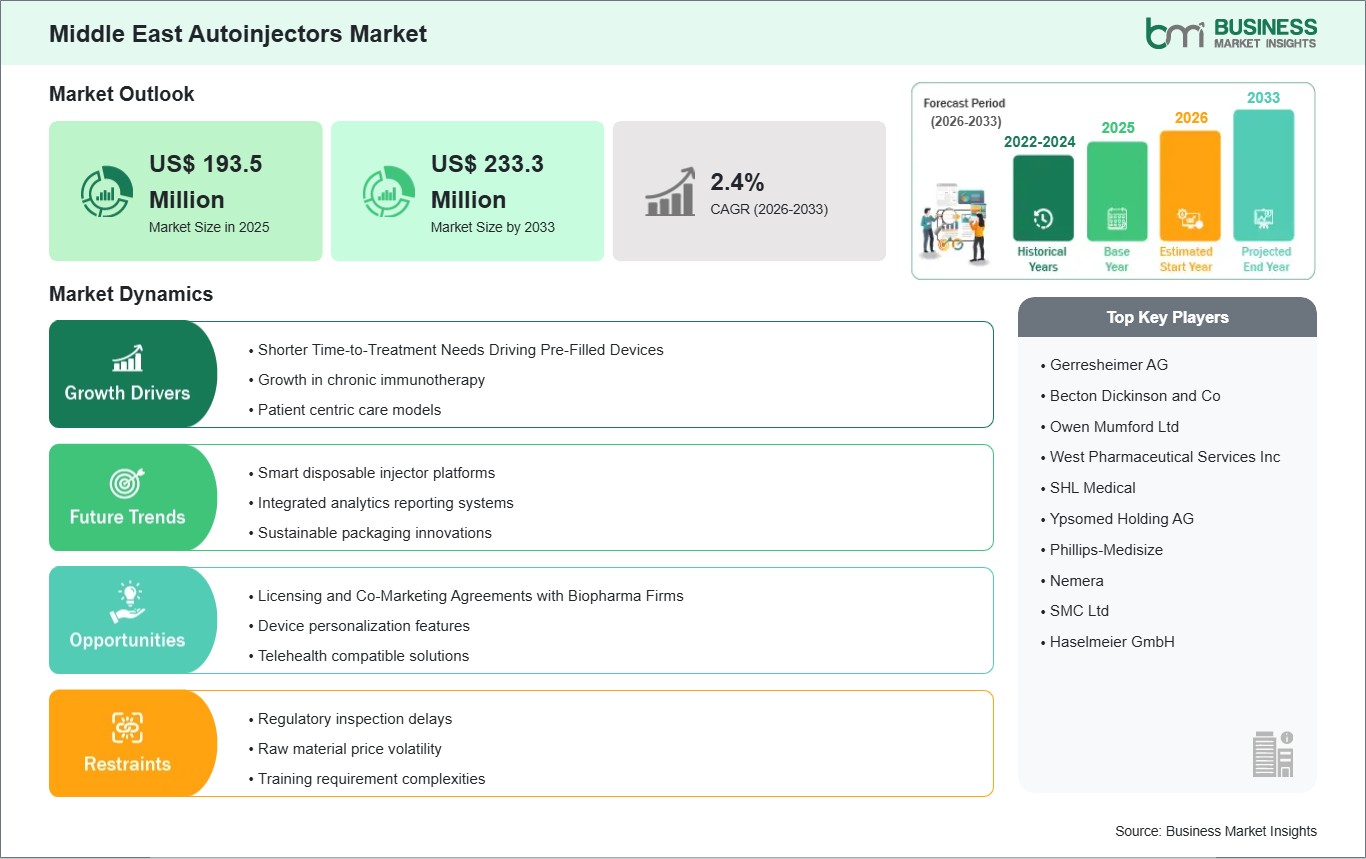
The Middle East autoinjectors market is experiencing steady growth, driven by increasing prevalence of chronic diseases, rising incidence of severe allergies, and expanding adoption of biologics across key countries including Saudi Arabia, United Arab Emirates, Kuwait, Qatar, Bahrain, and Oman. Self-administration of injectables is increasingly preferred due to patient convenience, reduced hospital dependency, and improved adherence to long-term treatment regimens. Urban populations, particularly in Saudi Arabia and UAE, are leading adoption, driven by access to specialized clinics, advanced hospital networks, and robust healthcare reimbursement programs. The competitive landscape is dominated by global medical device manufacturers, although regional pharmaceutical companies are entering the market through strategic collaborations, co-development, and licensing agreements. Differentiation is primarily achieved through technological innovation, such as ergonomically designed autoinjectors, dual-chamber systems, prefilled formulations, and emerging digital features that allow dose tracking and remote adherence monitoring. Regulatory environments are evolving in alignment with GCC Health Regulations, requiring local approvals, clinical validation, and compliance with device safety standards. Distribution channels in the Middle East are transitioning from a hospital-centric approach to hybrid models, incorporating retail pharmacies, specialty clinics, and increasingly, e-commerce platforms. Government-backed awareness campaigns and patient training initiatives are enhancing the adoption of autoinjectors across pediatric and geriatric populations. Public-private partnerships and insurance coverage for chronic disease therapies are further accelerating market penetration. The Middle East autoinjectors market demonstrates a blend of high adoption potential, technological innovation, and growing patient awareness, positioning the region as a strategic growth area for manufacturers seeking long-term market opportunities.
Segment Analysis
Middle East Autoinjectors Market Segmentation
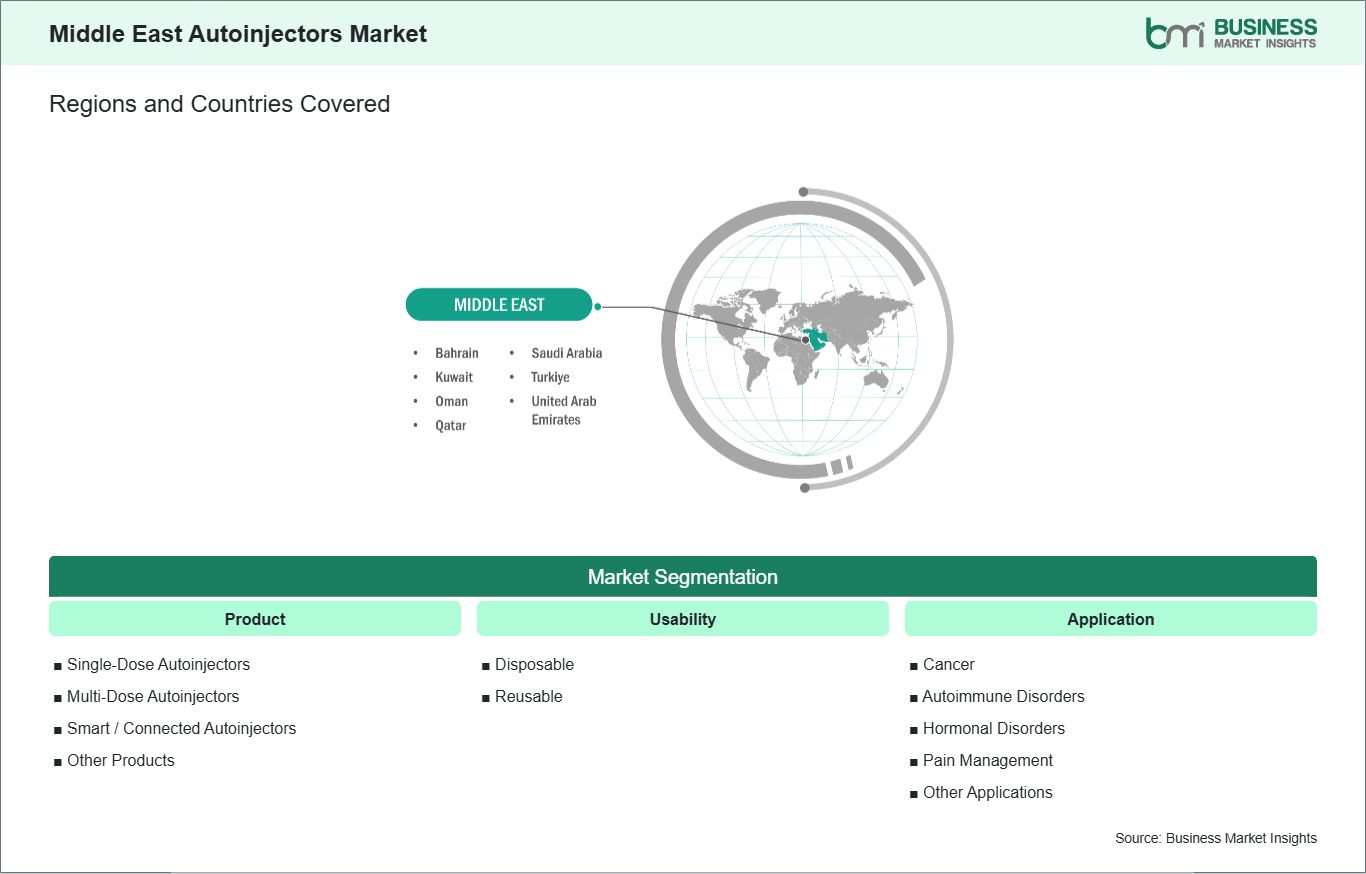
Key segments that contributed to the derivation of the Middle East autoinjectors market analysis are product, usability, and application.
- By product, the autoinjectors market is segmented into single-dose autoinjectors, multi-dose autoinjectors, smart / connected autoinjectors, and others. The single-dose autoinjectors segment dominated the market in 2025.
- Based on usability, the autoinjectors market is categorized into disposable and reusable. The disposable segment dominated the market in 2025.
- In terms of application, the market is classified into cancer, autoimmune disorders, hormonal disorders, pain management, and other applications. The autoimmune disorders segment dominated the market in 2025.
Market Forces
Middle East Autoinjectors Market Drivers and Opportunities
Shorter Time-to-Treatment Needs Driving Pre-Filled Devices
In the Middle East, rising demand for rapid access to therapy is intensifying the shift toward pre‑filled autoinjector devices. Healthcare systems in major urban centers — particularly in Riyadh, Jeddah, Abu Dhabi, and Doha are prioritizing strategies that reduce the time between diagnosis and treatment initiation. Hospitals and specialist clinics managing chronic conditions such as autoimmune diseases, multiple sclerosis, and diabetes report that pre‑filled autoinjectors significantly streamline the patient journey. Patients no longer need to schedule multiple follow‑up visits for instruction on syringe preparation, which accelerates therapy start and reduces outpatient congestion a key consideration in high‑volume specialty practices. Public health initiatives in the region are reinforcing the preference for pre‑filled delivery formats by emphasizing early intervention programs for populations at risk of treatment delays. For example, national diabetes screening campaigns in the Gulf Cooperation Council (GCC) countries are identifying more candidates for injectable therapies at earlier stages of disease progression. Clinicians note that when patients are presented with easily administered, pre‑filled solutions, initiation rates for self‑injectables climb compared with vial‑and‑syringe options. This trend is particularly visible in endocrinology centers in Dubai and Al‑Kuwait City, where reduced preparation time from a pre‑filled autoinjector enhances patient confidence and adherence. Moreover, emergency care protocols in regional hospitals are adapting to emphasize devices that expedite therapeutic delivery, especially in acute allergic reactions and anaphylaxis management. Pre‑filled epinephrine autoinjectors are being stocked more widely in primary care clinics, urgent care units, and school health facilities throughout the Middle East. Institutional procurement teams increasingly prefer pre‑filled formats because they eliminate the need for on‑site compounding, reduce risk of dosing errors, and ensure near‑immediate administration during critical events. As healthcare providers continue to align device selection with broader goals of shortening time to treatment and improving clinical outcomes, pre‑filled autoinjectors are positioned to see sustained demand growth across the region.
Licensing and Co-Marketing Agreements with Biopharma Firms
The Middle East autoinjectors market is also being shaped by strategic licensing and co‑marketing agreements between device manufacturers and biopharmaceutical companies. Global biopharma firms looking to expand their portfolios in GCC and broader Middle Eastern markets are increasingly partnering with regional device specialists to co‑brand autoinjector solutions that complement their injectable therapeutics. These alliances allow biopharma firms to extend their commercial reach for biologics and specialty drugs while leveraging established distribution channels for advanced autoinjector systems. In Saudi Arabia and the UAE, early examples of such collaborations are emerging in autoimmune and oncology segments. Biopharma companies with self‑injectable therapies are entering agreements that bundle their biologic products with compatible pre‑filled autoinjectors, thus offering an integrated therapy delivery solution. This co‑marketing approach enhances physician confidence in prescribing self‑administration formats and supports unified messaging in chronic disease management programs. As health authorities in the region emphasize adherence and patient convenience, co‑branded offerings create a competitive differentiation that resonates with both clinicians and patients. Additionally, licensing agreements that enable local assembly or regional customization of autoinjector devices are gaining traction. Middle Eastern distributors and biopharma affiliates in Doha and Manama are negotiating rights to adapt global device designs to meet local regulatory requirements and patient preferences, such as language‑specific labeling and enhanced ergonomic features suited to the region’s demographic mix. These licenses not only accelerate market entry but also foster deeper collaborations between international innovators and domestic healthcare stakeholders. By aligning device strategy with biopharma product launches and regional health priorities, these agreements are creating synergistic pathways for market growth and broader autoinjector adoption across the Middle East.
Size and Share Analysis
Middle East Autoinjectors Market Size and Share Analysis
The Middle East Autoinjectors Market demonstrates steady growth, with size and share analysis highlighting evolving trends and competitive dynamics among key players. The report examines subsegments categorized within product, usability, and application, offering insights into their contribution to overall market performance.
By product, the single-dose autoinjectors subsegment dominated the market in 2025, driven by their ease of use and suitability for home-based self-administration in chronic and emergency treatments.
Based on usability, the disposable subsegment dominated the market in 2025, driven by growing preference for hygienic, low-maintenance devices that eliminate the need for cleaning or reuse.
In terms of application, the autoimmune disorders subsegment dominated the market in 2025, driven by the rising prevalence of conditions like rheumatoid arthritis and multiple sclerosis, which require frequent self-administered biologic therapies.
Report Coverage
Middle East Autoinjectors Market Report Coverage and Deliverables
The "Middle East Autoinjectors Market Size and Forecast (2022–2033)" report provides a detailed analysis of the market covering below areas:
- Middle East Autoinjectors Market size and forecast at regional and country levels for all market segments covered under the scope
- Middle East Autoinjectors Market trends, as well as drivers, restraints, and opportunities
- Middle East Autoinjectors Market analysis covering key trends, regional framework, major players, regulations, and recent developments
- Industry landscape and competition analysis covering market concentration, heat map analysis, prominent players, and recent developments for the Middle East Autoinjectors Market
- Detailed company profiles, including SWOT analysis
Geographic Insights
Middle East Autoinjectors Market Geographic Insights
The geographical scope of the Middle East Autoinjectors Market report is divided into Egypt, South Middle East, Nigeria, and Algeria. Nigeria held the largest share in 2025.
Country-specific insights for the Middle East and Africa (MEA) autoinjectors market highlight varied adoption dynamics across key markets, with Nigeria emerging as the dominant player in the region. Nigeria’s large population, rising prevalence of chronic diseases such as diabetes, autoimmune disorders, and severe allergies, and increasing awareness of self-administration therapies position it as the central driver of market growth. Urban centers including Lagos, Abuja, and Port Harcourt demonstrate high adoption of autoinjectors for biologics, insulin, and emergency therapies. Government initiatives to improve healthcare access, support for local manufacturing, and expanding private hospital networks further enhance market penetration. Egypt reflects a cost-sensitive environment where urban adoption is stronger than rural uptake. Distribution strategies rely on localized retail pharmacies, hospital networks, and patient education campaigns to improve awareness of self-administration therapies. Affordability-focused autoinjectors and simplified device designs are increasingly preferred in this market, aligning with government efforts to broaden healthcare access. The South Middle East, encompassing countries such as Saudi Arabia, UAE, Kuwait, and Qatar, demonstrates high adoption in urban centers due to advanced hospital infrastructure, insurance coverage, and patient education initiatives. Digital health integration is supporting connected autoinjectors with dose tracking, adherence monitoring, and telemedicine-enabled support, particularly in technologically advanced areas such as Dubai and Abu Dhabi. Algeria presents an emerging market where adoption is gradually increasing through specialty clinics and urban pharmacies. Price sensitivity and limited insurance coverage in rural areas create challenges, necessitating targeted awareness campaigns, cost-effective device solutions, and strategic partnerships with local distributors to increase accessibility. Collectively, these country-specific dynamics indicate that Nigeria leads the MEA autoinjectors market in volume and strategic influence. Meanwhile, Egypt, South Middle East countries, and Algeria present differentiated opportunities through urban-focused adoption, digital integration, and affordability-driven strategies. Manufacturers seeking long-term growth in the region must leverage tailored commercialization approaches, incorporating premium product positioning, patient education programs, and adaptive pricing frameworks to maximize adoption across diverse healthcare landscapes.
Industry Activity
Recent Developments
The Middle East Autoinjectors Market is evaluated by gathering qualitative and quantitative data post primary and secondary research, which includes important corporate publications, association data, and databases. A few of the key developments in the Middle East autoinjectors market are:
- In December 2025, Enable Injections announced that the EMPAVELI® Injector, based on the enFuse on‑body delivery technology, received regulatory approval from the Saudi Food and Drug Authority (SFDA) under the Medical Device Marketing Authorization framework, allowing the device to be legally sold and distributed in the Kingdom. This wearable autoinjector is designed to support subcutaneous delivery of pegcetacoplan (EMPAVELI/Aspaveli), enhancing patient self‑administration convenience. The regulatory milestone marks a significant expansion of the company’s global footprint in the Middle East medical device market. Approval also complements prior global clearances including the U.S. FDA and CE Mark authorizations.
- In January 2025, AbbVie formed a strategic alliance with a Dubai‑based healthcare logistics provider to improve distribution efficiency for its Humira autoinjector products across Gulf Cooperation Council (GCC) countries. This collaboration aims to streamline supply chain operations and ensure wider, more reliable access to the established biologic autoinjector therapy for autoimmune conditions. The initiative supports enhanced regional availability of self‑administered biologic treatments. This broad distribution strategy aligns with growing regional demand for chronic disease management solutions.
Trust & Transparency
Research Methodology
The market analysis combines proprietary research with secondary data from government agencies, company disclosures, regulatory filings, industry databases and expert interviews. Market estimates are validated through data triangulation, cross-market benchmarking and analyst
review.
View Full Research Methodology
Key Sources Referred:
World Health Organization (WHO) Organisation for Economic Cooperation and Development (OECD) The World Bank Group Worldometer The Lancet International Bar Association International Trade Administration