Market Summary
Executive Summary and Market Analysis
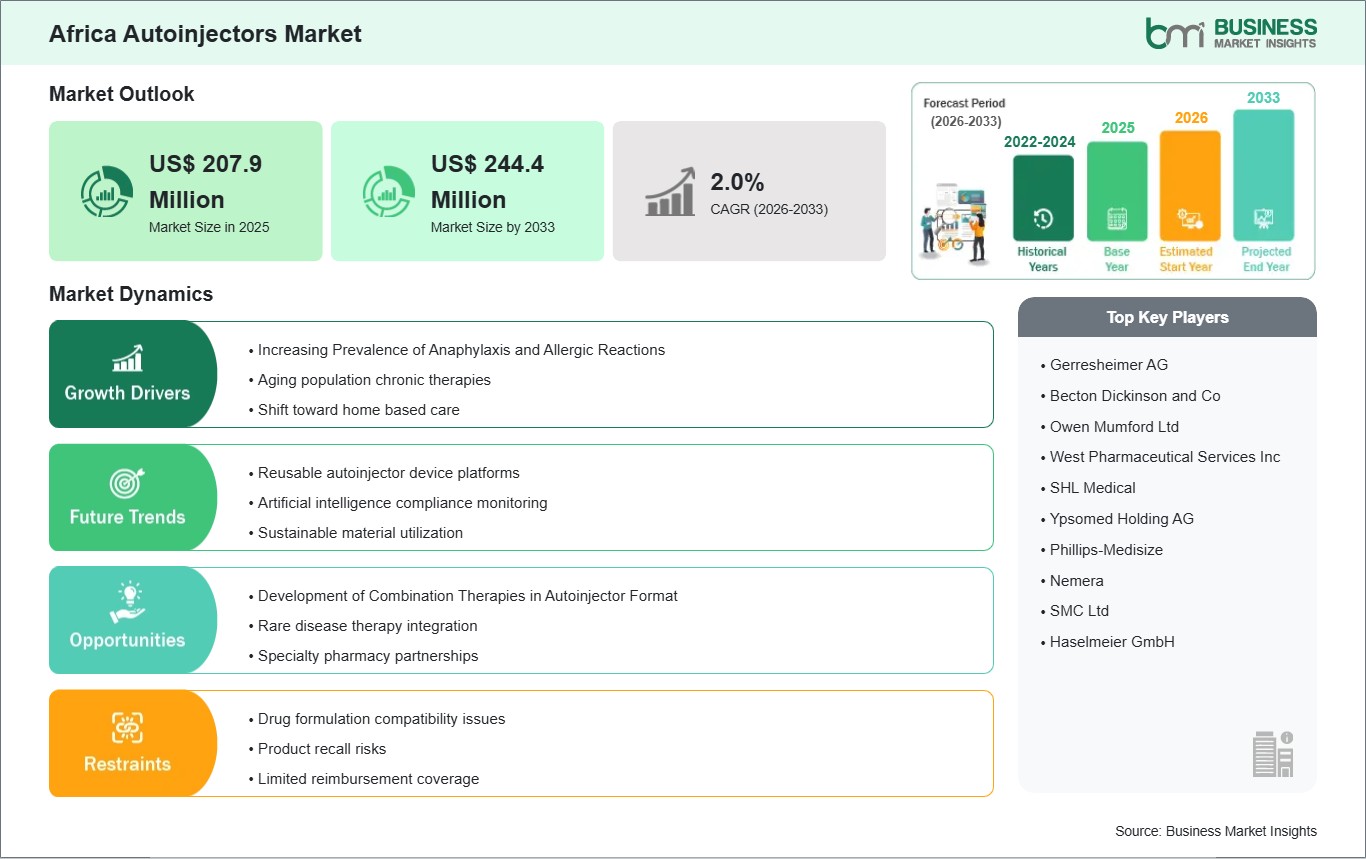
The Africa autoinjectors market is driven by shifts in chronic disease prevalence, healthcare delivery models, and patient empowerment initiatives. Although the region historically relied on traditional syringe‑based administration due to cost sensitivity and limited access to advanced devices, sustained improvements in healthcare infrastructure—particularly in urban centers—and rising incidence of autoimmune and allergic conditions have stimulated interest in autoinjector adoption. Manufacturers and healthcare stakeholders are prioritizing readily usable, prefilled autoinjector systems that minimize training needs and reduce dosing errors in both emergency and chronic care scenarios, such as anaphylaxis response and biologic therapy administration. The balance between disposable single‑use devices and reusable models highlights divergent provider priorities: disposables emphasize sterility and rapid deployment in institutional settings, while reusable options appeal to cost-conscious clinics and long‑term therapy programs that seek to reduce waste and per‑dose costs over time. Distribution and supply chain dynamics are redefining competitive positioning, with global OEMs expanding partnerships with regional distributors and healthcare providers to broaden product availability and support services. Regulatory engagement across African nations remains variable, prompting manufacturers to adapt submission strategies and invest in localized compliance expertise. Patient education and training are recognized industry frontiers; without adequate guidance on self‑administration and injection technique, device adoption and therapeutic adherence can lag. In response, several suppliers are integrating digital learning tools and clinician support networks to strengthen user confidence and ensure correct device usage. Operational constraints—such as limited specialist healthcare personnel in rural areas and ongoing logistical challenges in remote distribution—continue to temper rapid penetration, yet targeted investments and strategic alliances signal sustained momentum toward embedding autoinjectors into Africa's evolving healthcare delivery system.
Segment Analysis
Africa Autoinjectors Market Segmentation
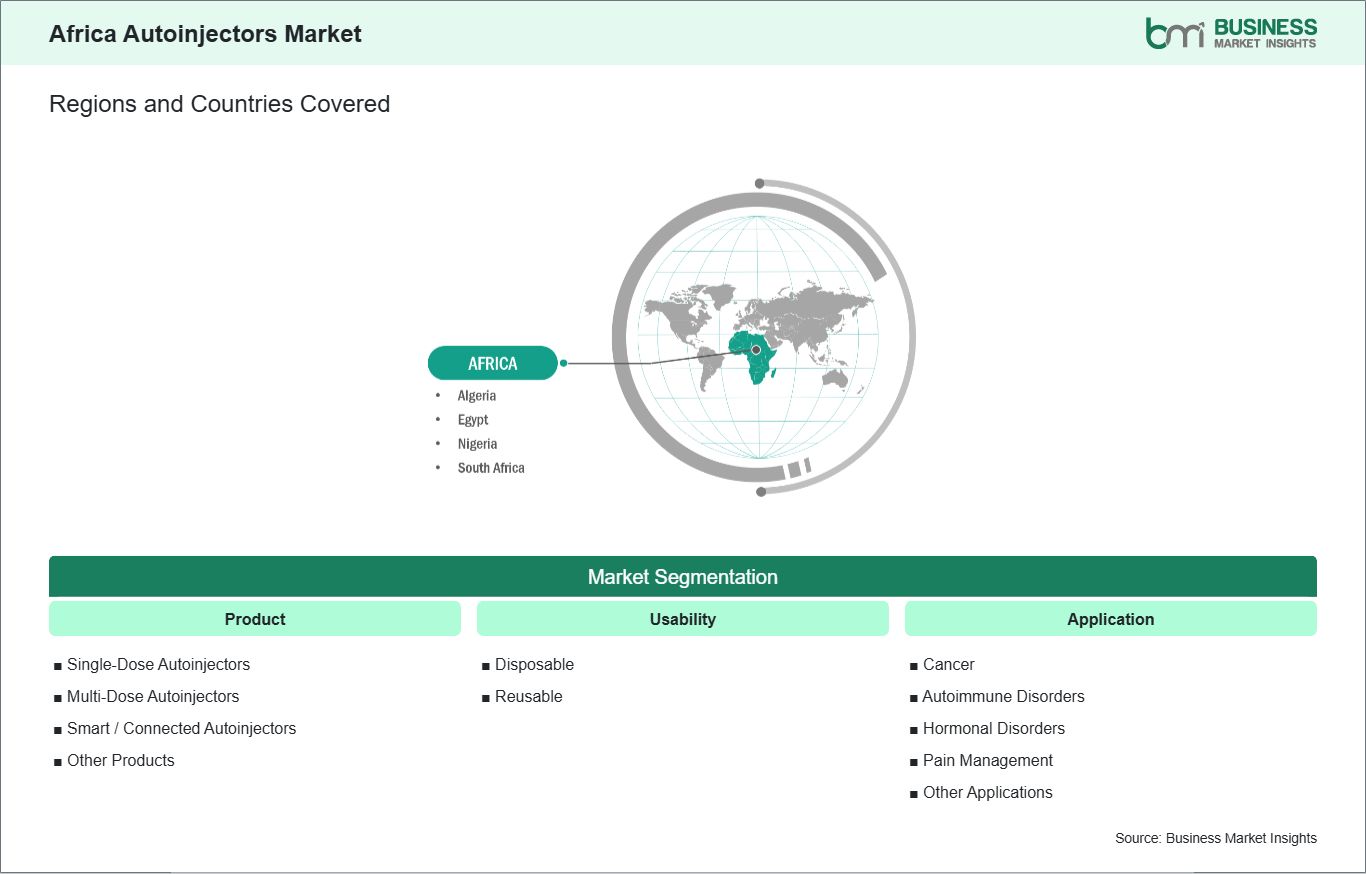
Key segments that contributed to the derivation of the Africa autoinjectors market analysis are product, usability, and application.
- By product, the autoinjectors market is segmented into single-dose autoinjectors, multi-dose autoinjectors, smart/connected autoinjectors, and others. The single-dose autoinjectors segment dominated the market in 2025.
- Based on usability, the autoinjectors market is categorized into disposable and reusable. The disposable segment dominated the market in 2025.
- In terms of application, the market is classified into cancer, autoimmune disorders, hormonal disorders, pain management, and other applications. The autoimmune disorders segment dominated the market in 2025.
Market Forces
Africa Autoinjectors Market Drivers and Opportunities
Increasing Prevalence of Anaphylaxis and Allergic Reactions
Autoinjectors provide a critical solution for the rapid administration of medication in emergencies, ensuring that patients can manage life-threatening situations effectively without waiting for professional assistance. Their ease of use, portability, and reliability make them a preferred choice for both patients and healthcare providers in the region. Healthcare professionals are increasingly emphasizing the importance of emergency preparedness for individuals at risk of anaphylaxis. As awareness of allergic reactions grows, patients are seeking self-administered solutions that allow for immediate intervention. Autoinjectors are particularly valuable in regions where access to emergency medical services may be limited, providing a practical and efficient method to manage sudden allergic events. The adoption of autoinjectors is further supported by initiatives from healthcare organizations that focus on improving patient safety and accessibility. Emphasis on patient education regarding proper usage has enhanced confidence and trust in these devices. The combination of simplicity, effectiveness, and portability positions autoinjectors as a key tool in modern allergy management. As awareness continues to expand and the demand for patient-centric care rises, the autoinjectors market in Africa is poised to grow steadily.
Development of Combination Therapies in Autoinjector Format
The development of combination therapies in autoinjector format is shaping the evolution of the self-injection device market in Africa. These devices integrate multiple therapeutic components into a single delivery system, simplifying administration and improving patient convenience. By reducing the complexity of treatment, combination autoinjectors enhance adherence and reduce the risk of dosing errors, particularly in chronic disease management. Healthcare providers are increasingly recognizing the value of these devices for improving patient outcomes. Combination autoinjectors offer consistent dosing and streamlined administration, making them particularly beneficial in regions with limited access to frequent clinical support. Patients are empowered to manage their treatment regimens independently, reducing the burden on healthcare facilities while maintaining therapeutic efficacy. In addition, manufacturers are focusing on user-friendly design, incorporating features such as intuitive operation and ergonomic form factors. These developments are aimed at increasing patient comfort and encouraging broader adoption across diverse healthcare settings. By integrating multiple therapies into a single autoinjector, the devices improve treatment convenience and align with the growing emphasis on patient-centric healthcare solutions.
Size and Share Analysis
Africa Autoinjectors Market Size and Share Analysis
The Africa Autoinjectors Market demonstrates steady growth, with size and share analysis highlighting evolving trends and competitive dynamics among key players. The report examines subsegments categorized within product, usability, and application, offering insights into their contribution to overall market performance.
By product, the single-dose autoinjectors subsegment dominated the market in 2025, driven by the strong preference for ready‑to‑use, prefilled devices that simplify self‑administration and reduce dosing errors in emergency and chronic care settings across the region.
Based on usability, the disposable subsegment dominated the market in 2025, driven by widespread adoption of single‑use autoinjectors due to their convenience, sterility assurance, and minimal risk of cross‑contamination, especially for emergency and self‑care use.
In terms of application, the autoimmune disorders subsegment dominated the market in 2025, driven by the rising prevalence of autoimmune conditions (such as rheumatoid arthritis and multiple sclerosis) that require frequent self‑injections of biologic therapies, boosting demand for autoinjector devices.
Report Coverage
Africa Autoinjectors Market Report Coverage and Deliverables
The "Africa Autoinjectors Market Size and Forecast (2022–2033)" report provides a detailed analysis of the market covering below areas:
- Africa Autoinjectors Market size and forecast at regional and country levels for all market segments covered under the scope
- Africa Autoinjectors Market trends, as well as drivers, restraints, and opportunities
- Africa Autoinjectors Market analysis covering key trends, regional framework, major players, regulations, and recent developments
- Industry landscape and competition analysis covering market concentration, heat map analysis, prominent players, and recent developments for the Africa Autoinjectors Market
- Detailed company profiles, including SWOT analysis
Geographic Insights
Africa Autoinjectors Market Geographic Insights
The geographical scope of the Africa Autoinjectors Market report is divided into Egypt, South Africa, Nigeria, and Algeria. Nigeria held the largest share in 2025.
Country‑level insights reveal heterogeneous adoption patterns and strategic priorities across Africa's diverse healthcare markets, shaped by disparities in infrastructure maturity, payer frameworks, disease burden, and government healthcare strategies. Nigeria stands out as a regional hub with comparatively advanced healthcare infrastructure, growing demand for minimally invasive drug delivery solutions, and progressive chronic disease management programs that have integrated autoinjectors into both hospital and community care settings. Public and private clinics increasingly leverage these devices for conditions such as rheumatoid arthritis and diabetes, supported by clinician training initiatives and collaborative programs with international suppliers. In Egypt, autoinjector adoption is steadily rising as government efforts to bolster outpatient care, expand access to biologics, and promote home‑based therapy options gain traction; partnerships between local distributors and global pharmaceutical firms are helping to introduce cost‑effective autoinjector products in urban and peri‑urban markets. South Africa exhibits a more nascent yet promising landscape driven by demographic growth, expanding urban healthcare facilities, and increasing disease awareness among younger populations; however, adoption is tempered by affordability barriers and variable insurance coverage, prompting stakeholders to explore tailored pricing and financing models to increase accessibility. Across East and West African countries, limited healthcare infrastructure and uneven distribution networks currently constrain penetration, but emerging regional initiatives focused on chronic disease surveillance and patient education are gradually laying the groundwork for more widespread autoinjector utilization. Collectively, country‑level dynamics emphasize the need for localized commercialization strategies that consider regulatory landscapes, healthcare funding models, and socio‑economic factors to maximize adoption and sustain growth across varied markets in Africa.
Industry Activity
Recent Developments
The Africa Autoinjectors Market is evaluated by gathering qualitative and quantitative data post primary and secondary research, which includes important corporate publications, association data, and databases. A few of the key developments in the Africa autoinjectors market are:
- In November 2025, SHL Medical expanded its autoinjector device portfolio, including the Molly modular platform and unveiling new devices at global industry events, showcasing support for large‑volume biologic delivery. These platform innovations strengthen the global autoinjector ecosystem, with wide use in biologics that may eventually be registered in markets including Africa.
- In November 2025, SHL Medical announced that it shipped over 1.5 billion autoinjector devices worldwide, highlighting broad global demand and extensive partnerships with pharma companies for combination products across therapeutic areas. This large‑scale expansion of autoinjector supply demonstrates capacity and infrastructure growth that could support future device availability across diverse regions, including African markets.
Trust & Transparency
Research Methodology
The market analysis combines proprietary research with secondary data from government agencies, company disclosures, regulatory filings, industry databases and expert interviews. Market estimates are validated through data triangulation, cross-market benchmarking and analyst
review.
View Full Research Methodology
Key Sources Referred:
World Health Organization (WHO) Organisation for Economic Cooperation and Development (OECD) The World Bank Group Worldometer The Lancet International Bar Association International Trade Administration