Market Summary
Executive Summary and Market Analysis
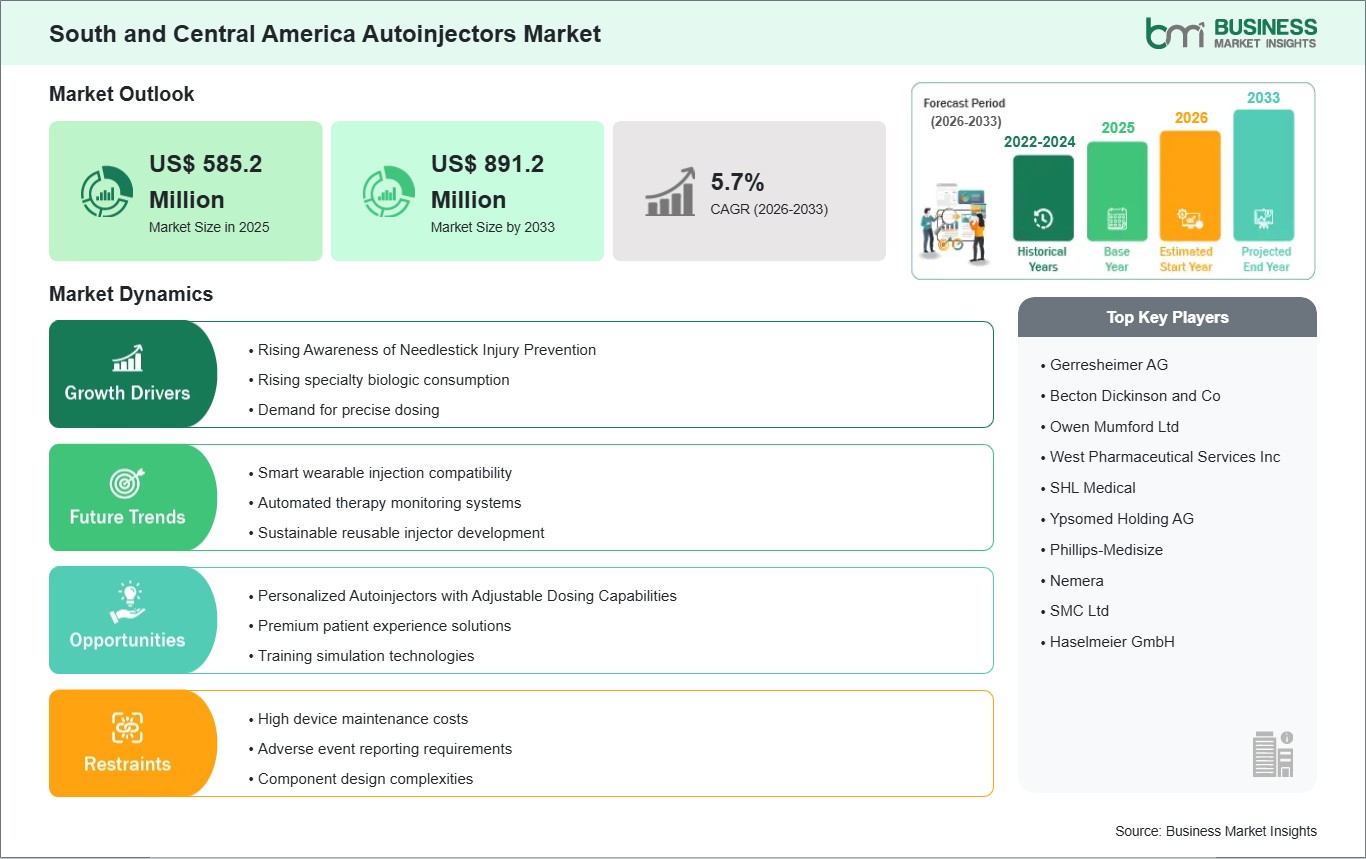
The South and Central America autoinjectors market is evolving steadily, supported by gradual modernization of healthcare systems and increasing penetration of specialty pharmaceuticals. Demand is primarily influenced by the rising incidence of chronic inflammatory diseases, metabolic disorders, and severe allergic reactions requiring rapid-response therapies. Healthcare providers across the region are placing greater emphasis on decentralized treatment models, encouraging the adoption of self-administered drug delivery solutions that reduce hospital dependency. Multinational pharmaceutical companies are expanding their regional footprint through distribution partnerships and localized packaging operations to enhance market responsiveness. Regulatory harmonization initiatives among regional trade blocs are contributing to streamlined product approvals, improving time-to-market for combination drug-device therapies. Private healthcare providers and urban hospital networks are early adopters of advanced autoinjector technologies, while public sector procurement remains price-sensitive and driven by essential medicines lists. Competitive dynamics are characterized by the presence of global manufacturers alongside regional distributors offering cost-optimized alternatives. Supply chain efficiency remains a strategic focus due to logistical complexities and import reliance in certain markets. Additionally, healthcare professional training programs and patient awareness campaigns are gradually strengthening confidence in self-injection devices. Overall, the market is transitioning from conventional syringe-based administration toward more sophisticated, safety-engineered delivery systems, reflecting broader healthcare transformation across South and Central America.
Segment Analysis
South and Central America Autoinjectors Market Segmentation
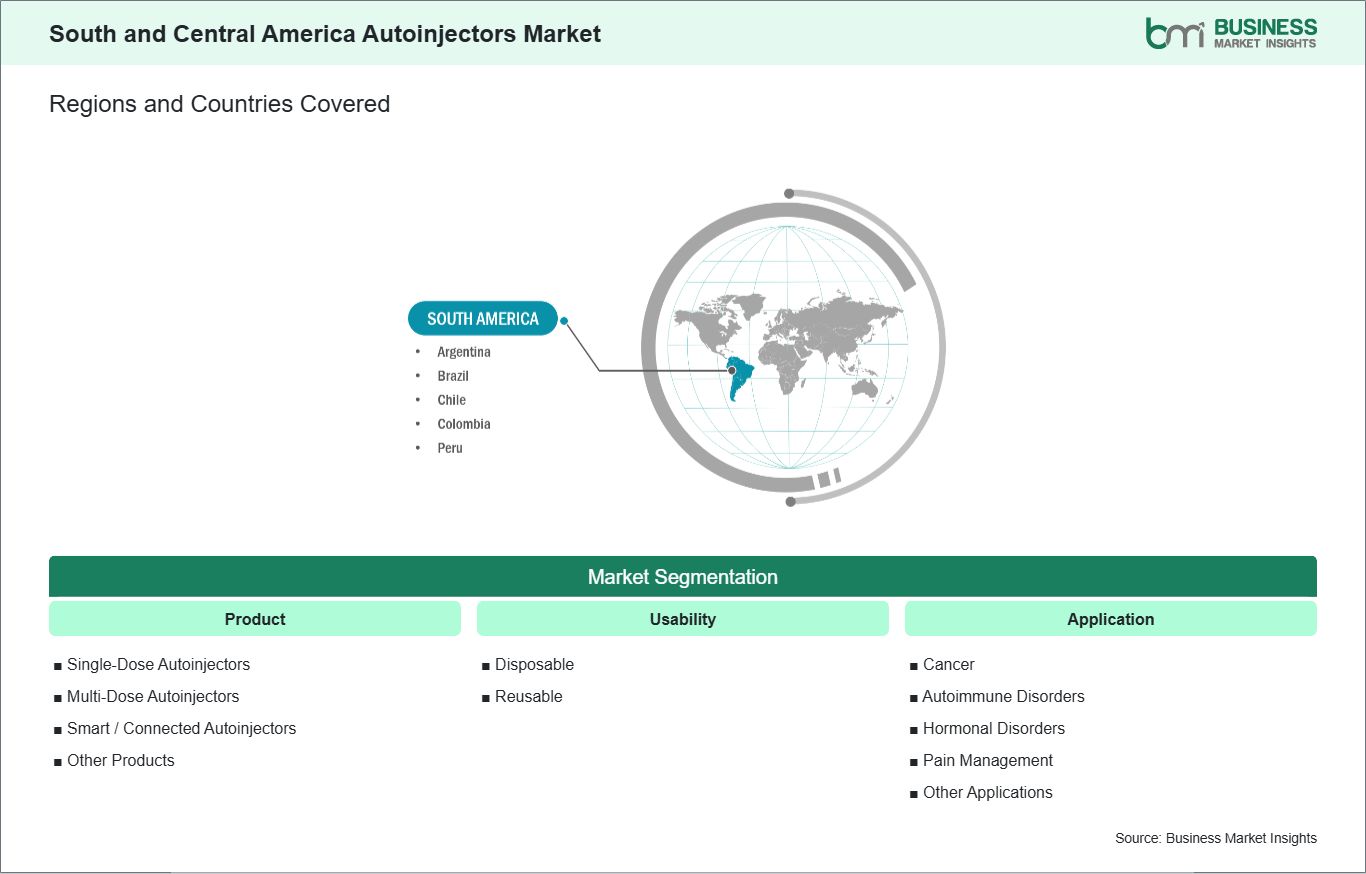
Key segments that contributed to the derivation of the South and Central America autoinjectors market analysis are product, usability, and application.
- By product, the autoinjectors market is segmented into single-dose autoinjectors, multi-dose autoinjectors, smart / connected autoinjectors, and others. The Single-Dose Autoinjectors segment dominated the market in 2025.
- Based on usability, the autoinjectors market is categorized into disposable and reusable. The disposable segment dominated the market in 2025.
- In terms of application, the market is classified into cancer, autoimmune disorders, hormonal disorders, pain management, and other applications. The autoimmune disorders segment dominated the market in 2025.
Market Forces
South and Central America Autoinjectors Market Drivers and Opportunities
Rising Awareness of Needlestick Injury Prevention
In South and Central America, increasing awareness of needlestick injury prevention is a key factor driving the adoption of autoinjectors. Healthcare systems across the region are gradually prioritizing devices that reduce occupational exposure to sharps, particularly in hospital and outpatient care settings. Safety-engineered autoinjectors with features such as retractable needles, automatic shielding, and single-use lockout mechanisms are gaining preference over traditional syringes. This trend is reinforced by regional health authorities promoting regulations and guidelines that encourage safer injection practices to minimize the risk of bloodborne pathogen transmission among healthcare workers and patients. Beyond hospitals, the rise of home-based care programs has highlighted the importance of safe self-administration. Patients managing chronic conditions increasingly use autoinjectors with protective mechanisms to avoid accidental needle injuries, which is especially relevant in areas where community health services support patient self-care. Awareness campaigns by regional healthcare organizations and professional associations are educating both providers and patients on the risks of sharps exposure, emphasizing the role of autoinjectors in enhancing safety for users of all ages and skill levels. In broader healthcare networks throughout the region, procurement decisions are increasingly influenced by safety considerations. Hospitals, clinics, and community health programs are integrating autoinjectors into treatment protocols for chronic disease management, recognizing that devices with built-in injury prevention not only protect staff but also improve patient confidence in self-injection therapies. The combined effect of regulatory guidance, professional training, and patient education is establishing needlestick injury prevention as a major growth driver in the autoinjectors market throughout South and Central America.
Personalized Autoinjectors with Adjustable Dosing Capabilities
The demand for personalized autoinjectors with adjustable dosing capabilities is gradually increasing across South and Central America, driven by the need for precise and flexible chronic therapy management. Patients managing long-term conditions benefit from devices that allow dose adjustments within prescribed ranges, supporting adherence and reducing the risk of dosing errors. Adjustable autoinjectors are being integrated into treatment programs where titration is required, enabling patients to administer therapies safely at home and reducing reliance on frequent clinical visits. Healthcare networks are beginning to adopt these devices as part of patient-centered care models. Features such as dose selectors, ergonomic designs, and user-friendly interfaces help patients self-manage complex therapies while maintaining therapeutic accuracy. Clinics and specialty care programs are recognizing that devices with adjustable dosing can improve outcomes for patients requiring variable therapy levels, particularly in chronic inflammatory and endocrine conditions. This trend aligns with regional priorities of improving treatment adherence and minimizing complications related to improper dosing. Across regional healthcare systems, partnerships with manufacturers are facilitating the introduction of adjustable dosing autoinjectors into urban and semi-urban healthcare facilities. Training programs for healthcare professionals and patient education initiatives are supporting safe adoption, ensuring that devices are used effectively and consistently. While overall penetration is still emerging due to cost considerations, the increasing focus on personalized therapy management is expected to drive steady growth in the autoinjectors market throughout South and Central America, highlighting the region’s gradual shift toward innovative, patient-centric injection solutions.
Size and Share Analysis
South and Central America Autoinjectors Market Size and Share Analysis
The South and Central America Autoinjectors Market demonstrates steady growth, with size and share analysis highlighting evolving trends and competitive dynamics among key players. The report examines subsegments categorized within product, usability, and application, offering insights into their contribution to overall market performance.
By product, the single-dose autoinjectors subsegment dominated the market in 2025, driven by the strong preference for easy‑to‑use, pre‑measured devices that improve safety and adherence in self‑administration settings, especially for chronic and long‑term therapies.
Based on usability, the disposable subsegment dominated the market in 2025, driven by the widespread adoption of single‑use devices that reduce contamination risk, eliminate maintenance needs, and support home‑based treatment models common in Latin American self‑injection markets.
In terms of application, the autoimmune disorders subsegment dominated the market in 2025, driven by the rising prevalence of autoimmune diseases in the region and the corresponding demand for biologic treatments that are conveniently and safely delivered via autoinjectors for chronic disease management.
Report Coverage
South and Central America Autoinjectors Market Report Coverage and Deliverables
The "South and Central America Autoinjectors Market Size and Forecast (2022–2033)" report provides a detailed analysis of the market covering below areas:
- South and Central America Autoinjectors Market size and forecast at regional and country levels for all market segments covered under the scope
- South and Central America Autoinjectors Market trends, as well as drivers, restraints, and opportunities
- South and Central America Autoinjectors Market analysis covering key trends, regional framework, major players, regulations, and recent developments
- Industry landscape and competition analysis covering market concentration, heat map analysis, prominent players, and recent developments for the South and Central America Autoinjectors Market
- Detailed company profiles, including SWOT analysis
Geographic Insights
South and Central America Autoinjectors Market Geographic Insights
The geographical scope of the South and Central America Autoinjectors Market report is divided into Brazil, Argentina, Peru, Chile, and Colombia. Brazil held the largest share in 2025.
Country-level analysis highlights varied adoption patterns across key markets such as Brazil, Argentina, Chile, and Colombia. Brazil represents the most structurally developed market in the region, supported by a mixed public-private healthcare system and domestic pharmaceutical manufacturing capabilities. Regulatory oversight by National Health Surveillance Agency has strengthened quality standards and facilitated approvals for complex drug-device combinations. Argentina demonstrates strong clinical expertise in immunology and oncology, although economic volatility influences procurement cycles and pricing negotiations. Chile’s comparatively stable regulatory and reimbursement environment encourages early adoption of specialty therapies within private healthcare networks. Colombia is witnessing growing private insurance penetration, enhancing access to innovative biologics and associated delivery devices. Across Central America, smaller economies rely heavily on imports and multinational distribution agreements, resulting in limited but gradually expanding availability of advanced autoinjector systems. Infrastructure disparities between urban and rural areas continue to shape utilization rates, with metropolitan centers driving most of the demand. Trade integration initiatives and regional logistics hubs are improving product flow efficiency, reducing lead times and inventory constraints. Collectively, these country-specific characteristics create a diverse competitive landscape, requiring manufacturers to tailor pricing strategies, regulatory navigation, and partnership models to local market realities.
Industry Activity
Recent Developments
The South and Central America Autoinjectors Market is evaluated by gathering qualitative and quantitative data post primary and secondary research, which includes important corporate publications, association data, and databases. A few of the key developments in the South and Central America autoinjectors market are:
- In August 2025, The ANVISA approval of Enable Injections’ enFuse® system represents a major regulatory milestone for the region, authorizing the wearable on‑body injector and associated transfer systems for subcutaneous medication administration throughout Brazil. This approval supports both at‑home and clinical use of drug delivery devices that can serve as alternatives to traditional autoinjectors.
- In August 2025, Enable Injections announced plans to expand commercial deployment of its enFuse® on‑body drug delivery system in Brazil following regulatory milestones, positioning the wearable autoinjector‑style device for broader use with partnered biologic therapies in the Latin American market. This expansion supports upcoming product availability and pharmaceutical collaborations in the region.
Trust & Transparency
Research Methodology
The market analysis combines proprietary research with secondary data from government agencies, company disclosures, regulatory filings, industry databases and expert interviews. Market estimates are validated through data triangulation, cross-market benchmarking and analyst
review.
View Full Research Methodology
Key Sources Referred:
World Health Organization (WHO) Organisation for Economic Cooperation and Development (OECD) The World Bank Group Worldometer The Lancet International Bar Association International Trade Administration