Market Summary
Executive Summary and Market Analysis
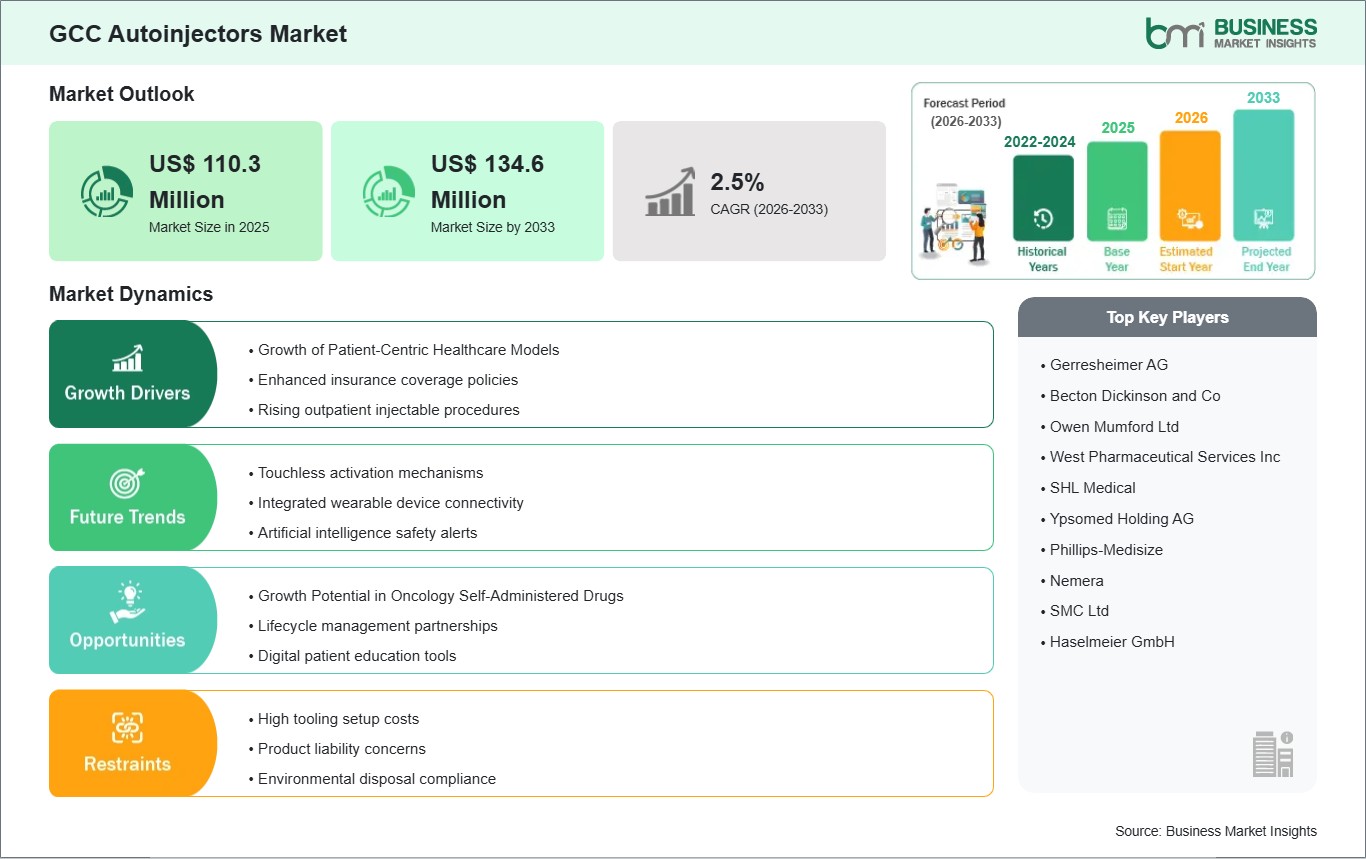
The GCC autoinjectors market, covering Saudi Arabia, United Arab Emirates, Kuwait, Qatar, Bahrain, and Oman, is witnessing steady growth, driven by rising prevalence of chronic diseases, increased patient awareness, and government-led healthcare modernization initiatives. The region has seen a surge in cases of diabetes, autoimmune disorders, and severe allergies, which has escalated demand for patient-friendly, prefilled autoinjector devices. Self-administration is increasingly recognized for its benefits, including reduced hospital visits, improved adherence, and enhanced patient autonomy. The competitive landscape is dominated by global medical device manufacturers, though regional pharmaceutical companies are entering via strategic partnerships, co-development agreements, and technology transfer programs. Market differentiation is achieved through innovation in ergonomics, safety features, dual-chamber systems, and digital connectivity, enabling adherence monitoring and remote patient support. Regulatory frameworks in the GCC, while harmonizing gradually under Gulf Cooperation Council Health Regulations, require market entrants to navigate country-specific approval procedures and local clinical validation protocols. Distribution channels are evolving from hospital-centric models toward hybrid approaches that include retail pharmacies, specialty clinics, and emerging e-commerce platforms. Health insurance coverage in countries like Saudi Arabia and the UAE is improving, supporting wider patient access to high-cost biologics delivered via autoinjectors. Furthermore, public awareness campaigns and patient training programs are facilitating adoption, particularly among pediatric and geriatric populations. The GCC autoinjectors market demonstrates a combination of high adoption potential, strong government support, and increasing patient preference for self-care, making it an attractive region for device manufacturers seeking sustainable growth.
Segment Analysis
GCC Autoinjectors Market Segmentation
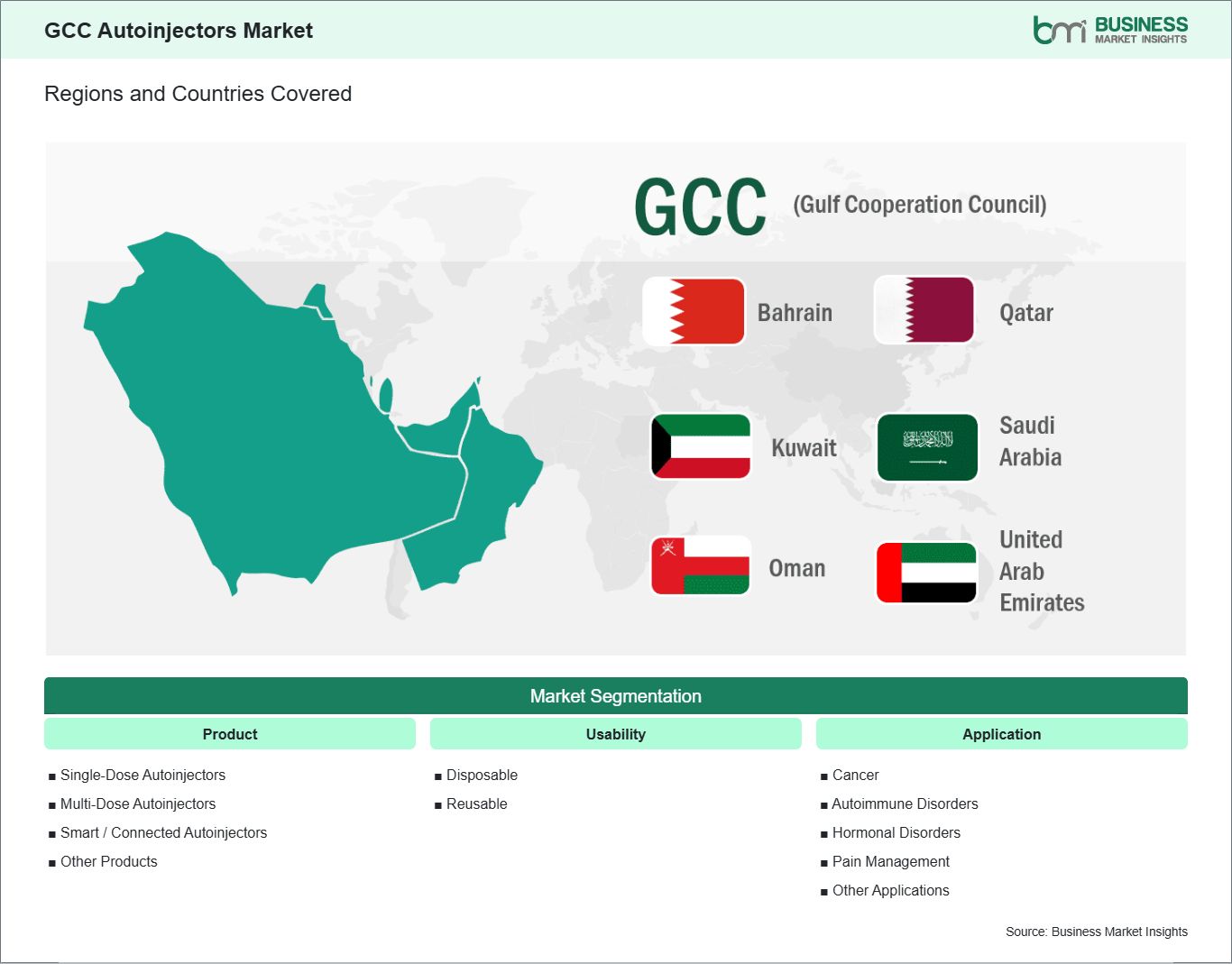
Key segments that contributed to the derivation of the GCC autoinjectors market analysis are product, usability, and application.
- By product, the autoinjectors market is segmented into single-dose autoinjectors, multi-dose autoinjectors, smart / connected autoinjectors, and others. The single-dose autoinjectors segment dominated the market in 2025.
- Based on usability, the autoinjectors market is categorized into disposable and reusable. The disposable segment dominated the market in 2025.
- In terms of application, the market is classified into cancer, autoimmune disorders, hormonal disorders, pain management, and other applications. The autoimmune disorders segment dominated the market in 2025.
Market Forces
GCC Autoinjectors Market Drivers and Opportunities
Growth of Patient-Centric Healthcare Models
The GCC region is undergoing a significant transformation toward patient‑centric healthcare models, driven by government strategies to diversify healthcare delivery and improve quality of care. In Saudi Arabia’s Vision 2030 health sector reforms, chronic disease management is a priority, and autoinjectors are increasingly recognized as tools that enable patients to administer treatment at home with greater convenience. In Riyadh and Jeddah, outpatient clinics and diabetes centers report rising uptake of autoinjectors for chronic conditions such as rheumatoid arthritis and multiple sclerosis, as physicians seek to empower patients and reduce hospital visit frequency. This shift reflects a broader move toward care models that emphasize autonomy, convenience, and long‑term adherence. In the UAE, patient‑centric models are supported by advanced digital health infrastructures that integrate electronic health records (EHRs) with patient education programs. Clinics in Dubai and Abu Dhabi have implemented initiatives where healthcare providers work closely with patients to select devices that fit individual lifestyles, particularly for self‑injectable biologics. Autoinjectors with features such as intuitive actuation and dose feedback are preferred for their ability to enhance confidence in self‑administration, especially among working adults managing complex treatment regimens. These device choices are increasingly reflected in prescription patterns across private and government health facilities. Furthermore, Qatar’s national health strategy emphasizes personalized care pathways for chronic illnesses, driving adoption of autoinjectors in both urban and semi‑urban settings. Education campaigns coordinated by public health authorities and clinic networks train patients to self‑inject safely, thereby reducing pressure on specialty care units. In Kuwait and Bahrain, enhanced patient support programs — including mobile nurse visits and telehealth follow‑ups — further reinforce the shift to patient‑centric care. Across the GCC, these healthcare models are creating fertile ground for autoinjector market growth, as stakeholders prioritize accessible, comfortable, and safe self‑administration options that improve treatment outcomes.
Growth Potential in Oncology Self-Administered Drugs
The oncology landscape in the GCC is rapidly evolving, with an increasing focus on early detection programs and expansion of cancer care beyond major hospital centers. As biologic therapies and supportive oncology drugs with self‑administration potential become more broadly available, autoinjectors are emerging as enablers of home‑based cancer care. In Saudi Arabia, oncology centers in Riyadh and Dammam are piloting autoinjector formats for supportive medications such as growth factors used to manage chemotherapy‑induced neutropenia. Patients and care teams alike report that these devices reduce hospital dependency and improve quality of life during treatment cycles. In the UAE, integrated cancer care networks are preparing for broader use of autoinjectors in oncology maintenance regimens that are suitable for home administration. Oncology specialists in Dubai and Abu Dhabi have begun recommending autoinjector delivery formats for subcutaneous monoclonal antibodies used in targeted cancer therapies, citing improved patient comfort and reduced clinic congestion. These developments align with national goals of shifting appropriate care from inpatient settings to community and home environments, particularly as the population ages and demand for chronic cancer therapies increases. Other GCC countries including Qatar, Kuwait, and Bahrain are expanding screening and early‑detection infrastructure, which is leading to higher volumes of patients entering long‑term oncology care. Regional cancer institutes are evaluating connected autoinjector technologies with digital adherence tracking, enabling clinicians to monitor self‑administered oncology drugs remotely. In Oman, oncology outpatient programs are incorporating autoinjectors into treatment plans for supportive care, reducing travel costs and time burdens for patients in remote governorates. Collectively, these region‑specific patterns indicate significant growth potential for autoinjectors in oncology self‑administered drugs across the GCC as clinical practice shifts toward home‑based, patient‑empowered therapeutic models.
Size and Share Analysis
GCC Autoinjectors Market Size and Share Analysis
The GCC Autoinjectors Market demonstrates steady growth, with size and share analysis highlighting evolving trends and competitive dynamics among key players. The report examines subsegments categorized within product, usability, and application, offering insights into their contribution to overall market performance.
By product, the single-dose autoinjectors subsegment dominated the market in 2025, driven by strong regional preference for ready‑to‑use, pre‑filled devices that enhance patient convenience and reduce dosing errors in chronic and emergency care.
Based on usability, the disposable subsegment dominated the market in 2025, driven by widespread adoption of single‑use autoinjectors due to their convenience, sterility, and minimal risk of cross‑contamination in both home and clinical settings.
In terms of application, the autoimmune disorders subsegment dominated the market in 2025, driven by rising prevalence of chronic immune‑mediated conditions in GCC countries that require frequent biologic therapies optimally delivered through autoinjectors.
Report Coverage
GCC Autoinjectors Market Report Coverage and Deliverables
The "GCC Autoinjectors Market Size and Forecast (2022–2033)" report provides a detailed analysis of the market covering below areas:
- GCC Autoinjectors Market size and forecast at regional and country levels for all market segments covered under the scope
- GCC Autoinjectors Market trends, as well as drivers, restraints, and opportunities
- GCC Autoinjectors Market analysis covering key trends, regional framework, major players, regulations, and recent developments
- Industry landscape and competition analysis covering market concentration, heat map analysis, prominent players, and recent developments for the GCC Autoinjectors Market
- Detailed company profiles, including SWOT analysis
Geographic Insights
GCC Autoinjectors Market Geographic Insights
The geographical scope of the GCC Autoinjectors Market report is divided into UAE, Bahrain, Saudi Arabia, Oman, Qatar, and Kuwait. Saudi Arabia held the largest share in 2025.
Country-specific dynamics highlight unique adoption patterns across the GCC. Saudi Arabia dominates the region due to its large patient base, government-driven healthcare modernization, and expanding hospital and specialty clinic networks. Adoption of autoinjectors is particularly strong in urban centers, with local manufacturing partnerships and public reimbursement schemes facilitating growth. In the United Arab Emirates, digital health integration is driving uptake of connected autoinjectors, coupled with mobile app-based adherence monitoring, patient training programs, and private sector engagement. Kuwait and Qatar are characterized by smaller but affluent populations, with strong public healthcare investment and high adoption of premium autoinjector devices for chronic and emergency therapies. Bahrain shows growing uptake in private clinics and hospital networks, driven by patient awareness campaigns and gradual expansion of health insurance coverage. Meanwhile, Oman emphasizes affordability and accessibility, with demand concentrated in urban areas supported by government subsidies and localized distribution networks. Overall, these country-specific dynamics indicate that while Saudi Arabia leads the GCC in volume and influence, other member states present differentiated opportunities that require tailored strategies, including premium product positioning, digital integration, and targeted awareness programs to maximize autoinjector adoption across the region.
Industry Activity
Recent Developments
The GCC Autoinjectors Market is evaluated by gathering qualitative and quantitative data post primary and secondary research, which includes important corporate publications, association data, and databases. A few of the key developments in the GCC autoinjectors market are:
- In May 2025, Pfizer introduced a novel once‑weekly prefilled autoinjector therapy for hemophilia in the UAE, marking a key product launch that improves treatment convenience and patient independence for a rare chronic condition. The autoinjector enables subcutaneous self‑administration of a targeted therapy for bleeding reduction, broadening injectable care options in the region. This launch underscores increasing adoption of advanced autoinjector delivery formats. It highlights the GCC’s push toward patient‑centric therapeutic innovations.
- In June 2024, BD launched an educational collaboration with Saudi medical associations to train healthcare professionals on proper autoinjector use, especially for emergency allergy and chronic disease applications. This partnership focused on building local competency in device handling and correct administration techniques. It aimed to increase adoption and improve clinical outcomes from self‑administration devices. The initiative represents a key regional effort to strengthen autoinjector competence among care providers.
Trust & Transparency
Research Methodology
The market analysis combines proprietary research with secondary data from government agencies, company disclosures, regulatory filings, industry databases and expert interviews. Market estimates are validated through data triangulation, cross-market benchmarking and analyst
review.
View Full Research Methodology
Key Sources Referred:
World Health Organization (WHO) Organisation for Economic Cooperation and Development (OECD) The World Bank Group Worldometer The Lancet International Bar Association International Trade Administration