Market Summary
Executive Summary and Market Analysis
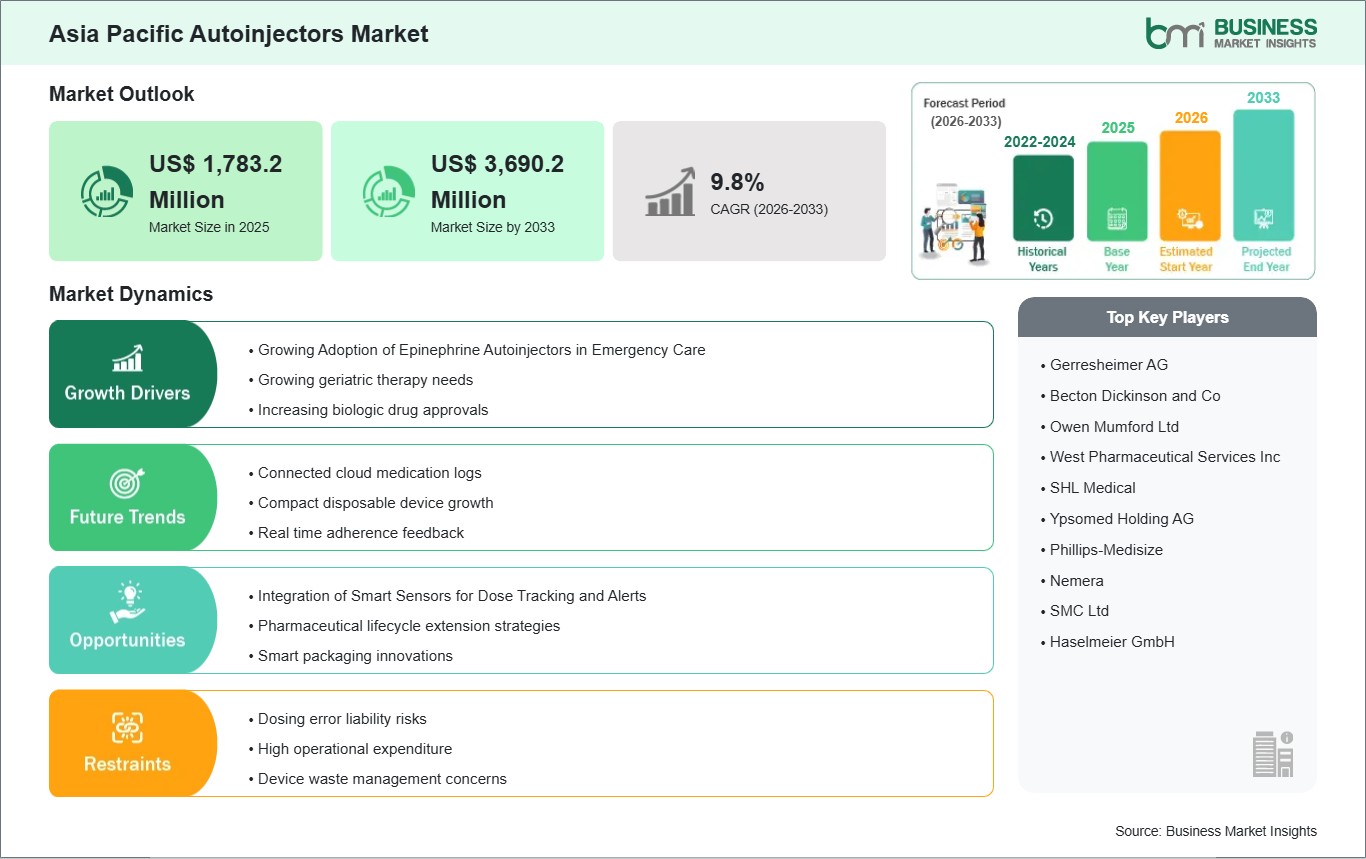
The Asia Pacific autoinjectors market is witnessing substantial evolution driven by rising chronic disease prevalence, increasing adoption of biologics, and growing emphasis on patient self-management. Countries across the region, including Japan, China, India, Australia, and South Korea, are increasingly integrating autoinjector devices into therapeutic protocols for autoimmune disorders, severe allergies, and metabolic conditions. Improved awareness among patients and healthcare providers regarding self-administration benefits—including reduced hospital visits, enhanced adherence, and minimized injection-related anxiety—is further propelling adoption. The market landscape is highly competitive, featuring established multinational medical device corporations alongside regional manufacturers seeking to expand their biologics-compatible portfolios. Strategic collaborations between pharmaceutical and device companies are emerging as a key trend, enabling development of combination drug-device products tailored for patient convenience. Regulatory alignment across Asia Pacific is gradually improving, though variations in device classification, registration timelines, and clinical evaluation requirements necessitate country-specific strategies. Innovation is central to differentiation, with an emphasis on ergonomic designs, safety mechanisms, reusable and disposable formats, and emerging connected autoinjectors offering digital adherence tracking. Distribution channels are diversifying, with hospitals and specialty clinics remaining core conduits, while retail pharmacies, homecare providers, and e-commerce platforms are gaining relevance in urban and semi-urban markets. Pricing remains a critical factor, particularly in middle-income countries, yet rising private healthcare expenditure and reimbursement reforms are supporting market expansion. In sum, the Asia Pacific autoinjectors sector is poised for sustained growth, anchored by increasing chronic disease burden, technological innovation, and a shift toward patient-centric care models that facilitate self-administration and long-term therapy compliance.
Segment Analysis
Asia Pacific Autoinjectors Market Segmentation
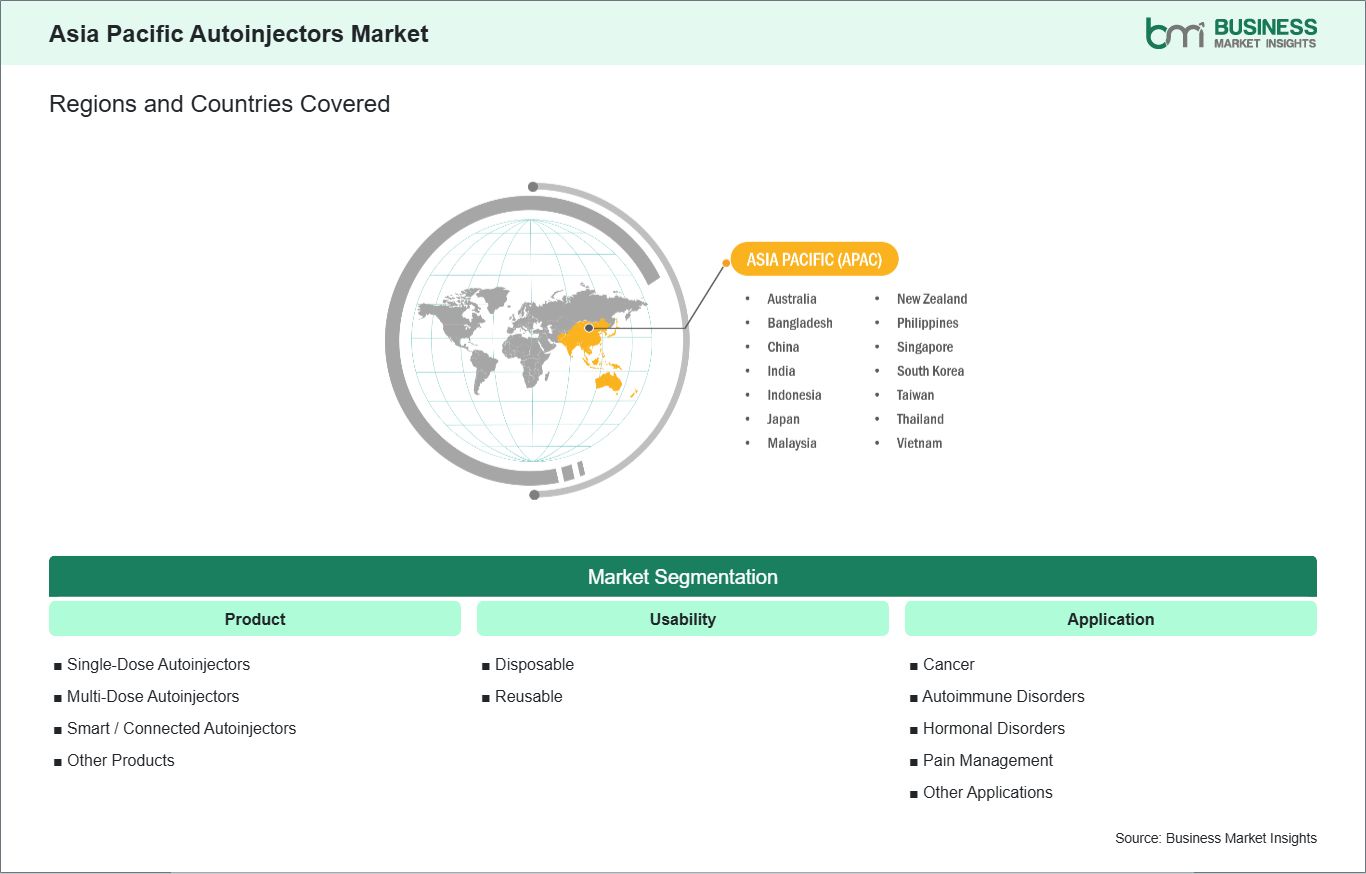
Key segments that contributed to the derivation of the Asia Pacific autoinjectors market analysis are product, usability, and application.
- By product, the autoinjectors market is segmented into single-dose autoinjectors, multi-dose autoinjectors, smart / connected autoinjectors, and others. The single-dose autoinjectors segment dominated the market in 2025.
- Based on usability, the autoinjectors market is categorized into disposable and reusable. The disposable segment dominated the market in 2025.
- In terms of application, the market is classified into cancer, autoimmune disorders, hormonal disorders, pain management, and other applications. The autoimmune disorders segment dominated the market in 2025.
Market Forces
Asia Pacific Autoinjectors Market Drivers and Opportunities
Growing Adoption of Epinephrine Autoinjectors in Emergency Care
Across the Asia Pacific region, the adoption of epinephrine autoinjectors for emergency anaphylaxis management is gaining traction as allergy prevalence rises among children, adolescents, and adults. Urban hospitals and emergency departments in major health corridors have reported increased instances of severe allergic reactions linked to food allergens, insect stings, and medication sensitivities. In densely populated healthcare centers, clinicians are increasingly standardizing epinephrine autoinjectors in emergency carts and patient discharge kits, recognizing that rapid self‑administration can be life‑saving before patients reach definitive care. Public awareness campaigns in several Asia Pacific nations have significantly contributed to this adoption trend. Schools and community centers now run workshops on recognizing anaphylaxis and proper autoinjector usage, particularly in regions where shellfish and peanut allergies are prevalent. Retail pharmacies in metropolitan centers are seeing year‑on‑year growth in over‑the‑counter epinephrine autoinjector demand from families managing known severe allergies. This urban community adoption complements institutional emergency preparedness programs, expanding the market beyond traditional hospital procurement channels. Government health ministries are also strengthening emergency response frameworks by incorporating epinephrine autoinjectors into national essential medicines lists and subsidized chronic care programs. For example, integrated purchase agreements at district hospitals guarantee stock availability for first responders and emergency clinicians in high‑density zones. Rural referral hospitals, previously challenged by long ambulance transit times, now report that local availability of epinephrine autoinjectors has improved patient outcomes for anaphylaxis occurring far from tertiary care. Collectively, these systemic shifts are accelerating regional demand for epinephrine autoinjectors as standard emergency care assets across the Asia Pacific.
Integration of Smart Sensors for Dose Tracking and Alerts
Technological integration is redefining autoinjector functionality in the Asia Pacific market, with smart sensors and connectivity features becoming key differentiators. Healthcare providers in technologically advanced health systems are piloting autoinjectors equipped with digital dose tracking and Bluetooth‑enabled alerts that synchronize with mobile health platforms. These capabilities support better adherence for chronic conditions such as rheumatoid arthritis and multiple sclerosis, where consistent dosing is critical for long‑term outcomes. In high‑mobile populations and digitally connected communities, smart sensors address two key clinician and patient priorities: dosage accuracy and real‑time monitoring. Patients using sensors report fewer missed doses due to automated reminders, while physicians gain insight into real‑world compliance trends without relying on self‑reported logs. Regional pharmacies in urban clusters have begun stocking sensor‑enabled autoinjectors alongside companion apps that allow users to track injection history, receive refill reminders, and share adherence data with care teams. These innovations are particularly valued in metropolitan healthcare ecosystems where chronic disease management is shifting toward value‑based care models. National telehealth initiatives across the region are further driving smart autoinjector adoption. Remote clinics connected to central specialist networks now leverage sensor data for virtual follow‑ups, reducing the need for in‑person visits. Patients in digitally supported community health programs are equipped with devices that automatically transmit dose records to registries, enabling clinicians to flag deviations and intervene early. As digital infrastructure expands across urban, suburban, and semi‑urban zones, manufacturers that integrate smart sensor platforms position themselves competitively within an evolving Asia Pacific landscape that prioritizes connectivity, data‑driven care, and personalized patient support.
Size and Share Analysis
Asia Pacific Autoinjectors Market Size and Share Analysis
The Asia Pacific Autoinjectors Market demonstrates steady growth, with size and share analysis highlighting evolving trends and competitive dynamics among key players. The report examines subsegments categorized within product, usability, and application, offering insights into their contribution to overall market performance.
By product, the single-dose autoinjectors subsegment dominated the market in 2025, driven by growing preference for convenient, pre-filled, ready-to-use devices that minimize dosing errors and support self-administration.
Based on usability, the disposable subsegment dominated the market in 2025, driven by high demand for safe, low-maintenance, single-use devices that eliminate contamination risk and simplify patient care.
In terms of application, the autoimmune disorders subsegment dominated the market in 2025, driven by increasing prevalence of chronic immune-mediated diseases requiring frequent biologic injections suitable for autoinjector delivery.
Report Coverage
Asia Pacific Autoinjectors Market Report Coverage and Deliverables
The "Asia Pacific Autoinjectors Market Size and Forecast (2022–2033)" report provides a detailed analysis of the market covering below areas:
- Asia Pacific Autoinjectors Market size and forecast at regional and country levels for all market segments covered under the scope
- Asia Pacific Autoinjectors Market trends, as well as drivers, restraints, and opportunities
- Asia Pacific Autoinjectors Market analysis covering key trends, regional framework, major players, regulations, and recent developments
- Industry landscape and competition analysis covering market concentration, heat map analysis, prominent players, and recent developments for the Asia Pacific Autoinjectors Market
- Detailed company profiles, including SWOT analysis
Geographic Insights
Asia Pacific Autoinjectors Market Geographic Insights
The geographical scope of the Asia Pacific Autoinjectors Market report is divided into Needle-free Injectors Market report is divided into China, India, Japan, Australia, Bangladesh, Indonesia, Malaysia, New Zealand, Philippines, Singapore, South Korea, Taiwan, Thailand, and Vietnam. China held the largest share in 2025.
Country-specific insights reveal distinct dynamics across the Asia Pacific autoinjectors landscape. China represents a mature, innovation-driven market with advanced hospital infrastructure, strong regulatory oversight, and high adoption of biologics, making it a strategic launchpad for novel autoinjector products. In Japan, rising chronic disease prevalence, government support for local manufacturing, and urban hospital expansion provide a favorable environment for both domestic and international manufacturers. India exhibits high growth potential driven by expanding healthcare access, urbanization, and increasing awareness of self-injection devices, though cost sensitivity and regional healthcare disparities require tailored distribution strategies. In Australia, well-established healthcare reimbursement systems, high disposable income, and patient-centric care models support early adoption of advanced and smart autoinjectors. Meanwhile, South Korea demonstrates strong integration of digital healthcare solutions, facilitating the uptake of connected autoinjectors and digital adherence platforms. Emerging markets like Indonesia, Vietnam, and the Philippines are witnessing gradual adoption due to increasing awareness, improving healthcare infrastructure, and growing private sector participation. Collectively, these country-specific variations underscore the importance of adaptive strategies, including localized pricing, distribution optimization, regulatory navigation, and digital integration, to effectively capture growth opportunities across the Asia Pacific autoinjectors market.
Industry Activity
Recent Developments
The Asia Pacific Autoinjectors Market is evaluated by gathering qualitative and quantitative data post primary and secondary research, which includes important corporate publications, association data, and databases. A few of the key developments in the Asia Pacific autoinjectors market are:
- In October 2025, Ypsomed AG inaugurated its first dedicated autoinjector production facility in Changzhou, China, with capacity to manufacture up to 100 million units annually, marking a major strategic localisation in APAC. The plant supports faster delivery, reduced logistics risk and closer customer engagement in the region’s high‑growth markets. Local production directly addresses demand from China’s expanding biologics and self‑injection therapy sectors. This expansion reflects long‑term commitment to serve APAC with regional manufacturing scale.
- In October 2025, Singapore’s Health Sciences Authority (HSA) granted approval for WAINUA Solution for Injection in Autoinjector (eplontersen) for hereditary transthyretin‑mediated amyloidosis, marking a notable autoinjector‑related regulatory milestone in the Asia Pacific region. This approval demonstrates increasing regulatory receptivity toward advanced self‑injection therapies in APAC jurisdictions. It supports broader patient access to biologic treatments with autoinjector delivery for chronic conditions. Such authorisations signal strengthening local regulatory frameworks for innovative devices.
Trust & Transparency
Research Methodology
The market analysis combines proprietary research with secondary data from government agencies, company disclosures, regulatory filings, industry databases and expert interviews. Market estimates are validated through data triangulation, cross-market benchmarking and analyst
review.
View Full Research Methodology
Key Sources Referred:
World Health Organization (WHO) Organisation for Economic Cooperation and Development (OECD) The World Bank Group Worldometer The Lancet International Bar Association International Trade Administration