Market Summary
Executive Summary and Market Analysis
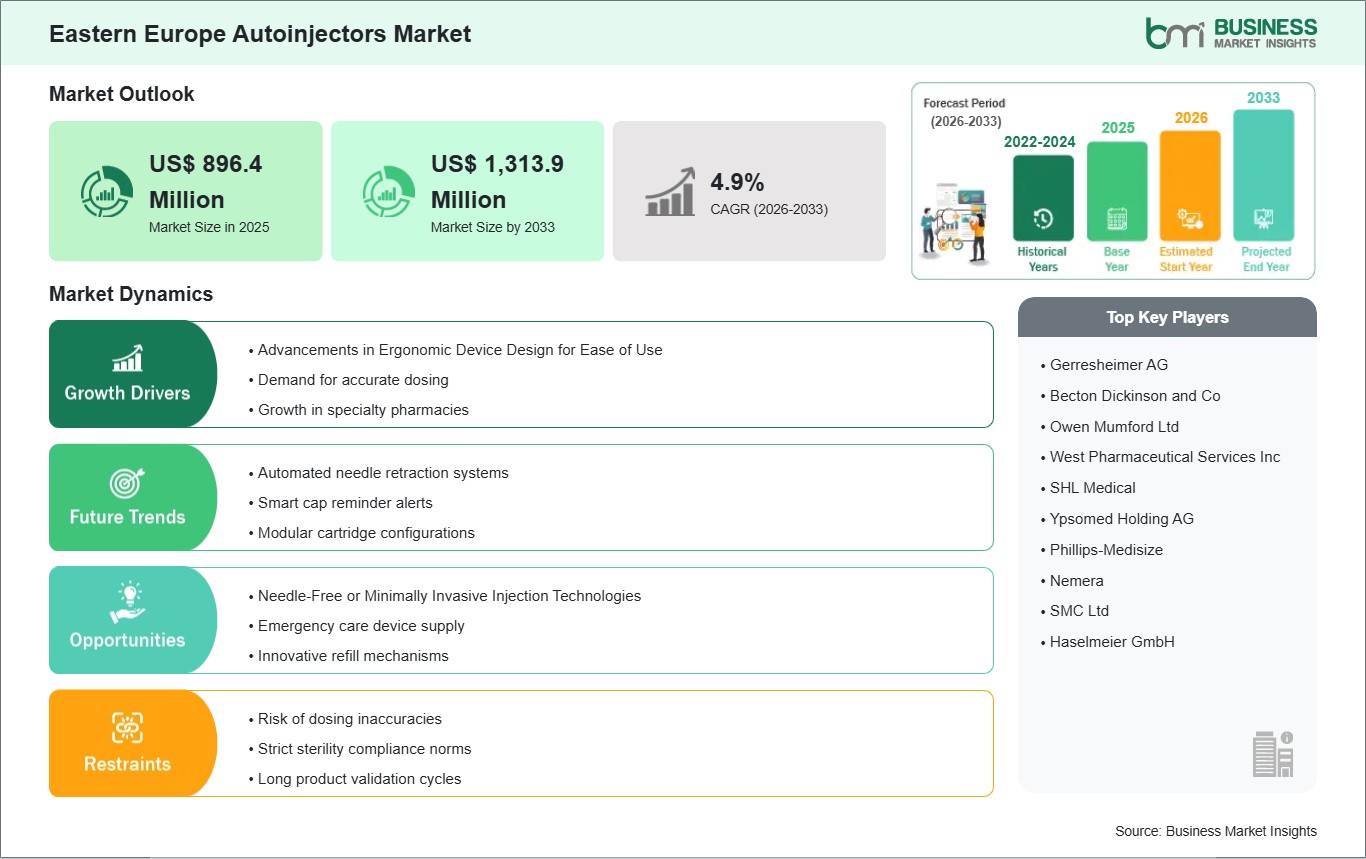
The Eastern Europe autoinjectors market is experiencing steady expansion, driven by increasing prevalence of chronic diseases, growing awareness of patient self-management, and improving healthcare infrastructure across the region. Key countries such as Poland, Czech Republic, Hungary, Romania, and Ukraine are witnessing a rise in autoimmune disorders, anaphylaxis, and chronic metabolic conditions, creating a strong demand for prefilled and user-friendly injection devices. Self-administration offers patients enhanced autonomy, reduced hospital dependency, and improved adherence to biologics and emergency therapies, which is driving adoption in both urban and semi-urban markets. Market dynamics in Eastern Europe are shaped by a combination of multinational device manufacturers and emerging domestic pharmaceutical players aiming to expand their portfolios through autoinjector integration. Strategic partnerships and technology transfer agreements are increasingly common, allowing regional players to access advanced delivery systems while maintaining cost competitiveness. Regulatory frameworks are evolving in alignment with EU medical device directives, though approval timelines vary between EU member states and non-EU countries like Ukraine, requiring tailored market entry approaches. Distribution channels are shifting toward a hybrid model. Hospitals and specialty clinics remain central, particularly for high-value biologics, while retail pharmacies and homecare services are gaining traction for epinephrine and other emergency autoinjectors. Product innovation emphasizes ergonomic design, safety mechanisms, and easy usability for pediatric and geriatric populations. Additionally, public health initiatives and patient education programs are supporting broader acceptance of self-injection practices. Collectively, these factors position the Eastern Europe autoinjectors market as an increasingly strategic region for device manufacturers seeking long-term growth, underpinned by expanding healthcare access, regulatory modernization, and heightened patient awareness.
Segment Analysis
Eastern Europe Autoinjectors Market Segmentation
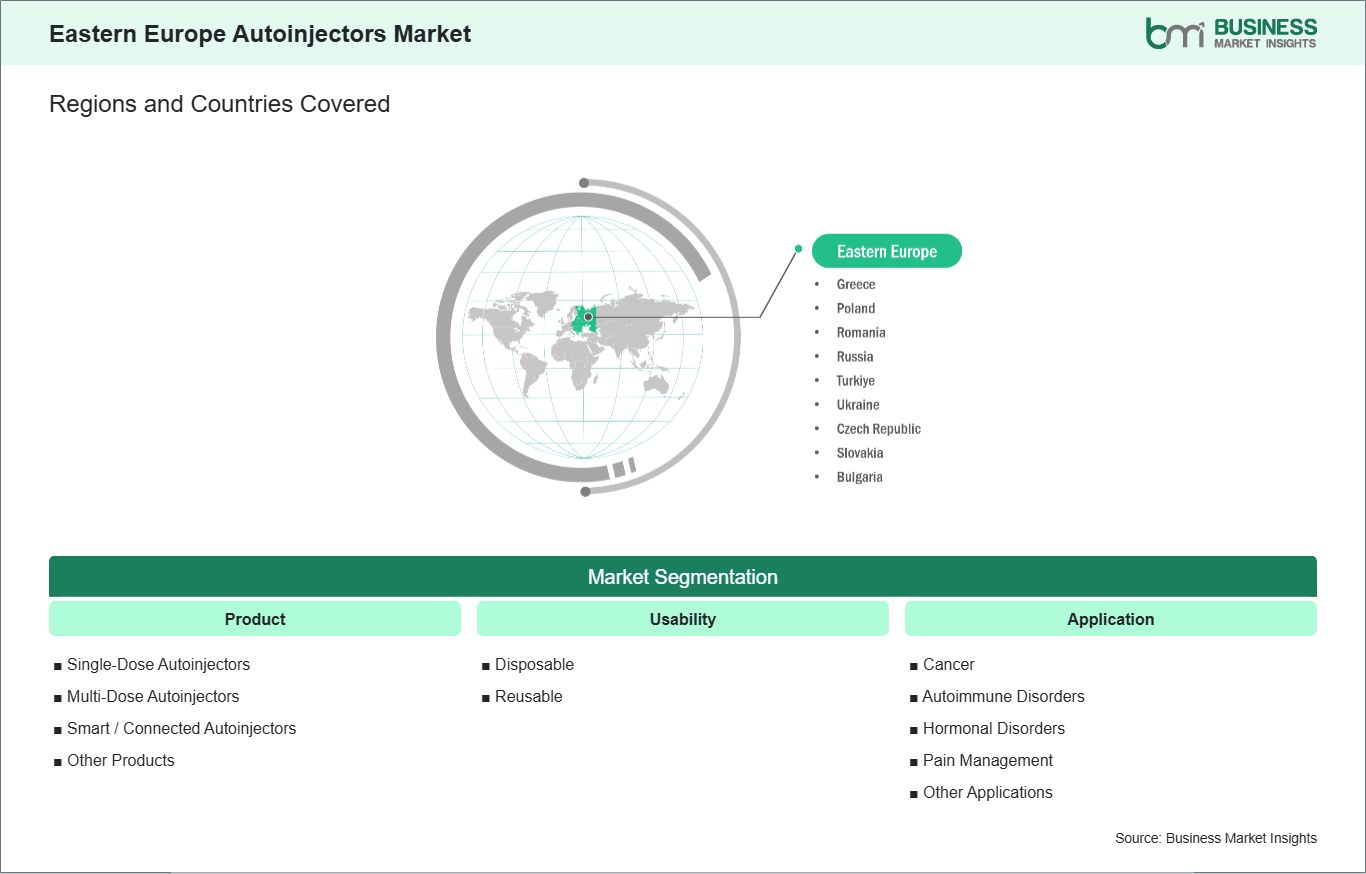
Key segments that contributed to the derivation of the Eastern Europe autoinjectors market analysis are product, usability, and application.
- By product, the autoinjectors market is segmented into single-dose autoinjectors, multi-dose autoinjectors, smart / connected autoinjectors, and others. The single-dose autoinjectors segment dominated the market in 2025.
- Based on usability, the autoinjectors market is categorized into disposable and reusable. The disposable segment dominated the market in 2025.
- In terms of application, the market is classified into cancer, autoimmune disorders, hormonal disorders, pain management, and other applications. The autoimmune disorders segment dominated the market in 2025.
Market Forces
Eastern Europe Autoinjectors Market Drivers and Opportunities
Advancements in Ergonomic Device Design for Ease of Use
In Eastern Europe, ergonomic enhancements in autoinjector design are becoming a key market differentiator as healthcare providers and patients alike prioritize ease of use, particularly for chronic therapies. In large urban centers with aging populations and high prevalence of rheumatoid arthritis and multiple sclerosis, clinicians report that traditional syringe formats often lead to lower adherence due to complexity of handling. Autoinjectors with contoured grips and simplified actuation have alleviated dexterity barriers for older adults managing biologic regimens at home. Rehabilitation clinics and outpatient rheumatology units have noted that patients switching to ergonomic designs complete their prescribed dosing schedules more reliably, a trend reflected in higher refill rates at regional pharmacies. Rehabilitation and chronic care networks in industrial and mining regions across Eastern Europe have also influenced design adoption. Patients with compromised hand strength such as those in post‑industrial towns undergoing long‑term treatment benefit from larger, non‑slip interfaces and reduced injection force. Healthcare practitioners in these rehabilitation ecosystems increasingly recommend autoinjectors with adaptive ergonomic features, noting improvements in self‑administration confidence among patients previously reliant on caregiver assistance. This has shifted demand towards devices that prioritize intuitive handling over legacy formats. Training centers and patient support groups in large metropolitan catchments have played a role in accelerating demand for ergonomic autoinjectors. Initiatives led by local healthcare NGOs and specialist clinics focus on “user‑first” device selection, emphasizing reduced pain perception and physical comfort during injections. These programs highlight how region‑specific ergonomic design — such as broadened grip surfaces for colder climates where joint stiffness is common — enhances patient autonomy. As a result, manufacturers responsive to these regional usability insights have seen stronger uptake in both public and private healthcare channels, positioning ergonomic design as a core competitive axis in the Eastern Europe autoinjectors market.
Needle-Free or Minimally Invasive Injection Technologies
Needle‑free and minimally invasive injection technologies are gaining traction in Eastern Europe as healthcare systems seek alternatives that reduce fear, improve compliance, and streamline administration. In outpatient vaccination initiatives beyond the seasonal flu campaign, public clinics in densely populated catchments have piloted jet injection systems and microneedle patch technologies to address needle‑aversion among younger populations. These needle‑free approaches have been particularly welcomed by school health services and community immunization drives, where high throughput and patient comfort are critical. Early feedback from these pilots indicates that reduced procedural anxiety translates into higher completion rates for entire immunization schedules. Adult chronic care populations are also showing interest in less invasive delivery systems. Among individuals managing long‑term conditions such as diabetes and autoimmune diseases, regional endocrinology and immunology practices have observed that fear of needles remains a significant barrier to self‑injection adherence. Needle‑free autoinjectors and micro‑injection technologies that minimize dermal penetration have drawn interest particularly in peri‑urban clinics where patient education programs emphasize quality‑of‑life outcomes. Clinics report that these technologies are not only improving patient satisfaction but also reducing needlestick injury risk among home caregivers. Healthcare innovation hubs and university hospital networks in Eastern Europe are conducting real‑world usability studies to assess the feasibility of minimally invasive technologies in routine practice. These studies are increasingly incorporating patient preference data along with clinical outcomes to build evidence supporting broader adoption. Early adopters in metropolitan healthcare centers find that integrating needle‑free options into device formularies differentiates their chronic care offerings and aligns with broader patient‑centric care strategies. As awareness grows and reimbursement models adapt to recognize the value of improved compliance and reduced complication rates, needle‑free and minimally invasive autoinjectors are expected to become a more pronounced segment of the regional market.
Size and Share Analysis
Eastern Europe Autoinjectors Market Size and Share Analysis
The Eastern Europe Autoinjectors Market demonstrates steady growth, with size and share analysis highlighting evolving trends and competitive dynamics among key players. The report examines subsegments categorized within product, usability, and application, offering insights into their contribution to overall market performance.
By product, the single-dose autoinjectors subsegment dominated the market in 2025, driven by increasing preference for simple, ready‑to‑use devices that enhance patient convenience and reduce dosing errors.
Based on usability, the disposable subsegment dominated the market in 2025, driven by strong demand for safe, single‑use delivery systems that minimise contamination risk and support home‑based treatment.
In terms of application, the autoimmune disorders subsegment dominated the market in 2025, driven by rising prevalence of chronic immune‑mediated diseases requiring frequent biologic therapies that are well‑suited to autoinjector delivery.
Report Coverage
Eastern Europe Autoinjectors Market Report Coverage and Deliverables
The "Eastern Europe Autoinjectors Market Size and Forecast (2022–2033)" report provides a detailed analysis of the market covering below areas:
- Eastern Europe Autoinjectors Market size and forecast at regional and country levels for all market segments covered under the scope
- Eastern Europe Autoinjectors Market trends, as well as drivers, restraints, and opportunities
- Eastern Europe Autoinjectors Market analysis covering key trends, regional framework, major players, regulations, and recent developments
- Industry landscape and competition analysis covering market concentration, heat map analysis, prominent players, and recent developments for the Eastern Europe Autoinjectors Market
- Detailed company profiles, including SWOT analysis
Geographic Insights
Eastern Europe Autoinjectors Market Geographic Insights
The geographical scope of the Eastern Europe Autoinjectors Market report is divided into Russia, Poland, Ukraine, Romania, the Czech Republic, Slovakia, Bulgaria, and Greece. Russia held the largest share in 2025.
The Eastern Europe autoinjectors market exhibits a diverse set of dynamics across key countries, with Russia dominating the region due to its large patient population, expanding healthcare infrastructure, and growing adoption of self-administration therapies. High demand for autoinjectors in chronic disease management and emergency care, coupled with government initiatives supporting local pharmaceutical production, positions Russia as the primary driver of regional growth. Domestic manufacturing partnerships and import substitution policies further strengthen its market dominance, enabling both global and local players to scale operations efficiently. Poland represents a mature EU market with strong reimbursement coverage, robust hospital networks, and a growing preference for biologics delivered via autoinjectors. Urban areas show higher adoption due to advanced healthcare services, whereas semi-urban regions require targeted awareness campaigns to increase patient confidence in self-administration. In Ukraine, adoption is concentrated in metropolitan centers where healthcare investment is higher. Challenges include rural access limitations and the need for cost-sensitive device solutions. Strategic partnerships and physician training initiatives are critical to expanding penetration. Romania is witnessing gradual uptake through private clinics and specialty hospitals, with patient education programs driving awareness of self-injection benefits. Healthcare modernization efforts are supporting a steady rise in autoinjector adoption. The Czech Republic demonstrates growing integration of digital health solutions, including smart autoinjectors with adherence tracking for chronic disease patients, while Slovakia emphasizes regulatory alignment with EU standards, focusing on safety-compliant devices and efficient hospital distribution networks. Bulgaria is an emerging market with increasing awareness campaigns and gradual private healthcare expansion, highlighting opportunities for affordable, user-friendly autoinjectors. Meanwhile, Greece reflects a mixed healthcare system, with urban adoption of premium devices driven by private hospitals, while public sector procurement emphasizes cost-efficiency. Collectively, these country-specific dynamics underline the necessity of differentiated strategies—Russia leads the region, while other Eastern European countries require adaptive pricing, distribution optimization, and patient education to maximize autoinjector market penetration.
Industry Activity
Recent Developments
The Eastern Europe Autoinjectors Market is evaluated by gathering qualitative and quantitative data post primary and secondary research, which includes important corporate publications, association data, and databases. A few of the key developments in the Eastern Europe autoinjectors market are:
- In May 2025, Sandoz launched the Pyzchiva Autoinjector across Europe, including Eastern European countries, as the first biosimilar ustekinumab available in an autoinjector format that supports home self‑ This product offers patients with plaque psoriasis, psoriatic arthritis, Crohn’s disease, and pediatric plaque psoriasis a convenient pre‑filled pen option for chronic therapy. Initial availability began in Spain and is being rolled out progressively across European markets, including Poland, Romania, Hungary and other Eastern European member states. The Pyzchiva autoinjector delivers flexible dosing with 90 mg and 45 mg strengths and is part of broader efforts to expand autoinjector‑format biologics in the region.
- In April 2024, The European Medicines Agency (EMA) granted centralised marketing authorisation for the Pyzchiva sequence of products including the autoinjector format, valid in all EU member states, which includes key Eastern European countries (e.g., Poland, Czechia, Romania, Hungary). This regulatory clearance enables the autoinjector format to be authorised for use throughout the region once national reimbursement and distribution processes are completed. Autoinjector approval through the EMA’s centralised procedure simplifies access and eliminates multiple national filings. The authorisation marked a key step in expanding autoinjector‑format biologics across Europe.
Trust & Transparency
Research Methodology
The market analysis combines proprietary research with secondary data from government agencies, company disclosures, regulatory filings, industry databases and expert interviews. Market estimates are validated through data triangulation, cross-market benchmarking and analyst
review.
View Full Research Methodology
Key Sources Referred:
World Health Organization (WHO) Organisation for Economic Cooperation and Development (OECD) The World Bank Group Worldometer The Lancet International Bar Association International Trade Administration