Market Summary
Executive Summary and Market Analysis
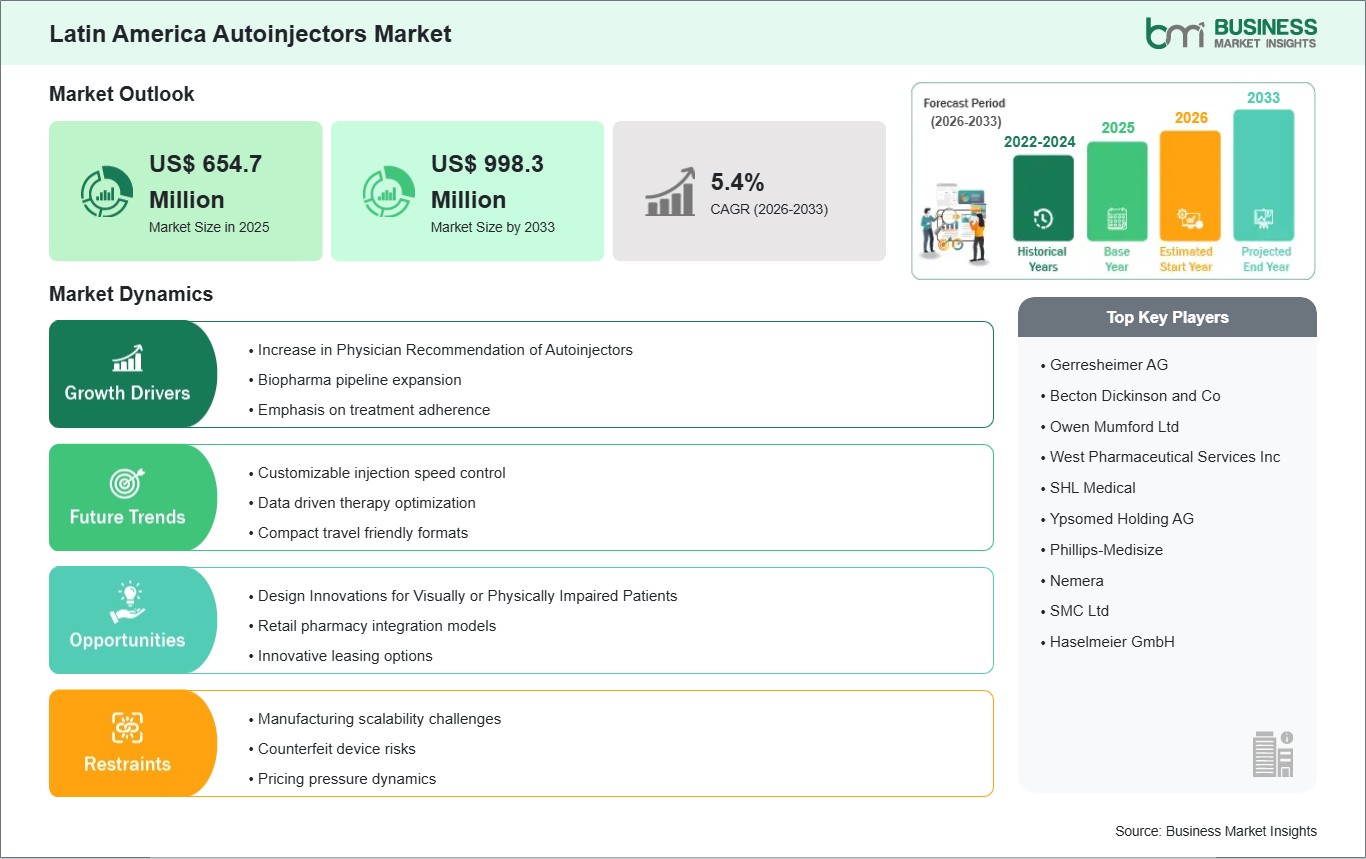
The Latin America autoinjectors market is witnessing significant transformation, driven by increasing prevalence of chronic and autoimmune diseases, rising awareness of self-administration therapies, and modernization of healthcare infrastructure across the region. Key countries such as Brazil, Mexico, Argentina, Colombia, and Chile are driving demand for user-friendly autoinjectors, particularly for biologics, epinephrine, and insulin therapies. The shift toward patient-centric care, supported by urban hospital networks and specialty clinics, is enhancing self-injection adoption while reducing reliance on in-clinic administration. The competitive landscape is defined by global medical device manufacturers, complemented by emerging regional players seeking market entry through partnerships, co-development, and licensing agreements. Innovation is increasingly critical, with manufacturers emphasizing ergonomic designs, dual-chamber systems, prefilled formulations, and digital connectivity for adherence monitoring. Regulatory frameworks across Latin America vary widely, requiring companies to navigate country-specific approvals, import regulations, and clinical validation standards. Distribution channels are evolving beyond traditional hospitals and clinics to include retail pharmacies, homecare services, and emerging e-commerce platforms, particularly in urban centers with higher patient engagement. Reimbursement mechanisms, although uneven across the region, are gradually supporting access to high-cost biologics delivered via autoinjectors. Public health awareness campaigns, patient training programs, and telemedicine initiatives are further driving adoption, especially among pediatric and geriatric populations. Collectively, the Latin America autoinjectors market is positioned as a high-potential growth region, where innovation, regulatory navigation, and patient education remain key factors for sustained market success.
Segment Analysis
Latin America Autoinjectors Market Segmentation
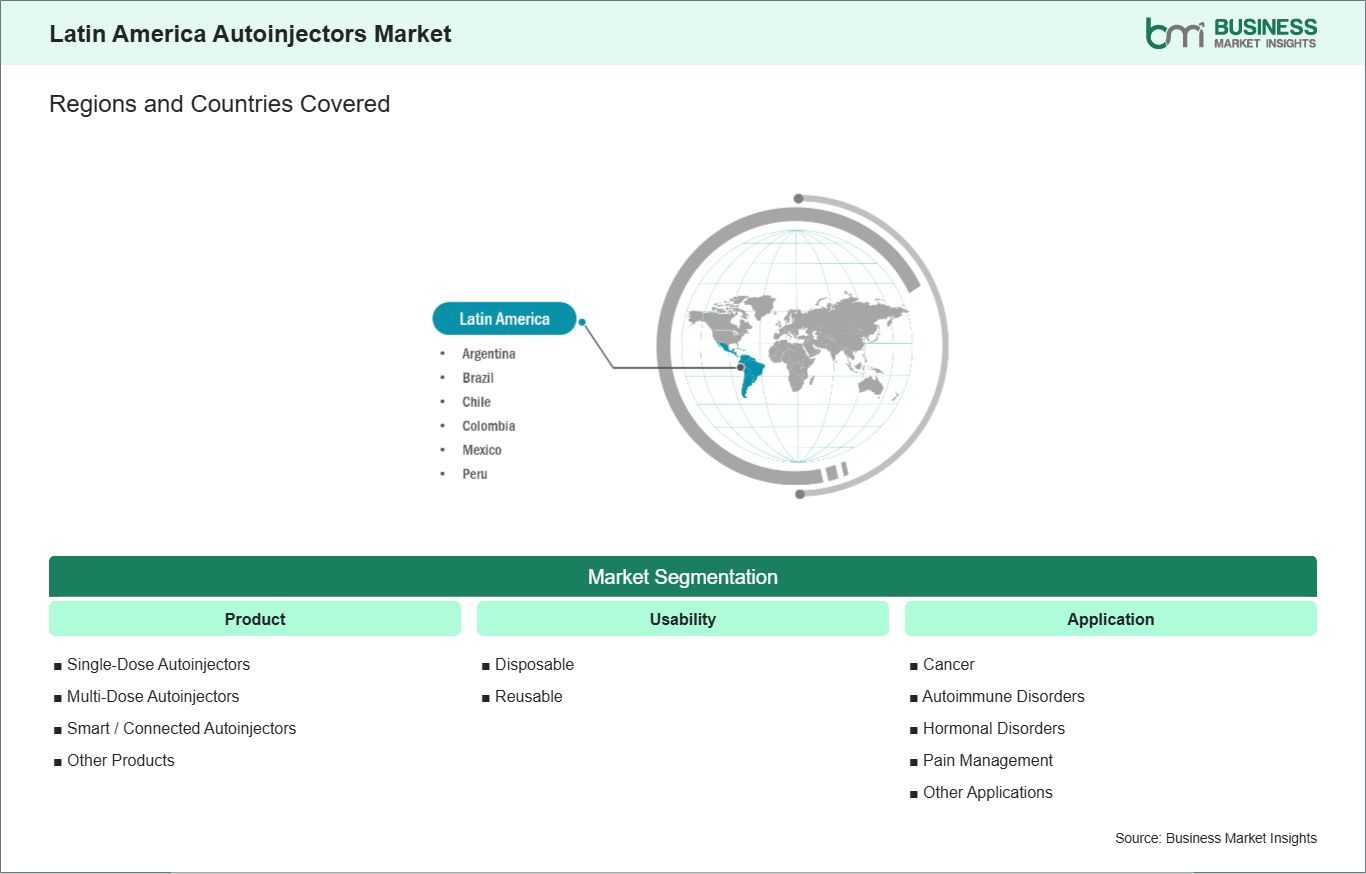
Key segments that contributed to the derivation of the Latin America autoinjectors market analysis are product, usability, and application.
- By product, the autoinjectors market is segmented into Single-Dose Autoinjectors, Multi-Dose Autoinjectors, Smart / Connected Autoinjectors, and Others. The single-dose autoinjectors segment dominated the market in 2025.
- Based on usability, the autoinjectors market is categorized into disposable and reusable. The disposable segment dominated the market in 2025.
- In terms of application, the market is classified into cancer, autoimmune disorders, hormonal disorders, pain management, and other applications. The autoimmune disorders segment dominated the market in 2025.
Market Forces
Latin America Autoinjectors Market Drivers and Opportunities
Increase in Physician Recommendation of Autoinjectors
Across Latin America, physician prescribing behavior is increasingly favoring autoinjector technologies for a broad range of chronic and acute conditions, driven by clinical evidence supporting improved adherence and patient satisfaction. In major urban healthcare centers such as Sao Paulo, Mexico City, and Buenos Aires rheumatologists and endocrinologists are more frequently recommending autoinjectors for biologics and long‑term injectable therapies. Physicians have cited ease of use and lower administration error rates as key drivers behind this shift, particularly for patients managing autoimmune diseases and diabetes who were previously reliant on clinic‑administered injections. Public and private hospitals in Colombia and Chile have also observed that autoinjectors reduce clinic workload by empowering patients to self‑administer treatment. Endocrinology units in Bogota and Santiago report fewer missed follow‑up appointments among patients prescribed autoinjector formats compared with traditional syringe‑and‑vial therapies. As a result, autoinjectors are increasingly incorporated into standard treatment guidelines for chronic conditions because physicians view them as tools that help stabilize long‑term care plans and reinforce therapeutic continuity. This evolving clinical preference is becoming especially pronounced in specialist networks where patient adherence directly influences outcomes and overall care costs. In Mexico and Peru, general practitioners (GPs) in community health centers are also embracing autoinjector recommendations as part of broader chronic disease management strategies. GPs report that patients are more confident initiating and maintaining injectable therapies at home when guided by a device with clear actuation cues and minimal technical complexity. Increased physician comfort with autoinjector technology has driven prescription growth beyond major cities into mid‑sized regional healthcare markets, expanding demand across diverse care settings. Collectively, these regional physician trends indicate that clinician endorsement will continue to be a central driver of autoinjector market expansion in Latin America.
Design Innovations for Visually or Physically Impaired Patients
Design innovation has become a focal point for autoinjector manufacturers seeking to address unmet needs among visually and physically impaired patients across Latin America. In populations with high rates of chronic disease — including regions of Brazil and Argentina with aging demographics — patients with limited dexterity or visual impairment require devices that are accessible and intuitive. Clinicians at rehabilitation centers and diabetes clinics report strong patient preference for autoinjectors featuring tactile feedback, auditory delivery confirmation, and enlarged ergonomic grips, which collectively reduce the risk of dosing errors and build confidence among users with sensory challenges. In Mexico City and Monterrey, specialty pharmacies are stocking autoinjector variants with adaptive design elements such as color‑contrasted components and simplified actuation sequences. These innovations are particularly valued by patients with diabetic neuropathy or arthritis complications that compromise hand function. Patient support programs in these metropolitan markets often pair device training with educational materials tailored to visually impaired users, helping individuals master injection technique and reinforcing adherence. As community pharmacies and outpatient clinics observe improved self‑injection success rates, demand has begun to grow for designs that prioritize accessibility without sacrificing therapeutic effectiveness. Healthcare providers in Chile and Colombia are also incorporating user‑centric design insights into procurement decisions, recognizing that enhancing usability for physically or visually impaired patients can improve long‑term health outcomes. Rehabilitation units in Santiago and Bogota have piloted autoinjector devices with adjustable dose settings and haptic feedback, allowing patients with limited vision or motor control to self‑administer biologic therapies with reduced caregiver dependency. These pilot programs have demonstrated tangible improvements in adherence and patient satisfaction, prompting broader adoption in chronic care pathways. As device makers continue to innovate with inclusive design principles, autoinjectors tailored for visually and physically impaired patients are expected to be a growth differentiator in the Latin America market.
Size and Share Analysis
Latin America Autoinjectors Market Size and Share Analysis
The Latin America Autoinjectors Market demonstrates steady growth, with size and share analysis highlighting evolving trends and competitive dynamics among key players. The report examines subsegments categorized within product, usability, and application, offering insights into their contribution to overall market performance.
By product, the single-dose autoinjectors subsegment dominated the market in 2025, driven by strong regional preference for simple, ready‑to‑use devices that enhance convenience in self‑administration and improve treatment adherence amidst growing chronic disease management needs.
Based on usability, the disposable subsegment dominated the market in 2025, driven by high demand for safe, single‑use systems that reduce contamination risk, require no maintenance, and are suited to decentralised home‑based care models.
In terms of application, the autoimmune disorders subsegment dominated the market in 2025, driven by rising prevalence of immune‑mediated diseases such as rheumatoid arthritis and multiple sclerosis that rely increasingly on biologic therapies delivered through autoinjectors.
Report Coverage
Latin America Autoinjectors Market Report Coverage and Deliverables
The "Latin America Autoinjectors Market Size and Forecast (2022–2033)" report provides a detailed analysis of the market covering below areas:
- Latin America Autoinjectors Market size and forecast at regional and country levels for all market segments covered under the scope
- Latin America Autoinjectors Market trends, as well as drivers, restraints, and opportunities
- Latin America Autoinjectors Market analysis covering key trends, regional framework, major players, regulations, and recent developments
- Industry landscape and competition analysis covering market concentration, heat map analysis, prominent players, and recent developments for the Latin America Autoinjectors Market
- Detailed company profiles, including SWOT analysis
Geographic Insights
Latin America Autoinjectors Market Geographic Insights
The geographical scope of the Latin America Autoinjectors Market report is divided into Mexico, Brazil, Argentina, Peru, Chile, and Colombia. Brazil held the largest share in 2025.
Country-specific dynamics across Latin America highlight diverse adoption patterns. Brazil dominates the region due to its large patient population, expanding hospital networks, and government initiatives supporting local production and import substitution. Urban centers such as São Paulo and Rio de Janeiro demonstrate high uptake of autoinjectors, particularly for insulin, biologics, and emergency therapies. Mexico shows growing adoption through private hospitals, specialty clinics, and urban pharmacies, with digital health initiatives supporting connected autoinjector integration. Argentina emphasizes patient education campaigns and reimbursement programs that facilitate uptake, particularly in metropolitan areas. In Colombia, urban-rural disparities require tailored pricing strategies and awareness programs to drive adoption, while Chile benefits from a robust private healthcare sector, facilitating early adoption of premium, ergonomically designed autoinjectors. The region demands country-specific strategies that consider reimbursement frameworks, patient education, and distribution optimization. While Brazil leads in volume and market influence, other Latin American countries offer growth opportunities through urban adoption, private healthcare engagement, and digital integration, ensuring a balanced regional expansion for autoinjector manufacturers.
Industry Activity
Recent Developments
The Latin America Autoinjectors Market is evaluated by gathering qualitative and quantitative data post primary and secondary research, which includes important corporate publications, association data, and databases. A few of the key developments in the Latin America autoinjectors market are:
- In February 2025, Rx Bandz LLC signed a memorandum of understanding (MOU) with Mexican distributor Zeyco to manufacture and distribute the MiniJect epinephrine auto‑injector throughout Mexico and broader Latin America. This pact aims to improve pricing and increase availability of emergency allergy autoinjectors across the region’s large and under‑served markets. The collaboration combines Rx Bandz’s compact device technology with Zeyco’s regional distribution network. It represents a major step toward increasing access to self‑administration devices in Latin America.
- In August 2025, Agencia Nacional de Vigilancia Sanitária approved the enFuse on‑body drug delivery system for use in Brazil, allowing the wearable autoinjector‑style platform to be used for subcutaneous administration of medications (e.g., Empaveli/Aspaveli) throughout the country. This regulatory clearance confirms that the enFuse system meets Brazil’s safety and quality requirements for distribution and use in self‑administration settings. The approval supports expansion of advanced injector technologies beyond traditional epinephrine pens in Latin America. It marks one of the first approvals of a next‑generation autoinjector‑style device in the region.
Trust & Transparency
Research Methodology
The market analysis combines proprietary research with secondary data from government agencies, company disclosures, regulatory filings, industry databases and expert interviews. Market estimates are validated through data triangulation, cross-market benchmarking and analyst
review.
View Full Research Methodology
Key Sources Referred:
World Health Organization (WHO) Organisation for Economic Cooperation and Development (OECD) The World Bank Group Worldometer The Lancet International Bar Association International Trade Administration