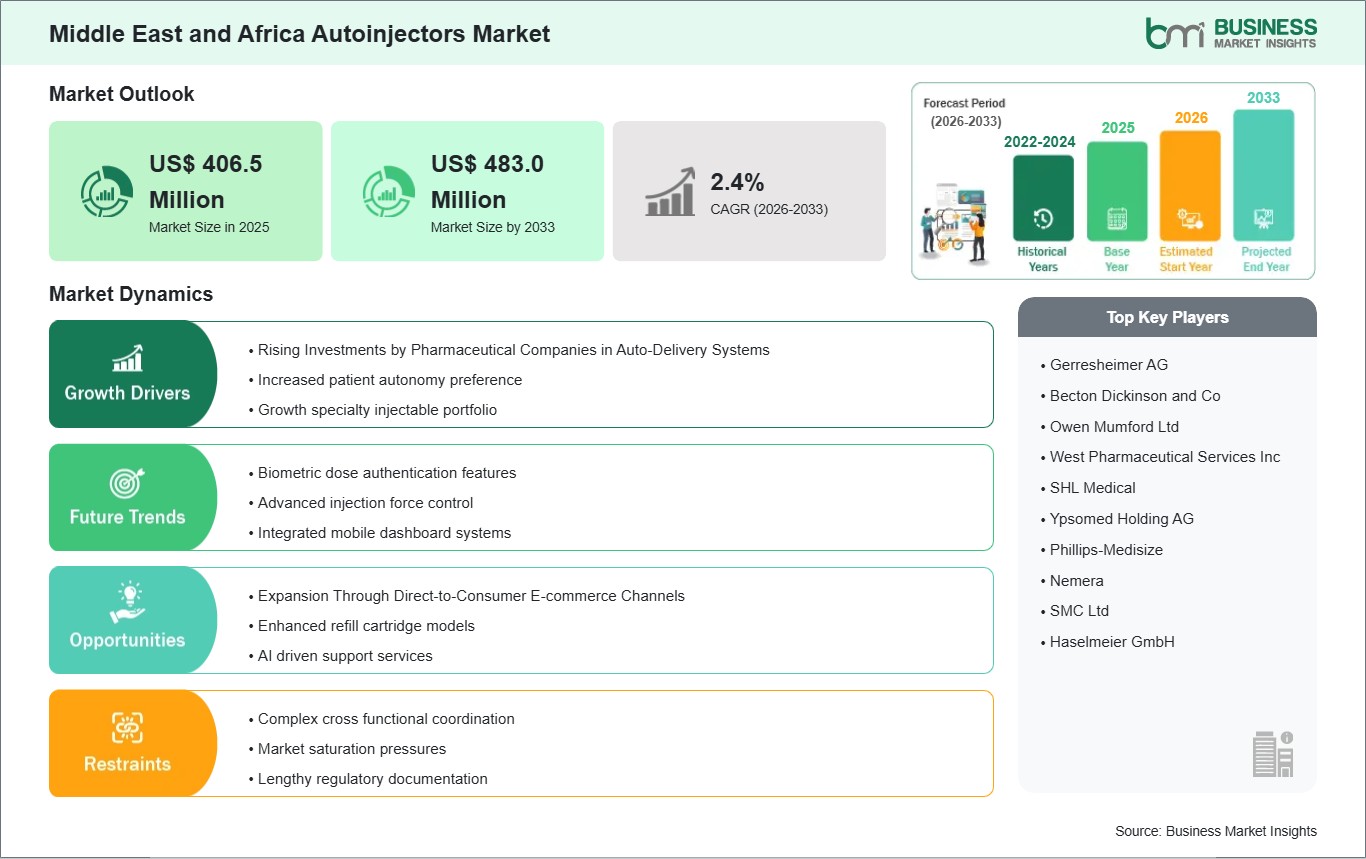
The Middle East and Africa Autoinjectors Market size is expected to reach US$ 483.0 million by 2033 from US$ 406.5 million in 2025. The market is estimated to record a CAGR of 2.4% from 2026 to 2033.
The Middle East and Africa (MEA) autoinjectors market is witnessing notable growth, driven by rising prevalence of chronic and autoimmune disorders, expanding healthcare infrastructure, and increasing awareness of self-administration therapies. Key markets in the region, including Saudi Arabia, United Arab Emirates, South Africa, Egypt, and Nigeria, are driving adoption of prefilled and easy-to-use autoinjectors for biologics, epinephrine, and insulin therapies. Urbanization and increasing patient autonomy have shifted preference toward homecare, reducing reliance on hospital-based administration and improving adherence to long-term treatment regimens. The competitive landscape is dominated by global medical device manufacturers, though regional players are increasingly entering the market through partnerships, co-development, and licensing agreements. Product innovation is a key differentiator, with emphasis on ergonomic design, safety mechanisms, dual-chamber systems, and emerging digital features for adherence monitoring. Regulatory frameworks vary across the region, requiring companies to navigate differing approval processes, local clinical validations, and import restrictions. Distribution channels are evolving from hospital-centric models to include retail pharmacies, specialty clinics, and telemedicine-enabled homecare delivery systems. Government initiatives and improving reimbursement policies in countries such as Saudi Arabia, UAE, and South Africa are enhancing patient access to autoinjectors. Public health awareness campaigns, patient training programs, and urban outreach initiatives are further supporting adoption, particularly among pediatric and geriatric populations. The MEA autoinjectors market presents a landscape of high potential but operational complexity, where innovation, regulatory navigation, and patient education are critical to achieving sustainable growth.

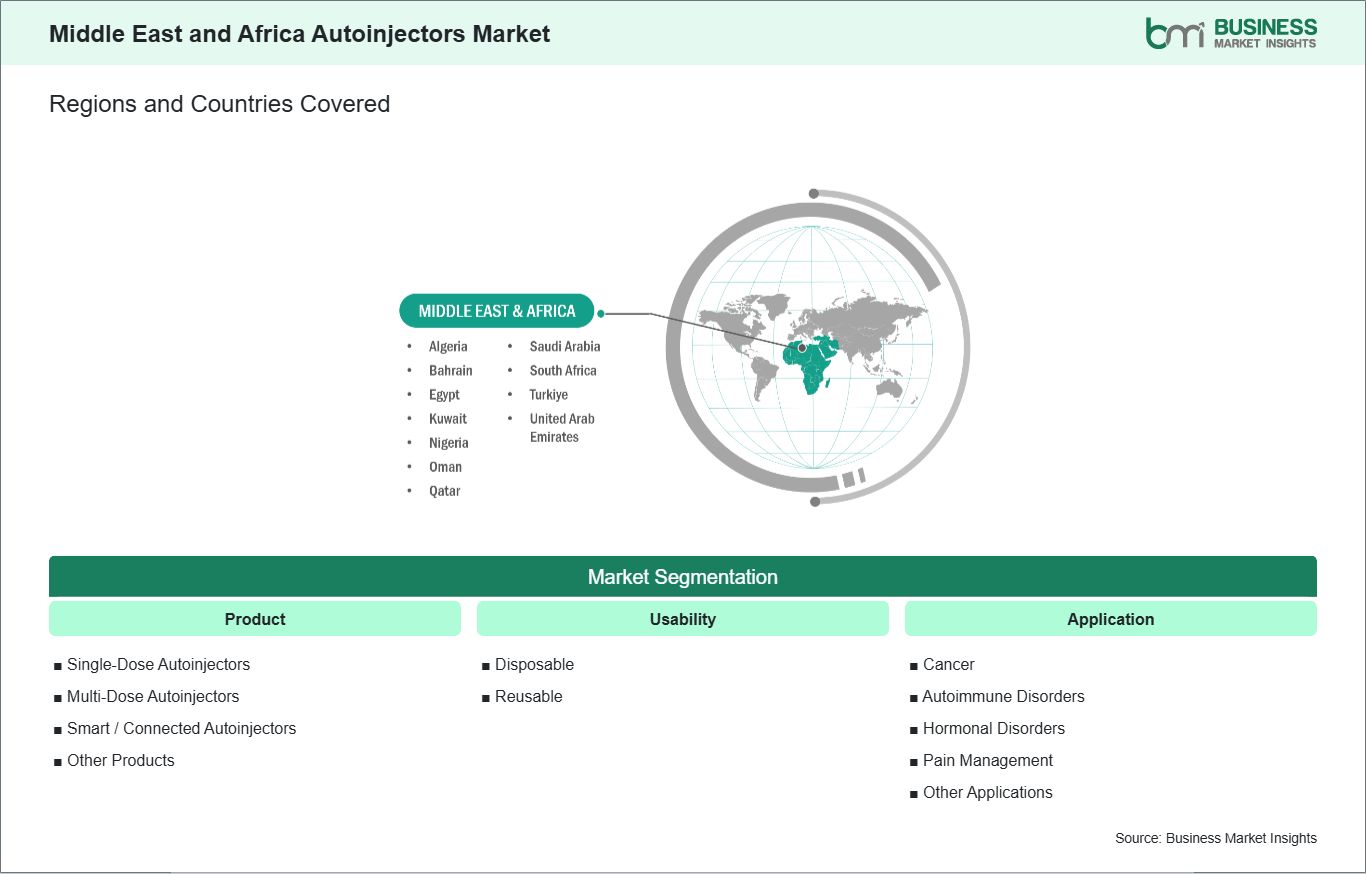
Key segments that contributed to the derivation of the Middle East and Africa autoinjectors market analysis are product, usability, and application.
Across the Middle East and Africa, pharmaceutical companies are significantly increasing investments in auto‑delivery systems to capture unmet needs in chronic disease management and immunization. In major healthcare hubs, leading multinational drugmakers are partnering with regional distributors to introduce autoinjector formats for established biologic therapies and newer monoclonal agents. These investments are being driven by an increasing prevalence of autoimmune diseases, diabetes, and allergic conditions that benefit from self‑injectable treatment. The strategic deployment of autoinjectors aligns with broader industry goals to reduce clinic burdens and improve patient compliance in markets where frequent hospital visits can be a barrier to sustained therapy. Investment patterns are particularly notable in the expansion of localized clinical training programs aimed at integrating autoinjector devices into standard treatment pathways. Pharmaceutical stakeholders are co‑funding educational initiatives with healthcare providers to ensure that physicians, nurses, and patients are fluent in self‑administration techniques. These programs often include in‑clinic demonstrations, digital training modules, and patient support hotlines that contextualize device use in the realities of urban outpatient care. Such efforts help mitigate concerns about incorrect administration, a key factor limiting adoption in regions where home self‑care models are still evolving. Regional pharmaceutical investment is also focused on manufacturing and supply chain enhancements that improve autoinjector accessibility in secondary and tertiary care settings. Companies are optimizing distribution networks to ensure that autoinjectors are consistently stocked in major pharmacy chains and hospital formularies. This is especially important in areas where logistics infrastructure varies widely, as reliable product availability directly influences physician willingness to prescribe auto‑delivery systems. As manufacturers continue to expand portfolios with region‑specific pricing, packaging, and support services, autoinjectors are increasingly viewed as a strategic growth segment rather than a niche delivery option in the broader Middle East and Africa healthcare ecosystem.
Direct‑to‑consumer (D2C) e‑commerce channels are emerging as a powerful growth vector for autoinjector products across the Middle East and Africa, particularly as digital health adoption accelerates. Urban populations with high mobile penetration are increasingly shopping for chronic care devices through online pharmacies and health marketplaces. Autoinjectors once primarily distributed through clinic prescriptions are now gaining visibility in online catalogs where consumers compare features, delivery options, and patient reviews before purchasing. This shift is especially evident among tech‑savvy segments that value home delivery and digital support services, reinforcing D2C as a strategic channel for market expansion. Healthcare providers and device manufacturers are capitalizing on this trend by integrating telehealth consultations with e‑commerce fulfillment, creating seamless pathways for patients to receive personalized device recommendations and doorstep delivery. For individuals managing long‑term injectable therapies, this hybrid model reduces dependence on periodic clinic visits, which can be logistically challenging in sprawling urban centers or remote regions with limited transportation infrastructure. Digital platforms that offer subscription‑based reorders and automated reminders further enhance adherence while increasing lifetime customer value for autoinjector vendors. Region‑specific digital marketing campaigns are also contributing to D2C sales growth by building awareness about the convenience and safety of self‑administration. Social media outreach, influencer collaborations with healthcare educators, and localized content in multiple languages help demystify device features and connect directly with patients and caregivers. In areas with limited brick‑and‑mortar healthcare infrastructure, online forums and support communities reinforce peer‑to‑peer learning about autoinjector use, reducing barriers to adoption. As e‑commerce ecosystems mature across the Middle East and Africa supported by expanding digital payment systems and last‑mile logistics improvements direct‑to‑consumer channels are poised to play a central role in autoinjector market development.
The Middle East and Africa Autoinjectors Market demonstrates steady growth, with size and share analysis highlighting evolving trends and competitive dynamics among key players. The report examines subsegments categorized within product, usability, and application, offering insights into their contribution to overall market performance.
By product, the single-dose autoinjectors subsegment dominated the market in 2025, driven by strong regional preference for convenient, pre‑filled, ready‑to‑use devices that improve ease of self‑administration and reduce contamination risk in home and emergency settings.
Based on usability, the disposable subsegment dominated the market in 2025, driven by widespread demand for single‑use, sterile systems that offer convenience, reduce cross‑contamination, and meet emergency care and home‑based treatment needs across diverse MEA healthcare environments.
In terms of application, the autoimmune disorders subsegment dominated the market in 2025, driven by rising prevalence of chronic immune‑mediated conditions such as rheumatoid arthritis, multiple sclerosis, and psoriasis that require frequent biologic treatments optimally delivered via autoinjectors.
| Report Attribute | Details |
|---|---|
| Market size in 2025 | US$ 406.5 Million |
| Market Size by 2033 | US$ 483.0 Million |
| CAGR (2026 - 2033) | 2.4% |
| Historical Data | 2022-2024 |
| Forecast period | 2026-2033 |
| Segments Covered | By Product
|
|
Regions and Countries Covered
| |
| Middle East and Africa | Turkiye, the UAE, Saudi Arabia, Bahrain, Oman, Egypt, South Africa, Algeria, Nigeria, Kuwait, Qatar |
| Market leaders and key company profiles |
|
The "Middle East and Africa Autoinjectors Market Size and Forecast (2022–2033)" report provides a detailed analysis of the market covering below areas:
The geographical scope of the Middle East and Africa Autoinjectors Market report is divided into Turkiye, the UAE, Saudi Arabia, Bahrain, Oman, Egypt, South Africa and Africa, Algeria, Nigeria, Kuwait, and Qatar. Turkiye held the largest share in 2025.
Country-specific insights for the Middle East and Africa (MEA) autoinjectors market reveal varied adoption patterns, with Turkey emerging as the dominant market in the region. Turkey’s large population, expanding healthcare infrastructure, and growing prevalence of chronic diseases and autoimmune disorders position it as the central driver of market growth. Hospitals, specialty clinics, and urban pharmacies in cities such as Istanbul, Ankara, and Izmir show high uptake of autoinjectors for biologics, insulin, and emergency therapies. Government initiatives supporting local manufacturing, reimbursement schemes, and regulatory alignment with European standards further enhance accessibility and adoption. In the Saudi Arabia, urban adoption is strong due to expanding hospital networks, government healthcare investment, and public-private partnerships, though the market is smaller in volume compared to Turkey. Advanced biologic therapies and premium autoinjectors are gaining traction in metropolitan areas, supported by patient training programs and awareness campaigns. The United Arab Emirates is characterized by high digital health integration, with connected autoinjectors, adherence tracking apps, and telemedicine-enabled self-administration programs driving adoption, particularly among private healthcare patients. South Africa presents a dual healthcare system where premium autoinjectors are mainly adopted by private hospitals, while cost-effective, disposable devices are prioritized in the public sector. Urban-rural disparities require tailored awareness and distribution strategies. Egypt and Nigeria represent cost-sensitive markets where adoption is concentrated in urban centers. Simplified devices, patient education programs, and localized distribution models are essential to drive penetration in these regions. Overall, Turkey leads the MEA autoinjectors market in volume and strategic influence, while other countries, including Saudi Arabia, UAE, South Africa, Egypt, and Nigeria, present diverse growth opportunities. Manufacturers need to implement differentiated strategies—focusing on premium product positioning in affluent markets, affordability and accessibility in cost-sensitive regions, and digital integration across technologically advanced healthcare systems—to maximize regional market penetration.

The Middle East and Africa Autoinjectors Market is evaluated by gathering qualitative and quantitative data post primary and secondary research, which includes important corporate publications, association data, and databases. A few of the key developments in the Middle East and Africa autoinjectors market are:
The Middle East and Africa Autoinjectors Market is valued at US$ 406.5 Million in 2025, it is projected to reach US$ 483.0 Million by 2033.
As per our report Middle East and Africa Autoinjectors Market, the market size is valued at US$ 406.5 Million in 2025, projecting it to reach US$ 483.0 Million by 2033. This translates to a CAGR of approximately 2.4% during the forecast period.
The Middle East and Africa Autoinjectors Market report typically cover these key segments-
The historic period, base year, and forecast period can vary slightly depending on the specific market research report. However, for the Middle East and Africa Autoinjectors Market report:
The Middle East and Africa Autoinjectors Market is populated by several key players, each contributing to its growth and innovation. Some of the major players include:
The Middle East and Africa Autoinjectors Market report is valuable for diverse stakeholders, including:
Essentially, anyone involved in or considering involvement in the Middle East and Africa Autoinjectors Market value chain can benefit from the information contained in a comprehensive market report.
Please tell us your area of interest
(Market Segments/ Regions and Countries/ Companies)