Market Summary
Executive Summary and Market Analysis
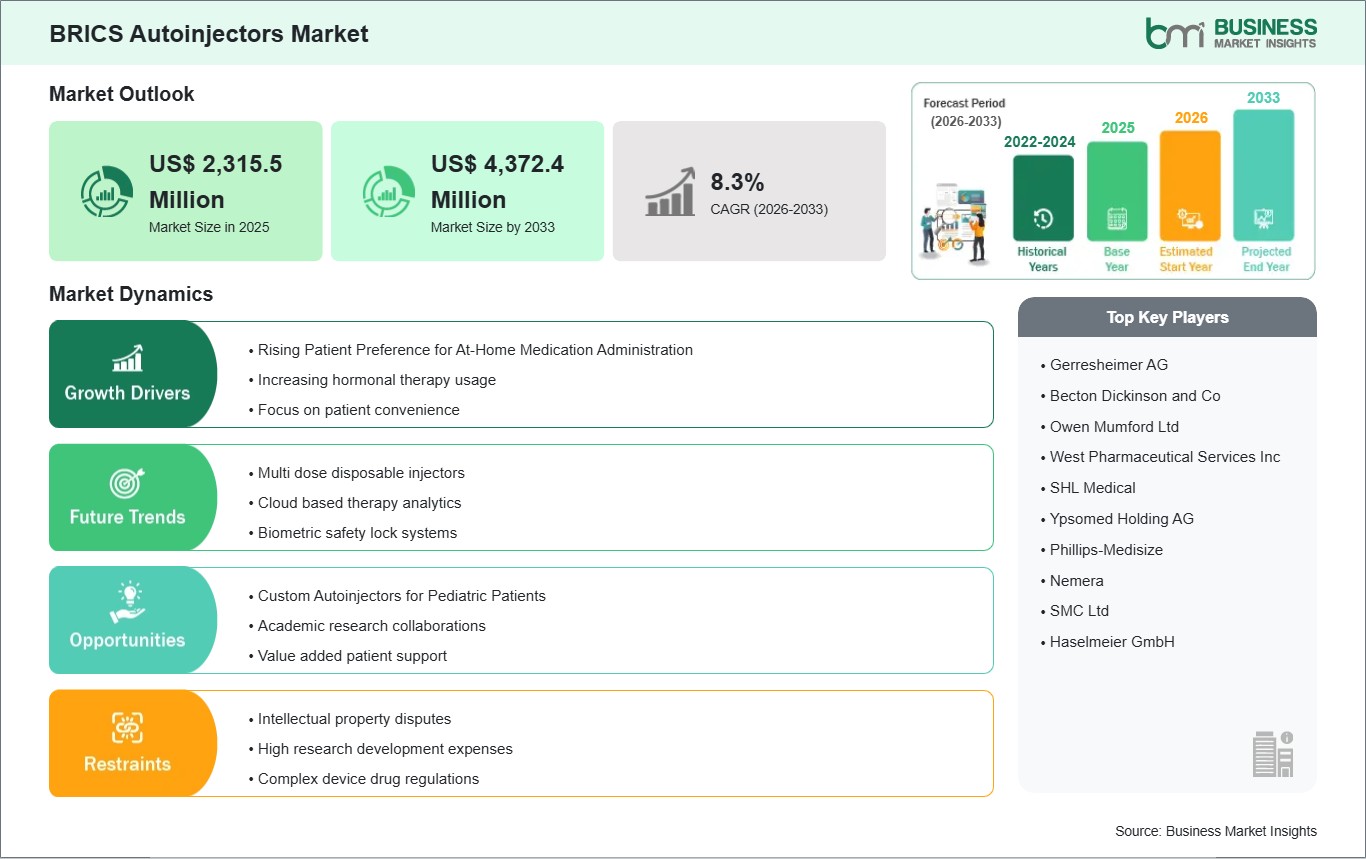
The BRICS autoinjectors market, comprising Brazil, Russia, India, China, and South Africa, is characterized by heterogeneous healthcare maturity levels and evolving demand for self-administration drug delivery systems. Rising incidence of autoimmune diseases, diabetes, anaphylaxis, and hormonal disorders across these economies is catalyzing the adoption of autoinjector technologies, particularly for biologics and emergency therapies. Urbanization, expanding middle-class populations, and improved access to specialty care are contributing to broader acceptance of patient-controlled injectable treatments. Market competition in BRICS is shaped by the presence of global device manufacturers alongside growing domestic pharmaceutical companies seeking vertical integration through combination drug-device offerings. Localization strategies, including domestic assembly and technology transfer partnerships, are becoming increasingly important to mitigate import dependency and manage pricing pressures. Regulatory pathways vary significantly across BRICS nations, necessitating adaptive compliance strategies and localized clinical validation processes. Procurement models differ by country, with public healthcare systems playing a dominant role in Brazil, Russia, China, and South Africa, while private healthcare expenditure significantly influences India’s market dynamics. Hospital-based administration remains prevalent; however, there is a gradual shift toward home-based therapy, particularly in urban centers with improved patient education and digital engagement. Product differentiation focuses on safety-lock mechanisms, ergonomic design, and ease of use, especially for elderly and pediatric populations. Overall, the BRICS autoinjectors market presents a high-growth but operationally complex environment, where regulatory navigation, pricing optimization, and local manufacturing partnerships are critical success factors for sustained expansion.
Segment Analysis
BRICS Autoinjectors Market Segmentation
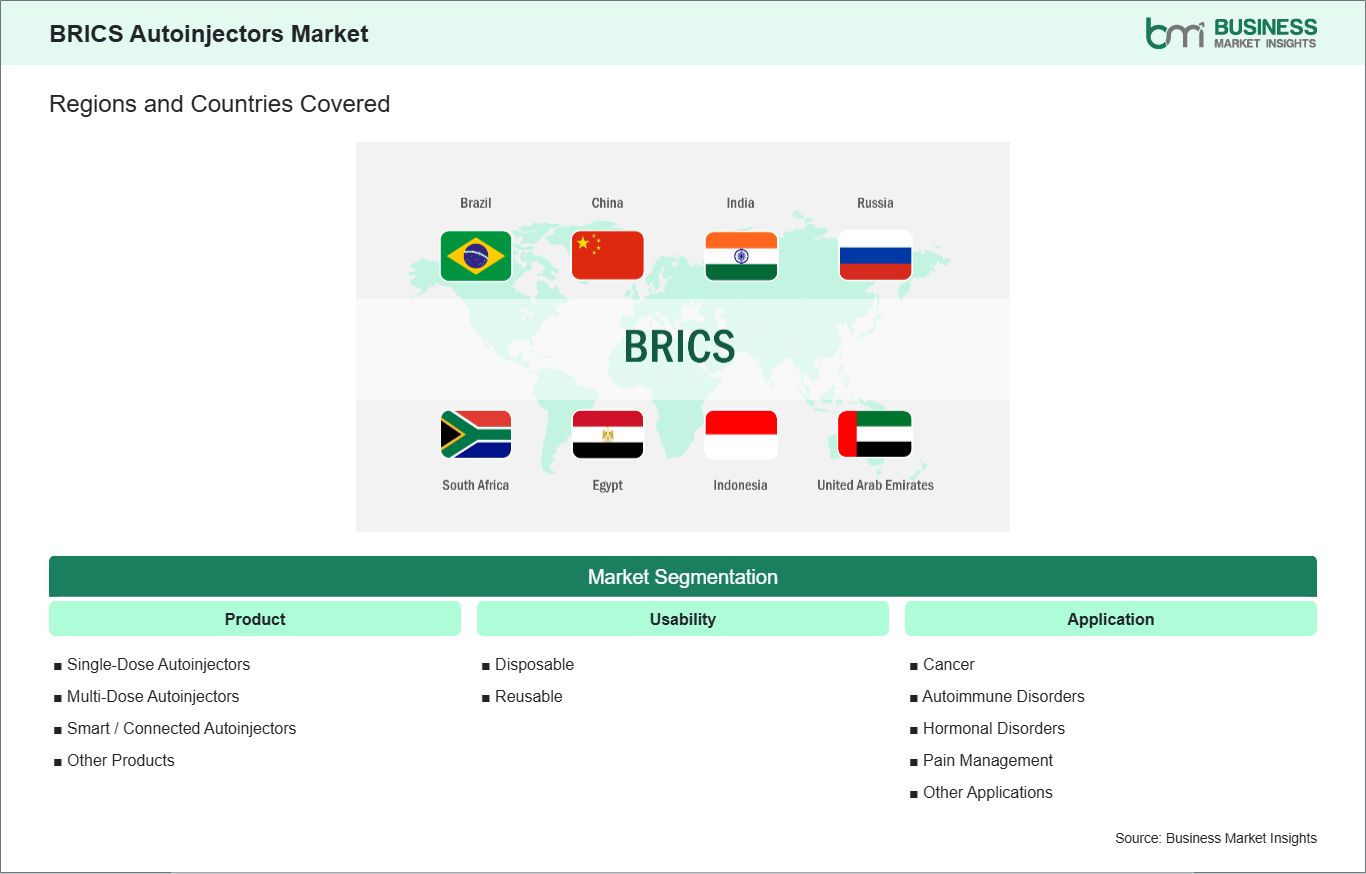
Key segments that contributed to the derivation of the BRICS autoinjectors market analysis are product, usability, and application.
- By product, the autoinjectors market is segmented into single-dose autoinjectors, multi-dose autoinjectors, smart / connected autoinjectors, and others. The single-dose autoinjectors segment dominated the market in 2025.
- Based on usability, the autoinjectors market is categorized into disposable and reusable. The disposable segment dominated the market in 2025.
- In terms of application, the market is classified into cancer, autoimmune disorders, hormonal disorders, pain management, and other applications. The autoimmune disorders segment dominated the market in 2025.
Market Forces
BRICS Autoinjectors Market Drivers and Opportunities
Rising Patient Preference for At-Home Medication Administration
Across the BRICS market, there is a pronounced shift toward patient-centric care models, and autoinjectors have become emblematic of this transformation. In chronic disease communities from São Paulo to Shanghai, patients and caregivers increasingly favor at-home medication administration because it reduces dependency on clinic visits and empowers independent management of long-term therapy. This trend is especially visible among diabetes and autoimmune disease populations where self-injectable biologics have replaced traditional infusion protocols in many urban and peri-urban healthcare settings. In Brazil, outpatient clinics and local pharmacies report growing demand for autoinjectors among working adults who struggle to attend frequent hospital appointments. Patients with rheumatoid arthritis in Rio de Janeiro, for example, cite the convenience and discretion of at-home autoinjectors as factors that improve adherence and quality of life. Similarly, in Russia, chronic disease support groups in Moscow and St. Petersburg advocate for device formats that allow patients to self-administer biologic therapies without repeated specialist consultation, a dynamic that has accelerated adoption among older adults managing multi-drug regimens. India and South Africa illustrate how resource considerations intersect with preference trends. In metropolitan Indian health hubs like Bengaluru and Pune, home healthcare services routinely educate patients on autoinjector use to mitigate urban transit burdens and overcrowded clinics. South African outpatient programs in Johannesburg have integrated autoinjector teaching into community health worker initiatives, enabling patients in both township and suburban contexts to manage injectable therapies at home with confidence. In China, national e-health platforms increasingly offer digital tutorials and telemedicine support that reinforce safe home injection practices, further cementing autoinjectors as a central tool in decentralized care. Across the BRICS block, the cumulative effect is strong market momentum anchored in the preference for at-home administration.
Custom Autoinjectors for Pediatric Patients
Within the BRICS region, pediatric healthcare demand is spurring innovation in autoinjector design tailored to children’s unique needs. Pediatric endocrinologists in São Paulo and Rio Grande do Sul have reported that child-friendly insulin autoinjectors — with lower minimum volumes and ergonomic grips significantly improve acceptance among young patients with type 1 diabetes. Parents increasingly request devices with visual dose indicators and simplified handling to reduce anxiety and errors during home administration. This demand is shaping local procurement patterns in both public clinics and private pediatric centers. In China, pediatric vaccination initiatives are piloting autoinjectors with customized safety features, such as retractable needles and audible feedback, to support first-time injectable vaccine recipients. Hospitals in Shanghai and Guangzhou report that younger children respond better to devices that reduce the visual and tactile stress associated with injections. These tailored features are also gaining traction for therapies beyond vaccines for example, growth hormone replacement and juvenile arthritis biologics — where comfort and performance are equally paramount. India’s large pediatric population and diverse healthcare environments further underscore the need for region-specific autoinjector solutions. Pediatric clinics in New Delhi and Hyderabad are adopting color-coded devices with dosage locks that prevent accidental overdosing, an important safeguard where caregivers may be managing complex regimens for children with chronic illnesses. South African children’s hospitals, from Cape Town to Durban, are engaging in community education campaigns that pair child-specific autoinjectors with age-appropriate training materials, bridging gaps in caregiver confidence and improving overall treatment outcomes. In Russia, specialist centers in Yekaterinburg and Novosibirsk are integrating digital dose-tracking features into pediatric autoinjectors, enabling clinicians to monitor adherence remotely a capability increasingly valued in geographically dispersed populations. Across the BRICS landscape, the convergence of pediatric design innovation and expanding clinical need is creating a vibrant niche within the broader autoinjectors market.
Size and Share Analysis
BRICS Autoinjectors Market Size and Share Analysis
The BRICS Autoinjectors Market demonstrates steady growth, with size and share analysis highlighting evolving trends and competitive dynamics among key players. The report examines subsegments categorized within product, usability, and application, offering insights into their contribution to overall market performance.
By product, the single-dose autoinjectors subsegment dominated the market in 2025, driven by growing patient and caregiver preference for easy-to-use, pre-filled devices that improve adherence and minimise administration errors.
Based on usability, the disposable subsegment dominated the market in 2025, driven by high demand for safe, low-maintenance, single-use delivery systems that reduce contamination risk and support expanding home-care treatment.
In terms of application, the autoimmune disorders subsegment dominated the market in 2025, driven by increasing prevalence of chronic immune-mediated diseases in BRICS countries that require frequent biologic injections suitable for autoinjector use.
Report Coverage
BRICS Autoinjectors Market Report Coverage and Deliverables
The "BRICS Autoinjectors Market Size and Forecast (2022–2033)" report provides a detailed analysis of the market covering below areas:
- BRICS Autoinjectors Market size and forecast at regional and country levels for all market segments covered under the scope
- BRICS Autoinjectors Market trends, as well as drivers, restraints, and opportunities
- BRICS Autoinjectors Market analysis covering key trends, regional framework, major players, regulations, and recent developments
- Industry landscape and competition analysis covering market concentration, heat map analysis, prominent players, and recent developments for the BRICS Autoinjectors Market
- Detailed company profiles, including SWOT analysis
Geographic Insights
BRICS Autoinjectors Market Geographic Insights
The geographical scope of the BRICS Autoinjectors Market report is divided into Russia, Brazil, South Africa, India, the UAE, and China. China held the largest share in 2025.
Country-level analysis within the BRICS autoinjectors market reveals differentiated strategic drivers. In China, strong public healthcare coverage under the national health system supports access to essential injectable therapies, though budgetary constraints necessitate competitive pricing strategies. Local distribution partnerships and regulatory compliance with ANVISA standards are critical for market entry. Russia emphasizes domestic pharmaceutical manufacturing and import substitution policies, creating opportunities for joint ventures and localized production of autoinjector components. Government procurement channels play a significant role in determining device adoption patterns. In India, rapid expansion of private hospitals and specialty clinics, coupled with a strong biosimilar manufacturing base, is fostering integration of autoinjector platforms into chronic disease treatment protocols. Affordability and physician training programs remain pivotal to scaling penetration. Brazil demonstrates increasing regulatory streamlining and centralized procurement reforms, influencing pricing negotiations and competitive dynamics. Domestic innovation in biologics is further enhancing demand for compatible delivery devices. Meanwhile, South Africa reflects a dual healthcare system where private-sector demand for premium autoinjectors contrasts with cost-sensitive public procurement frameworks. These country-specific distinctions underscore the necessity of tailored commercialization models, adaptive pricing frameworks, and strategic alliances to effectively capture growth within the diverse BRICS autoinjectors market landscape.
Industry Activity
Recent Developments
The BRICS Autoinjectors Market is evaluated by gathering qualitative and quantitative data post primary and secondary research, which includes important corporate publications, association data, and databases. A few of the key developments in the BRICS autoinjectors market are:
- In December 2025, China’s National Medical Products Administration (NMPA) approved neffy 2 mg (epinephrine nasal spray) for the emergency treatment of Type I allergic reactions including anaphylaxis in adults and children weighing 30 kg or more; this product serves as the first community-use epinephrine treatment available outside hospital settings in China. Although it is a needle-free epinephrine device rather than a classic spring-loaded autoinjector, its approval effectively fills the role of self-administered emergency epinephrine where no epinephrine auto-injectors (EAIs) were previously approved locally. The product, marketed under trade name by Pediatrix Therapeutics in China, is expected in spring 2026. This clearance marks a major milestone for self-administration emergency devices in a major BRICS market.
- In July 2025, India CDSCO Approval granted in India for abatacept 125 mg/mL solution in autoinjector or prefilled syringe (a biologic immunomodulator delivered via an autoinjector format), enabling local access to this device‑based therapy.
Trust & Transparency
Research Methodology
The market analysis combines proprietary research with secondary data from government agencies, company disclosures, regulatory filings, industry databases and expert interviews. Market estimates are validated through data triangulation, cross-market benchmarking and analyst
review.
View Full Research Methodology
Key Sources Referred:
World Health Organization (WHO) Organisation for Economic Cooperation and Development (OECD) The World Bank Group Worldometer The Lancet International Bar Association International Trade Administration