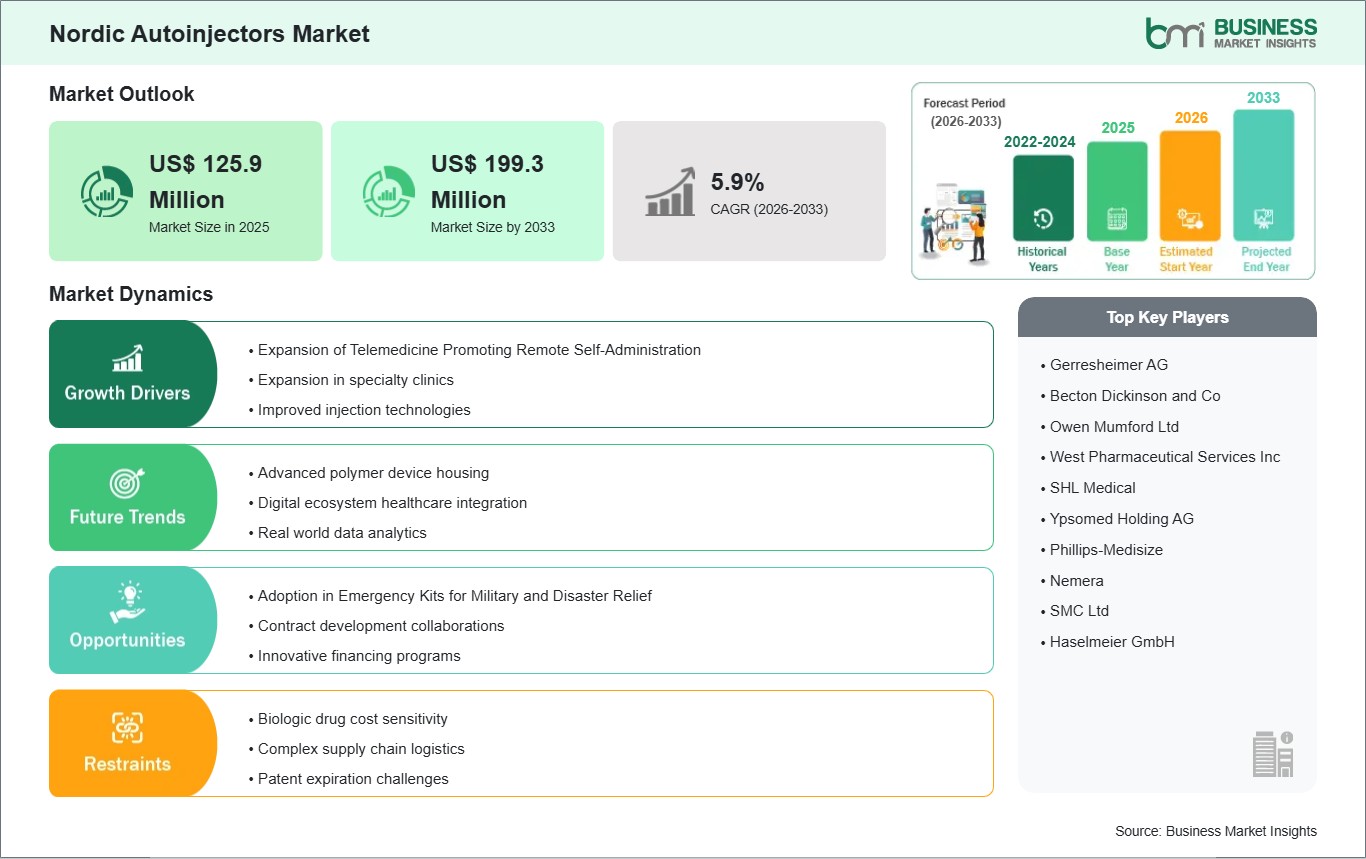
Market Summary
Executive Summary and Market Analysis
The Nordic autoinjectors market is characterized by a high level of sophistication in healthcare infrastructure, widespread patient awareness, and strong adoption of self-administration therapies. Key countries driving the market include Sweden, Norway, Denmark, and Finland. These countries exhibit high incidences of chronic and autoimmune diseases, such as rheumatoid arthritis, multiple sclerosis, and severe allergies, which underpin demand for prefilled autoinjectors. The region’s focus on patient-centric care, home-based therapies, and adherence monitoring has reinforced self-injection as a preferred mode of drug delivery. The competitive landscape in the Nordic region is dominated by global manufacturers, though local players actively collaborate on research and development to improve device ergonomics and usability. Technological innovation is a major differentiator, including dual-chamber systems, user-friendly safety mechanisms, and digital integration for dose tracking and adherence support. Regulatory oversight is stringent, aligning with European Union medical device regulations, requiring comprehensive clinical validation, safety testing, and compliance documentation. Distribution channels are evolving, with hospitals and specialty clinics remaining central for high-value biologics, while retail pharmacies and homecare services are increasingly significant for emergency therapies such as epinephrine. National reimbursement systems, combined with public health campaigns and patient education initiatives, facilitate widespread adoption. The Nordic autoinjectors market demonstrates a high degree of maturity, driven by technology adoption, robust healthcare policies, and patient-focused care models, positioning the region as an attractive and stable market for both existing and new entrants.
Segment Analysis
Nordic Autoinjectors Market Segmentation
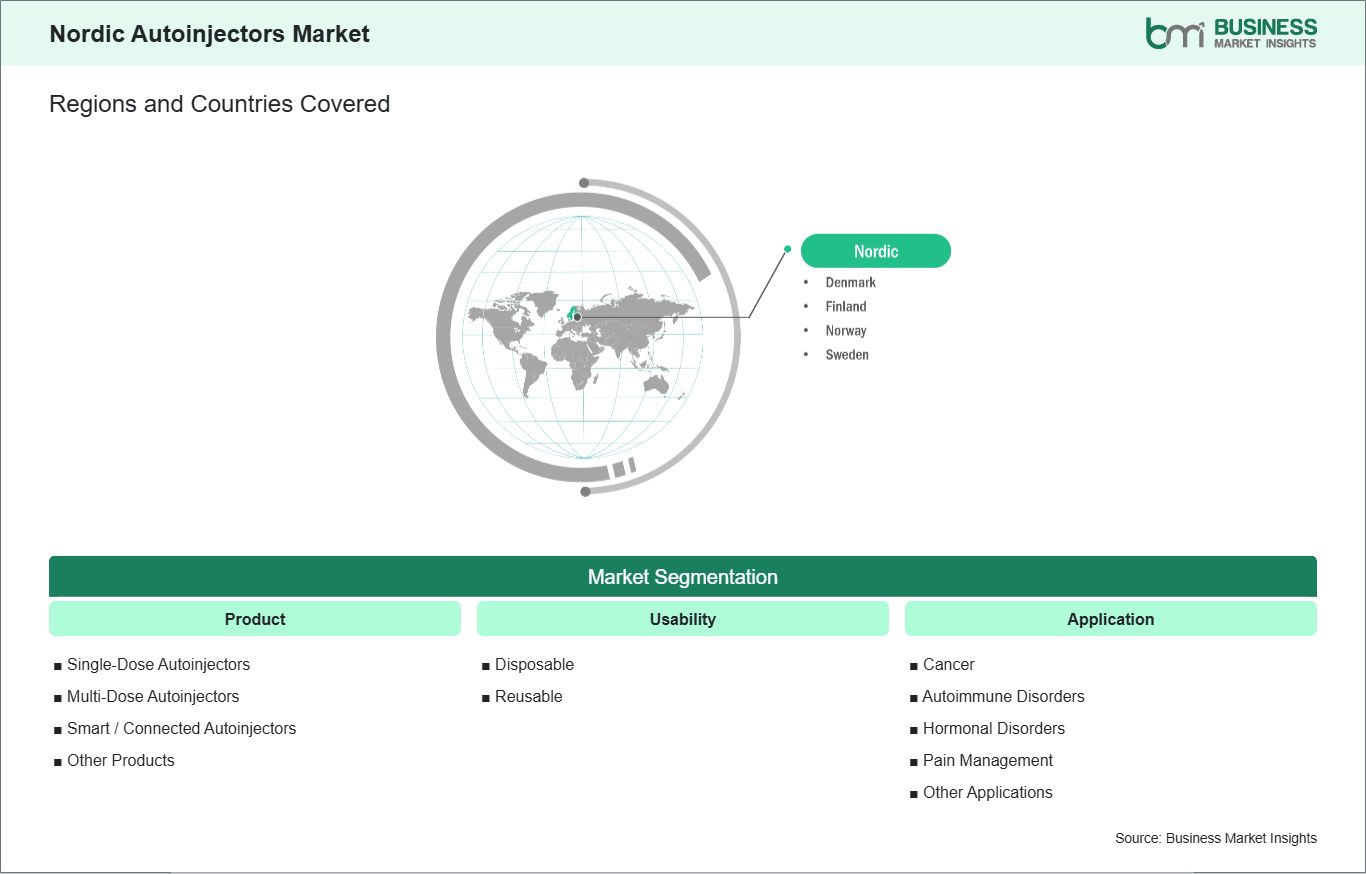
Key segments that contributed to the derivation of the Nordic autoinjectors market analysis are product, usability, and application.
- By product, the autoinjectors market is segmented into single-dose autoinjectors, multi-dose autoinjectors, smart / connected autoinjectors, and others. The single-dose autoinjectors segment dominated the market in 2025.
- Based on usability, the autoinjectors market is categorized into disposable and reusable. The disposable segment dominated the market in 2025.
- In terms of application, the market is classified into cancer, autoimmune disorders, hormonal disorders, pain management, and other applications. The autoimmune disorders segment dominated the market in 2025.
Market Forces
Nordic Autoinjectors Market Drivers and Opportunities
Expansion of Telemedicine Promoting Remote Self-Administration
The rapid expansion of telemedicine across the Middle East is reshaping care delivery models and accelerating adoption of autoinjector technologies that support remote self‑administration. National e‑health initiatives in Saudi Arabia and the UAE are integrating virtual consultation platforms into chronic disease management pathways, allowing clinicians to prescribe, demonstrate, and monitor self‑injectable therapies without requiring patients to visit clinics in person. For conditions like diabetes, rheumatoid arthritis, and multiple sclerosis which increasingly rely on biologic therapies telemedicine has proved instrumental in reducing barriers to initiation and adherence. Patients in Riyadh and Dubai now receive live guidance via video consultations on proper autoinjector usage, significantly improving confidence and reducing clinical visit frequency. In Kuwait and Qatar, public health authorities have strengthened telehealth infrastructure to support continuity of care during seasonal health challenges and travel disruptions. Remote care platforms connect endocrinologists and immunologists with patients in smaller towns and semi‑urban governorates, where access to specialty clinics has historically been limited. Clinicians can review patients’ injection history, answer real‑time questions about technique, and adjust dosing regimens without necessitating in‑person visits, making telemedicine an enabler of decentralized autoinjector adoption. As a result, self‑administration at home supported by virtual guidance is becoming an accepted standard of care for chronic injectable therapies across diverse Middle Eastern healthcare settings. Telemedicine’s impact is also evident in patient education and support ecosystems. In Bahrain and Oman, digital health apps linked to teleconsultation services provide instructional videos, reminders, and remote check‑ins that reinforce correct autoinjector use. This blend of virtual care and device support fosters higher adherence, particularly among patients managing multi‑drug regimens or experiencing mobility constraints. With ministries of health emphasizing digital transformation and remote service expansion, telemedicine platforms are expected to further propel autoinjector utilization across the region, especially for chronic conditions that benefit from long‑term home self‑administration.
Adoption in Emergency Kits for Military and Disaster Relief
Autoinjectors are increasingly being incorporated into emergency medical kits across military units and disaster response teams throughout the Middle East due to their speed, safety, and ease of use in high‑pressure settings. Regional defense forces and civil defense organizations have prioritized rapid response readiness in environments ranging from border security operations to mass gathering events. Pre‑filled epinephrine autoinjectors, naloxone devices, and other emergency therapeutics are now standard issue in tactical medical backpacks used by field medics in Saudi Arabian and Emirati armed forces. These devices ensure that frontline personnel can deliver urgent care, such as anaphylaxis management or opioid reversal, with minimal training and maximum reliability. In Qatar and Kuwait, disaster relief agencies and first responder corps have integrated autoinjectors into mobile emergency units deployed during extreme weather events and mass casualty exercises. Given the region’s susceptibility to heat‑related illnesses and large‑scale public events, emergency planners emphasize tools that reduce administration complexity and improve response time. Autoinjectors’ single‑action design and clear visual cues make them particularly suited for emergency scenarios where rapid intervention can be life‑saving and where traditional injectable preparations are impractical. Civilian disaster response frameworks in Oman and Bahrain are also adopting autoinjector deployment strategies as part of community resilience programs. Public health authorities train volunteer responders and municipal health workers on autoinjector use during earthquake simulations, pandemic surges, and other crisis preparations. Placement of autoinjector kits in schools, community centers, and remote outposts extends emergency care capacity beyond formal clinical settings, reinforcing public safety objectives. As regional governments continue to prioritize integrated emergency preparedness systems, autoinjector inclusion in military and disaster relief kits is expected to expand, solidifying their role as essential tools for rapid response and first aid interventions throughout the Middle East.
Size and Share Analysis
Nordic Autoinjectors Market Size and Share Analysis
The Nordic Autoinjectors Market demonstrates steady growth, with size and share analysis highlighting evolving trends and competitive dynamics among key players. The report examines subsegments categorized within product, usability, and application, offering insights into their contribution to overall market performance.
By product, the single-dose autoinjectors subsegment dominated the market in 2025, driven by their convenience, reduced risk of contamination, and strong patient preference for simple, ready‑to‑use delivery in chronic and emergency self‑administration therapies.
Based on usability, the disposable subsegment dominated the market in 2025, driven by ease of use, no maintenance requirements, built‑in safety features, and high adoption in healthcare protocols for at‑home and clinical injections.
In terms of application, the autoimmune disorders subsegment dominated the market in 2025 driven by the rising prevalence of conditions such as rheumatoid arthritis, multiple sclerosis, and other chronic immune‑mediated diseases requiring frequent biologic injections that benefit from reliable autoinjector delivery.
Report Coverage
Nordic Autoinjectors Market Report Coverage and Deliverables
The "Nordic Autoinjectors Market Size and Forecast (2022–2033)" report provides a detailed analysis of the market covering below areas:
- Nordic Autoinjectors Market size and forecast at regional and country levels for all market segments covered under the scope
- Nordic Autoinjectors Market trends, as well as drivers, restraints, and opportunities
- Nordic Autoinjectors Market analysis covering key trends, regional framework, major players, regulations, and recent developments
- Industry landscape and competition analysis covering market concentration, heat map analysis, prominent players, and recent developments for the Nordic Autoinjectors Market
- Detailed company profiles, including SWOT analysis
Geographic Insights
Nordic Autoinjectors Market Geographic Insights
The geographical scope of the Nordic Autoinjectors Market report is divided into Sweden, Denmark, Norway, and Finland. Sweden held the largest share in 2025.
Country-specific insights reveal nuanced adoption trends across the Nordic region. Sweden is a mature market with high adoption of both standard and smart autoinjectors, supported by universal healthcare coverage, advanced hospital networks, and strong patient education initiatives. Norway demonstrates high penetration of biologic autoinjectors for chronic and autoimmune diseases, with urban areas showing greater uptake due to access to specialized clinics and digital adherence monitoring programs. In Denmark, public awareness campaigns and national immunization programs drive adoption of emergency therapies, particularly epinephrine autoinjectors, while the integration of telemedicine enhances patient compliance. Finland reflects a balanced market where both public and private healthcare sectors contribute to adoption. Disposable and ergonomically optimized devices are preferred, especially for pediatric and elderly patients, with digital adherence features gradually being incorporated into urban markets. Collectively, these insights indicate that the Nordic market emphasizes patient safety, digital integration, and adherence support, requiring manufacturers to tailor strategies to each country’s healthcare infrastructure, reimbursement policies, and patient demographics to maximize adoption and long-term growth.
Industry Activity
Recent Developments
The Nordic Autoinjectors Market is evaluated by gathering qualitative and quantitative data post primary and secondary research, which includes important corporate publications, association data, and databases. A few of the key developments in the Nordic autoinjectors market are:
- In May 2025, Sandoz launched the Pyzchiva (ustekinumab) autoinjector across Europe, representing the first commercially available ustekinumab biosimilar in an autoinjector format. The device is approved to treat moderate‑to‑severe plaque psoriasis, psoriatic arthritis, Crohn’s disease, and pediatric plaque psoriasis, offering a ready‑to‑use pre‑filled pen for self‑ Designed to improve patient comfort, it features accurate automatic dosing and a compact form factor that supports adherence to chronic inflammatory disease therapies. Pyzchiva is being rolled out progressively across European markets, including those in the Nordic region, where EMA approvals apply.
- In August 2024, the European Commission authorised Pyzchiva, a biosimilar to ustekinumab, for use in the EU after a positive EMA assessment. This centralised EU approval allowed the autoinjector presentation (and other formulations) to be marketed throughout all EU/EEA member states, including Nordic countries. The approval reflected equivalence to the reference product in treating conditions such as plaque psoriasis and Crohn’s disease, enabling its delivery via an autoinjector device for patient self‑administration
Trust & Transparency
Research Methodology
The market analysis combines proprietary research with secondary data from government agencies, company disclosures, regulatory filings, industry databases and expert interviews. Market estimates are validated through data triangulation, cross-market benchmarking and analyst
review.
View Full Research Methodology
Key Sources Referred:
World Health Organization (WHO) Organisation for Economic Cooperation and Development (OECD) The World Bank Group Worldometer The Lancet International Bar Association International Trade Administration