Market Summary
Executive Summary and Market Analysis
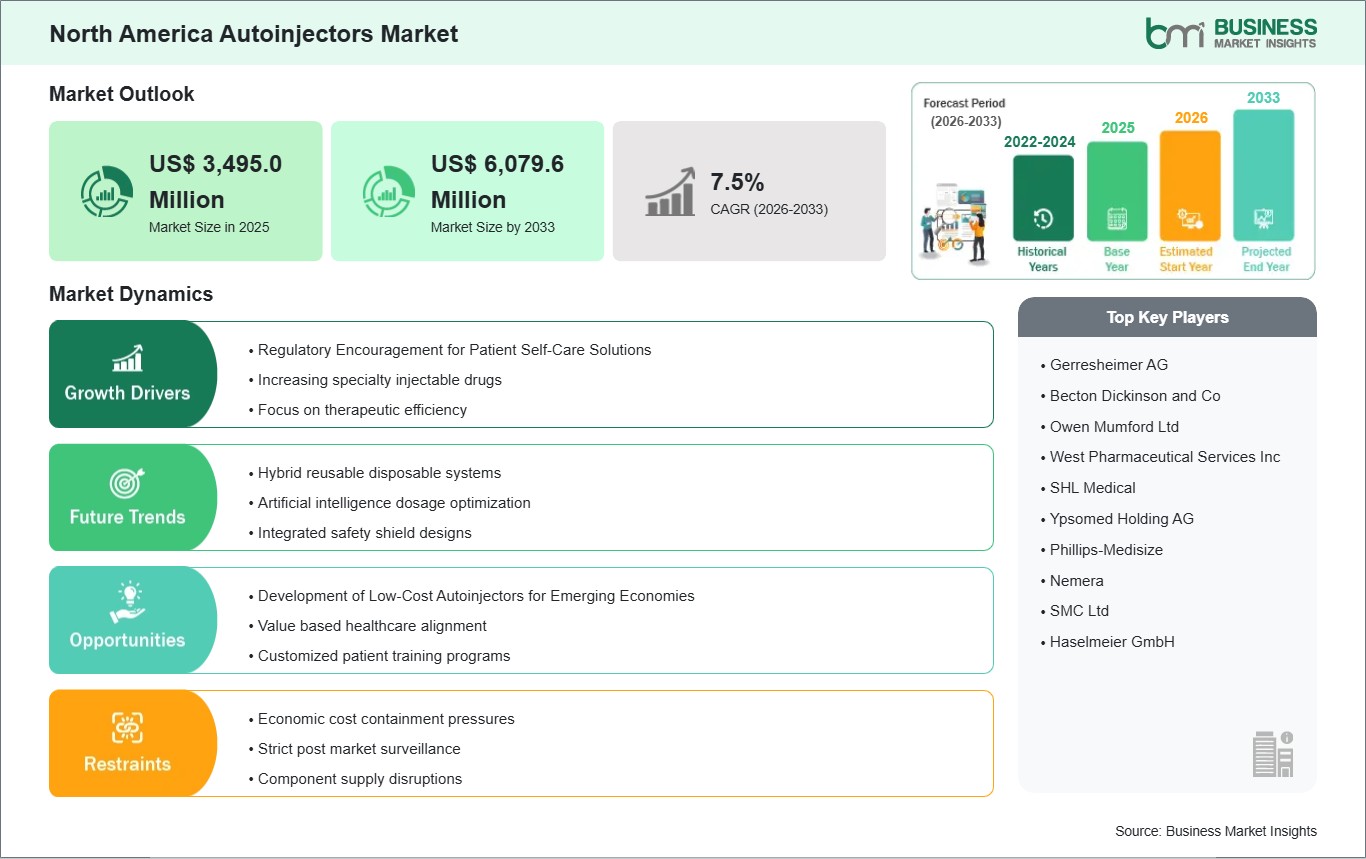
The North America autoinjectors market demonstrates a structurally strong growth trajectory driven by rising chronic disease prevalence, increasing biologics adoption, and expanding patient-centric drug delivery models. Autoinjectors are becoming integral to therapeutic areas such as autoimmune disorders, anaphylaxis, multiple sclerosis, and rheumatoid arthritis, where self-administration improves adherence and clinical outcomes. Regulatory support from agencies such as the U.S. Food and Drug Administration has accelerated approvals for combination products, encouraging pharmaceutical manufacturers to integrate device innovation early in drug development pipelines. Market competition is intensifying as established medical device companies and specialty drug manufacturers pursue differentiation through ergonomic design, safety mechanisms, and connectivity-enabled smart autoinjectors. Strategic collaborations between biotechnology firms and device engineering companies are reshaping commercialization models, emphasizing lifecycle management and value-added services. Additionally, payer pressure across the region is influencing product positioning, with emphasis on cost-efficient drug delivery systems that reduce hospital visits and nursing dependency. Supply chain resilience and localized manufacturing investments are emerging as strategic priorities, particularly in response to geopolitical volatility and raw material constraints. Sustainability considerations, including recyclable components and reduced plastic content, are increasingly influencing procurement decisions among institutional buyers. Overall, the market is transitioning from volume-driven expansion to value-driven innovation, where device reliability, patient usability, and digital integration form key competitive differentiators.
Segment Analysis
North America Autoinjectors Market Segmentation
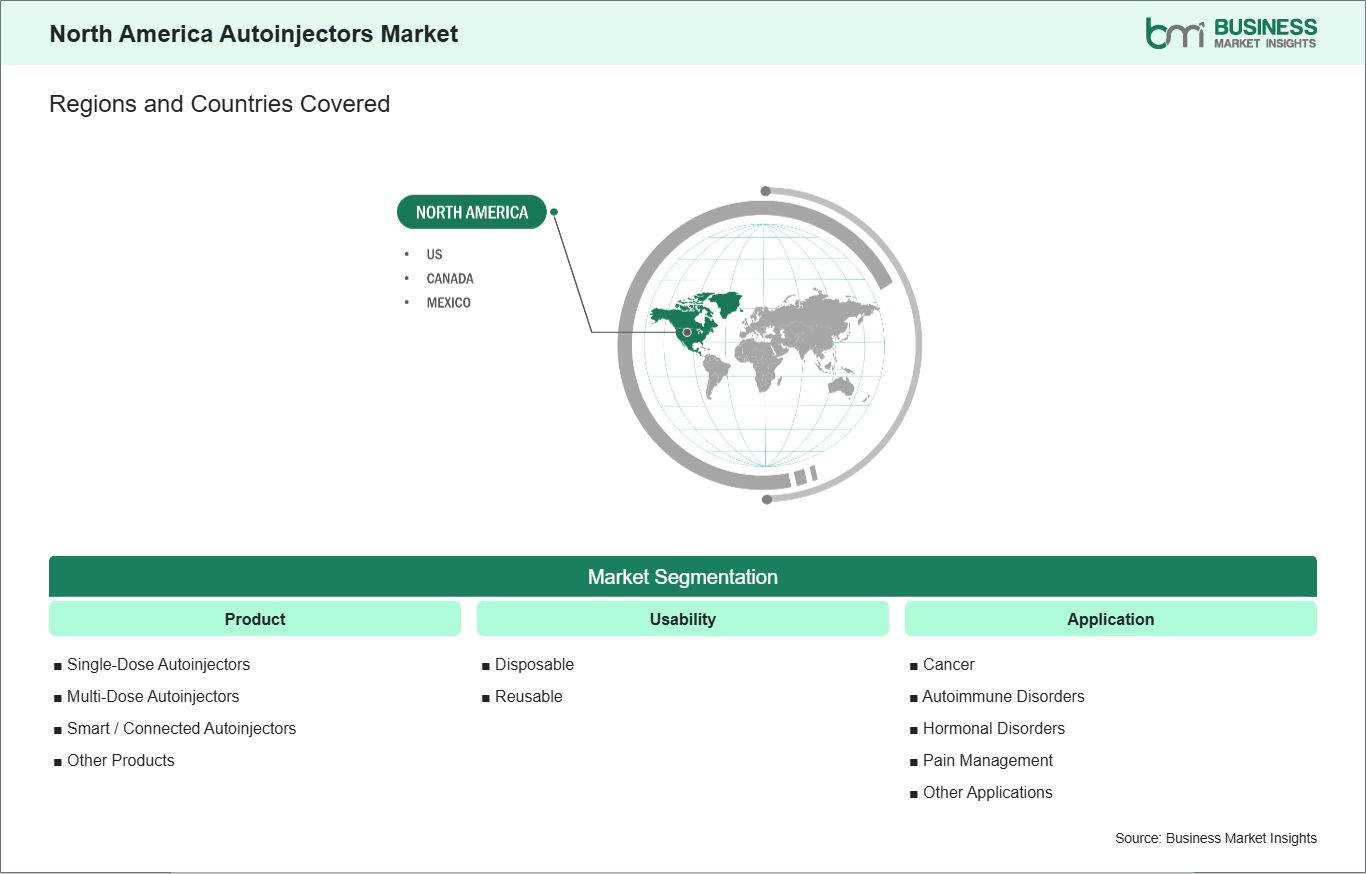
Key segments that contributed to the derivation of the North America autoinjectors market analysis are product, usability, and application.
- By product, the autoinjectors market is segmented into single-dose autoinjectors, multi-dose autoinjectors, smart / connected autoinjectors, and others. The single-dose autoinjectors segment dominated the market in 2025.
- Based on usability, the autoinjectors market is categorized into disposable and reusable. The disposable segment dominated the market in 2025.
- In terms of application, the market is classified into cancer, autoimmune disorders, hormonal disorders, pain management, and other applications. The autoimmune disorders segment dominated the market in 2025.
Market Forces
North America Autoinjectors Market Drivers and Opportunities
Regulatory Encouragement for Patient Self-Care Solutions
North America’s autoinjectors market has been significantly shaped by proactive regulatory frameworks that encourage self-care and at-home administration of injectable therapies. In the United States, the U.S. Food and Drug Administration (FDA) has clarified regulatory pathways for combination drug-device products that include autoinjectors, making it easier for developers to bring user-centric designs to market. Guidance documents emphasize human factors engineering and ease-of-use for lay users, reflecting a broader policy goal of reducing burden on healthcare facilities and empowering patients to self-manage chronic conditions like rheumatoid arthritis and multiple sclerosis. This regulatory clarity has influenced nearly all major product launches in the U.S. over the past five years, leading to a growing portfolio of FDA-cleared autoinjectors capable of supporting self-administration outside of clinical settings. Parallel to FDA efforts, payer policies in the U.S. including Medicare and major private insurers — have adapted coverage to support at-home autoinjector use. Recent reimbursement updates now include specific billing codes for patient education and remote training on autoinjector use, which helps clinicians justify prescribing home-use devices instead of clinic-administered injections. These reimbursement shifts directly affect adoption rates: a 2025 payer report highlighted a double-digit increase in claims for autoinjector devices across self-administered biologics compared with 2020, underscoring how aligned policy and reimbursement can drive market expansion within North America. In Canada, Health Canada and provincial health authorities have taken complementary steps to expand self-care solutions. Federal regulatory reviews have streamlined reviews of injection device modifications, enabling faster entry for improved autoinjector designs for conditions such as severe allergies and chronic inflammatory diseases. Provincial formularies in Ontario and Alberta increasingly list autoinjectors as preferred devices for first-line biologic therapies, encouraging use outside hospitals and clinics. Across North America, including Mexico, there is growing alignment between regulatory encouragement and health system priorities, such as reducing hospital congestion and supporting remote or rural patient populations with safe, self-administered solutions.
Development of Low-Cost Autoinjectors for Emerging Economies
Even within the high-income context of North America, there is focused innovation around lower-cost autoinjector solutions, driven by rising healthcare costs, insurance coverage variability, and equity concerns among underserved populations. In the United States, out-of-pocket costs for branded autoinjectors — particularly emergency epinephrine devices — have become a significant barrier for many patients. As a result, major device manufacturers are developing simplified, disposable autoinjector platforms that reduce manufacturing complexity and offer lower list prices while maintaining safety. For example, competitive bidding and value-based contracting with pharmacy benefit managers have led to generic epinephrine autoinjectors entering U.S. distribution at substantially reduced prices compared to legacy products, increasing accessibility for patients without comprehensive coverage. Beyond epinephrine, biologic therapies administered via autoinjectors for conditions like psoriasis and Crohn’s disease are also seeing cost-focused innovation. Several North American medtech companies have redesigned components — such as reducing the number of precision parts and adopting injection-assist technologies — to bring overall device costs down without sacrificing performance. These initiatives are targeted specifically at segments of the U.S. population where high copays and tiered formularies have previously limited adoption. Clinical advisors report that simpler, lower-cost autoinjector options have improved adherence rates in underinsured patient groups, demonstrating how cost reduction within the North American market itself is a key growth driver. In Canada and Mexico, cost considerations also influence procurement decisions for provincial health systems and national insurers. Canadian provinces with publicly funded healthcare increasingly negotiate bulk pricing for autoinjectors, including generics and simplified designs, to manage budget pressures while maintaining broad patient access. In Mexico, where private insurance penetration is lower and out-of-pocket spend is higher, manufacturers with lower-cost autoinjector offerings have seen faster uptake among hospital systems and outpatient clinics, especially for chronic disease management. These market pressures in North America — from high cost burdens in the U.S. to public procurement strategies in Canada and Mexico — ensure that low-cost autoinjector development remains a priority not for emerging markets abroad, but for addressing affordability and access within the region itself.
Size and Share Analysis
North America Autoinjectors Market Size and Share Analysis
The North America Autoinjectors Market demonstrates steady growth, with size and share analysis highlighting evolving trends and competitive dynamics among key players. The report examines subsegments categorized within product, usability, and application, offering insights into their contribution to overall market performance.
By product, the single-dose autoinjectors subsegment dominated the market in 2025, driven by strong patient preference for ready-to-use, pre-filled delivery formats that simplify self-administration and reduce dosing errors, particularly in chronic and emergency therapies where convenience and accuracy are critical.
Based on usability, the disposable subsegment dominated the market in 2025, driven by the widespread adoption of pre-filled, single-use devices that enhance safety (reducing cross-contamination and infection risk), require no maintenance, and align with home-care and chronic disease management needs.
In terms of application, the autoimmune disorders subsegment dominated the market in 2025, driven by the rising prevalence of autoimmune conditions (such as rheumatoid arthritis and multiple sclerosis) that rely on biologic therapies optimally delivered via autoinjectors for precise dosing and improved patient compliance.
Report Coverage
North America Autoinjectors Market Report Coverage and Deliverables
The "North America Autoinjectors Market Size and Forecast (2022–2033)" report provides a detailed analysis of the market covering below areas:
- North America Autoinjectors Market size and forecast at regional and country levels for all market segments covered under the scope
- North America Autoinjectors Market trends, as well as drivers, restraints, and opportunities
- North America Autoinjectors Market analysis covering key trends, regional framework, major players, regulations, and recent developments
- Industry landscape and competition analysis covering market concentration, heat map analysis, prominent players, and recent developments for the North America Autoinjectors Market
- Detailed company profiles, including SWOT analysis
Geographic Insights
North America Autoinjectors Market Geographic Insights
The geographical scope of the North America Autoinjectors Market report is divided into United States, Canada, and Mexico. US held the largest share in 2025.
Country-level dynamics within North America reveal differentiated growth drivers and regulatory environments. The United States remains the most innovation-intensive market, supported by a strong biotechnology ecosystem and advanced healthcare infrastructure. Institutional procurement through hospital systems and specialty clinics contributes significantly to demand, while direct-to-consumer awareness campaigns amplify adoption of emergency-use autoinjectors. Canada presents a distinct reimbursement landscape shaped by provincial healthcare systems, fostering structured formulary evaluations and price negotiations. Health technology assessment agencies emphasize cost-effectiveness and long-term therapeutic value, influencing device selection criteria. Meanwhile, Mexico is emerging as a developing opportunity market, driven by expanding private healthcare investments and improving biologics penetration. Regulatory oversight by entities such as Health Canada and Federal Commission for the Protection against Sanitary Risk ensures compliance with safety and quality standards, though approval timelines and documentation requirements vary across jurisdictions. Cross-border trade agreements and regional manufacturing partnerships are supporting supply continuity and reducing dependency on overseas imports. Additionally, demographic variations—such as aging populations in the United States and Canada versus a younger but increasingly urbanized population in Mexico—shape disease prevalence patterns and product demand profiles. Collectively, these country-specific factors create a heterogeneous yet strategically interconnected regional market landscape.
Industry Activity
Recent Developments
The North America Autoinjectors Market is evaluated by gathering qualitative and quantitative data post primary and secondary research, which includes important corporate publications, association data, and databases. A few of the key developments in the North America autoinjectors market are:
- In June 2025, The U.S. Food and Drug Administration (FDA) granted approval for a 200 mg/mL belimumab autoinjector (Benlysta) for pediatric lupus nephritis patients aged ≥5 years. This approval allows at-home subcutaneous administration of belimumab, reducing the need for clinic infusions and improving accessibility for families.
- In May 2025, The FDA approved Brekiya’s DHE autoinjector formulation for acute migraine and cluster headache, marking the first autoinjector option for this indication. This regulatory milestone enables broader patient self-administration for severe headache episodes and supports expanded therapeutic uses of autoinjector devices in North America.
Trust & Transparency
Research Methodology
The market analysis combines proprietary research with secondary data from government agencies, company disclosures, regulatory filings, industry databases and expert interviews. Market estimates are validated through data triangulation, cross-market benchmarking and analyst
review.
View Full Research Methodology
Key Sources Referred:
World Health Organization (WHO) Organisation for Economic Cooperation and Development (OECD) The World Bank Group Worldometer The Lancet International Bar Association International Trade Administration