Market Summary
Executive Summary and Market Analysis
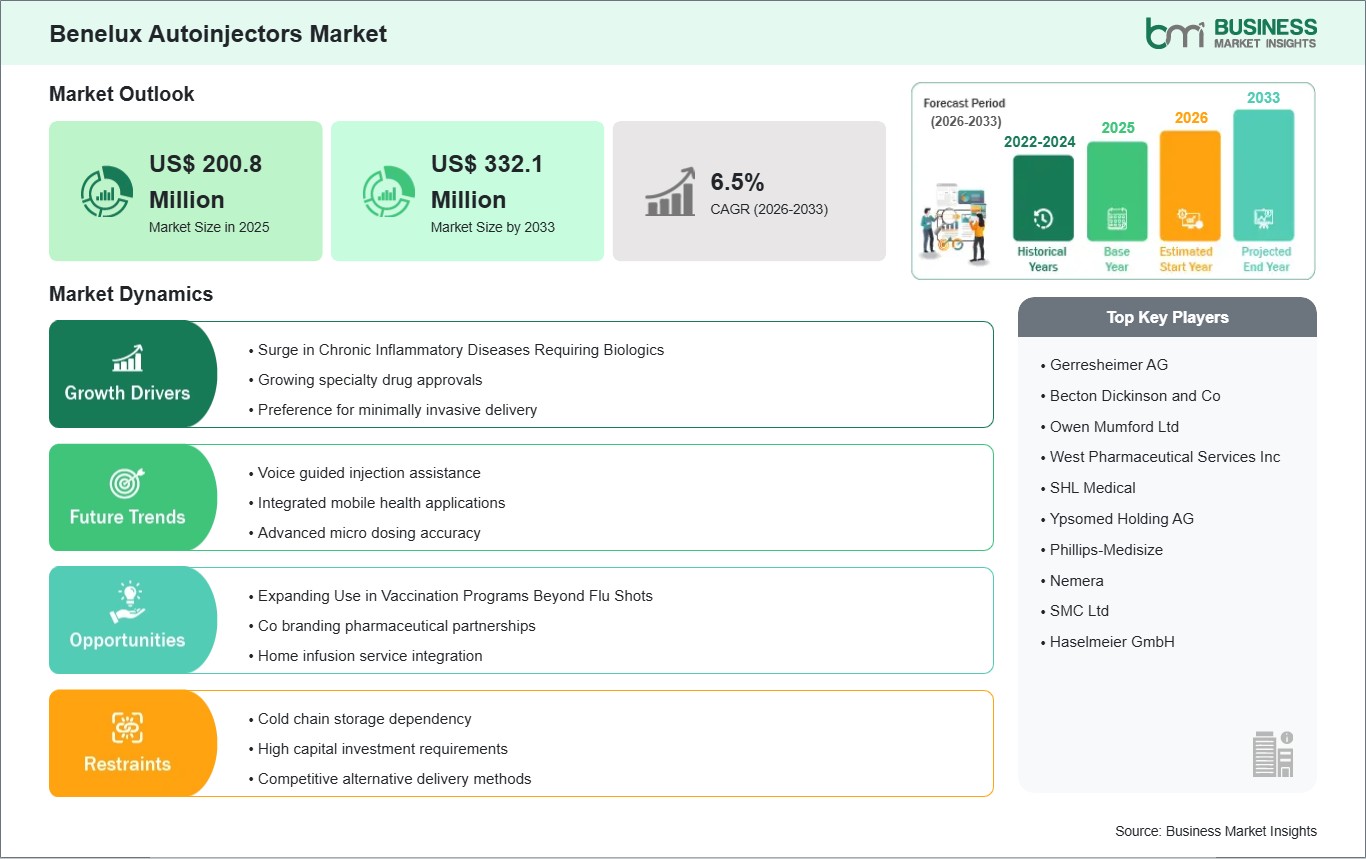
The Benelux autoinjectors market, encompassing Belgium, Netherlands, and Luxembourg, is marked by steady adoption driven by the region’s high healthcare standards, strong reimbursement infrastructure, and growing patient preference for self-administration of biologics and emergency therapies. Chronic disease prevalence, particularly autoimmune disorders, severe allergies, and an increasing number of patients requiring emergency epinephrine administration, is fueling demand for reliable and user-friendly autoinjector devices. Patient-centric care models and initiatives to reduce hospital dependency further support the transition toward at-home injectable therapy. From a competitive standpoint, multinational medical device manufacturers dominate the market, but regional pharmaceutical companies are increasingly engaging in strategic partnerships to develop localized solutions. Emphasis is being placed on ergonomically designed devices with safety mechanisms, dual-chamber systems, and prefilled formulations for enhanced patient compliance. Regulatory compliance under the European Medical Device Regulation (MDR) ensures safety and quality but also necessitates extended product validation cycles. Distribution dynamics in the Benelux region are increasingly hybrid. While hospital pharmacies and specialty clinics remain primary channels, retail pharmacies and e-commerce platforms are gaining importance, particularly for epinephrine autoinjectors. Health insurers in Belgium, the Netherlands, and Luxembourg are actively reimbursing select devices, incentivizing adoption among patients requiring long-term therapy. Additionally, public health awareness campaigns and patient training programs are enhancing confidence in self-administration. Overall, the Benelux autoinjectors market is characterized by advanced regulatory oversight, patient-focused innovation, and a strong alignment between healthcare policy and market growth, creating a resilient and sustainable environment for device adoption.
Segment Analysis
Benelux Autoinjectors Market Segmentation
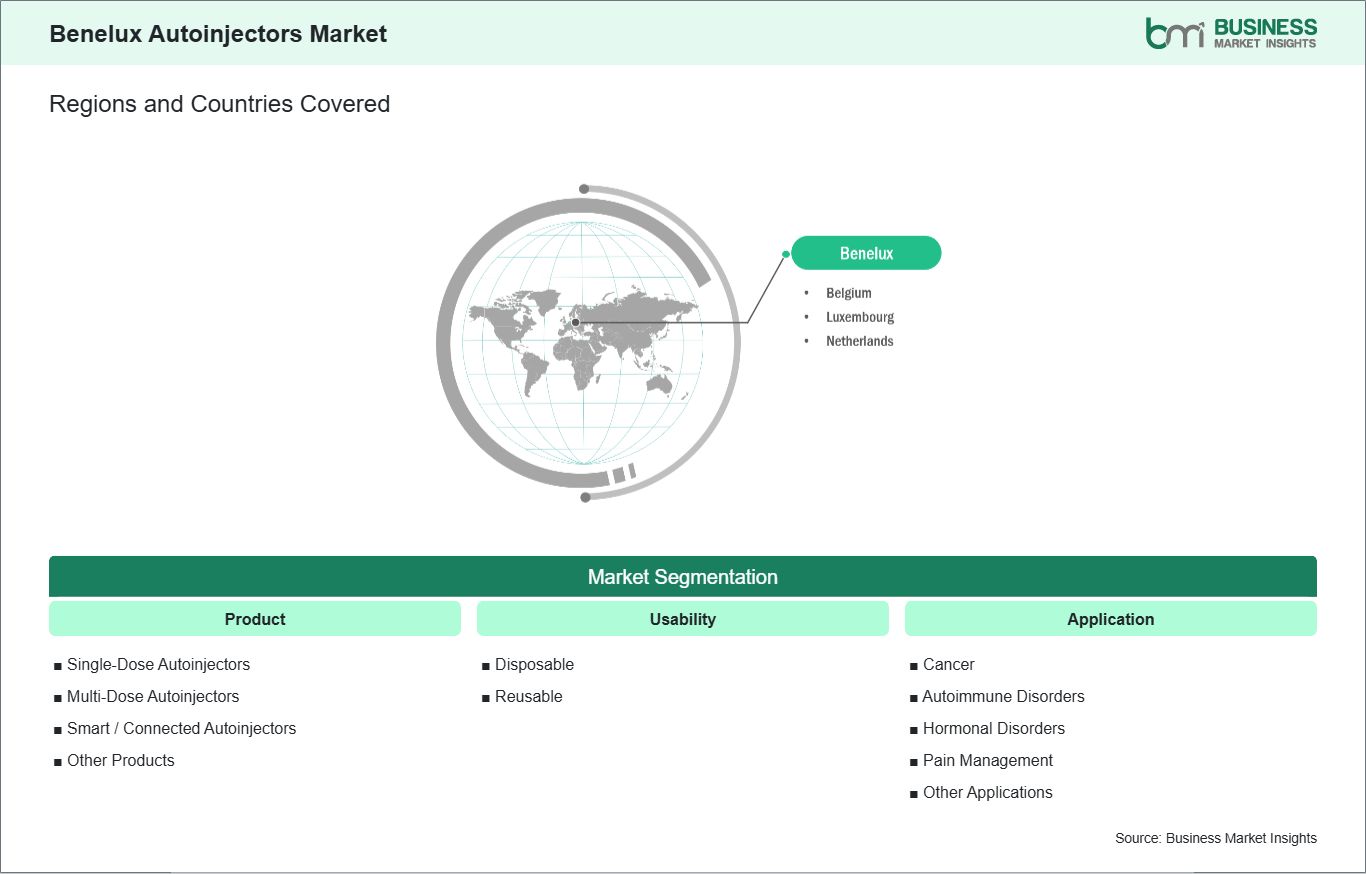
Key segments that contributed to the derivation of the Benelux autoinjectors market analysis are product, usability, and application.
- By product, the autoinjectors market is segmented into single-dose autoinjectors, multi-dose autoinjectors, smart / connected autoinjectors, and others. The single-dose autoinjectors segment dominated the market in 2025.
- Based on usability, the autoinjectors market is categorized into disposable and reusable. The disposable segment dominated the market in 2025.
- In terms of application, the market is classified into cancer, autoimmune disorders, hormonal disorders, pain management, and other applications. The autoimmune disorders segment dominated the market in 2025.
Market Forces
Benelux Autoinjectors Market Drivers and Opportunities
Surge in Chronic Inflammatory Diseases Requiring Biologics
In the Benelux region, an aging population and lifestyle‑linked health trends are contributing to a notable rise in chronic inflammatory diseases such as rheumatoid arthritis, psoriasis, and inflammatory bowel disease. Specialists in metropolitan care centers observe increasing numbers of patients requiring long‑term biologic therapies, many of which are transitioning from hospital‑administered infusions to self‑administered injections. This shift has driven demand for autoinjector devices among patients seeking convenient, reliable delivery options for their biologic regimens. Healthcare providers across the region’s robust insurance‑based health systems are increasingly prescribing autoinjectors for biologics due to demonstrated improvements in treatment adherence and patient satisfaction. In Belgium, for example, rheumatology clinics in Brussels and Antwerp report that autoinjectors have significantly reduced missed doses among working adults managing chronic inflammatory conditions. Similarly, Dutch specialists note that easy‑to‑use delivery systems help maintain therapy continuity among patients residing outside major urban centers, where frequent clinic visits are less practical. National reimbursement frameworks in Benelux countries have also adapted to support broader access to autoinjector delivery formats for biologics. Luxembourg’s national health service, in particular, has updated its reimbursement policies to minimize co‑pay gaps for self‑injectable therapies once reserved for hospital administration. These supportive policies are designed to relieve pressure on outpatient clinics while empowering patients with tools that simplify complex dosing schedules. As a result, autoinjectors are becoming a standard modality in chronic inflammatory disease management across the Benelux region.
Expanding Use in Vaccination Programs Beyond Flu Shots
While seasonal influenza vaccination has long been a fixture of public health campaigns in Benelux countries, health authorities and private providers are increasingly leveraging autoinjector technologies for a broader vaccination portfolio. Routine immunization schedules now include tetanus, HPV, and pneumococcal vaccines administered via autoinjectors in settings such as community pharmacies and general practitioner clinics, which has helped improve convenience and uptake among adults and adolescents alike. Public health programs in urban and suburban areas have embraced autoinjector use to streamline vaccination delivery, particularly in schools and workplace clinics. In the Netherlands, coordinated campaigns targeting adolescent HPV vaccination have used autoinjector formats to support efficient, high‑throughput delivery during school‑based initiatives. Clinics in Rotterdam and Amsterdam report that the standardized delivery mechanism reduces dosing errors and improves patient comfort, bolstering overall immunization rates. Beyond routine vaccines, Benelux health agencies are piloting autoinjector use for rapid response immunization efforts against emerging and seasonal pathogens, such as pertussis and shingles. Luxembourg’s public health department has experimented with autoinjector kits during regional vaccination drives aimed at older adults at risk for herpes zoster, citing ease of administration and reduced training requirements for temporary vaccination teams. As vaccination strategies continue to expand beyond traditional flu campaigns, autoinjectors are positioned to play an increasingly central role in comprehensive immunization programs throughout the Benelux region.
Size and Share Analysis
Benelux Autoinjectors Market Size and Share Analysis
The Benelux Autoinjectors Market demonstrates steady growth, with size and share analysis highlighting evolving trends and competitive dynamics among key players. The report examines subsegments categorized within product, usability, and application, offering insights into their contribution to overall market performance.
By product, the single-dose autoinjectors subsegment dominated the market in 2025, driven by strong clinician and patient preference for simple, ready‑to‑use devices that minimise dosing errors and support home self‑administration.
Based on usability, the disposable subsegment dominated the market in 2025, driven by high demand for safe, low‑cost, single‑use devices that eliminate the need for maintenance and reduce infection risk.
In terms of application, the autoimmune disorders subsegment dominated the market in 2025, driven by increasing prevalence of chronic immune‑mediated conditions requiring frequent biologic therapies well‑suited to autoinjector delivery.
Report Coverage
Benelux Autoinjectors Market Report Coverage and Deliverables
The "Benelux Autoinjectors Market Size and Forecast (2022–2033)" report provides a detailed analysis of the market covering below areas:
- Benelux Autoinjectors Market size and forecast at regional and country levels for all market segments covered under the scope
- Benelux Autoinjectors Market trends, as well as drivers, restraints, and opportunities
- Benelux Autoinjectors Market analysis covering key trends, regional framework, major players, regulations, and recent developments
- Industry landscape and competition analysis covering market concentration, heat map analysis, prominent players, and recent developments for the Benelux Autoinjectors Market
- Detailed company profiles, including SWOT analysis
Geographic Insights
Benelux Autoinjectors Market Geographic Insights
The geographical scope of the Benelux Autoinjectors Market report is divided into Belgium, the Netherlands, and Luxembourg. The Netherlands held the largest share in 2025.
Country-specific dynamics in the Benelux autoinjectors market reveal differentiated adoption patterns and strategic considerations. In Netherlands, a strong emphasis on patient safety and comprehensive reimbursement for epinephrine and chronic disease therapies fosters high device adoption, with hospitals, community pharmacies, and specialty clinics forming the primary distribution network. Belgium’s advanced healthcare monitoring systems also facilitate post-market surveillance and compliance initiatives. In Belgium, digital health integration is a defining factor. Connected autoinjectors, adherence tracking apps, and telemedicine support are being widely implemented, particularly for patients with autoimmune disorders requiring frequent dosing. Collaboration between hospitals, insurers, and device manufacturers enables efficient rollout of patient training programs, enhancing therapy compliance. Luxembourg, while smaller in population, demonstrates high per capita adoption due to strong healthcare funding, centralized procurement systems, and patient-centric policies. The focus in Luxembourg is on premium, ergonomically optimized autoinjectors with robust safety features, targeting patients requiring long-term biologic therapy. These country-specific insights highlight the importance of localized strategies, including digital integration in the Netherlands, broad reimbursement coverage in Belgium, and premium device positioning in Luxembourg, to optimize market penetration and long-term growth across the Benelux autoinjectors landscape.
Industry Activity
Recent Developments
The Benelux Autoinjectors Market is evaluated by gathering qualitative and quantitative data post primary and secondary research, which includes important corporate publications, association data, and databases. A few of the key developments in the Benelux autoinjectors market are:
- In January 2026, Sharp Services announced a US$ 23.74 million expansion of its injectable packaging and assembly capacity at sites in Hamont‑Achel, Belgium, and Heerenveen, Netherlands, enhancing regional support for autoinjectors, pre‑filled syringes and related devices. The investments include increased GMP production space, new packaging suites and massively expanded cold‑chain storage to support sensitive biologics and device formats. This upgrade improves local manufacturing and supply chain resilience for self‑injection products destined for Benelux and broader EU markets. The modernization also incorporates energy‑efficient technologies to support sustainability goals.
- In November 2025, SHL Medical announced that it shipped over 1.5 billion autoinjector devices worldwide, highlighting broad global demand and extensive partnerships with pharma companies for combination products across therapeutic areas. This large‑scale expansion of autoinjector supply demonstrates capacity and infrastructure growth that could support future device availability across diverse regions, including Middle East & Benelux markets.
Trust & Transparency
Research Methodology
The market analysis combines proprietary research with secondary data from government agencies, company disclosures, regulatory filings, industry databases and expert interviews. Market estimates are validated through data triangulation, cross-market benchmarking and analyst
review.
View Full Research Methodology
Key Sources Referred:
World Health Organization (WHO) Organisation for Economic Cooperation and Development (OECD) The World Bank Group Worldometer The Lancet International Bar Association International Trade Administration