Market Summary
Executive Summary and Market Analysis
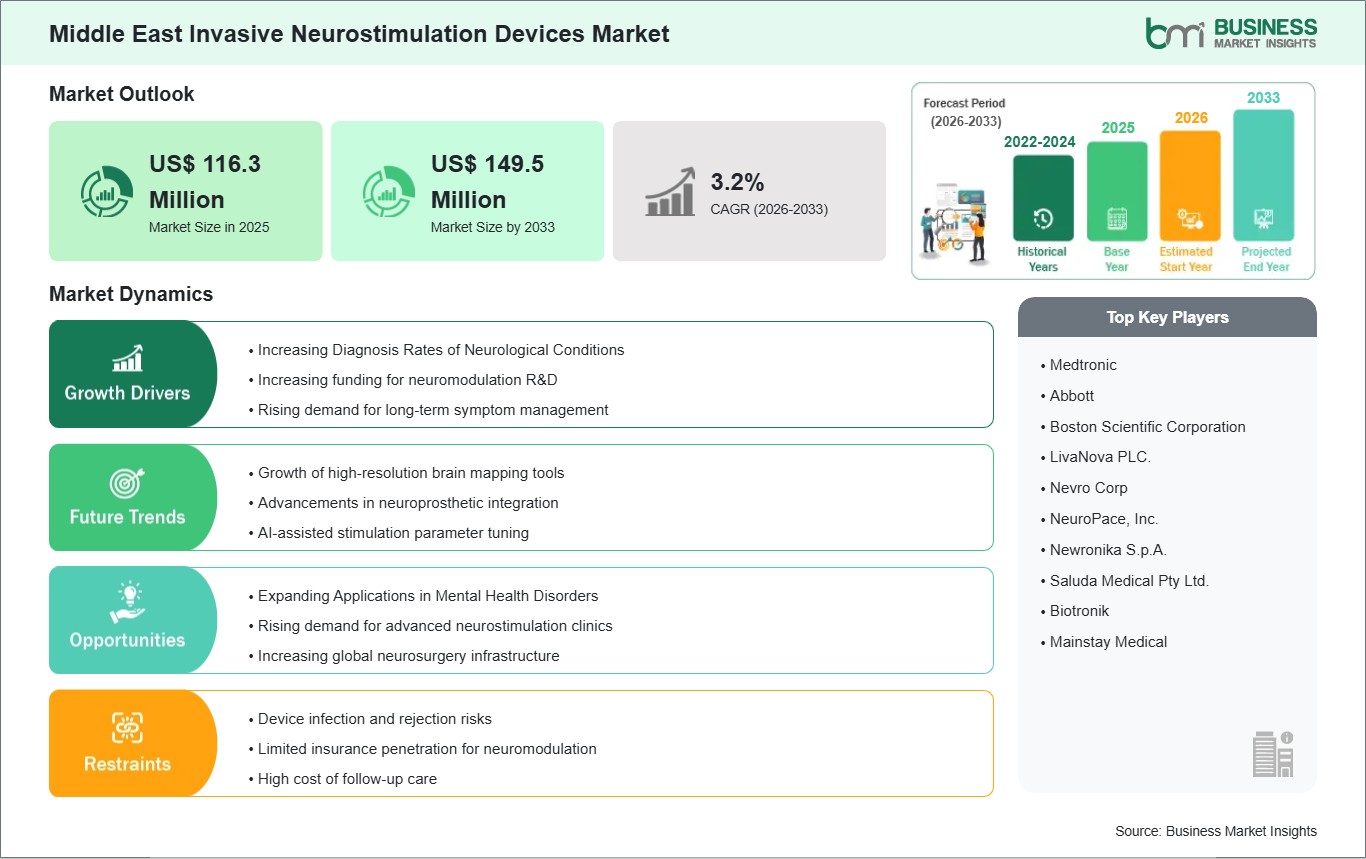
The Middle East market invasive neurostimulation devices is impacted positively by a trend towards enhanced neurological treatment, which involves an increasing use of implants such as deep brain stimulation, spinal cord stimulation, and vagus nerve stimulation in tertiary care settings. An increased number of neurological diseases, such as Parkinsonian syndromes, intractable epilepsy, and other types of chronic pain, is one of the factors that impact the development of the market. The other factor is linked to healthcare infrastructure developments in GCC countries, where growth in the specialty hospital sector, implementation of minimally invasive procedures in neurosurgery, and increasing numbers of medical tourists create an environment for the adoption of neuromodulation devices. At the same time, the market suffers from a relatively high cost of implantable devices and uneven insurance reimbursement policies that limit access and adoption of the technology in non-urban settings. Another important element of clinical adoption is associated with increased collaboration among neurosurgeons, neurologists, and physical medicine specialists, as well as a wider implementation of programming knowledge among hospital providers in urban areas. On the whole, the trend within the regional environment points toward increased adoption of precise care models within the field of neuromodulation, driven by advancements in surgical technique, improved post-operative device programming, and the steady integration of technology that allows digital monitoring in order to optimize treatment results for chronic neurological disorders, although discrepancies in availability between well-funded city hospitals and peripherally located healthcare institutions will remain a factor in shaping such trends in the future. Capacity-building efforts are also slowly gaining momentum at newly established centers specializing in neuromodulation across the region.
Segment Analysis
Middle East Invasive Neurostimulation Devices Market Segmentation
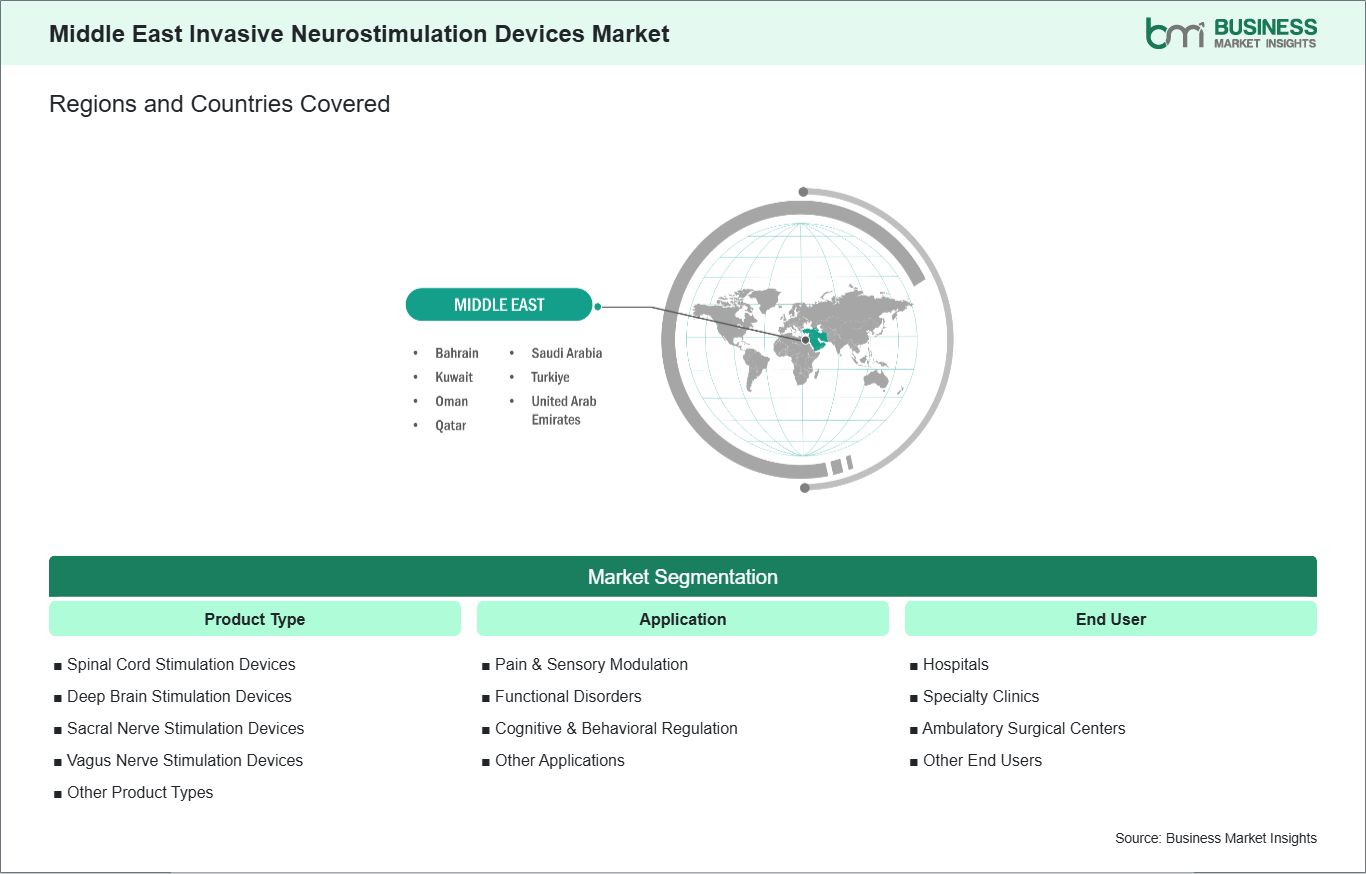
Key segments that contributed to the derivation of the Middle East invasive neurostimulation devices market analysis are product type, application and end user.
- By product type, the invasive neurostimulation devices market is segmented into spinal cord stimulation devices, deep brain stimulation devices, sacral nerve stimulation devices, vagus nerve stimulation devices, and other product types. The spinal cord stimulation devices segment dominated the market in 2025.
- Based on application, the invasive neurostimulation devices market is categorized into pain & sensory modulation, functional disorders, cognitive & behavioral regulation, and other applications. The pain & sensory modulation segment dominated the market in 2025.
- In terms of end user, the invasive neurostimulation devices market is categorized into hospitals, specialty clinics, ambulatory surgical centers, and other end users. The hospitals segment dominated the market in 2025.
Market Forces
Middle East Invasive Neurostimulation Devices Market Drivers and Opportunities
Increasing Diagnosis Rates of Neurological Conditions
There has been increased identification of movement disorders and intractable epilepsy in neurology clinics across the Middle East as a result of structured referral practices and increased familiarity with advanced imaging and electrophysiology among medical professionals. As a result of this development, there is early consideration of invasive neurostimulation procedures like deep-brain stimulation for individuals who would otherwise continue pharmacological therapy.
The establishment of multidisciplinary review boards within hospital neurosurgery units in GCC countries has facilitated a closer association between diagnosis and patient eligibility for surgery. The use of imaging to categorize patients with tremor and dystonia has become instrumental in determining the choice of devices, in particular in making decisions about whether lesion-based interventions should be conducted or not.
The inclusion of neurodiagnostic services and post-surgical follow-ups as part of comprehensive care programs at tertiary hospitals is expected to make the process of confirming patient eligibility for neurostimulation much more streamlined. In the process, it will ensure that more patients are identified whose conditions can only be managed using neurostimulation therapies.
Expanding Applications in Mental Health Disorders
Psychiatry and neurology departments in the Middle East are increasingly exploring implantable neurostimulation for treatment-resistant psychiatric conditions, particularly where conventional pharmacotherapy shows limited functional recovery. Clinical teams are evaluating vagus nerve and deep brain stimulation protocols within highly selected cohorts, often in collaboration with behavioral health units that manage long-term therapy adherence and postoperative monitoring.
In outpatient psychiatric services, particularly within private hospital networks, invasive neurostimulation is being positioned as an option for patients who cycle repeatedly through medication adjustments without sustained remission. Clinicians are incorporating neurocircuitry models of depression and obsessive-compulsive disorder into treatment planning, which is influencing patient selection for device-based interventions rather than solely psychotherapy escalation.
When specialized mental health programs begin integrating neurosurgical consultation earlier in the care continuum, the pathway to implantable stimulation is becoming more structured and protocol-driven. This evolution is reinforcing closer coordination between psychiatrists, neurosurgeons, and rehabilitation specialists, thereby shaping long-term management strategies for severe, treatment-resistant affective and anxiety-related disorders.
Size and Share Analysis
Middle East Invasive Neurostimulation Devices Market Size and Share Analysis
The Middle East invasive neurostimulation devices market is experiencing steady growth, with market size and share analysis reflecting evolving treatment preferences and competitive dynamics among key players. The report evaluates important subsegments categorized within product type, application and end user, highlighting their respective contributions to market performance.
By product type, the spinal cord stimulation devices subsegment dominated the market in 2025, driven by its widespread adoption for chronic pain management, particularly for failed back surgery syndrome and neuropathic pain conditions.
Based on application, the pain & sensory modulation subsegment dominated the market in 2025, driven by the rising global prevalence of chronic pain disorders and the growing preference for neuromodulation as an alternative to long-term drug therapy.
In terms of end user, the hospitals subsegment dominated the market in 2025, driven by their advanced neurosurgical infrastructure, availability of specialized healthcare professionals, and high volume of neurostimulation implantation procedures.
Report Coverage
Middle East Invasive Neurostimulation Devices Market Report Coverage and Deliverables
The "Middle East Invasive Neurostimulation Devices Market Size and Forecast (2022-2033)" report provides a detailed analysis of the market covering below areas:
- Market size and forecast at regional and country levels for all market segments covered under the scope
- Market trends, as well as drivers, restraints, and opportunities
- Market analysis covering key trends, regional framework, major players, regulations, and recent developments
- Market concentration, heat map analysis, prominent players, and recent developments for the Market
- Detailed company profiles, including SWOT analysis
Geographic Insights
Middle East Invasive Neurostimulation Devices Market Geographic Insights
The geographical scope of the Middle East Invasive Neurostimulation Devices Market report is divided into UAE, Saudi Arabia, Bahrain, Oman, Kuwait, Qatar, Turkiye. Turkiye held the largest share in 2025.
Turkiye assumes a position of prominence in the Middle East invasive neurostimulation devices market owing to its advanced neurosurgery capabilities, growing local production facilities in medical technology products and a location that acts as a bridge of medical tourism and product exports for Europe, Asia, and the Middle East. UAE experiences growth owing to the quick adoption of neuromodulation therapies within its private hospitals and innovative smart healthcare environments that prioritize digitized neurology services and minimally invasive pain relief procedures. The country of Saudi Arabia grows rapidly due to the construction of health infrastructure in line with the national transformation agenda, along with investments in neurorehabilitation facilities and enhancements in surgical capabilities within its tertiary care hospitals. Bahrain grows steadily through its positioning as a regulatory-friendly environment for testing novel neuromodulation technologies, aided by efficient healthcare management and judicious specialist collaborations. High per capita healthcare expenditure, coupled with an increasing incidence of chronic pain conditions and spinal conditions, provides incentives for utilizing new techniques of invasive neuromodulation in Kuwait‘s private and public hospitals. Qatar relies on the infrastructure boost within the healthcare delivery system, which results in faster adoption of specialized procedures, and has integrated neurological care into leading academic and research hospitals. In general, Turkey forms the base of the market demand due to its leadership in manufacturing and foreign patients from neighboring countries, while Gulf states contribute to the growth of the market demand with their specific healthcare programs aimed at expanding neurosurgical treatment capacities.
Industry Activity
Recent Developments
The Middle East Invasive Neurostimulation Devices Market is evaluated by gathering qualitative and quantitative data post primary and secondary research, which includes important corporate publications, association data, and databases. A few of the key developments in the Middle East invasive neurostimulation devices market are:
- In September 2024, Abbott announced that it had achieved a regional first implantation of its Esprit BTK Everolimus Eluting Resorbable Scaffold System at Al Qassimi Hospital in the United Arab Emirates, marking expanded adoption of Abbott‘s advanced minimally invasive therapeutic technologies across the Middle East healthcare market.
- In September 2023, Boston Scientific announced that it had entered into a definitive agreement to acquire Relievant Medsystems, expanding its neuromodulation and chronic pain portfolio and strengthening its ability to deliver minimally invasive neurostimulation-related therapies across global markets.
Trust & Transparency
Research Methodology
The market analysis combines proprietary research with secondary data from government agencies, company disclosures, regulatory filings, industry databases and expert interviews. Market estimates are validated through data triangulation, cross-market benchmarking and analyst
review.
View Full Research Methodology
Key Sources Referred:
U.S. Food and Drug Administration (FDA)National Institutes of Health (NIH)National Institute of Neurological Disorders and Stroke (NINDS)Centers for Medicare & Medicaid Services (CMS)Medical Device Innovation Consortium (MDIC)World Health Organization (WHO)International Organization for Standardization (ISO)International Neuromodulation Society (INS)North American Neuromodulation Society (NANS)Company WebsitesCompany Annual ReportsCompany Investor Presentations