Market Summary
Executive Summary and Market Analysis
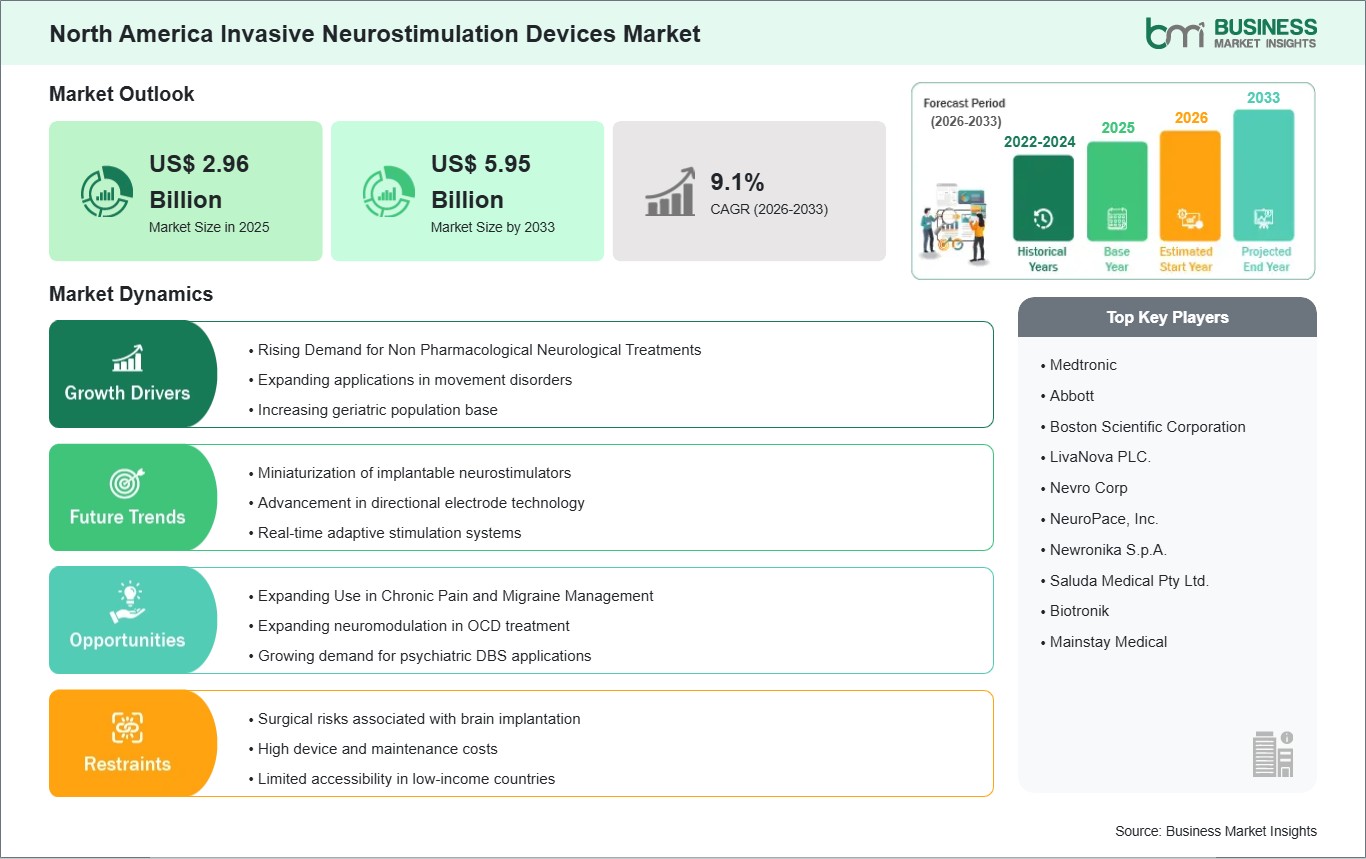
The North American invasive neurostimulation devices market is largely driven by the growing adoption of neuromodulatory devices in the treatment of complicated neurological conditions and chronic pain cases. There is a broad acceptance of deep brain stimulation, spinal cord stimulation, and vagus nerve stimulation technologies as a viable solution where drug-based therapy becomes less effective. Firstly, there is the issue of the rise of patients diagnosed with various movement disorders, refractory epilepsy, and neuropathic pain in connection with an older patient population and longer survivability of patients with these diseases. Secondly, innovations related to adaptive or closed-loop stimulation devices and the optimization of lead design, as well as smaller and more accurate implantable stimulation devices, make these solutions appealing for clinicians and patients alike. Thirdly, the current shift in the treatment paradigm in favor of reducing dependence on opioid drugs strengthens the case for invasive neurostimulation devices. Nonetheless, procedural complexity coupled with the need for neurosurgical implantation are important barrier, as surgical risk, complications, and infection associated with devices may discourage clinicians as well as patients from pursuing this modality of treatment, while at the same time making more burdensome follow-up visits and explantations possible. Furthermore, neurostimulation programs in hospitals are placing greater emphasis on coordinated care pathways involving the collaboration between neurosurgery, neurology, and pain management specialists, thus affecting procedural workflows and outcomes after the implantation procedure. In addition, this type of integration fosters iterative optimization of devices and personalized treatment for all implantable neurostimulation devices.
Segment Analysis
North America Invasive Neurostimulation Devices Market Segmentation
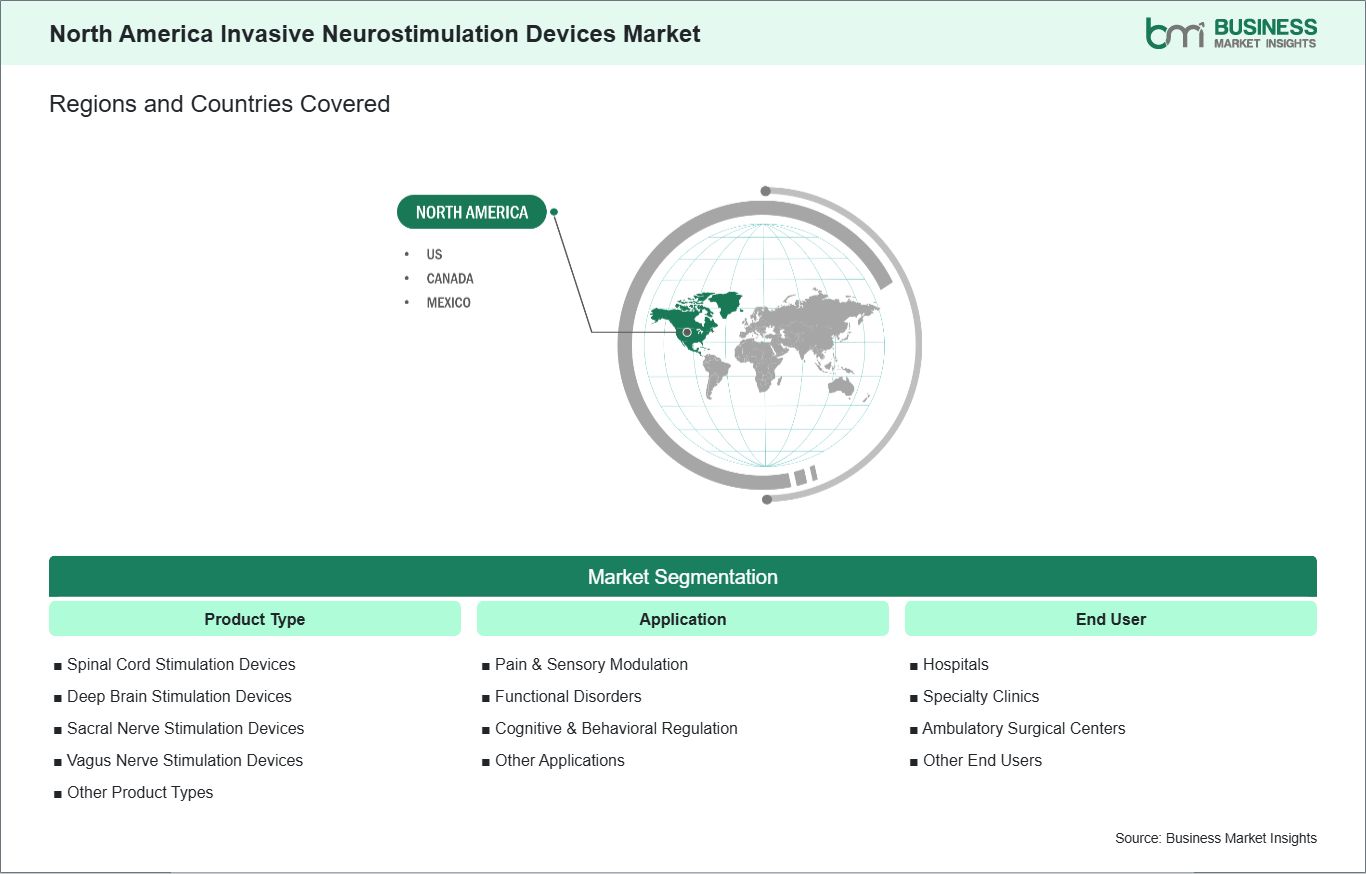
Key segments that contributed to the derivation of the North America invasive neurostimulation devices market analysis are product type, application and end user.
- By product type, the invasive neurostimulation devices market is segmented into spinal cord stimulation devices, deep brain stimulation devices, sacral nerve stimulation devices, vagus nerve stimulation devices, and other product types. The spinal cord stimulation devices segment dominated the market in 2025.
- Based on application, the invasive neurostimulation devices market is categorized into pain & sensory modulation, functional disorders, cognitive & behavioral regulation, and other applications. The pain & sensory modulation segment dominated the market in 2025.
- In terms of end user, the invasive neurostimulation devices market is categorized into hospitals, specialty clinics, ambulatory surgical centers, and other end users. The hospitals segment dominated the market in 2025.
Market Forces
North America Invasive Neurostimulation Devices Market Drivers and Opportunities
Rising Demand for Non Pharmacological Neurological Treatments
Within the region of North America, neurological care pathways are being influenced by treatment paradigms that emphasize device-centered approaches as opposed to reliance on medications for long periods of time. Healthcare professionals are utilizing neurostimulation within patient care pathways at an earlier point in the process, especially when there is evidence of resistance to the pharmacological approach.
There is also an impact of clinical practices as regards the inclusion of neurostimulation as part of the pathway within neurology departments. There are instances of clinical decision-making being delegated to multidisciplinary committees responsible for assessing the suitability of device use in relation to psychological evaluations and pain causes.
There are changes in patient preference in favor of approaches that have lower incidences of systemic side effects. As such, there is the tendency for neurostimulation to be positioned as a corrective treatment modality rather than as an approach of desperation. Within the case of neurologists who are familiar with neurostimulation devices, the discussion of these devices takes place during early consultations.
Expanding Use in Chronic Pain and Migraine Management
In chronic pain management across North American healthcare systems, neurostimulation devices are increasingly embedded within stepped care protocols that escalate beyond oral and injectable therapies. Pain specialists are leveraging targeted stimulation to modulate neural signaling in patients with refractory conditions, particularly where conventional regimens fail to maintain functional improvement. This integration is influencing referral patterns between primary care and specialized pain clinics.
Migraine care pathways reflect a growing reliance on non-drug neuromodulation, especially for patients who experience medication overuse or limited response to triptans and preventive therapies. Clinicians often deploy external stimulation devices that patients can self-administer during prodromal phases, reshaping episodic management into a more behavior-linked intervention model.
Reimbursement structures and clinical familiarity together influence how quickly neurostimulation becomes part of standard pain and migraine treatment hierarchies. As neurologists and pain physicians gain procedural confidence, device selection becomes more personalized, aligning stimulation parameters with patient-reported symptom patterns and long-term management goals.
Size and Share Analysis
North America Invasive Neurostimulation Devices Market Size and Share Analysis
The North America invasive neurostimulation devices market is experiencing steady growth, with market size and share analysis reflecting evolving treatment preferences and competitive dynamics among key players. The report evaluates important subsegments categorized within product type, application and end user, highlighting their respective contributions to market performance.
By product type, the spinal cord stimulation devices subsegment dominated the market in 2025, driven by its widespread adoption for chronic pain management, particularly for failed back surgery syndrome and neuropathic pain conditions.
Based on application, the pain & sensory modulation subsegment dominated the market in 2025, driven by the rising global prevalence of chronic pain disorders and the growing preference for neuromodulation as an alternative to long-term drug therapy.
In terms of end user, the hospitals subsegment dominated the market in 2025, driven by their advanced neurosurgical infrastructure, availability of specialized healthcare professionals, and high volume of neurostimulation implantation procedures.
Report Coverage
North America Invasive Neurostimulation Devices Market Report Coverage and Deliverables
The "North America Invasive Neurostimulation Devices Market Size and Forecast (2022-2033)" report provides a detailed analysis of the market covering below areas:
- Market size and forecast at regional and country levels for all market segments covered under the scope
- Market trends, as well as drivers, restraints, and opportunities
- Market analysis covering key trends, regional framework, major players, regulations, and recent developments
- Market concentration, heat map analysis, prominent players, and recent developments for the Market
- Detailed company profiles, including SWOT analysis
Geographic Insights
North America Invasive Neurostimulation Devices Market Geographic Insights
The geographical scope of the North America Invasive Neurostimulation Devices Market report is divided into US, Canada, and Mexico. US held the largest share in 2025.
The market in North America is dominated by the US due to its well-established neuromodulation environment, broad acceptance of invasive procedures in the medical community, and seamless integration of neurosurgery into tertiary care centers. Such factors are complemented by the quick adoption of new methods in the US, facilitated by close interaction between developers of new treatments and leading hospitals, as well as the positive reimbursement framework that promotes their implementation to treat chronic pain and other difficult cases. As for Canada, there is relatively moderate growth in the country, which is determined by the publicly funded health care system, where only evidence-based practices are considered, as well as the expansion of the availability of invasive procedures at prestigious medical organizations and specialized neurology centers. In contrast, Mexico represents a developing region that is benefiting from growing investment into private healthcare facilities, development of urban specialty clinics, and awareness regarding neuromodulation treatment options that facilitate gradual adoption trends; yet, these are primarily occurring in urban areas due to increased availability of advanced neurosurgery services, although financial and geographic barriers may continue to impact adoption rates in spite of the role played by medical tourism and specialist training programs. All of these factors combined paint an image of an inconsistent growth environment in North America, one that differs based on technological advancement, healthcare financing models, and infrastructure readiness, which all significantly influence the pace of invasive neurostimulator adoption in these countries. In the coming years, regional growth will continue to vary, shaped by evolving regulatory landscapes and clinical training programs.
Industry Activity
Recent Developments
The North America Invasive Neurostimulation Devices Market is evaluated by gathering qualitative and quantitative data post primary and secondary research, which includes important corporate publications, association data, and databases. A few of the key developments in the North America invasive neurostimulation devices market are:
- In January 2024, Medtronic announced that it had received U.S. FDA approval for its Percept RC deep brain stimulation (DBS) system with BrainSense technology, expanding its sensing-enabled neuromodulation portfolio for movement disorders and epilepsy patients across the United States.
- In May 2024, Abbott announced that the U.S. Food and Drug Administration (FDA) had approved its next-generation rechargeable spinal cord stimulation (SCS) systems, including the Eterna and Proclaim platforms, expanding treatment options for chronic pain patients in the United States.
Trust & Transparency
Research Methodology
The market analysis combines proprietary research with secondary data from government agencies, company disclosures, regulatory filings, industry databases and expert interviews. Market estimates are validated through data triangulation, cross-market benchmarking and analyst
review.
View Full Research Methodology
Key Sources Referred:
U.S. Food and Drug Administration (FDA)National Institutes of Health (NIH)National Institute of Neurological Disorders and Stroke (NINDS)Centers for Medicare & Medicaid Services (CMS)Medical Device Innovation Consortium (MDIC)World Health Organization (WHO)International Organization for Standardization (ISO)International Neuromodulation Society (INS)North American Neuromodulation Society (NANS)Company WebsitesCompany Annual ReportsCompany Investor Presentations