Market Summary
Executive Summary and Global Market Analysis
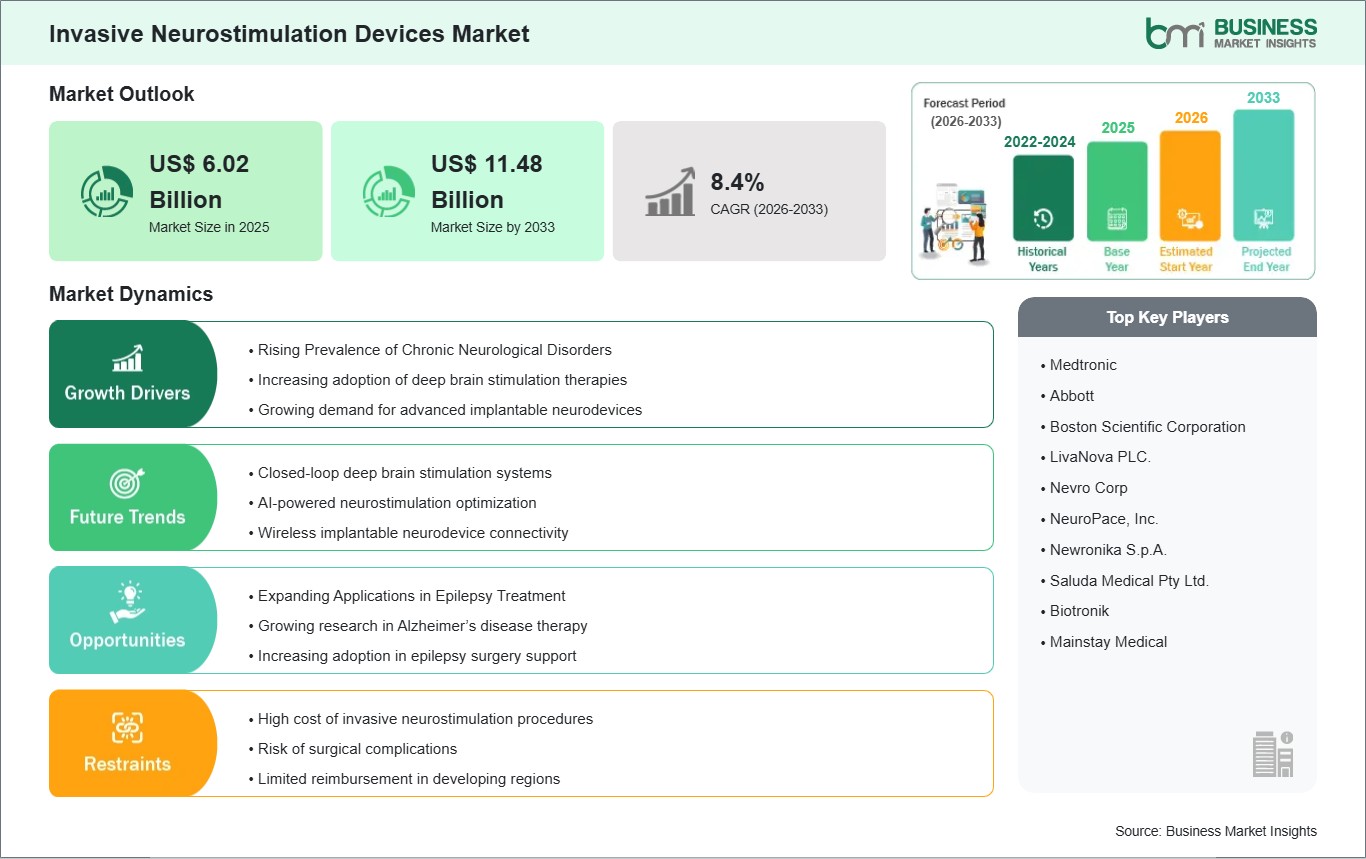
The global invasive neurostimulation devices market is being driven by advancements in neuromodulation technologies, which utilize sophisticated implantable systems to treat refractory neurological disorders and chronic pain syndromes. The increasing incidence of Parkinson's disease, epilepsy, and treatment-resistant depression is expected to continue fueling market demand, as physicians look for ways to modulate the nervous system electronically if pharmacological therapy fails to provide long-lasting effects. Developments related to closed-loop stimulation, adaptive approaches, and minimal invasiveness during electrode implantation will positively impact the therapeutic success of patients and promote the widespread adoption of neurostimulation devices.
The market will remain constrained due to the highly complicated procedures involved and the risk of adverse events during implantation and device management. As research into psychiatric and cognitive disorders continues to advance, the potential applications of neurostimulator implantation are expanding beyond their traditional use in treating chronic pain and movement disorders to include these emerging therapeutic areas. The combination of real-time data analysis capabilities and remote programming via artificial intelligence algorithms, coupled with postoperative monitoring opportunities, is transforming clinical care paths and allowing for the customization of parameters for all patients who undergo implantation surgery.
Collaboration among manufacturers of medical devices, neurosurgeons, and rehabilitation specialists is optimizing clinical procedures and promoting improvement in the development of better batteries and neurostimulation devices. Constant updates in the clinical guidelines ensure proper patient selection and safety during implantation procedures.
Segment Analysis
Invasive Neurostimulation Devices Market Segmentation
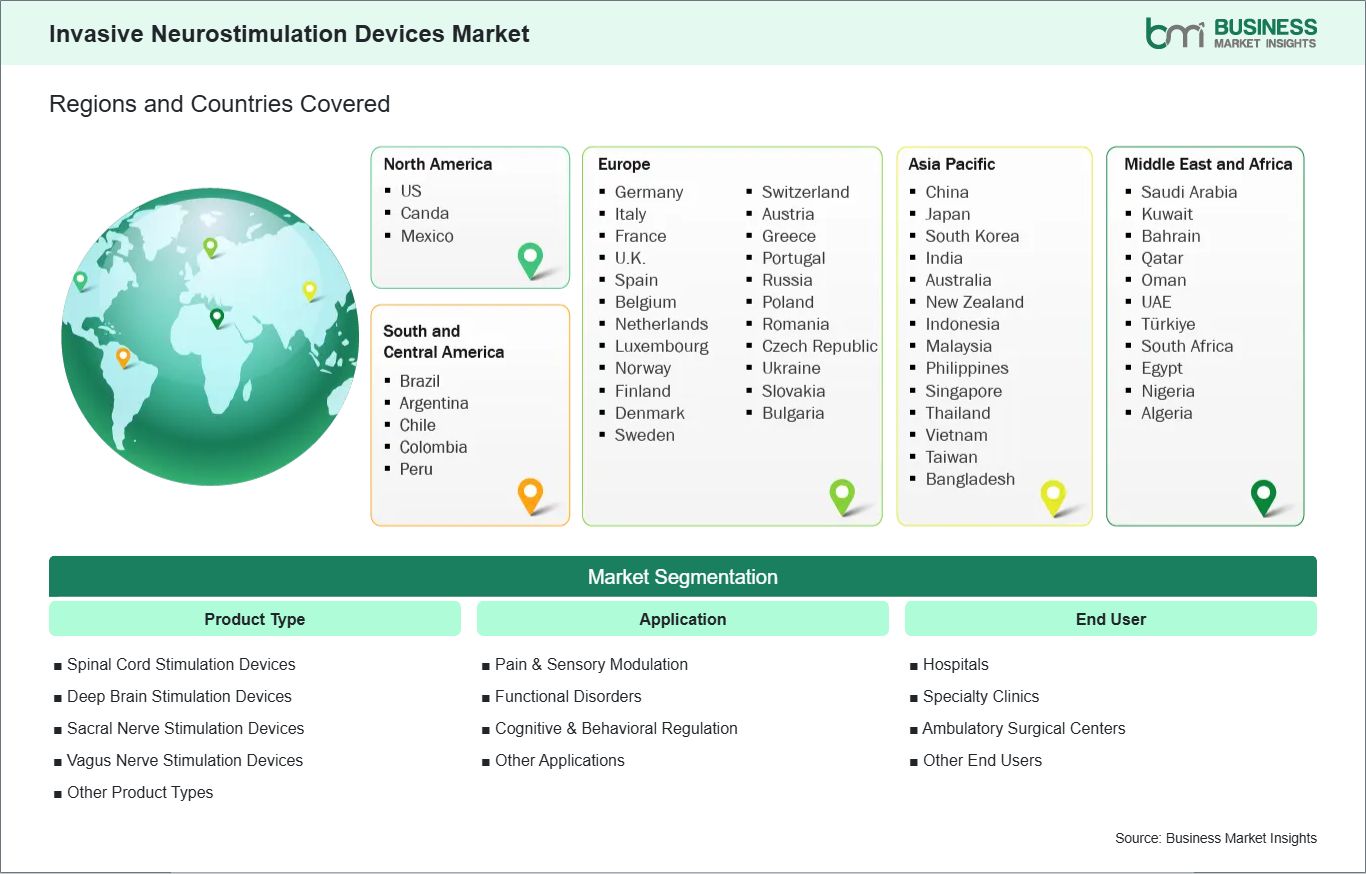
Key segments that contributed to the derivation of the invasive neurostimulation devices market analysis are product type, application, and end user.
- By product type, the invasive neurostimulation devices market is segmented into spinal cord stimulation devices, deep brain stimulation devices, sacral nerve stimulation devices, vagus nerve stimulation devices, and other product types. The spinal cord stimulation devices segment dominated the market in 2025.
- Based on application, the invasive neurostimulation devices market is categorized into pain & sensory modulation, functional disorders, cognitive & behavioral regulation, and other applications. The pain & sensory modulation segment dominated the market in 2025.
- In terms of end user, the invasive neurostimulation devices market is categorized into hospitals, specialty clinics, ambulatory surgical centers, and other end users. The hospitals segment dominated the market in 2025.
Market Forces
Invasive Neurostimulation Devices Market Drivers and Opportunities
Rising Prevalence of Chronic Neurological Disorders
Neurological diseases—including Parkinson's disease, epilepsy, and essential tremor—are on the rise, and there is an increased diagnosis rate in North America, Europe, and Asia Pacific.
The adoption of invasive neuromodulation techniques in healthcare is increasing due to the growing prevalence of neurological disorders that are resistant to conventional pharmacological treatments. Countries such as the US, Germany, China, and Japan are witnessing a rise in the number of hospitals performing neurostimulation procedures, driven by favorable reimbursement policies and technological advancements in implantable pulse generators and MRI-compatible neurostimulation devices.
Investment in the health sector and increased awareness about minimally invasive brain stimulation technologies are contributing positively to the market's growth. Emerging economies in Latin America and the Middle East are also contributing to the market expansion due to investments in neurological infrastructure and partnerships with medical device organizations.
Expanding Applications in Epilepsy Treatment
Vagus nerve stimulation and responsive neurostimulation systems are increasingly used when anti-seizure medications fail, particularly in the US, Europe, and parts of Asia, where the burden of epilepsy remains high and growing clinical adoption and regulatory approvals are expanding their use globally.
Clinical evidence continues to demonstrate the effectiveness of neurostimulation in reducing seizure frequency and improving the quality of life for refractory epilepsy patients. Countries such as Canada, Australia, and South Korea are integrating these devices into advanced epilepsy centers supported by neurosurgical expertise and long-term outcome studies, enhancing treatment outcomes across healthcare systems worldwide.
Future growth in epilepsy applications is supported by advancements in closed-loop systems, AI-based seizure prediction, and miniaturized implantable devices. Regulatory approvals in Europe and the US are accelerating commercialization, while increasing healthcare funding in emerging markets is expected to broaden patient access to invasive neurostimulation therapies, supporting global epilepsy treatment expansion efforts.
Size and Share Analysis
Invasive Neurostimulation Devices Market Size and Share Analysis
The invasive neurostimulation devices market demonstrates steady growth, with size and share analysis highlighting evolving trends and competitive dynamics among key players. The report examines subsegments categorized within product type, application, and end user, offering insights into their contribution to overall market performance.
By product type, the spinal cord stimulation devices subsegment dominated the market in 2025, driven by its widespread adoption for chronic pain management, particularly for failed back surgery syndrome and neuropathic pain conditions.
Based on application, the pain & sensory modulation subsegment dominated the market in 2025, driven by the rising global prevalence of chronic pain disorders and the growing preference for neuromodulation as an alternative to long-term drug therapy.
In terms of end user, the hospitals subsegment dominated the market in 2025, driven by their advanced neurosurgical infrastructure, availability of specialized healthcare professionals, and high volume of neurostimulation implantation procedures.
Report Coverage
Invasive Neurostimulation Devices Market Report Coverage and Deliverables
The "Invasive Neurostimulation Devices Market Size and Forecast (2022-2033)" report provides a detailed analysis of the market covering below areas:
- Market size and forecast at global, regional, and country levels for all the key market segments covered under the scope
- Market trends, as well as drivers, restraints, and opportunities
- Market analysis covering key trends, global and regional framework, major players, regulations, and recent developments
- Market concentration, heat map analysis, prominent players, and recent developments for the Market
- Detailed company profiles, including SWOT analysis
Geographic Insights
Invasive Neurostimulation Devices Market Geographic Insights
The geographical scope of the Invasive Neurostimulation Devices Market report is divided into North America, Asia Pacific, Europe, Middle East & Africa, and South & Central America. North America held the largest share in 2025.
North America continues to dominate the global invasive neurostimulation devices market, driven by its advanced neurosurgical infrastructure, early adoption of innovative neuromodulation therapies, and strong integration of technological advancements into clinical practice. The region also benefits from robust healthcare expenditure, favorable reimbursement policies, and ongoing investments in research and development, which further support market growth. The availability of established reimbursement protocols and the presence of a large number of specialized neurological clinics contribute to the extensive use of such procedures, and research in clinical settings further leads to an extension of applications into pain, movement disorders, and psychological diseases. Asia Pacific is witnessing high growth rates fueled by increased accessibility of neurological clinics, higher incidence of chronic neurological disorders, and gradual proliferation of tertiary care hospitals.
Increased investment in neurosurgeon training, development of local manufacture capacities for medical devices, and implementation of healthcare strategies by national governments are some of the major factors contributing to this trend. Europe witnesses continued expansion because of its well-developed public healthcare system and growing preference for minimally invasive therapies. Collaboration among scientific communities and regulation processes facilitate continuous introduction of updated neurostimulation solutions into clinical practice. Middle East & Africa shows gradual adoption, driven by the infrastructure improvements in Gulf countries, investments in special hospitals, and increased attention toward neurologic treatments. The adoption process is slow in several African countries due to the shortage of specialists. South and Central America is driven by the expansion of the private healthcare sector, greater availability of imported medical devices, and increased neurosurgical training opportunities.
Industry Activity
Recent Developments
The Invasive Neurostimulation Devices Market is evaluated by gathering qualitative and quantitative data post primary and secondary research, which includes important corporate publications, association data, and databases. A few of the key developments in the invasive neurostimulation devices market are:
- In January 2024, Medtronic received FDA approval for its Percept RC Deep Brain Stimulation (DBS) system, featuring BrainSense technology that enables sensing-enabled, adaptive neuromodulation for movement disorders such as Parkinson's disease.
- In April 2023, electroCore announced the expansion of access for its gammaCore Sapphire noninvasive vagus nerve stimulation device through clinical education channels, increasing adoption among healthcare providers for bioelectronic neuromodulation therapy..
Trust & Transparency
Research Methodology
The market analysis combines proprietary research with secondary data from government agencies, company disclosures, regulatory filings, industry databases and expert interviews. Market estimates are validated through data triangulation, cross-market benchmarking and analyst
review.
View Full Research Methodology
Key Sources Referred:
U.S. Food and Drug Administration (FDA) National Institutes of Health (NIH) National Institute of Neurological Disorders and Stroke (NINDS) Centers for Medicare & Medicaid Services (CMS) Medical Device Innovation Consortium (MDIC) World Health Organization (WHO) International Organization for Standardization (ISO) International Neuromodulation Society (INS) North American Neuromodulation Society (NANS) Company Websites Company Annual Reports Company Investor Presentations