Market Summary
Executive Summary and Market Analysis
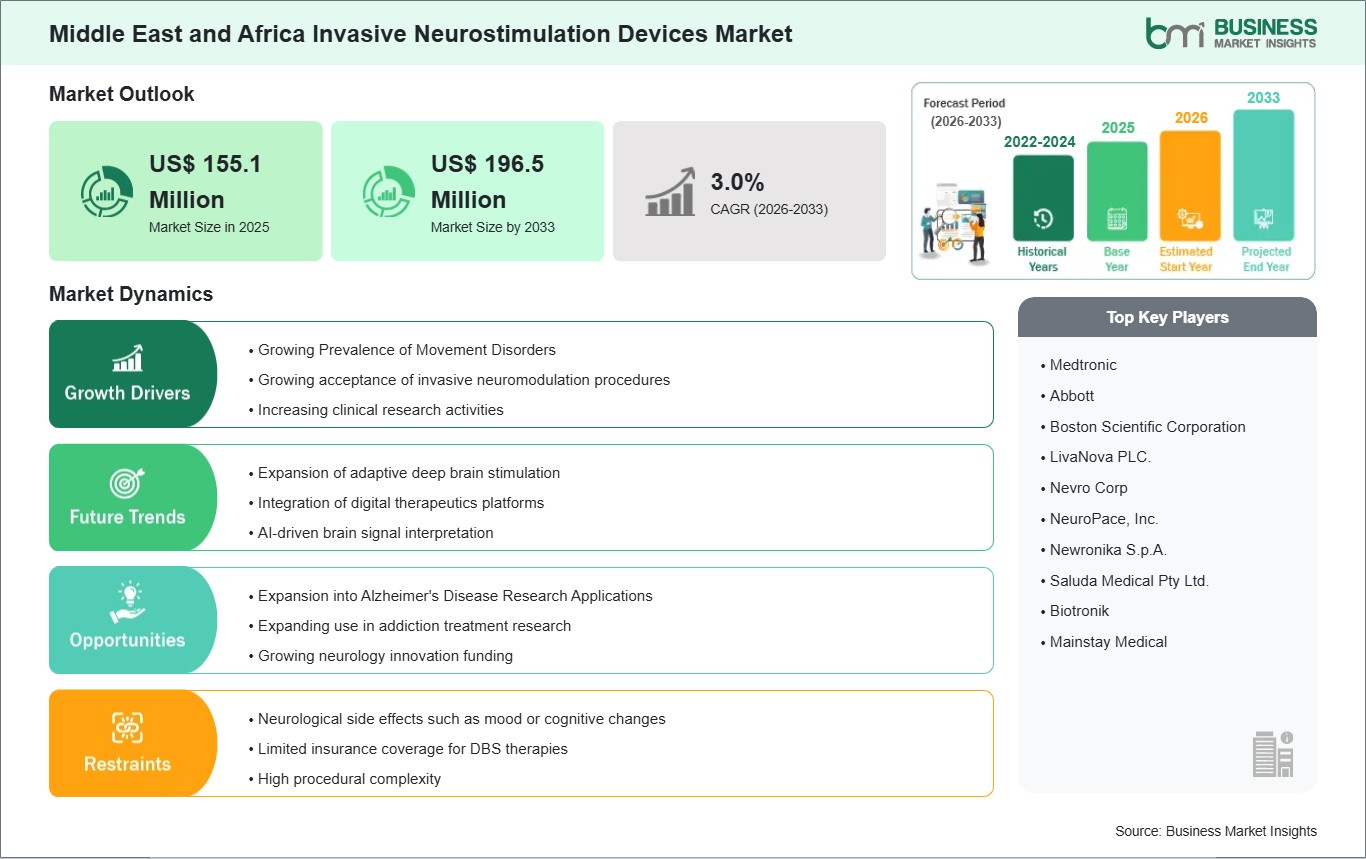
The Middle East and Africa market for invasive neurostimulation equipment is influenced by the trend of an increase in demand for implantable neuromodulation devices due to increased reliance on such devices in the diagnosis and treatment of complex neurological and chronic pain syndromes, especially when drug-based therapy does not yield effective results. High incidence rates of neurological disorders along with awareness regarding pain disorders that cannot be managed using conventional treatment regimens will prompt healthcare facilities to opt for more technologically advanced neurostimulation solutions. Growing expertise and development of minimally invasive neurosurgeries, along with advances made by neurosurgery centers based in urban locations, will lead to widespread acceptance of deep-brain stimulation and spinal cord stimulation therapies. But the steep prices involved in acquiring and administering such therapies, along with non-uniform reimbursement policies and a lack of skilled professionals, will restrict adoption rates. Moreover, the collaboration between global players manufacturing medical equipment and regional health care providers has started building up their efforts towards enhancing training programs and transferring of knowledge related to implant surgery, especially in major urban health care facilities, as their privatization processes and modernization efforts are altering specialty care delivery and increasing access to neurosurgical procedures, along with manufacturer interests in developing their local service networks, postoperative management of patients and training programs for physicians in order to tackle clinical skills variation in order to improve long-term device performance and safety in diverse treatment environments throughout the region.
Segment Analysis
Middle East and Africa Invasive Neurostimulation Devices Market Segmentation
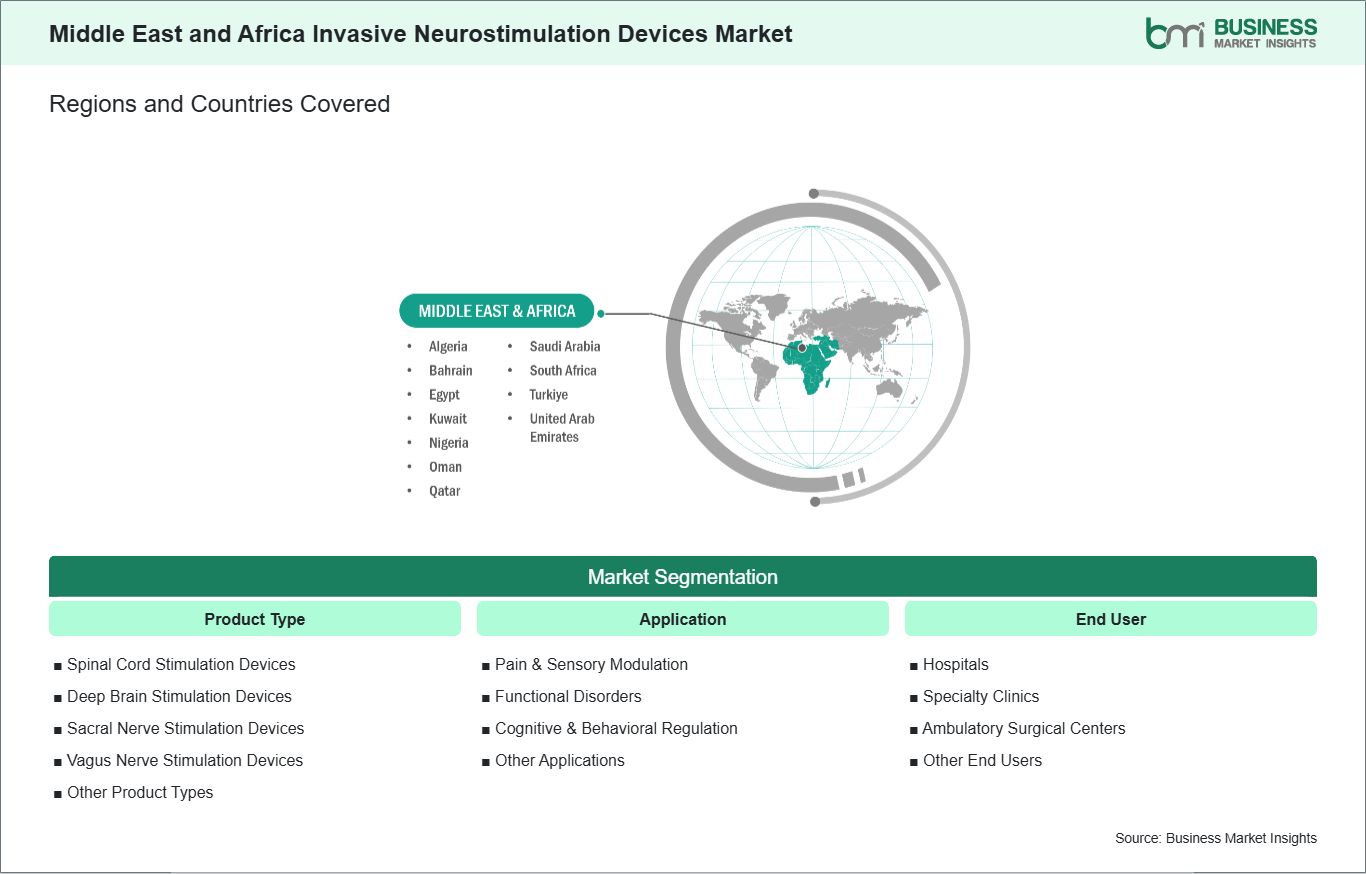
Key segments that contributed to the derivation of the Middle East and Africa invasive neurostimulation devices market analysis are product type, application and end user.
- By product type, the invasive neurostimulation devices market is segmented into spinal cord stimulation devices, deep brain stimulation devices, sacral nerve stimulation devices, vagus nerve stimulation devices, and other product types. The spinal cord stimulation devices segment dominated the market in 2025.
- Based on application, the invasive neurostimulation devices market is categorized into pain & sensory modulation, functional disorders, cognitive & behavioral regulation, and other applications. The pain & sensory modulation segment dominated the market in 2025.
- In terms of end user, the invasive neurostimulation devices market is categorized into hospitals, specialty clinics, ambulatory surgical centers, and other end users. The hospitals segment dominated the market in 2025.
Market Forces
Middle East and Africa Invasive Neurostimulation Devices Market Drivers and Opportunities
Growing Prevalence of Movement Disorders
The increase in movement disorders in the Middle East and Africa region is forcing neurology departments to give increased attention to interventional procedures for movement disorders, such as neurostimulation implants. The trend entails increased numbers of patients with severe Parkinsonism and non-responder tremors, leading to a shift from drug stabilization of symptoms to neurostimulation modulation of brain circuits.
Hospitals that offer specialty treatment for movement disorders in the MEA region incorporate deep-brain stimulators into the clinical routine and other neurostimulation procedures under multidisciplinary clinics for movement disorder treatment, whereby neurosurgeons, neurologists, and therapists all work together during patient consultation, surgery, and programming. This approach helps avoid referral breakdowns and encourages earlier consideration for device implantation for patients whose symptoms have plateaued on drugs.
The reimbursement environment and institutional planning have become increasingly focused on the need to incorporate programming and other aspects of neurostimulator treatment, thus promoting the use of invasive neurostimulation implants for patients with movement disorders.
Expansion into Alzheimer's Disease Research Applications
In the Middle East and Africa, academic medical centers are increasingly exploring invasive neurostimulation as a research avenue for Alzheimer's disease, particularly focusing on how targeted electrical modulation of memory-related brain regions may influence cognitive processing and neural connectivity patterns in later-stage neurodegeneration. Research groups often design pilot stimulation protocols to observe changes in synaptic plasticity and memory recall behavior under carefully controlled clinical monitoring conditions.
Experimental device studies in the region tend to focus on refining stimulation parameters, electrode placement strategies, and closed-loop feedback mechanisms that respond dynamically to cognitive biomarkers associated with Alzheimer's progression. These investigations are frequently conducted within ethically sensitive frameworks that emphasize patient safety, informed consent complexity, and careful balancing of risk versus uncertain therapeutic benefit in neurodegenerative contexts.
Clinical translation pathways in MEA are gradually linking neuromodulation research in Alzheimer's disease to early feasibility studies involving implantable stimulation systems, where outcomes are evaluated through cognitive and behavioral response tracking rather than purely structural imaging.
Size and Share Analysis
Middle East and Africa Invasive Neurostimulation Devices Market Size and Share Analysis
The Middle East and Africa invasive neurostimulation devices market is experiencing steady growth, with market size and share analysis reflecting evolving treatment preferences and competitive dynamics among key players. The report evaluates important subsegments categorized within product type, application and end user, highlighting their respective contributions to market performance.
By product type, the spinal cord stimulation devices subsegment dominated the market in 2025, driven by its widespread adoption for chronic pain management, particularly for failed back surgery syndrome and neuropathic pain conditions.
Based on application, the pain & sensory modulation subsegment dominated the market in 2025, driven by the rising global prevalence of chronic pain disorders and the growing preference for neuromodulation as an alternative to long-term drug therapy.
In terms of end user, the hospitals subsegment dominated the market in 2025, driven by their advanced neurosurgical infrastructure, availability of specialized healthcare professionals, and high volume of neurostimulation implantation procedures.
Report Coverage
Middle East and Africa Invasive Neurostimulation Devices Market Report Coverage and Deliverables
The "Middle East and Africa Invasive Neurostimulation Devices Market Size and Forecast (2022-2033)" report provides a detailed analysis of the market covering below areas:
- Market size and forecast at regional and country levels for all market segments covered under the scope
- Market trends, as well as drivers, restraints, and opportunities
- Market analysis covering key trends, regional framework, major players, regulations, and recent developments
- Market concentration, heat map analysis, prominent players, and recent developments for the Market
- Detailed company profiles, including SWOT analysis
Geographic Insights
Middle East and Africa Invasive Neurostimulation Devices Market Geographic Insights
The geographical scope of the Middle East and Africa Invasive Neurostimulation Devices Market report is divided into Turkiye, the UAE, Saudi Arabia, Bahrain, Oman, Egypt, South Africa and Africa, Algeria, Nigeria, Kuwait, and Qatar. Turkiye held the largest share in 2025.
The adoption pattern of the invasive neurostimulation devices market in the Middle East & Africa region shows uneven growth trends but is strategically growing; Turkiye has emerged as the leading center owing to its strong base of neurology centers, presence of hospitals accredited by international organizations, and serves as a medical tourism corridor connecting Europe and Asia, thereby driving rapid adoption of novel neuromodulation treatment modalities. The UAE sees growth being propelled by the presence of a highly digitally enabled hospital ecosystem, along with next-generation neurology devices having already been incorporated in premium care delivery networks. Rapid growth of Saudi Arabia is fueled by its efforts towards massive transformations in its healthcare system, especially focusing on the establishment of specialized neurological centers and the greater reach of surgical neuromodulation treatments. The growth in Bahrain can be attributed to its efforts towards making substantial investments in specialized centers and gradual expansion in insurance-based access to new procedures. Growth in Oman is a result of its continued development with hospital-level improvements and referral mechanisms in place. The momentum witnessed in South Africa emanates from its mixed private and public healthcare framework, whereby private neurology facilities introduce new medical technologies prior to the public sector. The African continent at large is motivated by substantial unfulfilled need for neurological therapy services as well as gradual implementation of neurotherapy in urban hospitals. In Algeria, the market environment is characterized by a drive toward upgrading of public hospitals under the influence of government initiatives, as well as reliance on imported health technologies. In Nigeria, the market is growing based on the expansion of the private sector, which includes the establishment of private hospitals and increasing urban demand for neurological procedures.
Industry Activity
Recent Developments
The Middle East and Africa Invasive Neurostimulation Devices Market is evaluated by gathering qualitative and quantitative data post primary and secondary research, which includes important corporate publications, association data, and databases. A few of the key developments in the Middle East and Africa invasive neurostimulation devices market are:
- In September 2024, Abbott announced that it had achieved a regional first implantation of its Esprit BTK Everolimus Eluting Resorbable Scaffold System at Al Qassimi Hospital in the United Arab Emirates, marking expanded adoption of Abbott‘s advanced minimally invasive therapeutic technologies across the Middle East healthcare market.
- In January 2024, Abbott announced that it had received U.S. FDA approval for its Liberta RC deep brain stimulation (DBS) system, expanding its next-generation neuromodulation portfolio and supporting global commercialization, in global markets where Abbott‘s DBS systems are distributed through established regulatory approvals.
Trust & Transparency
Research Methodology
The market analysis combines proprietary research with secondary data from government agencies, company disclosures, regulatory filings, industry databases and expert interviews. Market estimates are validated through data triangulation, cross-market benchmarking and analyst
review.
View Full Research Methodology
Key Sources Referred:
U.S. Food and Drug Administration (FDA)National Institutes of Health (NIH)National Institute of Neurological Disorders and Stroke (NINDS)Centers for Medicare & Medicaid Services (CMS)Medical Device Innovation Consortium (MDIC)World Health Organization (WHO)International Organization for Standardization (ISO)International Neuromodulation Society (INS)North American Neuromodulation Society (NANS)Company WebsitesCompany Annual ReportsCompany Investor Presentations