Market Summary
Executive Summary and Market Analysis
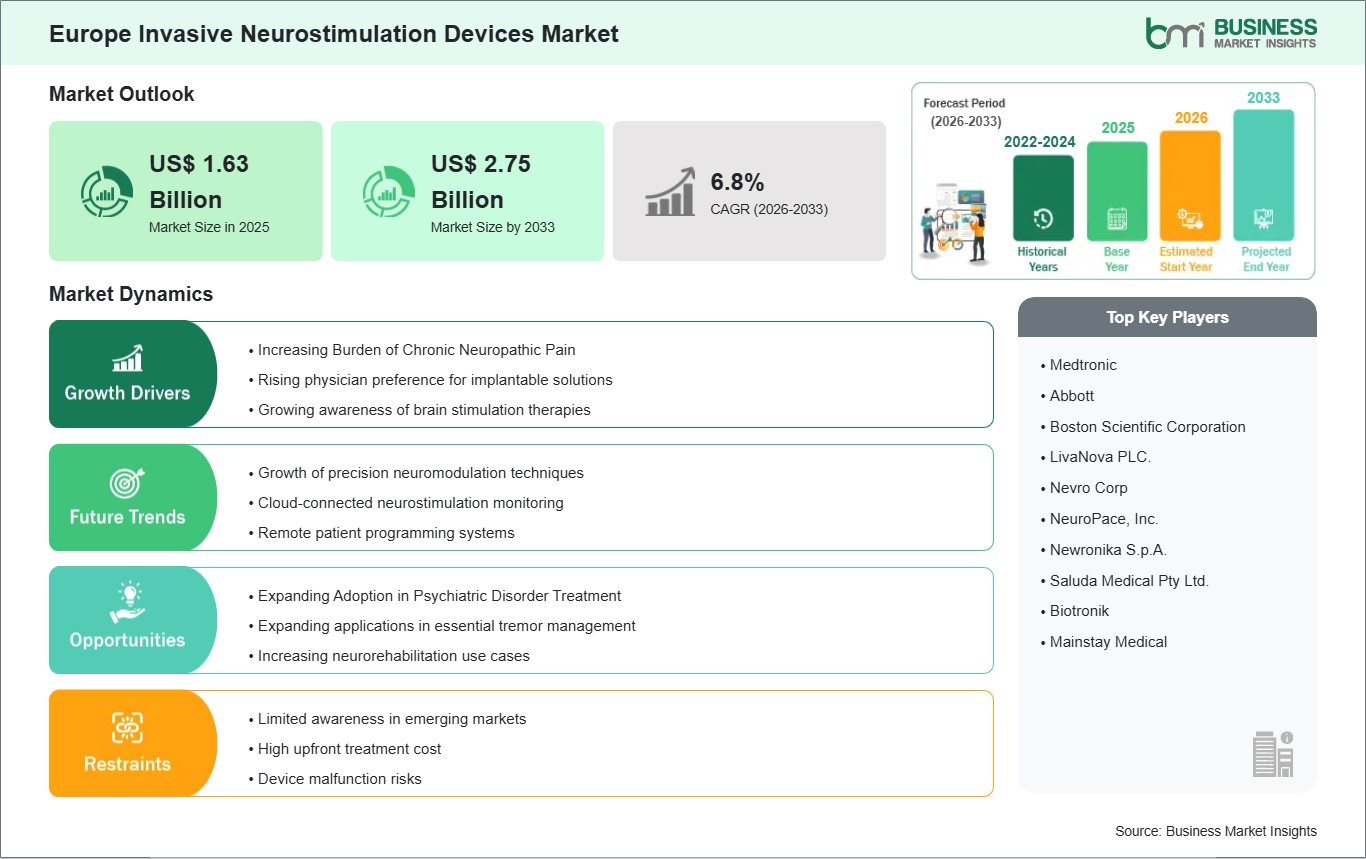
The European Invasive Neurostimulation Devices Market features ongoing advancements in devices used to treat various chronic neurological conditions, motor disorders, and cases of chronic pain where medication does not show adequate therapeutic benefits. The increasing need for neuromodulation therapy due to its precise approach in situations when medications fail to work or have harmful effects on patients has become an important factor shaping market demand. An additional driver is the increase in the prevalence of neurological disorders, such as Parkinson‘s disease, epilepsy, and chronic pain syndrome. Yet another factor fueling the industry is the evolution in device engineering that includes improved battery life, advanced programming options, small implants, and advanced stimulation algorithms that facilitate more personalized therapies. Moreover, there are some other factors, such as the presence of well-established players in the field of medical technology manufacturing, active clinical research, and increased collaboration between health professionals and device manufacturers to enhance therapy applications. However, regulatory priorities for safety, effectiveness, and post-market monitoring are also shaping product development and marketing trends in the industry. Nevertheless, despite the positive reception of neuromodulation devices, one constraint faced by the industry continues to be the high cost involved in the procedure, as well as follow-up and care in general. Increased focus of competition is on differentiating products, training physicians, and generating evidence regarding long-term outcomes. Moreover, growing knowledge about neuromodulation in the clinical world and among patients has been making clinicians consider neuromodulation as a part of a multidisciplinary treatment strategy for complicated conditions in Europe.
Segment Analysis
Europe Invasive Neurostimulation Devices Market Segmentation
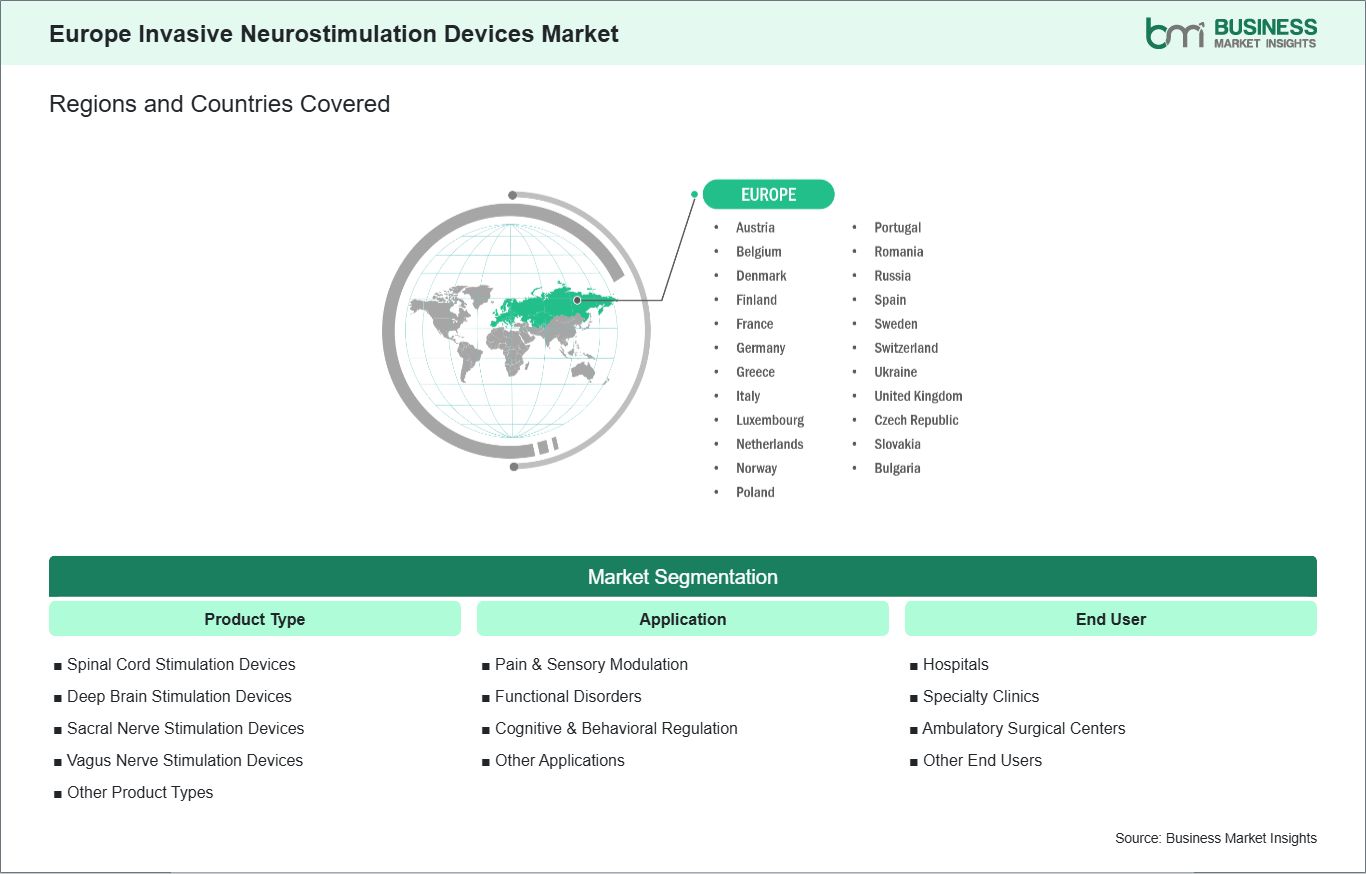
Key segments that contributed to the derivation of the Europe invasive neurostimulation devices market analysis are product type, application and end user.
- By product type, the invasive neurostimulation devices market is segmented into spinal cord stimulation devices, deep brain stimulation devices, sacral nerve stimulation devices, vagus nerve stimulation devices, and other product types. The spinal cord stimulation devices segment dominated the market in 2025.
- Based on application, the invasive neurostimulation devices market is categorized into pain & sensory modulation, functional disorders, cognitive & behavioral regulation, and other applications. The pain & sensory modulation segment dominated the market in 2025.
- In terms of end user, the invasive neurostimulation devices market is categorized into hospitals, specialty clinics, ambulatory surgical centers, and other end users. The hospitals segment dominated the market in 2025.
Market Forces
Europe Invasive Neurostimulation Devices Market Drivers and Opportunities
Increasing Burden of Chronic Neuropathic Pain
For patients with chronic neuropathic pain in Europe, referrals for neurologic and pain management have taken on a new twist. The growing failure of existing medications in some patients is leading providers to consider neurostimulation at an earlier stage within the treatment continuum.
In response, hospitals update their patient management procedures to include device evaluation as part of a comprehensive evaluation process. In many cases, patients who fail non-invasive treatments are recommended for device screening when the symptoms impact their sleep and functional ability. Such a step requires the close cooperation of neurosurgeons, anesthesiologists, and physical therapists.
As a result, medical device makers catering to this population modify their products and approaches accordingly. Specifically, in light of the hospital committee's preferences, they develop devices that ensure the reliability of the procedure and allow easy adjustment after implantation. Service-based sales models have been developed to address this requirement.
Expanding Adoption in Psychiatric Disorder Treatment
Within European mental health services, treatment-resistant psychiatric conditions are prompting closer evaluation of invasive neurostimulation as an adjunctive intervention. Clinical decision-making increasingly emerges from structured case conferences where pharmacological non-response is mapped against neuromodulation eligibility criteria, reshaping traditional boundaries between psychiatry and functional neurosurgery.
Treatment pathways are being reorganized around staged intervention frameworks, where patients move through tightly monitored therapeutic checkpoints before consideration of implantable stimulation systems. Psychiatric hospitals and academic centers often embed neuromodulation discussions into broader somatic treatment planning, especially when affective instability and refractory symptoms limit engagement with psychotherapy and medication-only approaches.
Technology developers and clinical partners in Europe are refining device programming flexibility to accommodate variable psychiatric symptom profiles, including fluctuating response patterns over time. This has led to deeper integration of follow-up adjustment protocols, where long-term clinical oversight and iterative stimulation tuning become central to sustaining therapeutic continuity rather than achieving immediate symptom suppression.
Size and Share Analysis
Europe Invasive Neurostimulation Devices Market Size and Share Analysis
The Europe invasive neurostimulation devices market is experiencing steady growth, with market size and share analysis reflecting evolving treatment preferences and competitive dynamics among key players. The report evaluates important subsegments categorized within product type, application and end user, highlighting their respective contributions to market performance.
By product type, the spinal cord stimulation devices subsegment dominated the market in 2025, driven by its widespread adoption for chronic pain management, particularly for failed back surgery syndrome and neuropathic pain conditions.
Based on application, the pain & sensory modulation subsegment dominated the market in 2025, driven by the rising global prevalence of chronic pain disorders and the growing preference for neuromodulation as an alternative to long-term drug therapy.
In terms of end user, the hospitals subsegment dominated the market in 2025, driven by their advanced neurosurgical infrastructure, availability of specialized healthcare professionals, and high volume of neurostimulation implantation procedures.
Report Coverage
Europe Invasive Neurostimulation Devices Market Report Coverage and Deliverables
The "Europe Invasive Neurostimulation Devices Market Size and Forecast (2022-2033)" report provides a detailed analysis of the market covering below areas:
- Market size and forecast at regional and country levels for all market segments covered under the scope
- Market trends, as well as drivers, restraints, and opportunities
- Market analysis covering key trends, regional framework, major players, regulations, and recent developments
- Market concentration, heat map analysis, prominent players, and recent developments for the Market
- Detailed company profiles, including SWOT analysis
Geographic Insights
Europe Invasive Neurostimulation Devices Market Geographic Insights
The geographical scope of the Europe Invasive Neurostimulation Devices Market report is divided into Germany, Italy, France, U.K., Spain, Belgium, Netherlands, Luxembourg, Norway, Finland, Denmark, Sweden, Switzerland, Austria, Greece, Portugal, Russia, Poland, Romania, Czech Republic, Ukraine, Slovakia, Bulgaria. Germany held the largest share in 2025.
The German market leads in Europe because of its well-developed neurosurgical system, high reimbursement consistency, and timely acceptance of invasive procedures for deep brain and spinal cord stimulation treatments. The Italian market shows consistent growth as a result of an aging population and improvement in the rehabilitation neurology system. The French market sees benefits from government-backed initiatives aimed at developing innovative health care technologies, as well as widespread adoption of neurotechnologies in tertiary care hospitals. The UK market sees growth because of innovations in neuromodulation technology use and NHS-driven programs for pain management and treatment of movement disorders. The Spanish market sees growth as a result of increasing demand for epilepsy and movement disorder interventions in neurology centers. Belgian market sees consistent development through focused expertise in neurovasculature and cross-border referrals. The Dutch market sees growth because of the robust medical device industry and involvement in neuromodulation studies. The growth in Norway is facilitated through strong government funding, as well as focusing on chronic pain and neurorehabilitation treatments. Finland is favored by digital healthcare and neurotechnology collaboration initiatives. Denmark witnesses higher adoption due to the use of pain management centers implementing new technologies of stimulation treatments. The progress in Sweden is due to established neuroscience centers and early adoption of implantable neuro-devices. The progress in Switzerland is associated with a higher adoption rate that corresponds with the country's high-quality provision of healthcare services and fast availability of innovative neuromodulation solutions. Austria expands due to the development of the hospital's neurosurgery department, along with reimbursement programs. The increase in Greece is due to progressive neurology units and growing numbers of neurological disorders. In Portugal, the growth of the neurology services market is driven by the growth of private neurology services and the aging population. Russian development is related to urban-based investments into neurosurgery services. Polish development is due to the implementation of new reimbursement policies and specialization education. Romanian growth comes from improved healthcare infrastructure and neurological programs supported by Europe.
Industry Activity
Recent Developments
The Europe Invasive Neurostimulation Devices Market is evaluated by gathering qualitative and quantitative data post primary and secondary research, which includes important corporate publications, association data, and databases. A few of the key developments in the Europe invasive neurostimulation devices market are:
- In August 2023, Medtronic announced that it had received CE Mark approval for its Inceptiv closed-loop spinal cord stimulator in Europe, introducing real-time sensing-based neuromodulation designed to improve chronic pain management and strengthening its invasive neurostimulation portfolio across European markets.
- In February 2023, LivaNova announced that it had initiated a limited commercial release in Europe of the Essenz Perfusion System for cardiopulmonary bypass procedures, expanding its advanced surgical and neuro-support ecosystem across select European clinical centers.
Trust & Transparency
Research Methodology
The market analysis combines proprietary research with secondary data from government agencies, company disclosures, regulatory filings, industry databases and expert interviews. Market estimates are validated through data triangulation, cross-market benchmarking and analyst
review.
View Full Research Methodology
Key Sources Referred:
U.S. Food and Drug Administration (FDA)National Institutes of Health (NIH)National Institute of Neurological Disorders and Stroke (NINDS)Centers for Medicare & Medicaid Services (CMS)Medical Device Innovation Consortium (MDIC)World Health Organization (WHO)International Organization for Standardization (ISO)International Neuromodulation Society (INS)North American Neuromodulation Society (NANS)Company WebsitesCompany Annual ReportsCompany Investor Presentations