Asia Pacific Invasive Neurostimulation Devices Market Outlook: Size, Share, Trends, Growth Analysis, Competitive Landscape & Forecast, 2026-2033

Historic Data: 2022-2024   |   Base Year: 2025   |   Forecast Period: 2026-2033
Report Content: Market Scope, Market Segmentation, Market Dynamics, and Competitive Analysis

Report Coverage:
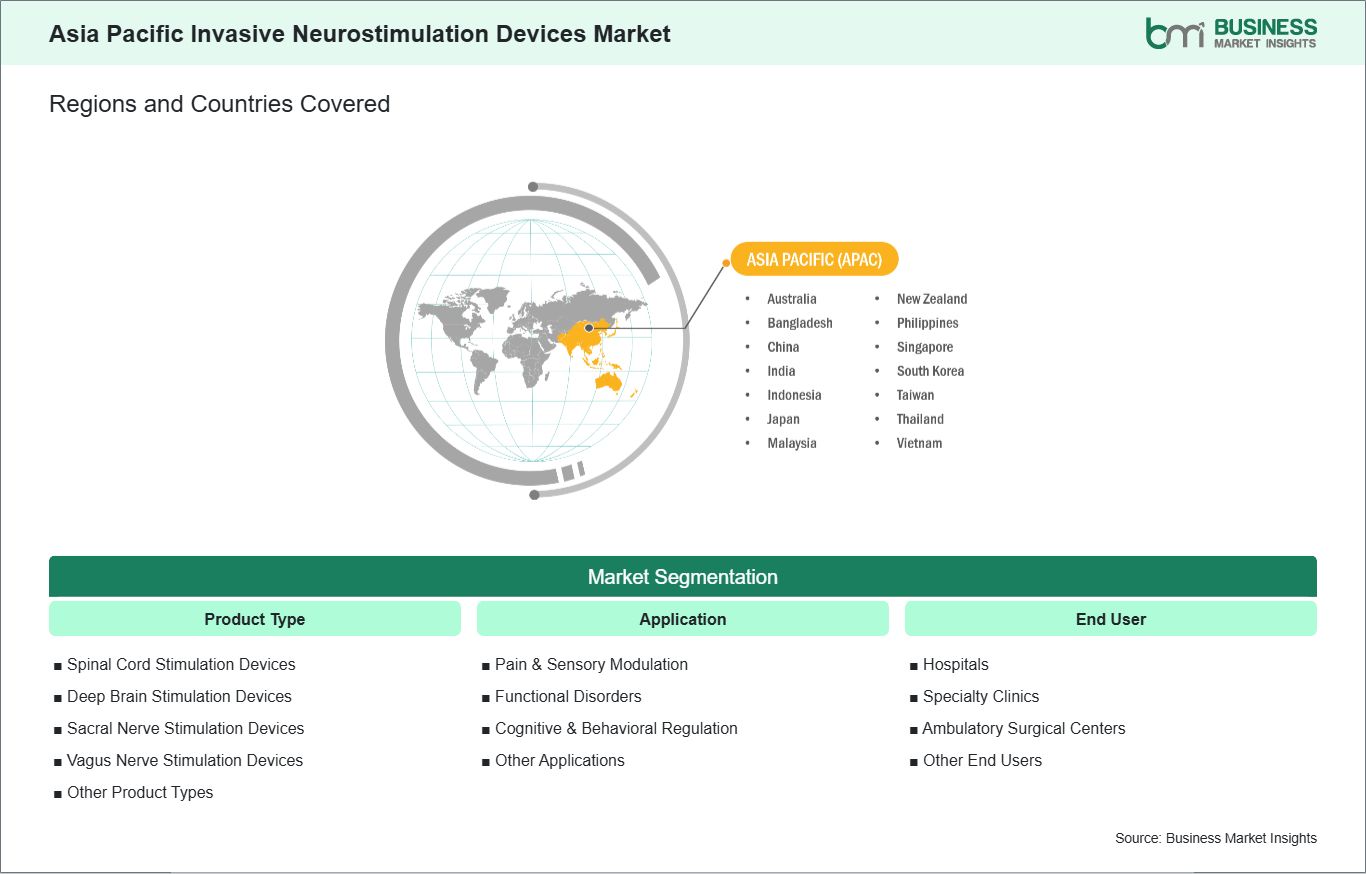
  • Product Type (Spinal Cord Stimulation Devices, Deep Brain Stimulation Devices, Sacral Nerve Stimulation Devices, Vagus Nerve Stimulation Devices, and Other Product Types)
  • Application (Pain & Sensory Modulation, Functional Disorders, Cognitive & Behavioral Regulation, and Other Applications)
  • End User (Hospitals, Specialty Clinics, Ambulatory Surgical Centers, and Other End Users)

No. of Pages: 150
Report Code: BMIPUB00035985
Category: Life Sciences
Asia Pacific Invasive Neurostimulation Devices Market

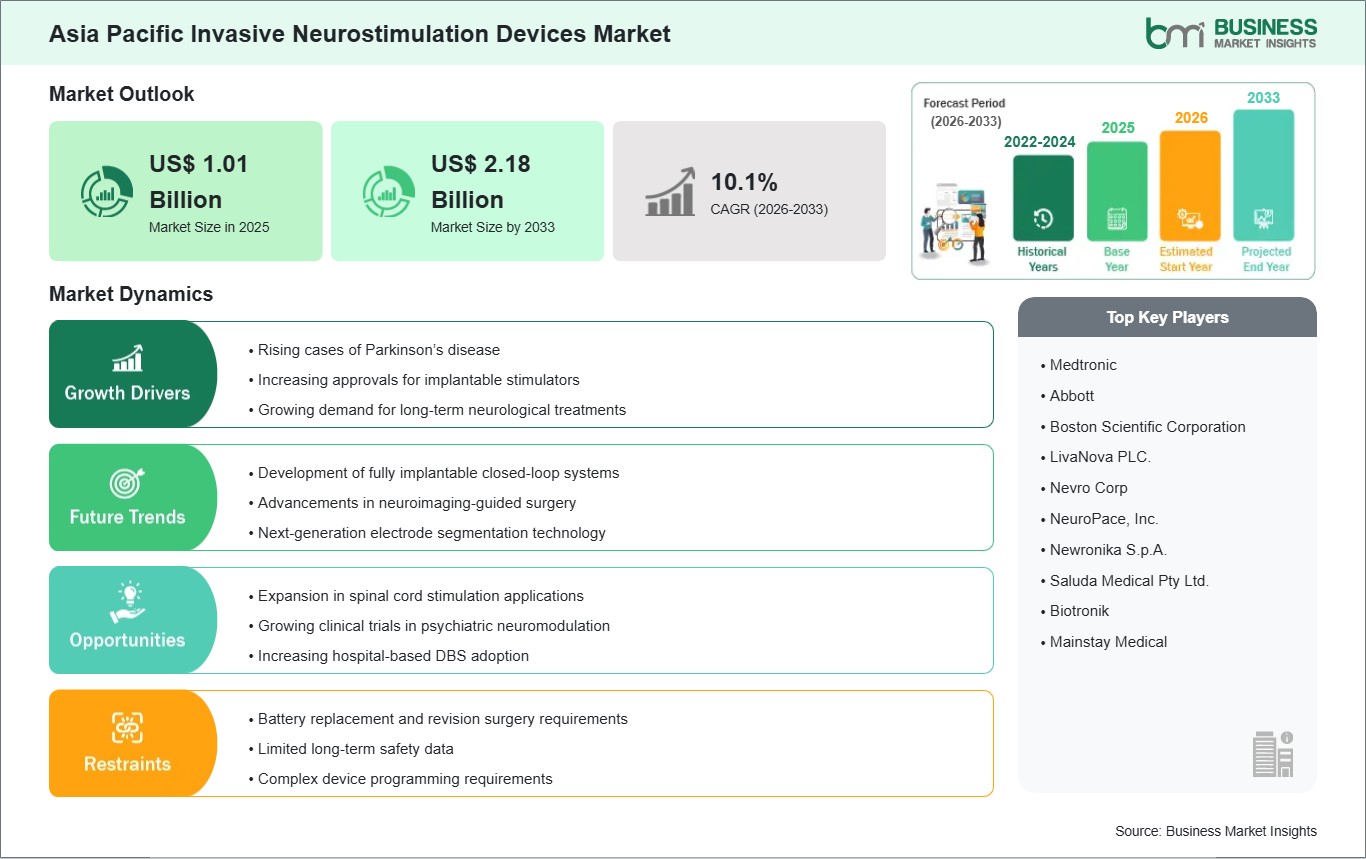
The Asia Pacific invasive neurostimulation devices market size is expected to reach US$ 2.18 billion by 2033 from US$ 1.01 billion in 2025. The market is estimated to register a CAGR of 10.1% from 2026 to 2033.

Executive Summary and Asia Pacific Invasive Neurostimulation Devices Market Analysis:

Within the Asia Pacific region, the environment surrounding the invasively deployed neurostimulation devices market reflects an increasing use of implantable neuromodulation treatments as alternatives to pharmaceutical treatments in cases of difficult-to-treat neurological diseases and chronic pain. Clinicians, namely neurologists and neurosurgeons, tend to consider these technologies as effective tools for the treatment of complex diseases like Parkinsonian syndromes, refractory epilepsy, and neuropathic pains, among other ailments. The increasing incidence of neurological diseases plays an essential role in driving demand for neurostimulation devices used for modulating dysfunctional neural circuits. The development of robust neurosurgical infrastructure is another catalyst that contributes to the growth of the market under consideration. Improvements in this sphere involve building operating rooms equipped with modern technologies, access to implantable neurostimulators, and education of clinicians involved in neurosurgery. Nonetheless, there remains an impediment due to disparities in payment schemes and affordability issues in certain regions, thus limiting the accessibility of such interventions outside the most advanced metropolitan hospitals. Moreover, the requirement for specialized surgical and postoperative care expertise remains another factor that limits the implementation of such interventions, especially in developing environments where neuromodulation programs are relatively new and still being developed. Collaboration between the makers of these devices and other stakeholders in the sector has also facilitated iterative innovation in programming, remote monitoring, and patient selection processes, hence enhancing the long-term effectiveness of neuromodulation interventions.

Asia Pacific Invasive Neurostimulation Devices Market - Strategic Insights:

global-market-strategic-framework
Get more information on this report

Asia Pacific Invasive Neurostimulation Devices Market Segmentation Analysis:

Key segments that contributed to the derivation of the Asia Pacific invasive neurostimulation devices market analysis are product type, application and end user.

  • By product type, the invasive neurostimulation devices market is segmented into spinal cord stimulation devices, deep brain stimulation devices, sacral nerve stimulation devices, vagus nerve stimulation devices, and other product types. The spinal cord stimulation devices segment dominated the market in 2025.
  • Based on application, the invasive neurostimulation devices market is categorized into pain & sensory modulation, functional disorders, cognitive & behavioral regulation, and other applications. The pain & sensory modulation segment dominated the market in 2025.
  • In terms of end user, the invasive neurostimulation devices market is categorized into hospitals, specialty clinics, ambulatory surgical centers, and other end users. The hospitals segment dominated the market in 2025.

Asia Pacific Invasive Neurostimulation Devices Market Drivers and Opportunities:

Rising cases of Parkinson's disease

Parkinson's disease has become instrumental in driving the integration of invasive neurostimulators in Asia Pacific neurological centers. Healthcare professionals are shifting their practices to identify candidates for deep brain stimulation when the medication becomes less reliable. This development is having an impact on the referral patterns from general neurologists to movement disorder specialists.

The design of stimulation devices manufactured in the region is evolving to cater to progressive condition treatments. Adaptive stimulation and remote programming are key features being integrated in order to manage patients under the long-term therapies using stimulation in hospital setups. Compatibility of the stimulators with neuro-navigation systems is prioritized by hospital procurement departments.

Integrated patient management processes are emerging among healthcare professionals. Multidisciplinary teams consisting of neurologists, neurosurgeons, and rehabilitation specialists play important roles in decision-making regarding implants. In urban neuro centers, special clinics for stimulation management are being set up.

Expansion in spinal cord stimulation applications

Expanding beyond traditional pain management, spinal cord stimulation is being incorporated into broader chronic pain workflows across Asia Pacific surgical and pain clinics. Physicians are increasingly considering neuromodulation earlier for patients with persistent neuropathic symptoms after conservative therapy. This is encouraging more structured pre-implant evaluation protocols within pain management departments.

Unlike earlier adoption patterns centered in tertiary hospitals, spinal cord stimulation is now appearing in mid-tier private hospitals that have developed interventional pain units. This spread is supported by training programs that familiarize anesthesiologists and pain specialists with implantation techniques and post-procedure management.

As reimbursement frameworks and clinical guidelines evolve within national healthcare systems, spinal cord stimulation is being positioned as a long-term management option rather than a last-resort intervention. Hospitals are aligning follow-up services to include device reprogramming clinics, ensuring sustained therapy optimization for patients with complex pain conditions.

Asia Pacific Invasive Neurostimulation Devices Market Size and Share Analysis:

The Asia Pacific invasive neurostimulation devices market is experiencing steady growth, with market size and share analysis reflecting evolving treatment preferences and competitive dynamics among key players. The report evaluates important subsegments categorized within product type, application and end user, highlighting their respective contributions to market performance.

By product type, the spinal cord stimulation devices subsegment dominated the market in 2025, driven by its widespread adoption for chronic pain management, particularly for failed back surgery syndrome and neuropathic pain conditions.

Based on application, the pain & sensory modulation subsegment dominated the market in 2025, driven by the rising global prevalence of chronic pain disorders and the growing preference for neuromodulation as an alternative to long-term drug therapy.

In terms of end user, the hospitals subsegment dominated the market in 2025, driven by their advanced neurosurgical infrastructure, availability of specialized healthcare professionals, and high volume of neurostimulation implantation procedures.

Asia Pacific Invasive Neurostimulation Devices Market Report Highlights:

Report Attribute Details
Market size in 2025 US$ 1.01 Billion
Market Size by 2033 US$ 2.18 Billion
CAGR (2026 - 2033)10.1%
Historical Data 2022-2024
Forecast period 2026-2033
Segments Covered By Product Type
  • Spinal Cord Stimulation Devices
  • Deep Brain Stimulation Devices
  • Sacral Nerve Stimulation Devices
  • Vagus Nerve Stimulation Devices
  • Other Product Types
By Application
  • Pain & Sensory Modulation
  • Functional Disorders
  • Cognitive & Behavioral Regulation
  • Other Applications
By End User
  • Hospitals
  • Specialty Clinics
  • Ambulatory Surgical Centers
  • Other End Users
Regions and Countries Covered
Asia Pacific China, Japan, South Korea, India, Australia, New Zealand, Indonesia, Malaysia, Philippines, Singapore, Thailand, Vietnam, Taiwan, Bangladesh
Market leaders and key company profiles
  • Medtronic
  • Abbott
  • Boston Scientific Corporation
  • LivaNova PLC.
  • Nevro Corp
  • NeuroPace, Inc.
  • Newronika S.p.A.
  • Saluda Medical Pty Ltd.
  • Biotronik
  • Mainstay Medical
Get more information on this report

Asia Pacific Invasive Neurostimulation Devices Market Report Coverage and Deliverables:

The "Asia Pacific Invasive Neurostimulation Devices Market Size and Forecast (2022-2033)" report provides a detailed analysis of the market covering below areas:

  • Market size and forecast at regional and country levels for all market segments covered under the scope
  • Market trends, as well as drivers, restraints, and opportunities
  • Market analysis covering key trends, regional framework, major players, regulations, and recent developments
  • Market concentration, heat map analysis, prominent players, and recent developments for the Market
  • Detailed company profiles, including SWOT analysis

Asia Pacific Invasive Neurostimulation Devices Market Geographic Insights:

The geographical scope of the Asia Pacific Invasive Neurostimulation Devices Market report is divided into China, Japan, South Korea, India, Australia, New Zealand, Indonesia, Malaysia, Philippines, Singapore, Thailand, Vietnam, Taiwan, Bangladesh. China held the largest share in 2025.

China leads the market due to sheer production capacity, hospital use, depth of R&D ecosystem, and increased coverage in terms of deep penetration. Japan benefits from an aging society, the adoption of neurosurgery procedures, a positive reception of such procedures, and a mature rehabilitation process. South Korea is technologically driven when it comes to healthcare, with precision surgeries, health platform integration, and robotic procedures. India focuses on increasing healthcare availability, growing neurological awareness and cost-conscious adoption in tiered cities and hospitals. Australia enjoys strong networks for tertiary care, implantable procedures adoption, clinical research, and guideline-based practices. New Zealand may be small in size, but it has specialized neuro centers and treats cases involving crossing borders for treatments of chronic pain. Rising medical tourism, urban hospitals' improvement, an increase in insurance coverage, and the creation of specialty centers for neurology in Malaysia. Increase in specialists, reduction of the gap between urban and rural areas, increase in the number of private neurology centers and outreach programs in the Philippines. Advanced medical hub, innovation ecosystem, role as regional referral center, and precision neurosurgeons in Singapore. Government-led construction of more hospitals, neurosurgery training programs, a rise in electives, and a balance between private and public care in Thailand. Fast-paced modernization of healthcare facilities, increasing diagnostics for neurology issues, investments by foreign companies in hospitals, and growth in neurology specialists in Vietnam. Good connection between semiconductors and the medtech industry, precision devices manufacturing, expert surgeons, and an innovation ecosystem for neurosurgery in Taiwan. New healthcare facilities in Bangladesh, rising awareness about neurology problems, the upgrade of hospitals with the help of donations, and a lack of specialists. Overall, regional developments are also bolstered by increased training networks, technology transfer, and cooperation between hospitals and medtech manufacturers in the Asia Pacific region.

global-market-geography
Get more information on this report

Asia Pacific Invasive Neurostimulation Devices Market Research Report Guidance:

  • The report includes qualitative and quantitative data in the Asia Pacific Invasive Neurostimulation Devices Market across product type, application, end user, and geography.
  • The report starts with the key takeaways (chapter 2), highlighting the key trends and outlook of the Asia Pacific Invasive Neurostimulation Devices Market.
  • Chapter 3 focuses on the research methodology of the study.
  • Chapter 4 includes ecosystem analysis.
  • Chapter 5 highlights the major industry dynamics in the Asia Pacific Invasive Neurostimulation Devices Market, including factors that are driving the market, prevailing deterrents, potential opportunities, as well as future trends. Impact analysis of these drivers and restraints is also covered in this section.
  • Chapter 6 discusses the Asia Pacific Invasive Neurostimulation Devices Market scenario, in terms of historical market revenues, and forecast till the year 2033.
  • Chapters 7 to 10 cover the Asia Pacific Invasive Neurostimulation Devices Market segments by product type, application, end user, and geography across China, Japan, South Korea, India, Australia, New Zealand, Indonesia, Malaysia, Philippines, Singapore, Thailand, Vietnam, Taiwan, Bangladesh. They cover the market revenue, forecast, and factors driving the market.
  • Chapter 11 describes the competitive analysis along with the heat map analysis for the key players operating in the market.
  • Chapter 12 describes the industry landscape analysis. It provides detailed descriptions of business activities such as market initiatives, new developments, mergers, and joint ventures globally, along with a competitive landscape.
  • Chapter 13 provides detailed profiles of the major companies operating in the Asia Pacific Invasive Neurostimulation Devices Market. Companies have been profiled on the basis of their key facts, business descriptions, products, financial overview, SWOT analysis, and key developments.
  • Chapter 14, i.e., the appendix, is inclusive of a brief overview of the company, list of abbreviations, and a disclaimer.

Asia Pacific Invasive Neurostimulation Devices Market News and Key Development:

The Asia Pacific Invasive Neurostimulation Devices Market is evaluated by gathering qualitative and quantitative data post primary and secondary research, which includes important corporate publications, association data, and databases. A few of the key developments in the Asia Pacific invasive neurostimulation devices market are:

  • In August 2023, BrainsWay announced that it expanded access to its Deep Transcranial Magnetic Stimulation (Deep TMS) systems in Taiwan through Unison Healthcare Group, increasing installed systems across the Asia Pacific region to improve availability of non-invasive neurostimulation for treatment-resistant depression.
  • In December 2023, BIOTRONIK announced the opening of its new Asia-Pacific Manufacturing and Research Hub in Singapore, expanding regional capabilities in development and production of implantable medical technologies, including devices supporting cardiac rhythm management and neurostimulation-adjacent implantable systems.

Key Sources Referred:

U.S. Food and Drug Administration (FDA)National Institutes of Health (NIH)National Institute of Neurological Disorders and Stroke (NINDS)Centers for Medicare & Medicaid Services (CMS)Medical Device Innovation Consortium (MDIC)World Health Organization (WHO)International Organization for Standardization (ISO)International Neuromodulation Society (INS)North American Neuromodulation Society (NANS)Company WebsitesCompany Annual ReportsCompany Investor Presentations
The List of Companies - Asia Pacific Invasive Neurostimulation Devices Market
  • Medtronic
  • Abbott
  • Boston Scientific Corporation
  • LivaNova PLC.
  • Nevro Corp
  • NeuroPace, Inc.
  • Newronika S.p.A.
  • Saluda Medical Pty Ltd.
  • Biotronik
  • Mainstay Medical
About Author — Life Sciences Research Team

Krishna is a Market Research Analyst with over 4 years of experience across Life Sciences and Materials & Chemicals industries. He holds a Bachelor's degree in Pharmacy (B.Pharm.) and a Master's degree in Pharmaceutical Medicinal Chemistry (M.Pharm.). His expertise spans market intelligence, competitive benchmarking, market sizing and forecasting, primary and secondary research, and strategic consulting.

Krishna has successfully contributed to numerous syndicated and custom research engagements, delivering industry reports, market assessments, competitive analyses, and business proposals for clients across diverse sectors. With .. Show More

Frequently Asked Questions
How big is the Asia Pacific Invasive Neurostimulation Devices Market?

The Asia Pacific Invasive Neurostimulation Devices Market is valued at US$ 1.01 Billion in 2025, it is projected to reach US$ 2.18 Billion by 2033.

What is the CAGR for Asia Pacific Invasive Neurostimulation Devices Market by (2026 - 2033)?

As per our report Asia Pacific Invasive Neurostimulation Devices Market, the market size is valued at US$ 1.01 Billion in 2025, projecting it to reach US$ 2.18 Billion by 2033. This translates to a CAGR of approximately 10.1% during the forecast period.

What segments are covered in this report?

The Asia Pacific Invasive Neurostimulation Devices Market report typically cover these key segments-

  • Product Type (Spinal Cord Stimulation Devices, Deep Brain Stimulation Devices, Sacral Nerve Stimulation Devices, Vagus Nerve Stimulation Devices, and Other Product Types)
  • Application (Pain & Sensory Modulation, Functional Disorders, Cognitive & Behavioral Regulation, and Other Applications)
  • End User (Hospitals, Specialty Clinics, Ambulatory Surgical Centers, and Other End Users)

What is the historic period, base year, and forecast period taken for Asia Pacific Invasive Neurostimulation Devices Market?

The historic period, base year, and forecast period can vary slightly depending on the specific market research report. However, for the Asia Pacific Invasive Neurostimulation Devices Market report:

  • Historic Period : 2022-2024
  • Base Year : 2025
  • Forecast Period : 2026-2033
  • Who are the major players in Asia Pacific Invasive Neurostimulation Devices Market?

    The Asia Pacific Invasive Neurostimulation Devices Market is populated by several key players, each contributing to its growth and innovation. Some of the major players include:

  • Medtronic
  • Abbott
  • Boston Scientific Corporation
  • LivaNova PLC.
  • Nevro Corp
  • NeuroPace, Inc.
  • Newronika S.p.A.
  • Saluda Medical Pty Ltd.
  • Biotronik
  • Mainstay Medical
  • Who should buy this report?

    The Asia Pacific Invasive Neurostimulation Devices Market report is valuable for diverse stakeholders, including:

    • Investors: Provides insights for investment decisions pertaining to market growth, companies, or industry insights. Helps assess market attractiveness and potential returns.
    • Industry Players: Offers competitive intelligence, market sizing, and trend analysis to inform strategic planning, product development, and sales strategies.
    • Suppliers and Manufacturers: Helps understand market demand for components, materials, and services related to concerned industry.
    • Researchers and Consultants: Provides data and analysis for academic research, consulting projects, and market studies.
    • Financial Institutions: Helps assess risks and opportunities associated with financing or investing in the concerned market.

    Essentially, anyone involved in or considering involvement in the Asia Pacific Invasive Neurostimulation Devices Market value chain can benefit from the information contained in a comprehensive market report.

    Available Report Formats

    pdf-format excel-format pptx-format
    Buy Now
    Sales Assistance
    +1 646 791 7070 (US & UK)
    Customization Form

    Please tell us your area of interest
    (Market Segments/ Regions and Countries/ Companies)