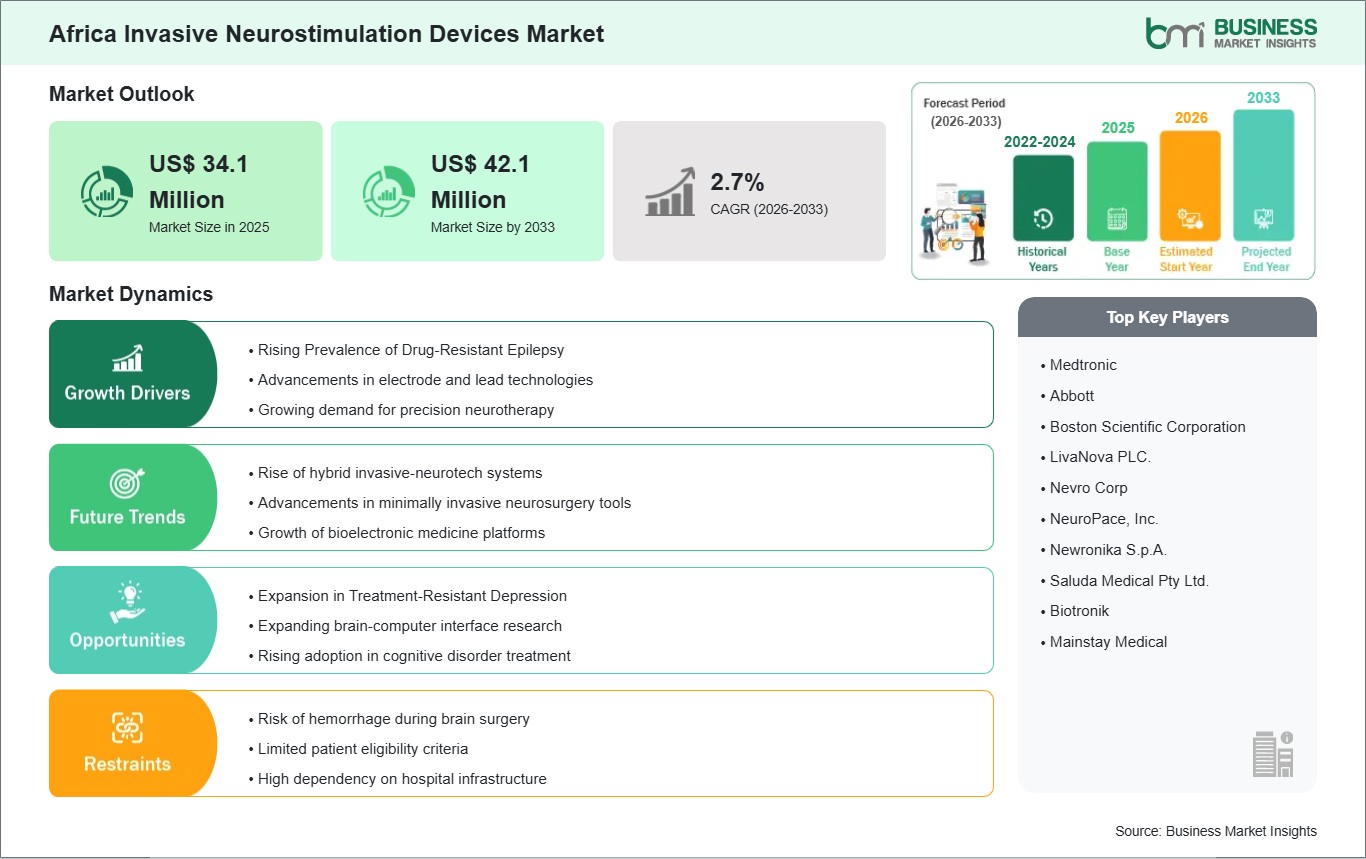
The Africa invasive neurostimulation devices market size is expected to reach US$ 42.1 million by 2033 from US$ 34.1 million in 2025. The market is estimated to register a CAGR of 2.7% from 2026 to 2033.
The landscape of Africa's invasive neurostimulation devices is shaped by changing requirements of neurology services and the gradual adoption of high-tech neurosurgical devices in major healthcare centers. The rising incidence of complex neurological disorders—including Parkinsonian syndromes, refractory seizures, and neuropathic pain—is prompting clinicians to increasingly rely on neuromodulation interventions such as deep brain stimulation and spinal cord stimulation, particularly in cases where pharmacological treatments are insufficient. A major contributing factor is the emergence of dedicated neurosurgery centers within tertiary medical institutions in urban areas, supported by improved training expertise and stronger interaction with foreign manufacturers of medical devices. The increasing demand for effective long-term pain management solutions is driving greater interest among pain specialists toward invasive neuromodulation techniques.
Private investments in the health sector and the gradual development of advanced surgical facilities act as key enablers for the adoption of neurostimulation procedures and the improvement of post-procedure patient management capacity. However, a major barrier persists in the region, particularly issues of affordability and limited financing channels, which restrict access to costly neurostimulation implants. Another significant challenge is the uneven distribution of neurosurgical expertise and the shortage of specialized facilities outside major metropolitan hubs, resulting in the use of these devices being concentrated among a limited number of industry players and centers. Despite these constraints, there have been gradual advancements in the adoption of neurostimulation implants in the region, supported by increasing clinical awareness and improving technical capability.

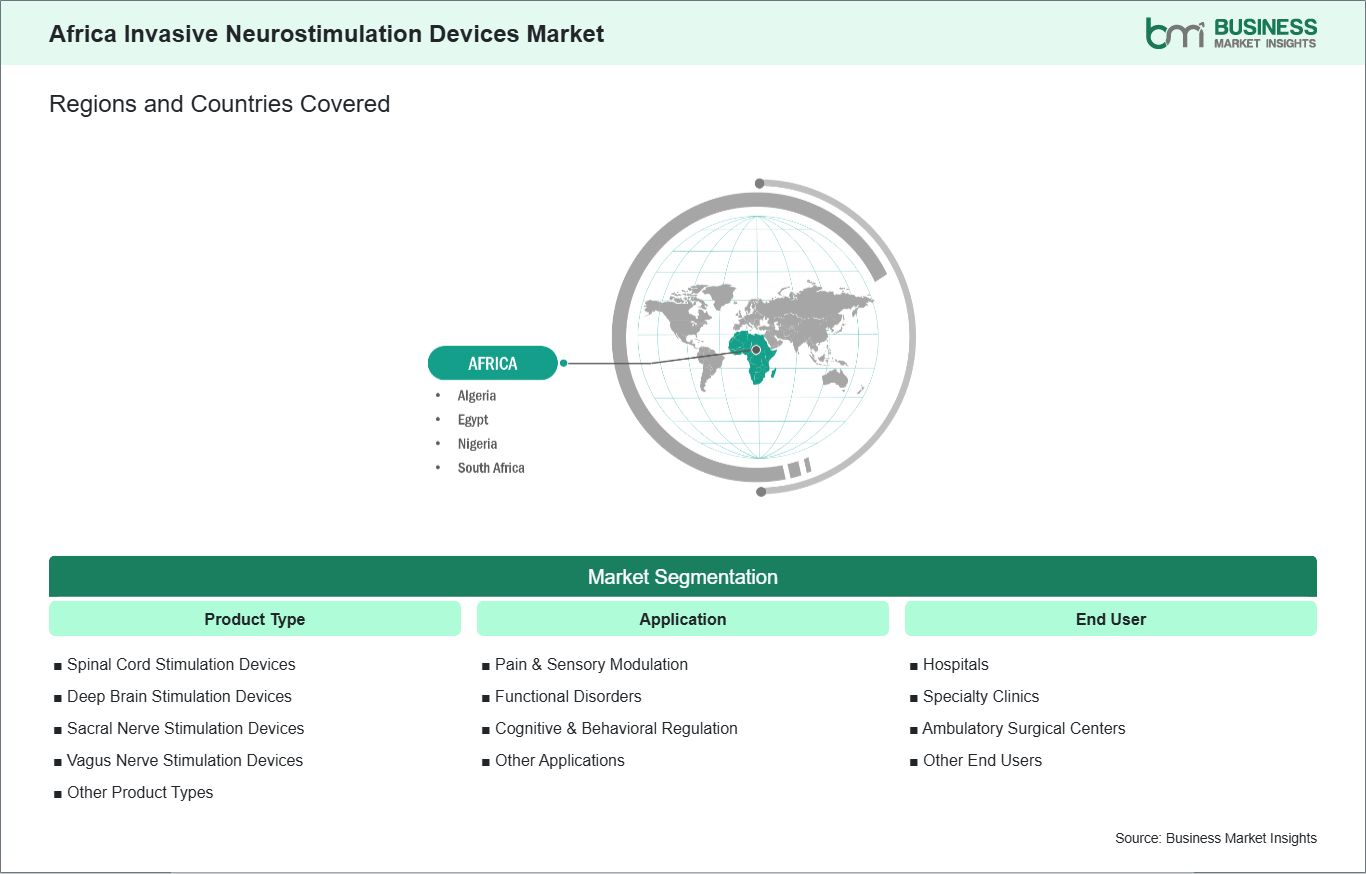
Key segments that contributed to the derivation of the Africa invasive neurostimulation devices market analysis are product type, application, and end user.
In African neurology practices, drug-resistant epilepsy cases are frequently recognized after numerous rounds of anticonvulsant medication optimization that have taken place in routine neurology or even general practice environments. The referral process for surgery or neuromodulation often occurs at a late stage, largely due to fragmented referral pathways and limited access to dedicated epilepsy monitoring units.
In this context, decisions become more multidisciplinary once pharmacologic management fails, but in most African tertiary care centers, neuromodulation approaches are discussed only after exhausting all medication attempts and managing comorbidities. Consequently, device-based therapy is often positioned as a late-stage, advanced option within a constrained neurosurgical workflow, heavily influenced by available resources and operating theater prioritization.
On the other hand, the use of invasive neurostimulation devices is becoming increasingly concentrated in private neurology clinics and selected teaching hospitals, where clinicians gain familiarity with these technologies through gradual clinical exposure and overseas training opportunities. In parallel, device manufacturers often engage hospitals through a demonstration-led adoption model rather than broad, system-wide distribution.
Within psychiatric care pathways in African urban centers, treatment-resistant depression is managed through layered escalation frameworks, where pharmacological switching is followed by structured intensification of psychotherapy before any consideration of device-based neuromodulation. Clinical teams typically depend on longitudinal observation within outpatient psychiatry units to assess suitability for interventions beyond medication-based strategies.
Driven by the growing acceptance of neuromodulation in psychiatric practice, clinicians in selected African referral hospitals are beginning to integrate noninvasive and invasive stimulation techniques into stepwise treatment plans, particularly for patients with recurrent non-response to antidepressant regimens. However, adoption remains influenced by protocol conservatism and the requirement for multidisciplinary psychiatric and neurological consensus before proceeding.
In private mental health networks and specialized neurology-psychiatry crossover clinics, device-based interventions for treatment-resistant depression are being introduced through carefully selected patient cohorts, often prioritizing individuals with stable clinical histories and documented pharmacotherapy resistance. Follow-up structures emphasize programming adjustments, side-effect monitoring, and caregiver engagement, while manufacturers support adoption through clinician training workshops and limited-site pilot implementations that emphasize procedural familiarity over scale.

The Africa invasive neurostimulation devices market is experiencing steady growth, with market size and share analysis reflecting evolving treatment preferences and competitive dynamics among key players. The report evaluates important subsegments categorized within product type, application, and end user, highlighting their respective contributions to market performance.
By product type, the spinal cord stimulation devices subsegment dominated the market in 2025, driven by its widespread adoption for chronic pain management, particularly for failed back surgery syndrome and neuropathic pain conditions.
Based on application, the pain & sensory modulation subsegment dominated the market in 2025, driven by the rising global prevalence of chronic pain disorders and the growing preference for neuromodulation as an alternative to long-term drug therapy.
In terms of end user, the hospitals subsegment dominated the market in 2025, driven by their advanced neurosurgical infrastructure, availability of specialized healthcare professionals, and high volume of neurostimulation implantation procedures.
| Report Attribute | Details |
|---|---|
| Market size in 2025 | US$ 34.1 Million |
| Market Size by 2033 | US$ 42.1 Million |
| CAGR (2026 - 2033) | 2.7% |
| Historical Data | 2022-2024 |
| Forecast period | 2026-2033 |
| Segments Covered | By Product Type
|
|
Regions and Countries Covered
| |
| Africa | Egypt, South Africa, Nigeria, Algeria |
| Market leaders and key company profiles |
|
The "Africa Invasive Neurostimulation Devices Market Size and Forecast (2022-2033)" report provides a detailed analysis of the market covering below areas:
The geographical scope of the Africa Invasive Neurostimulation Devices Market report is divided into Nigeria, Egypt, South Africa, and Algeria. South Africa held the largest share in 2025.
In terms of adoption trends, the African invasive neurostimulation devices market has shown an uneven yet progressively dynamic performance trajectory, particularly across key national healthcare systems. South Africa continues to perform strongly due to a relatively developed neurosurgical infrastructure, high levels of practitioner specialization, and effective integration between private and public tertiary hospitals, enabling earlier incorporation of implantable neurostimulation treatments for chronic neurological disorders. In addition, active clinician training programs and reliable servicing capabilities have contributed to sustained treatment delivery. Nigeria is driven by the rising burden of neurological diseases, increased patient referrals to urban specialty hospitals, and growing investment in private healthcare facilities that support selective importation of neuromodulation devices.
Egypt reflects steady growth supported by government-led modernization of tertiary hospitals, the establishment of specialized neurology and pain management units, and its positioning as a regional medical tourism hub. Algeria is also slowly gaining traction through the upgradation of health infrastructure funded by energy revenues, improvements in neurology units within hospitals, and increasing openness to foreign neurostimulation technologies. This growth is further reinforced by the rising incidence of chronic pain and movement disorders, alongside interclinic collaboration across North Africa that supports gradual acceptance of neurostimulators in public hospitals and training centers within urban regions.

The Africa invasive neurostimulation devices market is evaluated by gathering qualitative and quantitative data post primary and secondary research, which includes important corporate publications, association data, and databases. A few of the key developments in the Africa invasive neurostimulation devices market are:
The Africa Invasive Neurostimulation Devices Market is valued at US$ 34.1 Million in 2025, it is projected to reach US$ 42.1 Million by 2033.
As per our report Africa Invasive Neurostimulation Devices Market, the market size is valued at US$ 34.1 Million in 2025, projecting it to reach US$ 42.1 Million by 2033. This translates to a CAGR of approximately 2.7% during the forecast period.
The Africa Invasive Neurostimulation Devices Market report typically cover these key segments-
The historic period, base year, and forecast period can vary slightly depending on the specific market research report. However, for the Africa Invasive Neurostimulation Devices Market report:
The Africa Invasive Neurostimulation Devices Market is populated by several key players, each contributing to its growth and innovation. Some of the major players include:
The Africa Invasive Neurostimulation Devices Market report is valuable for diverse stakeholders, including:
Essentially, anyone involved in or considering involvement in the Africa Invasive Neurostimulation Devices Market value chain can benefit from the information contained in a comprehensive market report.
Please tell us your area of interest
(Market Segments/ Regions and Countries/ Companies)