Market Summary
Executive Summary and Market Analysis
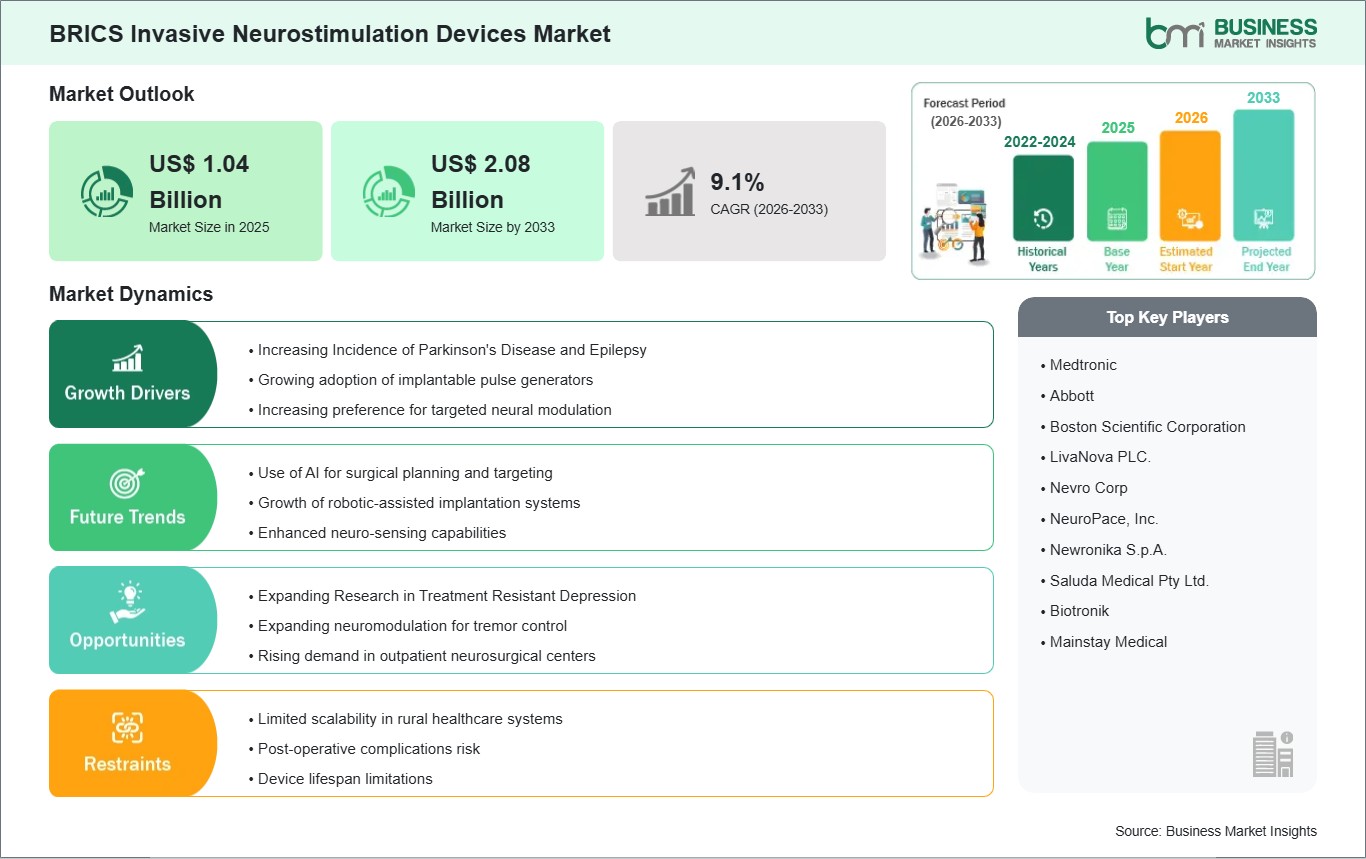
The BRICS Invasive Neurostimulation Devices Market is marked by the emergence of an ever-changing clinical environment driven by the development of advanced neurology and neurosurgery practices, increased awareness about sophisticated treatment options for refractory neurological disorders, and increased spending on highly specialized healthcare facilities. Growth opportunities in demand for invasive neurostimulation systems like Deep Brain Stimulation and Spinal Cord Stimulation devices are fueled by the burden of movement disorders, chronic pain syndromes, and other neurological illnesses that necessitate persistent symptom management. One of the major growth drivers within the segment includes the emerging prevalence of specialized healthcare facilities like tertiary care hospitals and neuroscience centers, providing greater access to complex procedures along with postoperative follow-up care. Another critical driver associated with market dynamics includes the development of device technologies, ranging from superior programming options, increased battery life, and enhanced targeting accuracy to allow for delivering more personalized results for patients suffering from neurological disorders. Increased awareness among physicians and multi-disciplinary approaches, alongside minimally invasive procedures, are among the factors positively impacting the market environment. Nevertheless, there is a challenge to the growth of the market due to high procedural and device costs, which may affect access, especially in healthcare systems that do not have a solid mechanism for reimbursement. There are other factors affecting competition, including differences in regulations across the BRICS nations, localization strategies, collaboration between foreign medical device manufacturers and local hospitals, and improvement of local medical device manufacturing. In light of growing scientific evidence of neurostimulation and as hospitals try to find solutions that do not depend on drug therapy in the long run, the use of invasive neurostimulators is becoming an essential part of neurological treatment programs in the BRICS region.
Segment Analysis
BRICS Invasive Neurostimulation Devices Market Segmentation
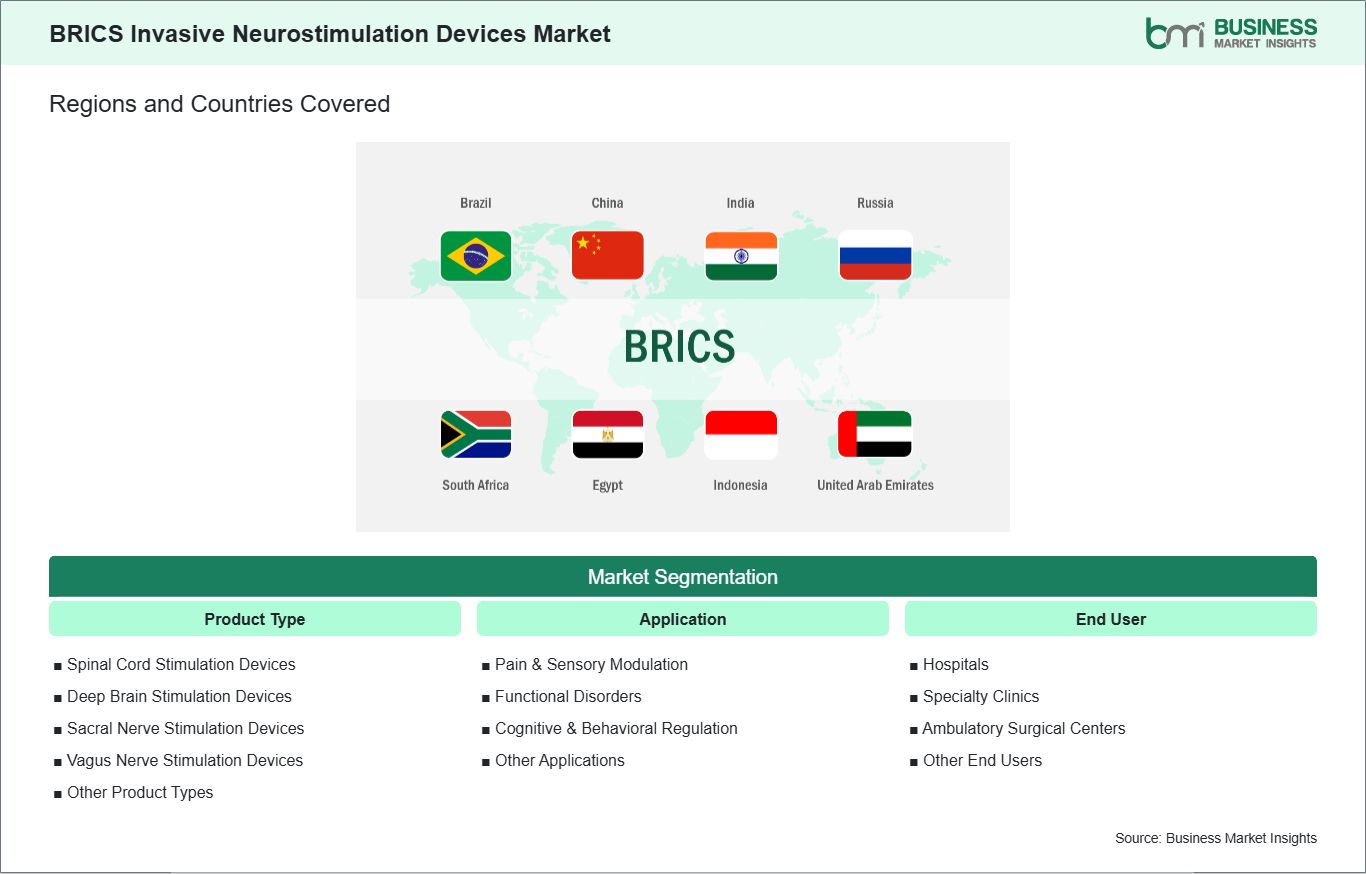
Key segments that contributed to the derivation of the BRICS invasive neurostimulation devices market analysis are product type, application and end user.
- By product type, the invasive neurostimulation devices market is segmented into spinal cord stimulation devices, deep brain stimulation devices, sacral nerve stimulation devices, vagus nerve stimulation devices, and other product types. The spinal cord stimulation devices segment dominated the market in 2025.
- Based on application, the invasive neurostimulation devices market is categorized into pain & sensory modulation, functional disorders, cognitive & behavioral regulation, and other applications. The pain & sensory modulation segment dominated the market in 2025.
- In terms of end user, the invasive neurostimulation devices market is categorized into hospitals, specialty clinics, ambulatory surgical centers, and other end users. The hospitals segment dominated the market in 2025.
Market Forces
BRICS Invasive Neurostimulation Devices Market Drivers and Opportunities
Increasing Incidence of Parkinson's Disease and Epilepsy
With regard to the growing burden of neurology disease associated with Parkinson's disease and epilepsy in BRICS countries, invasive neurostimulators are being considered as a means of long-term treatment in case of ineffective medication management. With respect to Parkinson's disease, the choice of neurostimulators is justified by the occurrence of motor fluctuations, drug-induced side effects, or uncontrolled seizure activity.
In the context of minimizing disease burden in terms of disability, the use of neurostimulation devices is not considered exclusively as a means of late-stage management but rather as a component of the holistic approach in managing difficult-to-treat neurological cases. Moreover, a particular feature of the device market can be attributed to the increasing prevalence of implants in neurology and neuroscience centers. In particular, the introduction of advanced diagnostics for selecting patients, programming stimulators, and planning surgery increases the reliability of neurostimulation use in the treatment of neurological diseases.
The manufacturers that operate in BRICS countries try to develop their devices taking into account the requirements of neurosurgeons and neurologists engaged in treating movement disorders and seizures. Therefore, special attention is paid to the precision targeting of stimulation as well as the ability to adapt its parameters and provide effective device management.
Expanding Research in Treatment Resistant Depression
Research activity focused on treatment resistant depression is creating new opportunities for invasive neurostimulation technologies across BRICS healthcare markets. Academic medical centers and neuroscience institutes are investigating neuromodulation-based approaches for patients who experience limited benefit from conventional antidepressant therapies. These efforts are broadening the clinical dialogue around targeted brain stimulation and encouraging the evaluation of invasive devices within carefully selected patient populations.
Unlike traditional psychiatric treatment models that rely primarily on pharmacotherapy and psychotherapy, emerging research programs are exploring how neural circuit modulation can address persistent depressive symptoms. This shift has encouraged stronger collaboration between psychiatrists, neurosurgeons, neurophysiologists, and clinical researchers.
The market is also benefiting from the gradual expansion of translational research initiatives that bridge laboratory findings with real-world therapeutic applications. Device manufacturers are increasingly participating in investigator-led studies and clinical partnerships aimed at refining stimulation parameters and improving patient outcomes. As evidence generation continues to evolve, healthcare providers across BRICS countries are becoming more familiar with invasive neurostimulation as a potential component of comprehensive management strategies for complex depressive disorders.
Size and Share Analysis
BRICS Invasive Neurostimulation Devices Market Size and Share Analysis
The BRICS invasive neurostimulation devices market is experiencing steady growth, with market size and share analysis reflecting evolving treatment preferences and competitive dynamics among key players. The report evaluates important subsegments categorized within product type, application and end user, highlighting their respective contributions to market performance.
By product type, the spinal cord stimulation devices subsegment dominated the market in 2025, driven by its widespread adoption for chronic pain management, particularly for failed back surgery syndrome and neuropathic pain conditions.
Based on application, the pain & sensory modulation subsegment dominated the market in 2025, driven by the rising global prevalence of chronic pain disorders and the growing preference for neuromodulation as an alternative to long-term drug therapy.
In terms of end user, the hospitals subsegment dominated the market in 2025, driven by their advanced neurosurgical infrastructure, availability of specialized healthcare professionals, and high volume of neurostimulation implantation procedures.
Report Coverage
BRICS Invasive Neurostimulation Devices Market Report Coverage and Deliverables
The "BRICS Invasive Neurostimulation Devices Market Size and Forecast (2022-2033)" report provides a detailed analysis of the market covering below areas:
- Market size and forecast at regional and country levels for all market segments covered under the scope
- Market trends, as well as drivers, restraints, and opportunities
- Market analysis covering key trends, regional framework, major players, regulations, and recent developments
- Market concentration, heat map analysis, prominent players, and recent developments for the Market
- Detailed company profiles, including SWOT analysis
Geographic Insights
BRICS Invasive Neurostimulation Devices Market Geographic Insights
The geographical scope of the BRICS Invasive Neurostimulation Devices Market report is divided into Russia, Brazil, South Africa, India, China, Egypt, Indonesia, Saudi Arabia, and the UAE. China held the largest share in 2025.
The BRICS Invasive Neurostimulation Devices Market has demonstrated varied dynamics in different regions. For example, China still represents the leading country in this market due to the existence of advanced neurosurgery infrastructure and medical equipment manufacturing industry within the country, as well as the incorporation of modern neurotechnologies into healthcare facilities. Meanwhile, India reports considerable growth fueled by higher awareness of neurological diseases, increased accessibility of treatment clinics, and advanced approaches to their therapy. Brazil has become an attractive market due to the modernization of its hospitals, as well as the rising popularity of minimally invasive surgical interventions related to neurology. Moreover, Russia has shown promising development due to high investments into complex medical procedures and in strengthening the domestic capability in advanced neurological solutions. Similarly, South Africa demonstrates growing prospects for these types of products due to the improvement of neuroscientist services and treatment of patients with chronic neurological disorders. Finally, Egypt can be considered a growing market due to the increased availability of neurology/neurosurgery services. The progress in Indonesia is seen in terms of private health care facilities' growth and greater interest among patients in modern therapeutic methods that enhance neurological results. Healthcare innovations in Saudi Arabia are making it a favorable country due to its focus on advanced healthcare technology, which helps in promoting innovative neurostimulation products in the market. The UAE's strategic advantage lies in the development of excellence centers, medical tourism, and early adoption of advanced therapies. Overall, it can be seen that different regions show growth in various aspects, helping to adopt invasive neurostimulation devices in the BRICS region.
Industry Activity
Recent Developments
The BRICS Invasive Neurostimulation Devices Market is evaluated by gathering qualitative and quantitative data post primary and secondary research, which includes important corporate publications, association data, and databases. A few of the key developments in the BRICS invasive neurostimulation devices market are:
- In June 2024, Nexalin Technology announced that its Gen-2 neurostimulation device received regulatory approval from Brazil‘s ANVISA, enabling commercialization in one of the largest healthcare markets within the BRICS bloc. The approval represents a geographic expansion of the company‘s neurostimulation business into Brazil.
- In June 2024, Nexstim Plc announced a planned strategic collaboration with Sinaptica Therapeutics to develop and supply a precision neuromodulation system for Alzheimer‘s disease, combining Nexstim‘s neuronavigation and TMS-EEG capabilities with Sinaptica‘s personalization platform. The partnership highlights ongoing innovation and collaboration within the neurostimulation industry.
Trust & Transparency
Research Methodology
The market analysis combines proprietary research with secondary data from government agencies, company disclosures, regulatory filings, industry databases and expert interviews. Market estimates are validated through data triangulation, cross-market benchmarking and analyst
review.
View Full Research Methodology
Key Sources Referred:
U.S. Food and Drug Administration (FDA)National Institutes of Health (NIH)National Institute of Neurological Disorders and Stroke (NINDS)Centers for Medicare & Medicaid Services (CMS)Medical Device Innovation Consortium (MDIC)World Health Organization (WHO)International Organization for Standardization (ISO)International Neuromodulation Society (INS)North American Neuromodulation Society (NANS)Company WebsitesCompany Annual ReportsCompany Investor Presentations