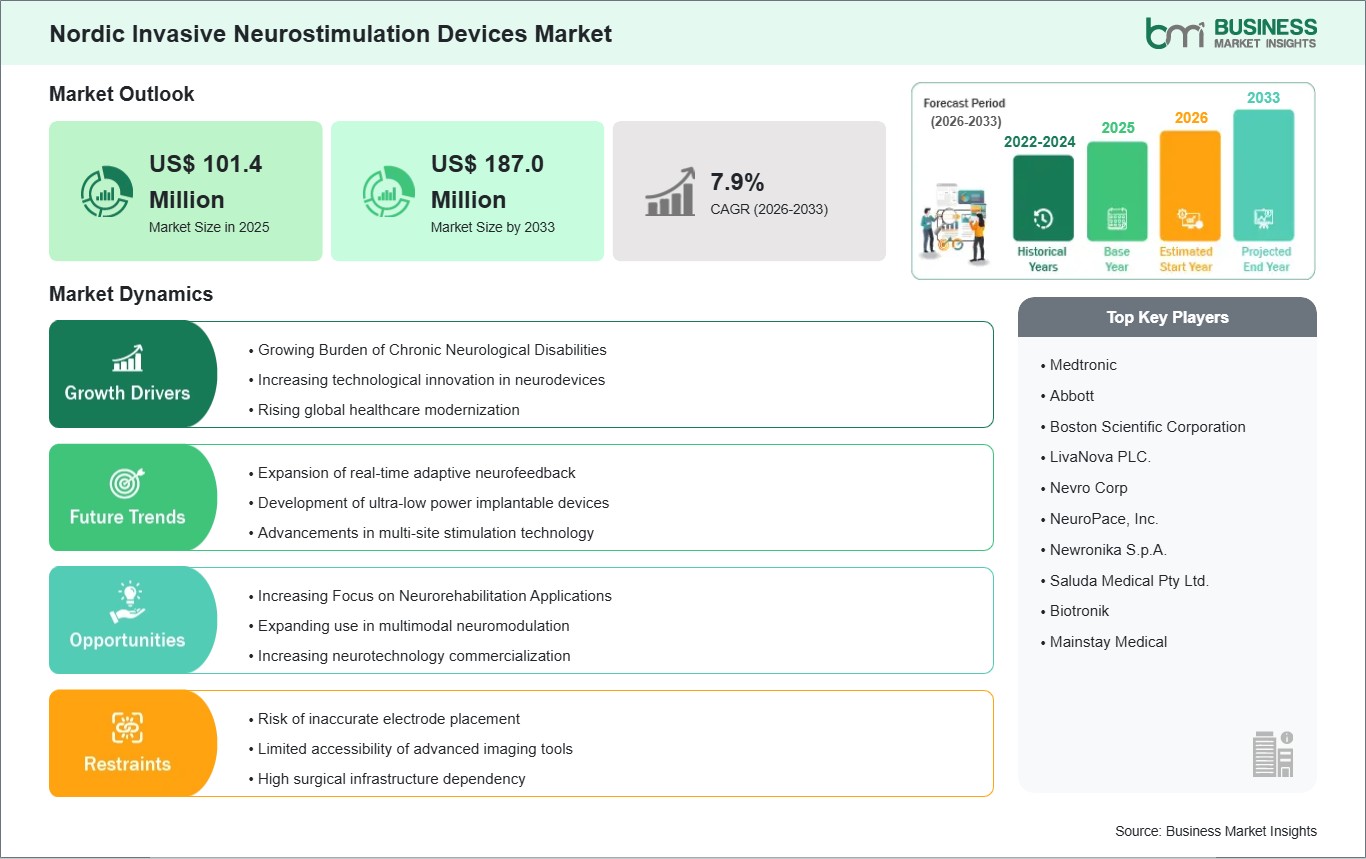
Market Summary
Executive Summary and Market Analysis
The Nordic Invasive Neurostimulation Devices Market is driven by the clinical demand resulting from innovative neurosurgical procedures, which are applied to alleviate neurological diseases and pain syndrome patients in Sweden, Denmark, Norway, Finland, and Iceland. The regional healthcare sector relies on precision medicine and favors the use of innovative devices, including deep-brain stimulators, spinal cord stimulators, and vagal nerve stimulators for neurosurgical treatment of diseases when conventional treatment using medicines fails. For instance, the increasing incidence of movement disorders, epilepsy, and neuropathic pain is spurring the adoption of these medical technologies due to their precision in delivering targeted neurosurgical care. Other factors spurring market development include advancements in device design through miniaturization technology, the use of closed-loop and real-time feedback, and magnetic resonance imaging-compatible devices, which increase the confidence of neurosurgeons in performing these procedures and expanding their clinical application areas. Nonetheless, the market development is hindered by the complicated nature of neurosurgical procedures, which require specialist skills of neurosurgeons and complex management during the surgical process. Moreover, strict selection criteria and careful reimbursement policies are additional hurdles in the broad implementation of DBS, despite considerable interest in its use clinically. The cooperation of neurology departments and biomedical engineers to iteratively program devices and optimize treatment after surgery is also being enhanced through interdisciplinary collaboration, thereby allowing for individualized treatment plans. Simultaneously, the Nordic focus on digital health integration allows for the remote monitoring of these devices, which will help facilitate better long-term monitoring and compliance.
Segment Analysis
Nordic Invasive Neurostimulation Devices Market Segmentation
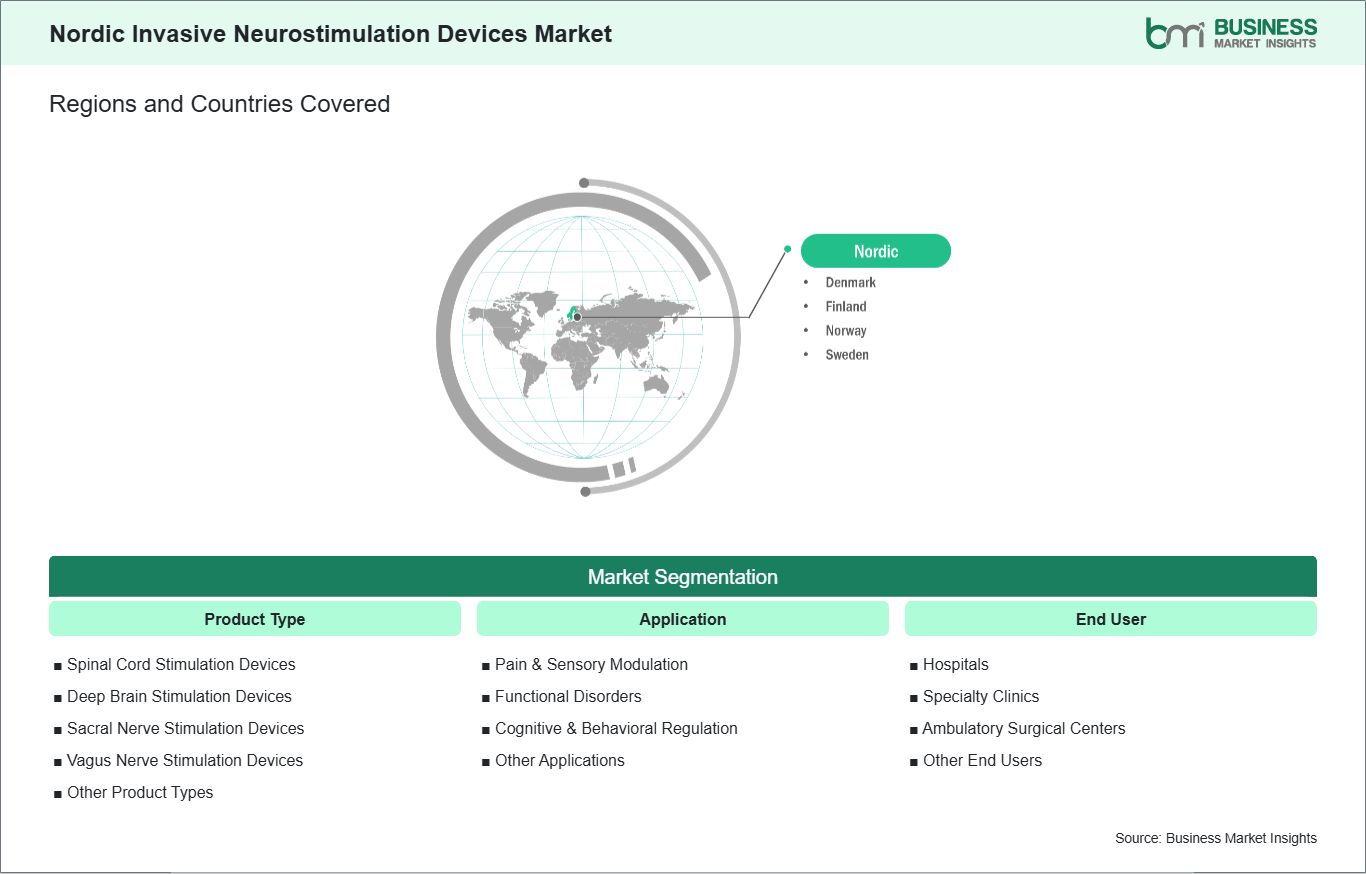
Key segments that contributed to the derivation of the Nordic invasive neurostimulation devices market analysis are product type, application and end user.
- By product type, the invasive neurostimulation devices market is segmented into spinal cord stimulation devices, deep brain stimulation devices, sacral nerve stimulation devices, vagus nerve stimulation devices, and other product types. The spinal cord stimulation devices segment dominated the market in 2025.
- Based on application, the invasive neurostimulation devices market is categorized into pain & sensory modulation, functional disorders, cognitive & behavioral regulation, and other applications. The pain & sensory modulation segment dominated the market in 2025.
- In terms of end user, the invasive neurostimulation devices market is categorized into hospitals, specialty clinics, ambulatory surgical centers, and other end users. The hospitals segment dominated the market in 2025.
Market Forces
Nordic Invasive Neurostimulation Devices Market Drivers and Opportunities
Growing Burden of Chronic Neurological Disabilities
The clinical scenario that characterizes Nordic health care providers tends to be dominated by chronic neurological disabilities associated with aging populations and underlying neurodegenerative disorders. Diseases such as Parkinson's syndrome, epilepsy with resistant symptoms, and stroke-related motor dysfunction are prompting clinicians to contemplate neuromodulation earlier on, after pharmacology fails to manage symptoms.
Decision criteria used in specialty clinics indicate a gradual progression model, in which invasive neurostimulation is employed for patients who are not responding well to conservative interventions. Multidisciplinary teams may assess functional decline patterns prior to considering an implant, indicating the preference for selective patient choice and extended observation periods in the treatment paradigm of movement disorder and pain management programs.
The procurement process in Nordic hospitals indicates a hierarchical clinical justification logic in which neuromodulation devices go through multiple levels of assessment prior to adoption. The adoption decision tends to favor neuromodulation devices that are compatible with current neurosurgical facilities and have standardized post-operative programming protocols. Vendor relationships are driven more by their capability and training capacity than by product novelty.
Increasing Focus on Neurorehabilitation Applications
Neurorehabilitation pathways in Nordic care settings are increasingly incorporating invasive neurostimulation as a functional restoration tool rather than solely a symptom-control intervention. Rehabilitation specialists coordinate with neurosurgeons to align stimulation parameters with physiotherapy cycles, particularly for motor recovery after stroke or traumatic neurological injury, emphasizing adaptability of implanted systems within recovery phases.
In rehabilitation wards, treatment sequencing often places device programming after early mobilization milestones are achieved, creating a feedback loop between clinician observation and neurostimulation adjustment. Therapists report functional changes that inform iterative recalibration, which makes the device part of a dynamic recovery system rather than a fixed intervention, with adjustments frequently tied to gait, balance, or fine motor response patterns.
Adoption decisions for invasive neurostimulation in rehabilitation contexts are strongly influenced by documented functional recovery trajectories and interdisciplinary consensus across neurology and physiotherapy teams. Health systems prioritize interventions that demonstrate measurable improvements in mobility independence, often linking continued device usage to structured rehabilitation milestones and long-term patient reintegration objectives within coordinated care pathways spanning hospital and outpatient settings.
Size and Share Analysis
Nordic Invasive Neurostimulation Devices Market Size and Share Analysis
The Nordic invasive neurostimulation devices market is experiencing steady growth, with market size and share analysis reflecting evolving treatment preferences and competitive dynamics among key players. The report evaluates important subsegments categorized within product type, application and end user, highlighting their respective contributions to market performance.
By product type, the spinal cord stimulation devices subsegment dominated the market in 2025, driven by its widespread adoption for chronic pain management, particularly for failed back surgery syndrome and neuropathic pain conditions.
Based on application, the pain & sensory modulation subsegment dominated the market in 2025, driven by the rising global prevalence of chronic pain disorders and the growing preference for neuromodulation as an alternative to long-term drug therapy.
In terms of end user, the hospitals subsegment dominated the market in 2025, driven by their advanced neurosurgical infrastructure, availability of specialized healthcare professionals, and high volume of neurostimulation implantation procedures.
Report Coverage
Nordic Invasive Neurostimulation Devices Market Report Coverage and Deliverables
The "Nordic Invasive Neurostimulation Devices Market Size and Forecast (2022-2033)" report provides a detailed analysis of the market covering below areas:
- Market size and forecast at regional and country levels for all market segments covered under the scope
- Market trends, as well as drivers, restraints, and opportunities
- Market analysis covering key trends, regional framework, major players, regulations, and recent developments
- Market concentration, heat map analysis, prominent players, and recent developments for the Market
- Detailed company profiles, including SWOT analysis
Geographic Insights
Nordic Invasive Neurostimulation Devices Market Geographic Insights
The geographical scope of the Nordic Invasive Neurostimulation Devices Market report is divided into Sweden, Denmark, Norway, Finland. Sweden held the largest share in 2025.
The Swedish market for the invasive neurostimulation devices industry is the most prominent one amongst the Nordic markets, owing to the presence of a sophisticated neurosurgery market ecosystem, effective integration of device innovations within academic hospitals, and early adoption of cutting-edge implantables for neurological diseases. The Danish market for invasive neurostimulation devices is characterized by a consistent growth trajectory thanks to the existence of a patient-oriented digital health model, higher rates of neuromodulation surgeries performed within tertiary hospitals, and an orientation towards training surgeons for performing minimally invasive operations using such neurostimulation devices. The Norwegian market for invasive neurostimulation devices is influenced by investments in special-needs neurological treatment services, a strong focus on post-operative rehab pathways, and demand for advanced pain management solutions within its widespread healthcare landscape. In the wider Nordic region, the development of the invasive neurostimulation sphere is additionally driven by the collaboration of healthcare governance structures, the transfer of information among clinics on an across-border level, and an approach to the use of implantable devices that promotes evidence-based decision-making, favoring improved outcomes for people with neurological and psychiatric conditions resistant to other treatments. The importance of long-term performance, safety, and compatibility of such devices with digital monitoring tools in the hospital setting becomes more evident when the process of procurement evolves. Moreover, the growing number of personalized neuromodulation strategies and multi-disciplinary approaches to treatment are continuously impacting clinician decisions in neurosurgical centers. All these processes lead to the sustainable implementation of invasive neurostimulation devices and gradual technology diffusion through the network of special care institutions,especially hospitals.
Industry Activity
Recent Developments
The Nordic Invasive Neurostimulation Devices Market is evaluated by gathering qualitative and quantitative data post primary and secondary research, which includes important corporate publications, association data, and databases. A few of the key developments in the Nordic invasive neurostimulation devices market are:
- In December 2023, Medtronic announced that it had received CE Mark approval for its Percept RC rechargeable deep brain stimulation (DBS) neurostimulator with BrainSense™ technology, enabling commercialization of next-generation DBS therapy across European markets including the Nordic region through established neuromodulation distribution networks.
- In September 2023, Boston Scientific announced that it had entered into a definitive agreement to acquire Relievant Medsystems, expanding its neuromodulation and chronic pain portfolio and strengthening its ability to deliver minimally invasive neurostimulation-related therapies across global markets.
Trust & Transparency
Research Methodology
The market analysis combines proprietary research with secondary data from government agencies, company disclosures, regulatory filings, industry databases and expert interviews. Market estimates are validated through data triangulation, cross-market benchmarking and analyst
review.
View Full Research Methodology
Key Sources Referred:
U.S. Food and Drug Administration (FDA)National Institutes of Health (NIH)National Institute of Neurological Disorders and Stroke (NINDS)Centers for Medicare & Medicaid Services (CMS)Medical Device Innovation Consortium (MDIC)World Health Organization (WHO)International Organization for Standardization (ISO)International Neuromodulation Society (INS)North American Neuromodulation Society (NANS)Company WebsitesCompany Annual ReportsCompany Investor Presentations