Market Summary
Executive Summary and Market Analysis
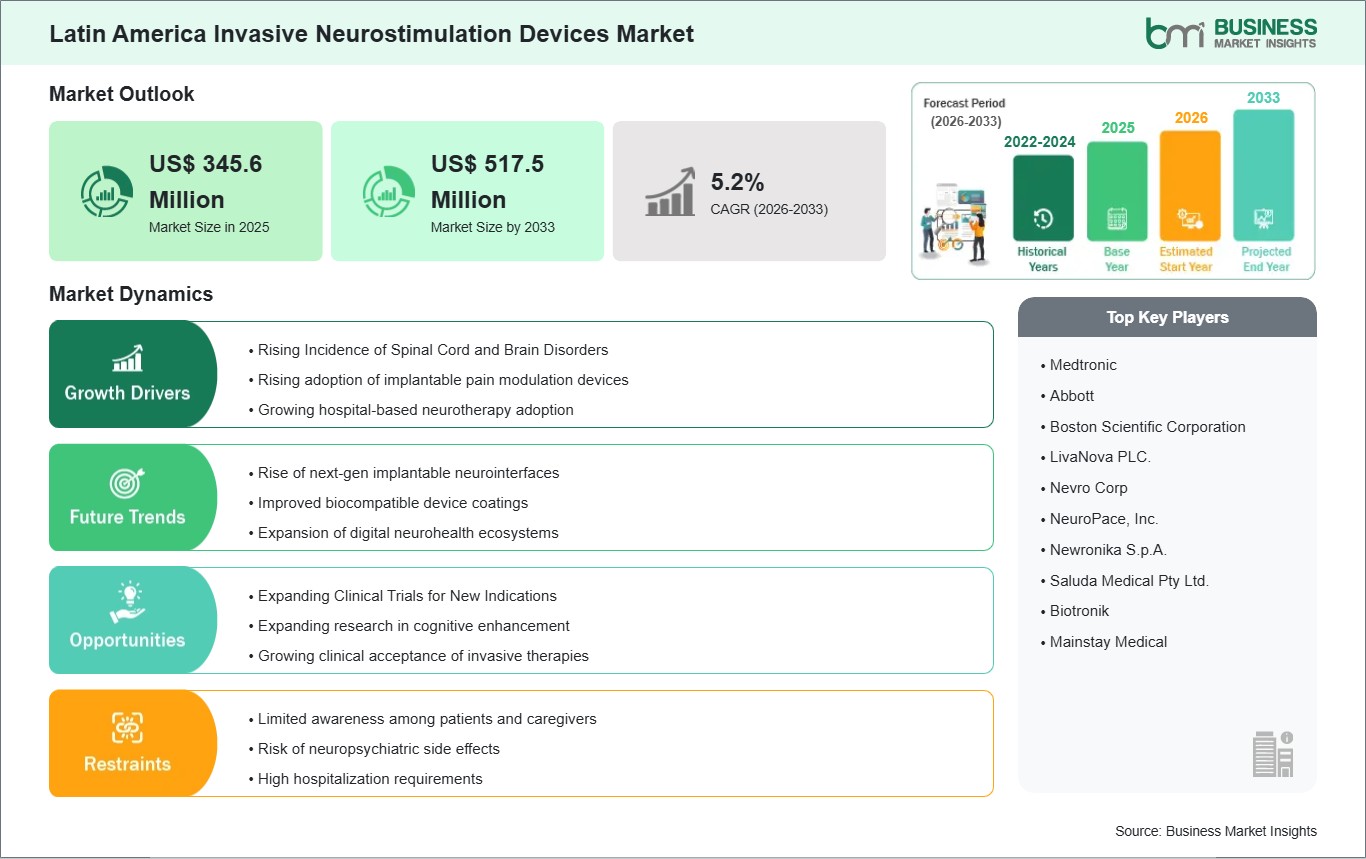
The current trend in Latin America related to invasive neurostimulation devices is being fueled by changes in the clinical need for modern neuromodulation therapy in various refractory neurological and pain syndromes. As doctors become interested in using these therapies as an option when conventional drug treatments provide inadequate results, more hospitals in major cities are adopting invasive therapies such as deep brain stimulation, spinal cord stimulation, and vagus nerve stimulation. The first key determinant driving growth comes from growing occurrences of movement disorders, epilepsy, and neuropathic pain syndromes, creating a need for more invasive procedures that could potentially help patients regain their normal functioning ability. The second determinant is related to the gradual development of neurosurgical infrastructure, thanks to private health system investments, collaborations, and the emergence of international players that develop new technologies for the field. However, the development of invasive neurostimulation devices is restrained by cost issues, the lack of adequate insurance coverage, differences in access to qualified neurosurgical treatment, the use of imported devices, and an inefficient health care system. The disparity in regulatory environments between countries and the lack of adequate programs post-surgery for programming and monitoring of the patients also play a part in decision-making, prompting a conservative approach to the procedure except in major tertiary care hospitals. The development of new technology in terms of reducing the size of the devices, better battery power, and making the devices compatible with MRI scanning is also having an impact on physician preference, as well as the incorporation of multi-disciplinary approaches, incorporating neurologists, neurosurgeons, and pain specialists.
Segment Analysis
Latin America Invasive Neurostimulation Devices Market Segmentation
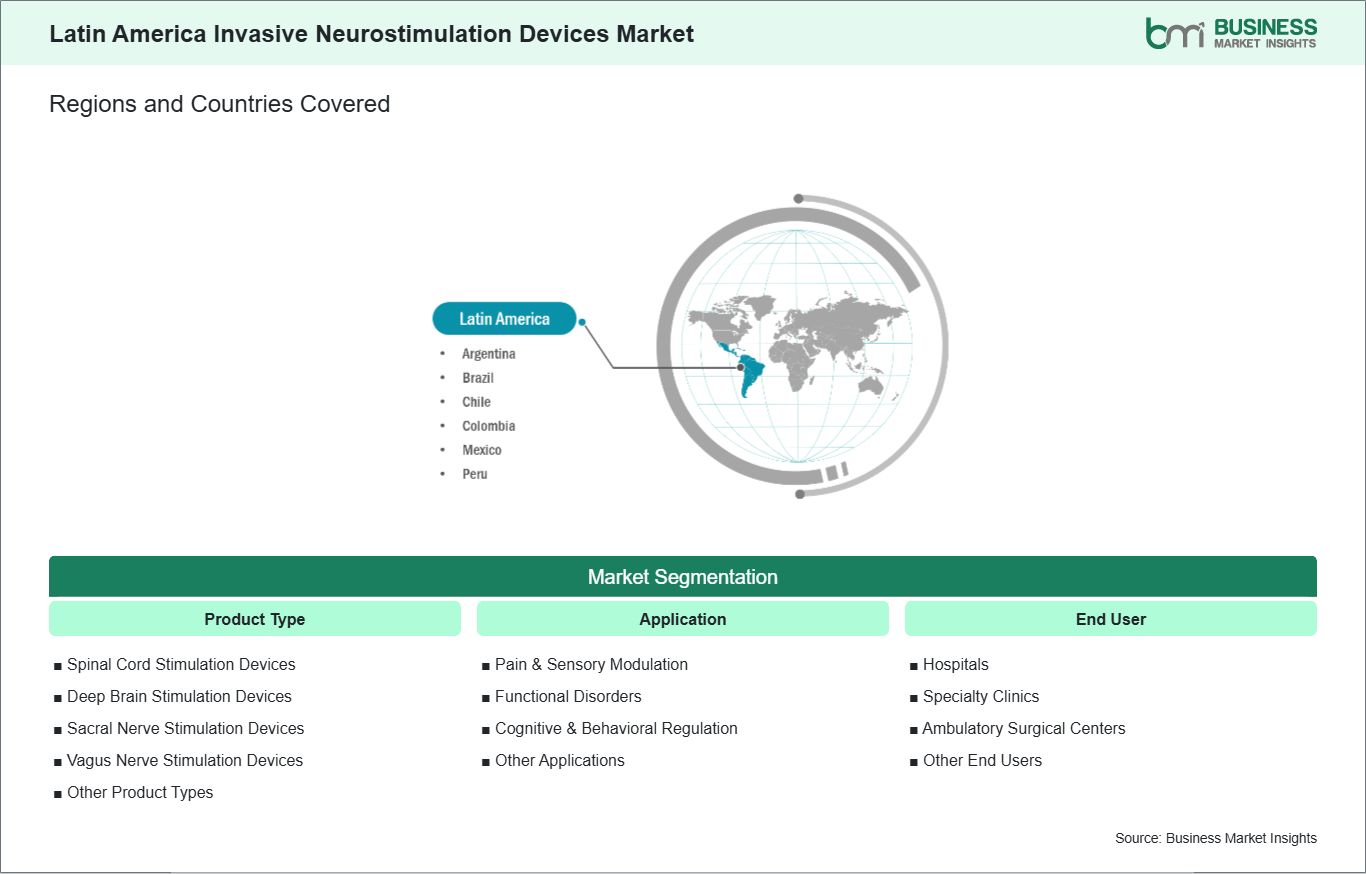
Key segments that contributed to the derivation of the Latin America invasive neurostimulation devices market analysis are product type, application and end user.
- By product type, the invasive neurostimulation devices market is segmented into spinal cord stimulation devices, deep brain stimulation devices, sacral nerve stimulation devices, vagus nerve stimulation devices, and other product types. The spinal cord stimulation devices segment dominated the market in 2025.
- Based on application, the invasive neurostimulation devices market is categorized into pain & sensory modulation, functional disorders, cognitive & behavioral regulation, and other applications. The pain & sensory modulation segment dominated the market in 2025.
- In terms of end user, the invasive neurostimulation devices market is categorized into hospitals, specialty clinics, ambulatory surgical centers, and other end users. The hospitals segment dominated the market in 2025.
Market Forces
Latin America Invasive Neurostimulation Devices Market Drivers and Opportunities
Rising Incidence of Spinal Cord and Brain Disorders
Latin American Neurological Care Centers are progressively experiencing challenges relating to complicated spinal cord and brain dysfunction cases associated with injury, degeneration, or postoperative complications. This trend is shaping the approach adopted by neurosurgeons to adopt neurostimulation as an alternative therapy to treat refractory functional disabilities and chronic neuropathic pain that cannot be controlled using traditional drug-based therapy.
Multidisciplinary surgical teams in the largest hospitals in Latin America are increasingly incorporating invasive neurostimulation devices into their therapeutic approaches towards treating refractory neurosurgical patients. In the process, they spend a significant amount of time deliberating the feasibility of the proposed procedure to ensure that the surgical risk is justified by the potential positive results.
In Latin American private hospital systems and state-owned neurology institutes, there is selective uptake of neurostimulation systems in patients with refractory neurosurgical problems. Most vendors are now adopting different training techniques based on differential levels of surgical preparedness across urban and secondary hospitals to facilitate localized adoption processes.
Expanding Clinical Trials for New Indications
Clinical research groups in Latin America are broadening investigational use of invasive neurostimulation devices beyond conventional pain pathways, with neurosurgical centers initiating protocol-driven studies in movement disorders and post-stroke rehabilitation. These trials often emerge from hospital-based research units that coordinate closely with device manufacturers on protocol refinement and electrode placement strategies.
Ethics committees and institutional review boards across the region are shaping how invasive neurostimulation trials are structured, often requiring adaptive protocols that account for heterogeneous patient follow-up environments. This has led investigators to design recruitment strategies that rely heavily on tertiary hospitals where longitudinal monitoring of implanted devices can be maintained more reliably.
Device manufacturers are increasingly participating in early-stage clinical collaborations, supporting investigator-led studies that test novel stimulation targets and parameter settings. This engagement is reshaping indication expansion pathways, as clinical evidence generated in hospital networks feeds directly into product adaptation cycles and post-market refinement strategies within neuromodulation programs, accelerating iterative device indication validation processes across region.
Size and Share Analysis
Latin America Invasive Neurostimulation Devices Market Size and Share Analysis
The Latin America invasive neurostimulation devices market is experiencing steady growth, with market size and share analysis reflecting evolving treatment preferences and competitive dynamics among key players. The report evaluates important subsegments categorized within product type, application and end user, highlighting their respective contributions to market performance.
By product type, the spinal cord stimulation devices subsegment dominated the market in 2025, driven by its widespread adoption for chronic pain management, particularly for failed back surgery syndrome and neuropathic pain conditions.
Based on application, the pain & sensory modulation subsegment dominated the market in 2025, driven by the rising global prevalence of chronic pain disorders and the growing preference for neuromodulation as an alternative to long-term drug therapy.
In terms of end user, the hospitals subsegment dominated the market in 2025, driven by their advanced neurosurgical infrastructure, availability of specialized healthcare professionals, and high volume of neurostimulation implantation procedures.
Report Coverage
Latin America Invasive Neurostimulation Devices Market Report Coverage and Deliverables
The "Latin America Invasive Neurostimulation Devices Market Size and Forecast (2022-2033)" report provides a detailed analysis of the market covering below areas:
- Market size and forecast at regional and country levels for all market segments covered under the scope
- Market trends, as well as drivers, restraints, and opportunities
- Market analysis covering key trends, regional framework, major players, regulations, and recent developments
- Market concentration, heat map analysis, prominent players, and recent developments for the Market
- Detailed company profiles, including SWOT analysis
Geographic Insights
Latin America Invasive Neurostimulation Devices Market Geographic Insights
The geographical scope of the Latin America Invasive Neurostimulation Devices Market report is divided into Mexico, Brazil, Argentina, Peru, Chile, Colombia. Brazil held the largest share in 2025.
Brazil continues to be the leading country in Latin America for invasive neurostimulation systems due to the country‘s extensive neurosurgical base, dense presence of tertiary hospitals, and increased applications for chronic pain conditions and movement disorders, which are fueled by advancements in clinical research and progressive localized manufacturing, which facilitates easier procurement. Mexico has seen growth in terms of its adoption due to its geographical location to North American medical device makers and increased activity in private neurology and pain clinics, cross-border patient flow into Mexico, and high prevalence rates of spinal injury and diabetes-related neuropathies. Argentina‘s adoption trend has been influenced largely by its strong base of academic neurosurgical centers and specialized public hospitals, with Buenos Aires becoming an important center for clinical innovations and procedures. The development of Peru has been characterized by modernization in the healthcare sector, which includes the development of urban hospitals, neurology services moving from the coastal regions, and the emergence of occupational neurological injuries among workers in the mining and transport sectors, leading to neuromodulation being encouraged. The development of neuromodulation in Chile has been facilitated by stable regulations in the sector, the presence of many private insurance policies, cultural readiness for new technology in advanced pain management, and increasing interest in treating neurodegenerative diseases.
Industry Activity
Recent Developments
The Latin America Invasive Neurostimulation Devices Market is evaluated by gathering qualitative and quantitative data post primary and secondary research, which includes important corporate publications, association data, and databases. A few of the key developments in the Latin America invasive neurostimulation devices market are:
- In January 2024, Medtronic announced that it had received U.S. FDA approval for its Percept RC deep brain stimulation system with BrainSense™ technology, strengthening its global DBS portfolio and supporting broader commercialization across international markets such as Latin America, where Percept™-family systems are distributed through approved regional regulatory pathways.
- In January 2024, Abbott announced that it had received U.S. FDA approval for its Liberta RC deep brain stimulation (DBS) system, expanding its next-generation neuromodulation portfolio and supporting global commercialization, including Latin American markets where Abbott‘s DBS systems are distributed through established regulatory approvals.
Trust & Transparency
Research Methodology
The market analysis combines proprietary research with secondary data from government agencies, company disclosures, regulatory filings, industry databases and expert interviews. Market estimates are validated through data triangulation, cross-market benchmarking and analyst
review.
View Full Research Methodology
Key Sources Referred:
U.S. Food and Drug Administration (FDA)National Institutes of Health (NIH)National Institute of Neurological Disorders and Stroke (NINDS)Centers for Medicare & Medicaid Services (CMS)Medical Device Innovation Consortium (MDIC)World Health Organization (WHO)International Organization for Standardization (ISO)International Neuromodulation Society (INS)North American Neuromodulation Society (NANS)Company WebsitesCompany Annual ReportsCompany Investor Presentations