Market Summary
Executive Summary and Market Analysis
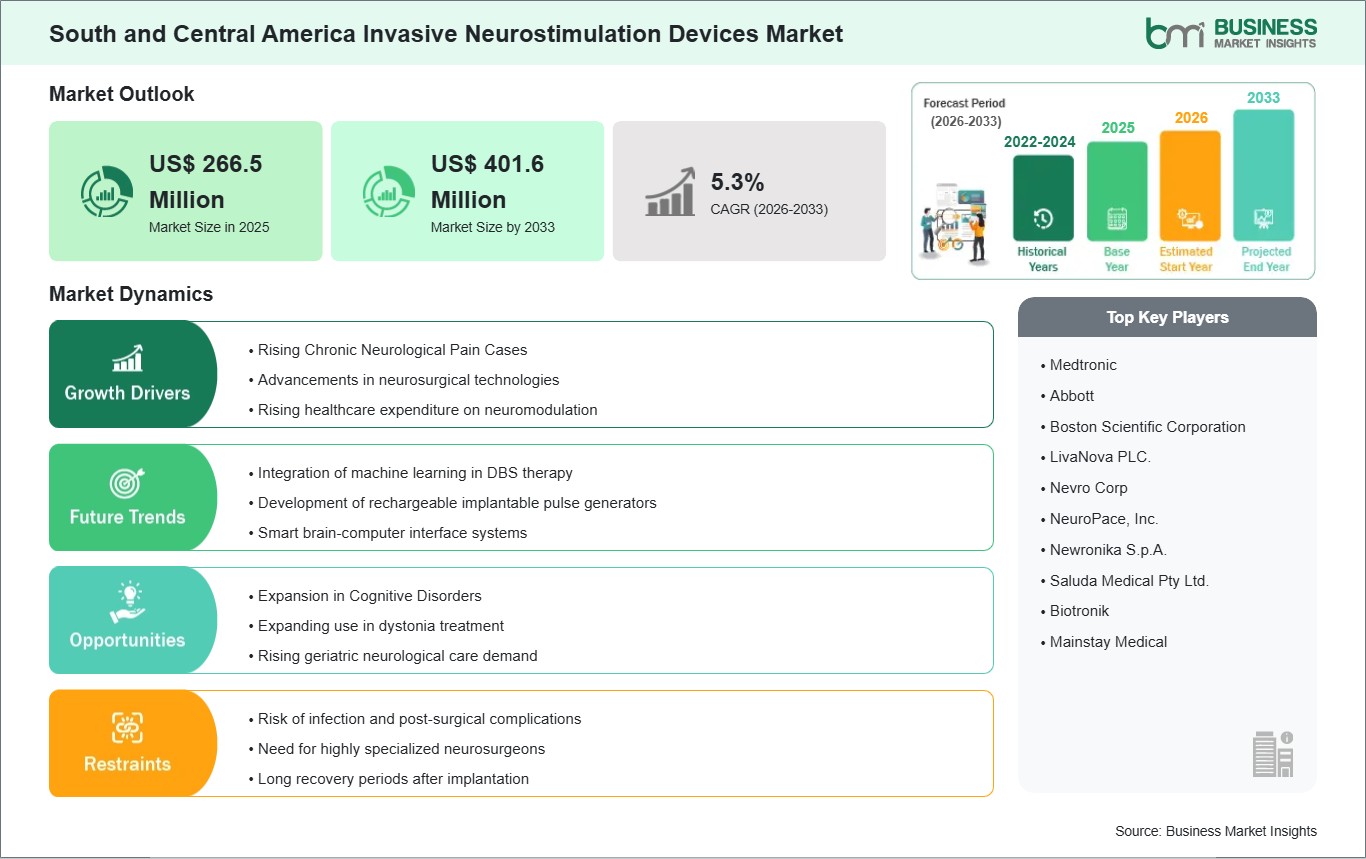
The invasive neurostimulation devices market landscape of South and Central America is characterized by the trend of transitioning to more advanced forms of neuromodulation, including deep brain stimulation (DBS), spinal cord stimulation, and vagus nerve stimulators employed for refractory neurological and pain disorders. Demand among physicians is driven by the increasing incidence of Parkinsonian syndromes, epilepsy, and neuropathic pain resistant to drug therapy, thereby motivating specialists to explore options of neurostimulation when pharmacological treatment fails to deliver results. One of the factors supporting this trend is the improving availability of specialized neurosurgical units in tertiary-level hospitals with hybrid operating theaters, intraoperative imaging capabilities, and enhanced perioperative management practices that make the process of device implantation relatively safer. Furthermore, the involvement of private healthcare facilities and dedicated centers for neurology in the market is facilitating the accessibility of advanced neuromodulation treatments, as such centers can afford to purchase and apply implantable technology from international vendors. Concurrently, there is an increased clinical awareness of neurostimulation therapy among doctors through academic partnerships and international conferences, which is slowly contributing to improved patient referrals for the neurostimulation therapy. Nonetheless, the rate of growth is constrained due to a major limitation arising from the high cost of procedures and equipment, coupled with inadequate reimbursement policies in most nations within the geographical region, which limits access to treatment beyond the affluent sections of the population living in urban areas. The problem is exacerbated by the limited availability of trained neurosurgeons and neurophysiologists, thus limiting procedures to a few urban centers only.
Segment Analysis
South and Central America Invasive Neurostimulation Devices Market Segmentation
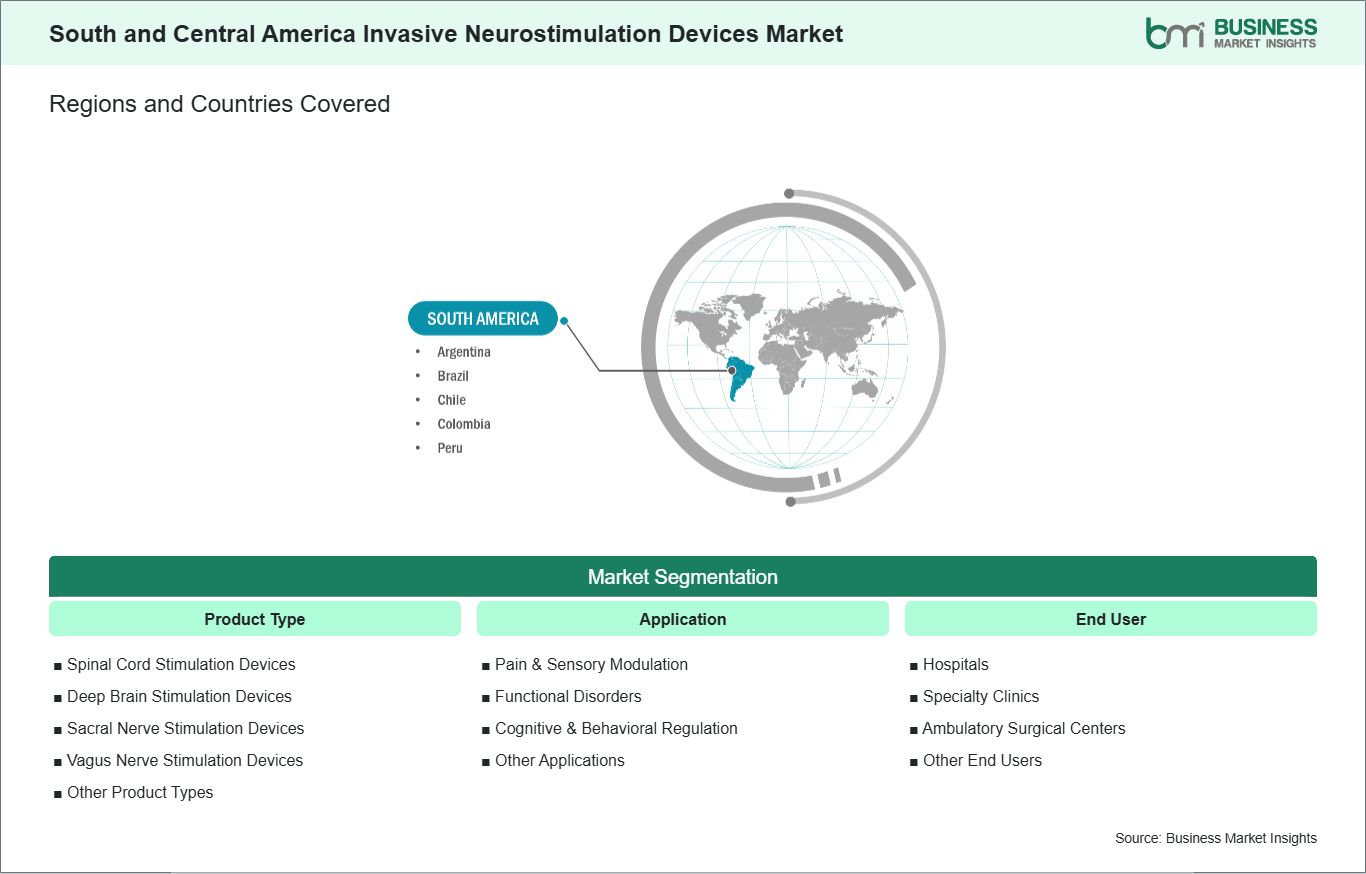
Key segments that contributed to the derivation of the South and Central America invasive neurostimulation devices market analysis are product type, application and end user.
- By product type, the invasive neurostimulation devices market is segmented into spinal cord stimulation devices, deep brain stimulation devices, sacral nerve stimulation devices, vagus nerve stimulation devices, and other product types. The spinal cord stimulation devices segment dominated the market in 2025.
- Based on application, the invasive neurostimulation devices market is categorized into pain & sensory modulation, functional disorders, cognitive & behavioral regulation, and other applications. The pain & sensory modulation segment dominated the market in 2025.
- In terms of end user, the invasive neurostimulation devices market is categorized into hospitals, specialty clinics, ambulatory surgical centers, and other end users. The hospitals segment dominated the market in 2025.
Market Forces
South and Central America Invasive Neurostimulation Devices Market Drivers and Opportunities
Rising Chronic Neurological Pain Cases
Neurological conditions associated with persistent pain in South and Central America are referred to tertiary facilities where neuromodulation treatments are offered. Clinically, there is a standardized pathway involving initial use of drugs, followed by implantable stimulation upon persistence of impairment in function. In surgical suites, preference is given to those systems that integrate well with current procedures and postoperative management strategies.
For many countries, the referral pattern leads to an extended wait time for invasive neurostimulation treatments as patients are referred via general neurology, pain management centers and rehabilitation units. On the other hand, private facilities offer more streamlined processes, whereas public systems focus more on extended conservative treatments. The availability of imaging technology affects decision-making.
The adoption process within hospitals varies with the level of exposure to neurostimulation systems and their compatibility with existing implant procedures. Neurosurgeons prefer systems that integrate well into the procedure flow for implants. There is a trend towards acquiring and using reliable systems within hospitals, whereas smaller centers refer their patients to central hospitals.
Expansion in Cognitive Disorders
In South and Central America, invasive neurostimulation is being explored for cognitive disorders within specialized neurology and neuropsychiatry units. Clinical focus centers on neurodegenerative conditions with pronounced executive dysfunction, where stimulation is considered adjunctive. Academic hospitals lead early implementation under controlled protocols and strict patient selection criteria frameworks only used.
In behavioral health integrated settings, cognitive impairment linked to Parkinsonian syndromes and depression-related decline is increasingly evaluated alongside neuromodulation options. Multidisciplinary teams coordinate neurological and psychiatric assessments, but access varies widely across systems. Private centers accelerate treatment alignment, while public hospitals depend on staged therapeutic evaluation before device consideration processes.
Invasive neurostimulation for cognitive disorders is largely confined to tertiary hospitals developing structured neuromodulation units. Protocols define strict eligibility criteria for progressive neurodegenerative cases, emphasizing safety and outcome consistency. Cross-disciplinary collaboration strengthens procedural confidence, but resource intensity limits broader diffusion, keeping adoption concentrated within academic and high-complexity centers region overall.
Size and Share Analysis
South and Central America Invasive Neurostimulation Devices Market Size and Share Analysis
The South and Central America invasive neurostimulation devices market is experiencing steady growth, with market size and share analysis reflecting evolving treatment preferences and competitive dynamics among key players. The report evaluates important subsegments categorized within product type, application and end user, highlighting their respective contributions to market performance.
By product type, the spinal cord stimulation devices subsegment dominated the market in 2025, driven by its widespread adoption for chronic pain management, particularly for failed back surgery syndrome and neuropathic pain conditions.
Based on application, the pain & sensory modulation subsegment dominated the market in 2025, driven by the rising global prevalence of chronic pain disorders and the growing preference for neuromodulation as an alternative to long-term drug therapy.
In terms of end user, the hospitals subsegment dominated the market in 2025, driven by their advanced neurosurgical infrastructure, availability of specialized healthcare professionals, and high volume of neurostimulation implantation procedures.
Report Coverage
South and Central America Invasive Neurostimulation Devices Market Report Coverage and Deliverables
The "South and Central America Invasive Neurostimulation Devices Market Size and Forecast (2022-2033)" report provides a detailed analysis of the market covering below areas:
- Market size and forecast at regional and country levels for all market segments covered under the scope
- Market trends, as well as drivers, restraints, and opportunities
- Market analysis covering key trends, regional framework, major players, regulations, and recent developments
- Market concentration, heat map analysis, prominent players, and recent developments for the Market
- Detailed company profiles, including SWOT analysis
Geographic Insights
South and Central America Invasive Neurostimulation Devices Market Geographic Insights
The geographical scope of the South and Central America Invasive Neurostimulation Devices Market report is divided into Brazil, Argentina, Chile, Colombia, Peru. Brazil held the largest share in 2025.
The market for invasive neurostimulation in South and Central America is influenced by varying levels of healthcare development in these countries. Specifically, Brazil stands out as the largest hub owing to the country‘s established network of neurosurgery facilities, the presence of numerous tertiary hospitals, and the substantial investments made in cutting-edge neurological interventions with financial support from both government and the private sector, in addition to the presence of active clinical research, which spurs the adoption of deep brain and spinal cord stimulation devices, with innovation clusters existing in Sao Paulo and Rio de Janeiro to train physicians and customize devices. The other notable contributor is Argentina, where the steady growth is fueled by the presence of expert neurologists in academic medical centers who are creating more demands for neuromodulation devices for pain and movement disorders, amid occasional economic instability that leads to a preference for cost-based procurement of devices and systems. Chile presents itself as a market demonstrating progressive adoption enabled by a highly structured private health care system along with streamlined regulatory processes, thus promoting early adoption of neurostimulation in pain clinics and rehabilitation after surgery, with the added advantage of functional restoration alongside the growing use of digital monitoring in the process of recovery. The market in Colombia is advancing via greater insurance coverage, advanced facilities in large cities, and increased attention being paid by clinicians to the treatment of epilepsy, spinal injuries, and trauma-related neurological disorders, thus leading to increased procedure volumes and reach-out into rural areas. Peru, on the other hand, is an emerging market where better facilities in hospitals, greater awareness on the part of clinicians, and the gradual growth of specialty neurology centers have made slow but steady adoption possible.
Industry Activity
Recent Developments
The South and Central America Invasive Neurostimulation Devices Market is evaluated by gathering qualitative and quantitative data post primary and secondary research, which includes important corporate publications, association data, and databases. A few of the key developments in the South and Central America invasive neurostimulation devices market are:
- In November 2025, Abbott announced that Brazil‘s health regulatory agency ANVISA had approved its Liberta RC deep brain stimulation (DBS) system, expanding access to next-generation DBS therapy for patients with Parkinson‘s disease, dystonia, and essential tremor in the Brazilian market.
- In November 2023, Boston Scientific announced that it had completed the acquisition of Relievant Medsystems, adding the Intracept Intraosseous Nerve Ablation System to its chronic pain and neuromodulation portfolio, strengthening its minimally invasive pain treatment offerings across global markets
Trust & Transparency
Research Methodology
The market analysis combines proprietary research with secondary data from government agencies, company disclosures, regulatory filings, industry databases and expert interviews. Market estimates are validated through data triangulation, cross-market benchmarking and analyst
review.
View Full Research Methodology
Key Sources Referred:
U.S. Food and Drug Administration (FDA)National Institutes of Health (NIH)National Institute of Neurological Disorders and Stroke (NINDS)Centers for Medicare & Medicaid Services (CMS)Medical Device Innovation Consortium (MDIC)World Health Organization (WHO)International Organization for Standardization (ISO)International Neuromodulation Society (INS)North American Neuromodulation Society (NANS)Company WebsitesCompany Annual ReportsCompany Investor Presentations