Market Summary
Executive Summary and Market Analysis
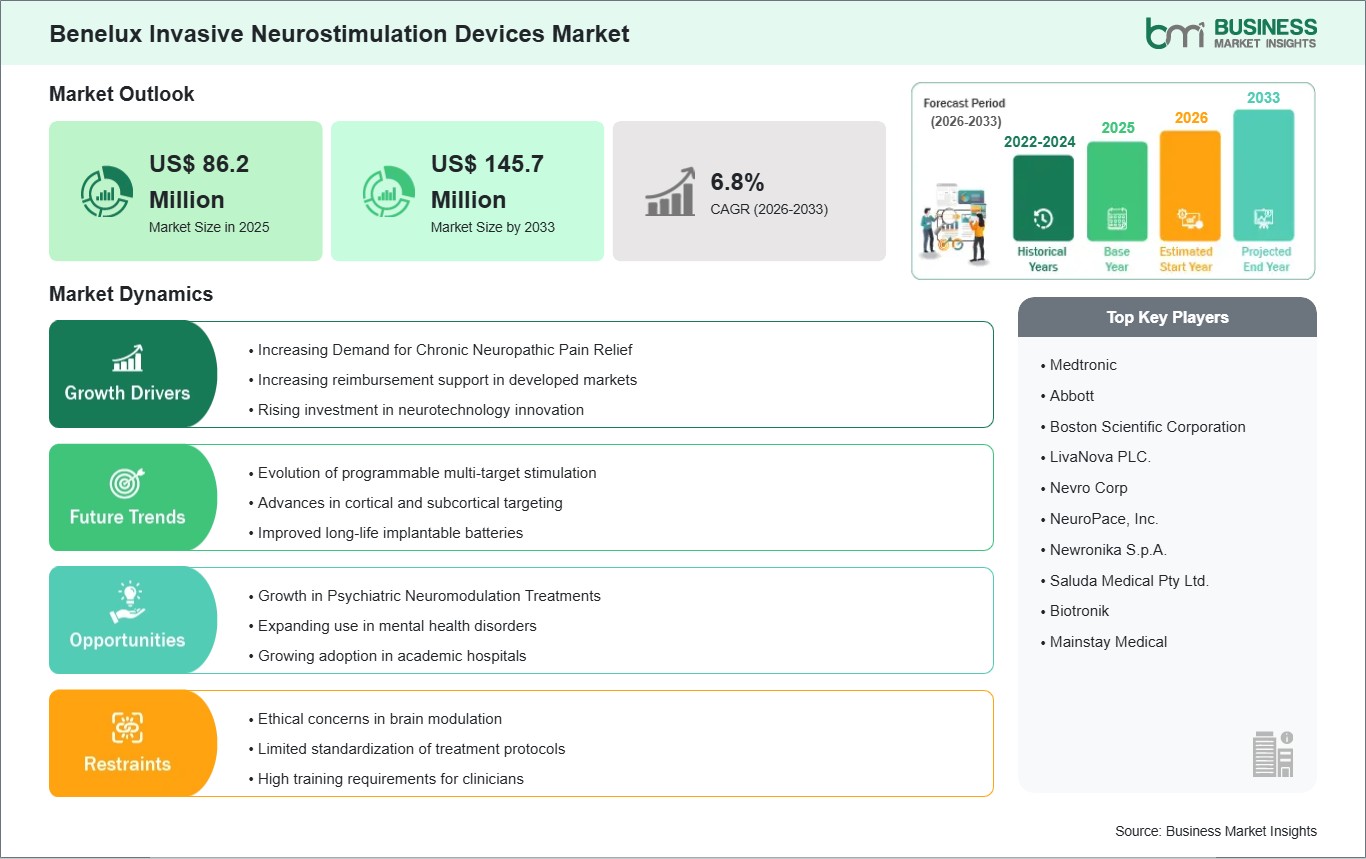
Throughout the Benelux market, the landscape of invasions related to neurostimulation devices is driven by the highly-regulated and innovative neuromodulation environment covering Belgium, the Netherlands, and Luxembourg, where secondary neurosurgical centers are increasingly adopting implantable devices, such as DBS, spinal cord stimulation, and vagus nerve stimulation for their complex neurological diseases. Decisions made by healthcare practitioners are significantly affected by the convergence of three key medical specializations - neurology, functional neurosurgery, and pain management, since hospitals favor the use of these devices on those patients who suffer from movement disorders, chronic neuropathic pain, or refractory epilepsy and where the effectiveness of traditional medication becomes insufficient. One major factor behind the increasing popularity of invasions in question is related to the growing demand for precision neuromodulation, which becomes possible due to the development of closed-loop stimulation systems and implantation techniques that help improve the accuracy and reduce the perioperative burden on patients. The other factor includes the growth of dedicated neurostimulation programs in academic and private hospitals. A significant constraint is the fact that the high level of procedural complexity, coupled with the requirement of highly trained surgical teams, constrains procedural volumes, resulting in unequal availability in other parts of the region apart from big urban centers, where healthcare infrastructure is more pronounced. Regulatory harmonization among the Benelux countries is also shaping device availability due to the strict requirements imposed by manufacturers in order to introduce next-generation devices. Physicians are increasingly taking part in programming the device after implantation, which suggests that chronic models of care have emerged as opposed to one-off procedures.
Segment Analysis
Benelux Invasive Neurostimulation Devices Market Segmentation
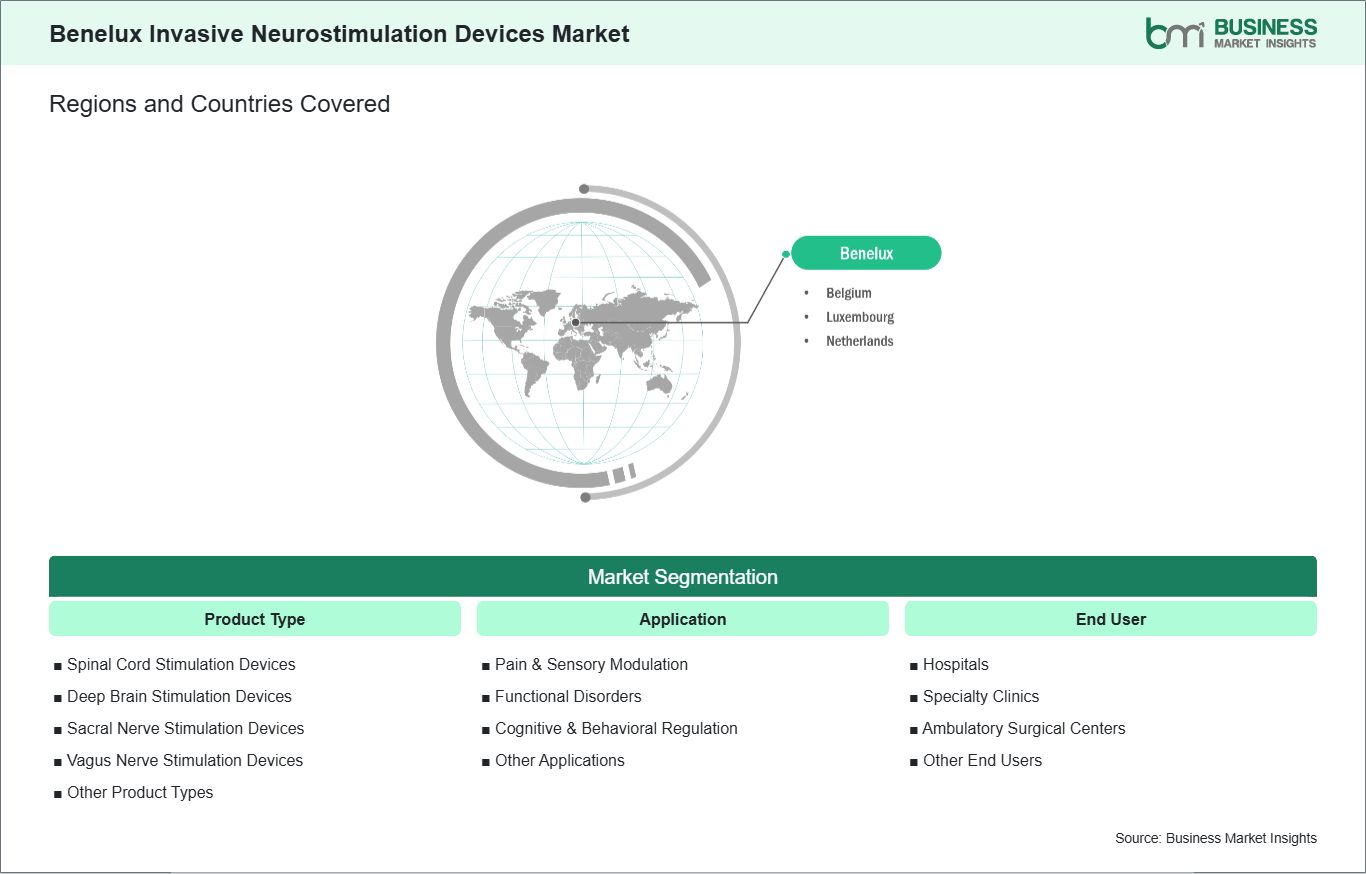
Key segments that contributed to the derivation of the Benelux invasive neurostimulation devices market analysis are product type, application and end user.
- By product type, the invasive neurostimulation devices market is segmented into spinal cord stimulation devices, deep brain stimulation devices, sacral nerve stimulation devices, vagus nerve stimulation devices, and other product types. The spinal cord stimulation devices segment dominated the market in 2025.
- Based on application, the invasive neurostimulation devices market is categorized into pain & sensory modulation, functional disorders, cognitive & behavioral regulation, and other applications. The pain & sensory modulation segment dominated the market in 2025.
- In terms of end user, the invasive neurostimulation devices market is categorized into hospitals, specialty clinics, ambulatory surgical centers, and other end users. The hospitals segment dominated the market in 2025.
Market Forces
Benelux Invasive Neurostimulation Devices Market Drivers and Opportunities
Increasing Demand for Chronic Neuropathic Pain Relief
Within pain centers in Benelux, patients are increasingly being directed towards implantable neurostimulation approaches when drug therapy fails. Device-dependent approaches are now being preferred to deal with nerve pain that arises from surgery-related problems, spinal problems, and diabetic neuropathy, especially in situations where functional recovery becomes a treatment goal as opposed to just symptom suppression.
Neuromodulation programs within hospitals in Belgium and the Netherlands have adopted screening for device suitability within the early stages of care, usually through joint assessment by a panel that includes experts from neurology, anesthesia, and physiotherapy fields. The approach demonstrates increased organization in care delivery, where invasive stimulation will only be considered after non-invasive and block therapy methods fail.
Device procurement at hospitals in Benelux is now being driven by the management needs of the devices, such as the ease of replacing lead wires, battery lifespan, and the ability to program the devices. In most cases, devices are preferred where their management fits into established neuromodulation programs of health facilities, thereby minimizing the need for further surgeries.
Growth in Psychiatric Neuromodulation Treatments
In Benelux psychiatric care networks, invasive neuromodulation is increasingly being explored for treatment-resistant conditions such as obsessive-compulsive disorder and severe affective disorders, particularly where pharmacotherapy and psychotherapy combinations fail to stabilize symptom cycles. Clinical interest is shaped by evolving neurocircuitry models that link targeted stimulation to behavioral regulation outcomes with increasing emphasis on patient-specific targeting.
Specialized neuropsychiatry units in Belgium and the Netherlands are incorporating invasive stimulation pathways into staged care models, where multidisciplinary boards evaluate treatment resistance trajectories before escalation. This operational design aligns neuromodulation with existing psychiatric follow-up systems rather than isolating it as a last-resort surgical intervention. Care pathways are increasingly standardized across tertiary centers clinically evolving.
Institutional review processes across Benelux hospitals place significant emphasis on patient selection rigor for invasive psychiatric neuromodulation, particularly regarding neuroethical considerations, reversibility expectations, and long-term monitoring obligations. Decision-making often involves layered approvals that balance innovation acceptance with conservative clinical governance. Ethics committees increasingly scrutinize long-term cognitive and behavioral outcome uncertainty before implantation decisions across centers.
Size and Share Analysis
Benelux Invasive Neurostimulation Devices Market Size and Share Analysis
The Benelux invasive neurostimulation devices market is experiencing steady growth, with market size and share analysis reflecting evolving treatment preferences and competitive dynamics among key players. The report evaluates important subsegments categorized within product type, application and end user, highlighting their respective contributions to market performance.
By product type, the spinal cord stimulation devices subsegment dominated the market in 2025, driven by its widespread adoption for chronic pain management, particularly for failed back surgery syndrome and neuropathic pain conditions.
Based on application, the pain & sensory modulation subsegment dominated the market in 2025, driven by the rising global prevalence of chronic pain disorders and the growing preference for neuromodulation as an alternative to long-term drug therapy.
In terms of end user, the hospitals subsegment dominated the market in 2025, driven by their advanced neurosurgical infrastructure, availability of specialized healthcare professionals, and high volume of neurostimulation implantation procedures.
Report Coverage
Benelux Invasive Neurostimulation Devices Market Report Coverage and Deliverables
The "Benelux Invasive Neurostimulation Devices Market Size and Forecast (2022-2033)" report provides a detailed analysis of the market covering below areas:
- Market size and forecast at regional and country levels for all market segments covered under the scope
- Market trends, as well as drivers, restraints, and opportunities
- Market analysis covering key trends, regional framework, major players, regulations, and recent developments
- Market concentration, heat map analysis, prominent players, and recent developments for the Market
- Detailed company profiles, including SWOT analysis
Geographic Insights
Benelux Invasive Neurostimulation Devices Market Geographic Insights
The geographical scope of the Benelux Invasive Neurostimulation Devices Market report is divided into Belgium, Netherlands, Luxembourg. Netherlands held the largest share in 2025.
Within the Benelux region, the invasive neurostimulation devices market is characterized by differential development trends that depend on health care infrastructural, specialization, and innovation factors. As far as the Netherlands is concerned, this country is the main driving force in the market growth, which is based on the existence of the integrated neuromodulation environment with leading hospitals specializing in neuroscience research and established pathways for educating clinicians on the use of stimulators and implantable devices, such as DBS. Effective collaboration between clinicians and medical technology innovators contributes to fast procedure improvement. At the same time, the existing referral networks and relatively effective reimbursement strategies motivate clinicians to use invasive neurostimulators for the treatment of movement disorders and intractable neurological disorders. In Belgium, continuous growth is observed due to the presence of specialized units providing neurology and functional neurosurgery treatment at big hospitals. The existence of collaborative hospital consortia is another factor contributing to the gradual standardization of neuromodulation protocols, increasing the level of confidence in implantable treatments. Although much smaller in size, Luxembourg benefits from high healthcare spending on a per capita basis and uses networks of tertiary care based abroad, making it easier to selectively adopt innovations within the field of neurostimulation technologies via cooperation with foreign specialists. Due to its unique approach to combining public and private health services, Luxembourg can become familiar with the latest developments related to implantables via participation in pilot projects and undergoing clinical journeys abroad. Together, the countries show different levels of technology adoption within the Benelux region, where the Netherlands leads the way, Belgium creates structured clinical expertise, and Luxembourg adds to the equation with its specialized approach.
Industry Activity
Recent Developments
The Benelux Invasive Neurostimulation Devices Market is evaluated by gathering qualitative and quantitative data post primary and secondary research, which includes important corporate publications, association data, and databases. A few of the key developments in the Benelux invasive neurostimulation devices market are:
- In October 2023, Medtronic announced that it had renewed and expanded its strategic collaboration with Maastricht UMC+ in the Netherlands, focusing on neurotechnology innovation, including neuromodulation and advanced neurostimulation therapies, aimed at strengthening clinical research and improving access to innovative neurological treatments in the Benelux region.
- In June 2024, Boston Scientific announced that it had received CE Mark approval for its Vercise Neural Navigator 5 software with STIMVIEW XT, designed to improve deep brain stimulation (DBS) programming efficiency and precision, supporting clinicians across Europe, including neurosurgical and movement disorder centers in Belgium and the Netherlands to optimize implantable DBS therapy outcomes.
Trust & Transparency
Research Methodology
The market analysis combines proprietary research with secondary data from government agencies, company disclosures, regulatory filings, industry databases and expert interviews. Market estimates are validated through data triangulation, cross-market benchmarking and analyst
review.
View Full Research Methodology
Key Sources Referred:
U.S. Food and Drug Administration (FDA)National Institutes of Health (NIH)National Institute of Neurological Disorders and Stroke (NINDS)Centers for Medicare & Medicaid Services (CMS)Medical Device Innovation Consortium (MDIC)World Health Organization (WHO)International Organization for Standardization (ISO)International Neuromodulation Society (INS)North American Neuromodulation Society (NANS)Company WebsitesCompany Annual ReportsCompany Investor Presentations