Market Summary
Executive Summary and Market Analysis
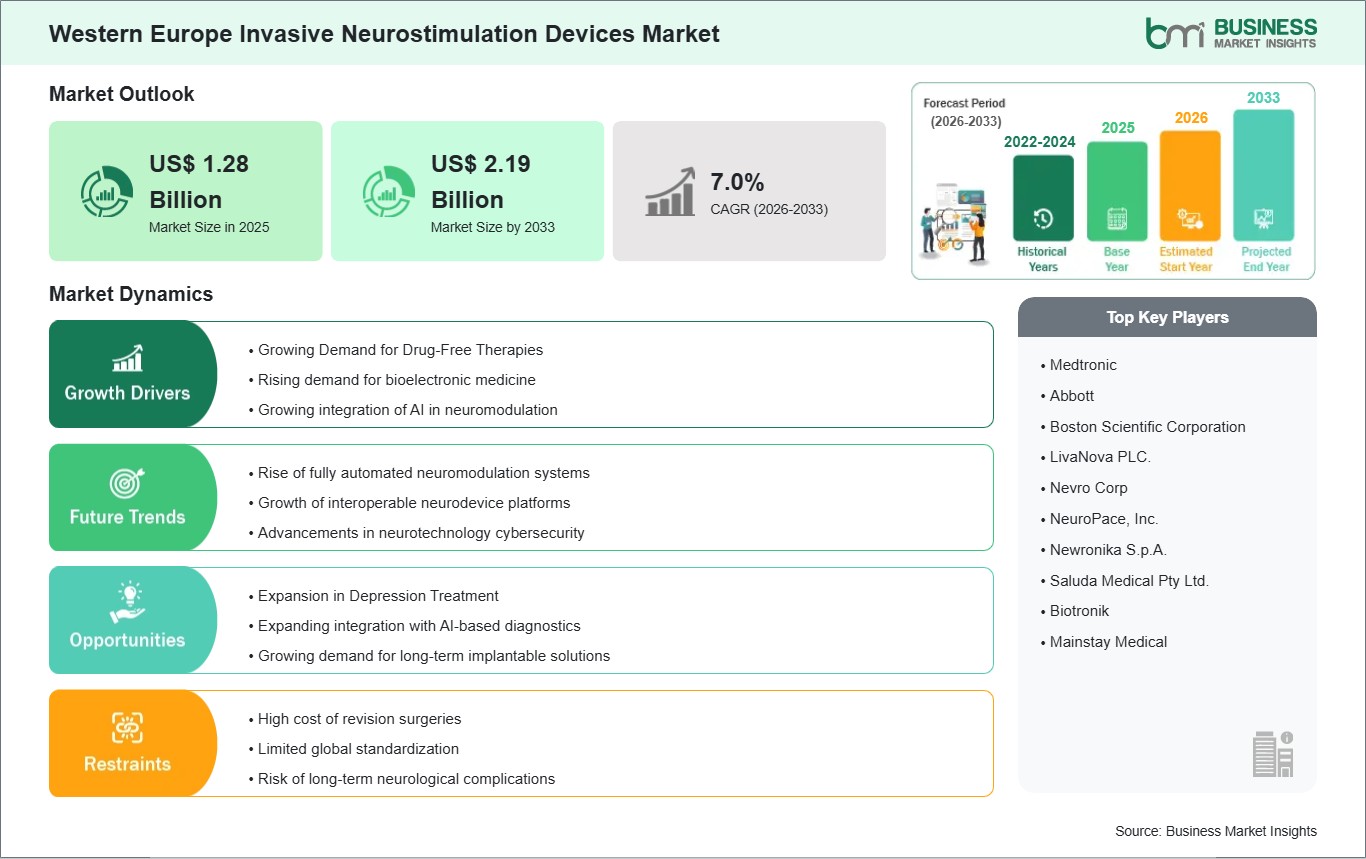
The invasive neurostimulation devices market in Western Europe has been witnessing strong clinical uptake, supported by a highly developed healthcare infrastructure and growing interest in advanced neuromodulation techniques for managing chronic neurological and pain-related conditions. This demand is being driven by the increasing prevalence of disorders such as Parkinson's disease, epilepsy, chronic pain syndromes, and therapy-refractory psychiatric conditions, leading to broader integration of implantable neurostimulation technologies into routine patient care pathways. Key market growth factors include continuous improvements in medical device technology, such as higher-performance batteries, more sophisticated programming capabilities, and improved precision in targeting neural structures, alongside rising awareness and acceptance of minimally invasive neurosurgical procedures across Western Europe.
Government reimbursement frameworks in several Western European countries are complemented by extensive clinical research activity, strong partnerships between device manufacturers and hospitals, and an active collaboration between universities and neurological centers. The market faces competitive pressure driven by rapid innovation cycles, stringent regulatory compliance requirements, and the need to consistently demonstrate long-term safety and efficacy. A key constraint remains the high overall cost of device implantation, programming, and long-term follow-up care, which limits accessibility within resource-constrained healthcare systems and contributes to regional disparities in adoption. In response, device manufacturers are focusing on product refinement, physician training initiatives, and the generation of robust clinical evidence to strengthen market penetration.
Segment Analysis
Western Europe Invasive Neurostimulation Devices Market Segmentation
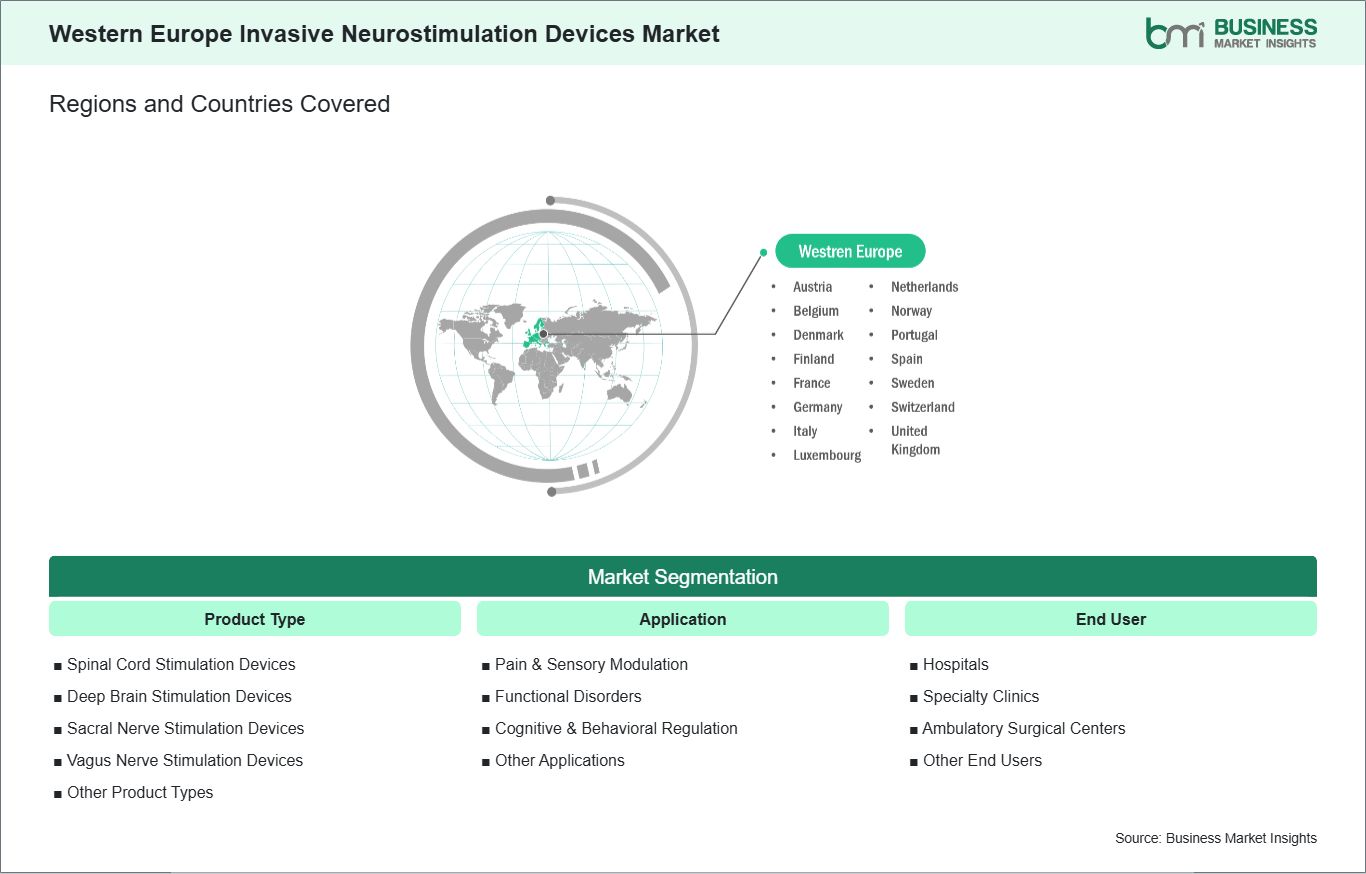
Key segments that contributed to the derivation of the Western Europe invasive neurostimulation devices market analysis are product type, application, and end user.
- By product type, the invasive neurostimulation devices market is segmented into spinal cord stimulation devices, deep brain stimulation devices, sacral nerve stimulation devices, vagus nerve stimulation devices, and other product types. The spinal cord stimulation devices segment dominated the market in 2025.
- Based on application, the invasive neurostimulation devices market is categorized into pain & sensory modulation, functional disorders, cognitive & behavioral regulation, and other applications. The pain & sensory modulation segment dominated the market in 2025.
- In terms of end user, the invasive neurostimulation devices market is categorized into hospitals, specialty clinics, ambulatory surgical centers, and other end users. The hospitals segment dominated the market in 2025.
Market Forces
Western Europe Invasive Neurostimulation Devices Market Drivers and Opportunities
Growing Demand for Drug-Free Therapies
Healthcare professionals in Western Europe are increasingly focusing on the use of invasive neurostimulation devices for patients who do not respond positively to prolonged medication therapy. This growing emphasis on nerve-targeted treatment approaches is driven by the adverse effects associated with long-term medication use, the need for frequent dose adjustments, and treatment fatigue among individuals living with chronic neurological conditions.
Patients with neurological disorders are actively seeking solutions that can provide continuous relief from their symptoms. They also aim to reduce dependence on frequent drug administration and prefer treatment options that ensure long-term continuity of care. This growing willingness among patients to adopt newer therapeutic approaches is positively contributing to the market development.
At present, there is a clear trend of increasing collaboration between neurology clinics, pain management centers, and functional neurosurgery units. This cooperation is enabling earlier evaluation of invasive neurostimulation devices, rather than reserving them for later stages when the condition has significantly progressed.
Expansion in Depression Treatment
The application of invasive neurostimulation technologies in depression treatment is becoming an important focus area in Western Europe. Mental health specialists are exploring advanced neuromodulation approaches for patients with severe depressive disorders that remain insufficiently controlled through conventional therapeutic strategies. This shift is driving greater attention toward implantable systems designed to target specific neural circuits involved in mood regulation and emotional processing.
Healthcare institutions are gradually establishing structured frameworks to evaluate candidates who may benefit from neurostimulation-based interventions. Psychiatric teams, neurosurgeons, and neuropsychologists are increasingly collaborating during patient assessment and follow-up, resulting in a more integrated and coordinated treatment environment.
Market activity is supported by the growing recognition that depression presents diverse biological and clinical profiles that require individualized treatment approaches. Invasive neurostimulation technologies align with this shift toward precision-focused care by enabling targeted intervention strategies tailored to specific patient needs. As treatment centers continue refining patient selection protocols and post-implantation management practices, the role of neurostimulation in depression care is expected to become increasingly established across Western Europe.
Size and Share Analysis
Western Europe Invasive Neurostimulation Devices Market Size and Share Analysis
The Western Europe invasive neurostimulation devices market is experiencing steady growth, with market size and share analysis reflecting evolving treatment preferences and competitive dynamics among key players. The report evaluates important subsegments categorized within product type, application, and end user, highlighting their respective contributions to market performance.
By product type, the spinal cord stimulation devices subsegment dominated the market in 2025, driven by its widespread adoption for chronic pain management, particularly for failed back surgery syndrome and neuropathic pain conditions.
Based on application, the pain & sensory modulation subsegment dominated the market in 2025, driven by the rising global prevalence of chronic pain disorders and the growing preference for neuromodulation as an alternative to long-term drug therapy.
In terms of end user, the hospitals subsegment dominated the market in 2025, driven by their advanced neurosurgical infrastructure, availability of specialized healthcare professionals, and high volume of neurostimulation implantation procedures.
Report Coverage
Western Europe Invasive Neurostimulation Devices Market Report Coverage and Deliverables
The "Western Europe Invasive Neurostimulation Devices Market Size and Forecast (2022-2033)" report provides a detailed analysis of the market covering below areas:
- Market size and forecast at regional and country levels for all market segments covered under the scope
- Market trends, as well as drivers, restraints, and opportunities
- Market analysis covering key trends, regional framework, major players, regulations, and recent developments
- Market concentration, heat map analysis, prominent players, and recent developments for the Market
- Detailed company profiles, including SWOT analysis
Geographic Insights
Western Europe Invasive Neurostimulation Devices Market Geographic Insights
The geographical scope of the Western Europe Invasive Neurostimulation Devices Market report is divided into Belgium, the Netherlands, Luxembourg, Germany, France, Italy, Spain, Switzerland, Sweden, Austria, the UK, Denmark, Portugal, Norway, and Finland. Germany held the largest share in 2025.
There are diverse growth trends in the invasive neurostimulation devices market across Western Europe, driven by differences in healthcare infrastructure, clinical specializations, reimbursement systems, and innovation ecosystems in each country. Germany leads the market due to its strong neurology and neurosurgical practices, high penetration of advanced implantable devices, and well-established systems that enable seamless integration of new therapies into routine clinical care. In France, steady growth is supported by continued investment in disease management initiatives and a growing emphasis on multidisciplinary treatment approaches for chronic conditions. The UK has recorded notable expansion in the use of neurostimulation techniques for pain management and movement disorders, while Italy is experiencing rising demand for minimally invasive neuromodulation treatments. In Spain, growth is expected to be driven by increased availability of neurology specialists and rising physician awareness of implant-based therapies. The Netherlands is characterized by a strong clinical research environment and early adoption of neurotechnology innovations.
In Belgium, collaboration within the healthcare sector is supporting the adoption of new neuromodulation techniques, while Luxembourg's market is influenced by cross-border healthcare provision for neurological treatments. Switzerland's growth is driven by high healthcare expenditure, whereas Sweden is advancing through healthcare innovation and the implementation of advanced therapeutic devices. In Austria, modernization of tertiary care hospitals and growing expertise in functional neurosurgery are key contributors to market development. Denmark is benefiting from the integration of digital health technologies and expanded neurological treatment options, while Portugal's growth is supported by increasing use of advanced neurology therapies. In Norway, investment in healthcare aimed at improving neurological disease treatment is driving expansion, and Finland's market growth is supported by innovation and a strong focus on precision-based neurological care.
Industry Activity
Recent Developments
The Western Europe Invasive Neurostimulation Devices Market is evaluated by gathering qualitative and quantitative data post primary and secondary research, which includes important corporate publications, association data, and databases. A few of the key developments in the Western Europe invasive neurostimulation devices market are:
- In December 2023, Medtronic received CE Mark approval for the Percept RC rechargeable deep brain stimulation (DBS) neurostimulator with BrainSense technology, enabling commercial availability in Western Europe and expanding access to sensing-enabled DBS therapy for patients with Parkinson's disease, essential tremor, dystonia, and epilepsy across Western European markets.
- In August 2023, Medtronic received CE Mark approval for its Inceptiv closed-loop rechargeable spinal cord stimulator (SCS), introducing real-time sensing technology that automatically adjusts therapy based on spinal cord signals. The approval enabled commercialization across Western European markets for chronic pain management.
Trust & Transparency
Research Methodology
The market analysis combines proprietary research with secondary data from government agencies, company disclosures, regulatory filings, industry databases and expert interviews. Market estimates are validated through data triangulation, cross-market benchmarking and analyst
review.
View Full Research Methodology
Key Sources Referred:
U.S. Food and Drug Administration (FDA)National Institutes of Health (NIH)National Institute of Neurological Disorders and Stroke (NINDS)Centers for Medicare & Medicaid Services (CMS)Medical Device Innovation Consortium (MDIC)World Health Organization (WHO)International Organization for Standardization (ISO)International Neuromodulation Society (INS)North American Neuromodulation Society (NANS)Company WebsitesCompany Annual ReportsCompany Investor Presentations