Market Summary
Executive Summary and Market Analysis
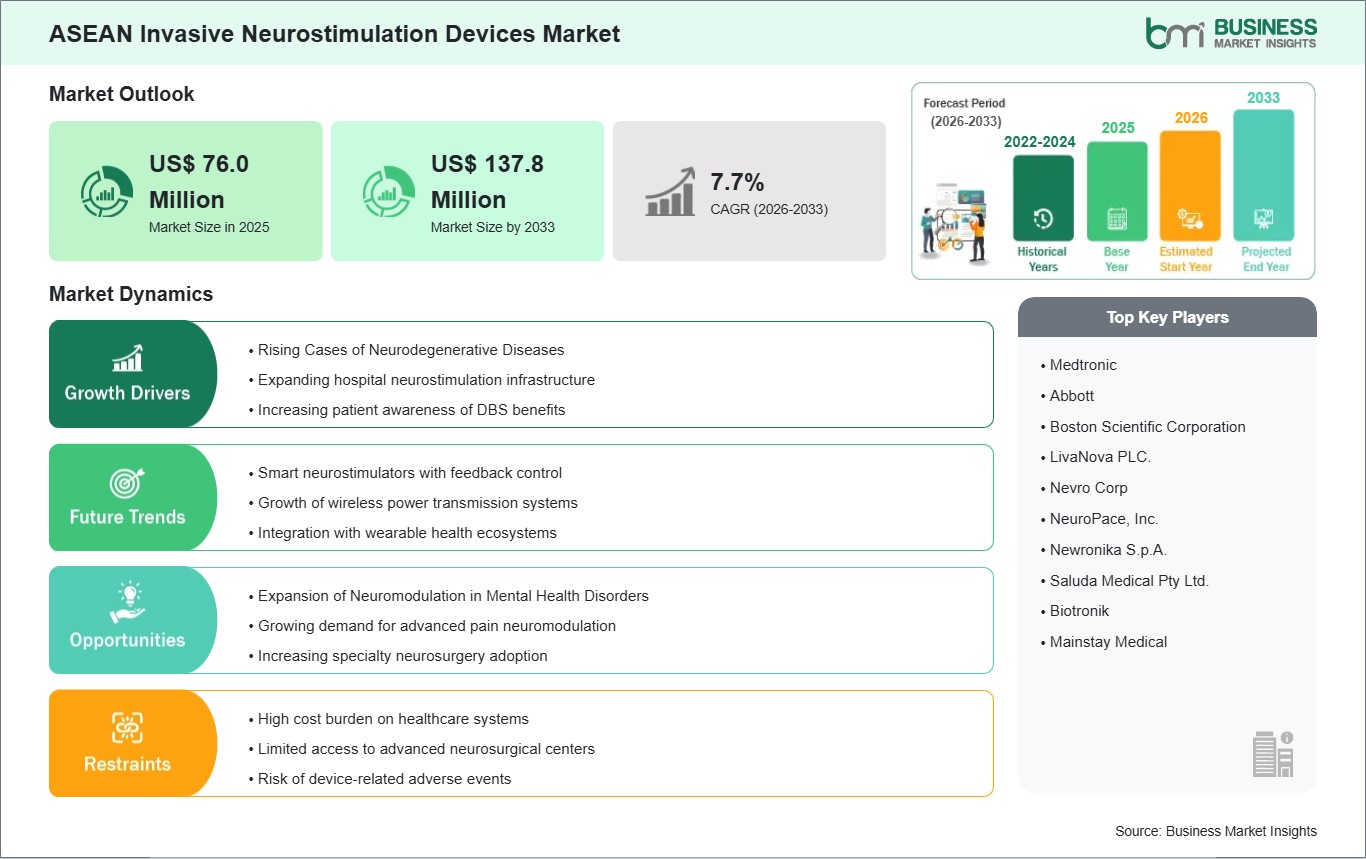
In ASEAN countries, the environment for neurostimulation medical devices is influenced by the trend towards adopting high-end implanted neuromodulation therapy, which addresses neurological and pain conditions that do not yield to traditional medication-based treatments. This is driven by an increase in cases of movement disorders, epileptic and neuropathic pains, necessitating an increased use of DBS, SCS, and VNS therapies. The other factor that shapes the market is increasing neurosurgical capability in urban hospitals, through development of image-guided surgical tools, hybrid OR suites, and specialist medical teams that perform implant procedures. A significant portion of growth in this field comes from medical tourism in select ASEAN cities, wherein patients seek treatment for neuromodulation through advanced devices in well-known neurological centers in private tertiary hospitals. In addition to the growing proficiency among healthcare professionals with regards to programmable and adaptive neuromodulation devices, the trend towards adopting an early approach to invasive neuromodulation therapies has emerged, considering these devices no longer as a last resort. Nonetheless, the industry still suffers from the high cost of implantable devices, inadequate reimbursement strategies, and affordability issues across multiple ASEAN healthcare environments. Furthermore, regulatory inconsistency across member states, a lack of neurosurgeons, and difficulties in patient management after surgery contribute to the challenges faced by the industry. The changing industry landscape motivates further collaboration between implantable medical device manufacturers, researchers, and healthcare organizations towards optimizing implantation procedures and patient selection criteria in diverse ASEAN healthcare environments.
Segment Analysis
ASEAN Invasive Neurostimulation Devices Market Segmentation
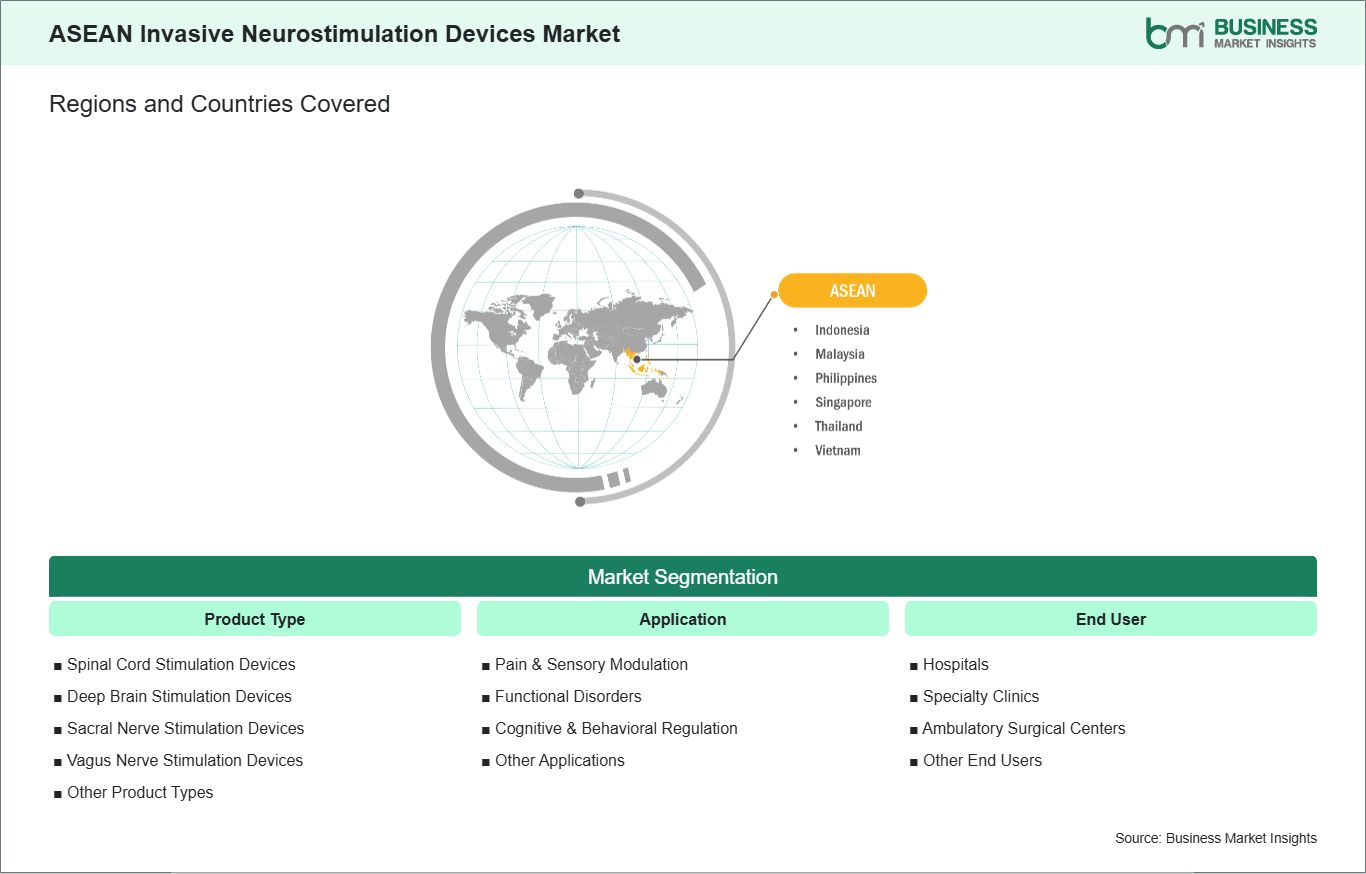
Key segments that contributed to the derivation of the ASEAN invasive neurostimulation devices market analysis are product type, application and end user.
- By product type, the invasive neurostimulation devices market is segmented into spinal cord stimulation devices, deep brain stimulation devices, sacral nerve stimulation devices, vagus nerve stimulation devices, and other product types. The spinal cord stimulation devices segment dominated the market in 2025.
- Based on application, the invasive neurostimulation devices market is categorized into pain & sensory modulation, functional disorders, cognitive & behavioral regulation, and other applications. The pain & sensory modulation segment dominated the market in 2025.
- In terms of end user, the invasive neurostimulation devices market is categorized into hospitals, specialty clinics, ambulatory surgical centers, and other end users. The hospitals segment dominated the market in 2025.
Market Forces
ASEAN Invasive Neurostimulation Devices Market Drivers and Opportunities
Rising Cases of Neurodegenerative Diseases
Within the healthcare landscape of ASEAN nations, neurodegenerative diseases have started influencing clinical pathways for neurologists and surgeons as they consider more advanced procedures, such as neurostimulation in hospitals within cities. This is happening because neurologists need to use surgical interventions, including brain stimulators, before patients stop responding to pharmacological methods and continue developing problems related to movement and cognition in specific units.
To address this emerging trend, manufacturers have started considering their products' compatibility with clinical procedures associated with neurology at the level of imaging and electrode implantation. Clinical specialists in the field of neurology prefer devices that offer an easy opportunity to program systems based on intraoperative imaging and reduce possible risks associated with surgical interventions in ASEAN nations.
When it comes to the development of diseases related to movement and memory, clinicians are now considering ways to map treatment protocols that involve the use of neurostimulation in conjunction with tapering pharmacological doses, especially when individuals lose their independence and increase the burden on caregivers and other specialists.
Expansion of Neuromodulation in Mental Health Disorders
In ASEAN psychiatric practice, neuromodulation techniques are gradually being incorporated into treatment algorithms for patients with refractory depression and anxiety disorders, particularly within private hospitals where interventional psychiatry units are forming around device-based protocols that supplement conventional psychotherapy and pharmacology especially in treatment resistant cohorts seeking alternative stimulation based interventions under structured clinical supervision pathways.
Technology adoption patterns among ASEAN neurology and psychiatry centers reflect a cautious integration of transcranial and implantable stimulation systems, with clinicians often evaluating device tolerability alongside behavioral outcomes before embedding neuromodulation into long-term mental health management frameworks for mood regulation disorders where follow up protocols emphasize adjustment of stimulation parameters based on response mapping data.
In community mental health settings across ASEAN, patients with severe obsessive-compulsive and post-traumatic conditions are increasingly evaluated for interventional neuromodulation when conventional therapy plateaus, leading clinicians to design staged care pathways that combine outpatient monitoring with periodic device calibration and psychiatric reassessment often coordinated through hybrid telemedicine and in-person specialist networks while tracking functional recovery.
Size and Share Analysis
ASEAN Invasive Neurostimulation Devices Market Size and Share Analysis
The ASEAN invasive neurostimulation devices market is experiencing steady growth, with market size and share analysis reflecting evolving treatment preferences and competitive dynamics among key players. The report evaluates important subsegments categorized within product type, application and end user, highlighting their respective contributions to market performance.
By product type, the spinal cord stimulation devices subsegment dominated the market in 2025, driven by its widespread adoption for chronic pain management, particularly for failed back surgery syndrome and neuropathic pain conditions.
Based on application, the pain & sensory modulation subsegment dominated the market in 2025, driven by the rising global prevalence of chronic pain disorders and the growing preference for neuromodulation as an alternative to long-term drug therapy.
In terms of end user, the hospitals subsegment dominated the market in 2025, driven by their advanced neurosurgical infrastructure, availability of specialized healthcare professionals, and high volume of neurostimulation implantation procedures.
Report Coverage
ASEAN Invasive Neurostimulation Devices Market Report Coverage and Deliverables
The "ASEAN Invasive Neurostimulation Devices Market Size and Forecast (2022-2033)" report provides a detailed analysis of the market covering below areas:
- Market size and forecast at regional and country levels for all market segments covered under the scope
- Market trends, as well as drivers, restraints, and opportunities
- Market analysis covering key trends, regional framework, major players, regulations, and recent developments
- Market concentration, heat map analysis, prominent players, and recent developments for the Market
- Detailed company profiles, including SWOT analysis
Geographic Insights
ASEAN Invasive Neurostimulation Devices Market Geographic Insights
The geographical scope of the ASEAN Invasive Neurostimulation Devices Market report is divided into Indonesia, Malaysia, Philippines, Singapore, Thailand, Vietnam. Indonesia held the largest share in 2025.
The Indonesian market maintains dominance over the use of neurostimulatory implants among ASEAN countries because of its large consumer pool, rising instances of intractable neurological conditions, and rapid growth of tertiary neurology centers within the nation‘s cities. There is an increase in surgical capability in terms of equipment use and patient surgeries outside metropolitan regions as a result of expanding health care coverage and hospital investments within private facilities. Malaysia, on the other hand, displays consistent adoption rates through its robust private sector health care infrastructure, neurosurgical expertise, and hospital willingness to incorporate implant technology. There is a gradual growth in the Philippines due to an increase in the availability of neurological services, as more hospitals provide such services, coupled with increasing diagnostic capabilities and investment in specialty care through public measures and individual healthcare spending. Singapore serves as a premium innovation and adaptation hub in which invasive neurostimulation technologies are brought to market early, facilitated by excellent infrastructure for clinical research, strong regulations, and emphasis on precision neuromodulation. Thailand has already gained recognition in neurosurgery and medical tourism, and there are substantial investments from large hospital groups into the provision of neurological treatments, together with universal health coverage that is increasingly geared towards complex treatments. Vietnam represents a rapidly growing region, driven by modernization within the healthcare system, expanding health insurance coverage, and growing demand for neurological treatments at urban hospitals.
Industry Activity
Recent Developments
The ASEAN Invasive Neurostimulation Devices Market is evaluated by gathering qualitative and quantitative data post primary and secondary research, which includes important corporate publications, association data, and databases. A few of the key developments in the ASEAN invasive neurostimulation devices market are:
- In June 2023, Nexalin Technology announced that it had entered a joint venture with Wider Come Limited to advance commercialization of its transcranial alternating current stimulation (tACS) neurostimulation devices across the Asia-Pacific region, including Southeast Asian markets, supporting clinical development and regional rollout of non-invasive brain stimulation therapies.
- In August 2023, Medtronic announced that it had received CE Mark approval for its Inceptiv closed-loop spinal cord stimulation system, a key advancement in implantable invasive neurostimulation therapy, enabling adaptive stimulation based on patient neural signals and strengthening its commercial neurostimulation portfolio relevant to Asia-Pacific and ASEAN healthcare systems.
Trust & Transparency
Research Methodology
The market analysis combines proprietary research with secondary data from government agencies, company disclosures, regulatory filings, industry databases and expert interviews. Market estimates are validated through data triangulation, cross-market benchmarking and analyst
review.
View Full Research Methodology
Key Sources Referred:
U.S. Food and Drug Administration (FDA)National Institutes of Health (NIH)National Institute of Neurological Disorders and Stroke (NINDS)Centers for Medicare & Medicaid Services (CMS)Medical Device Innovation Consortium (MDIC)World Health Organization (WHO)International Organization for Standardization (ISO)International Neuromodulation Society (INS)North American Neuromodulation Society (NANS)Company WebsitesCompany Annual ReportsCompany Investor Presentations