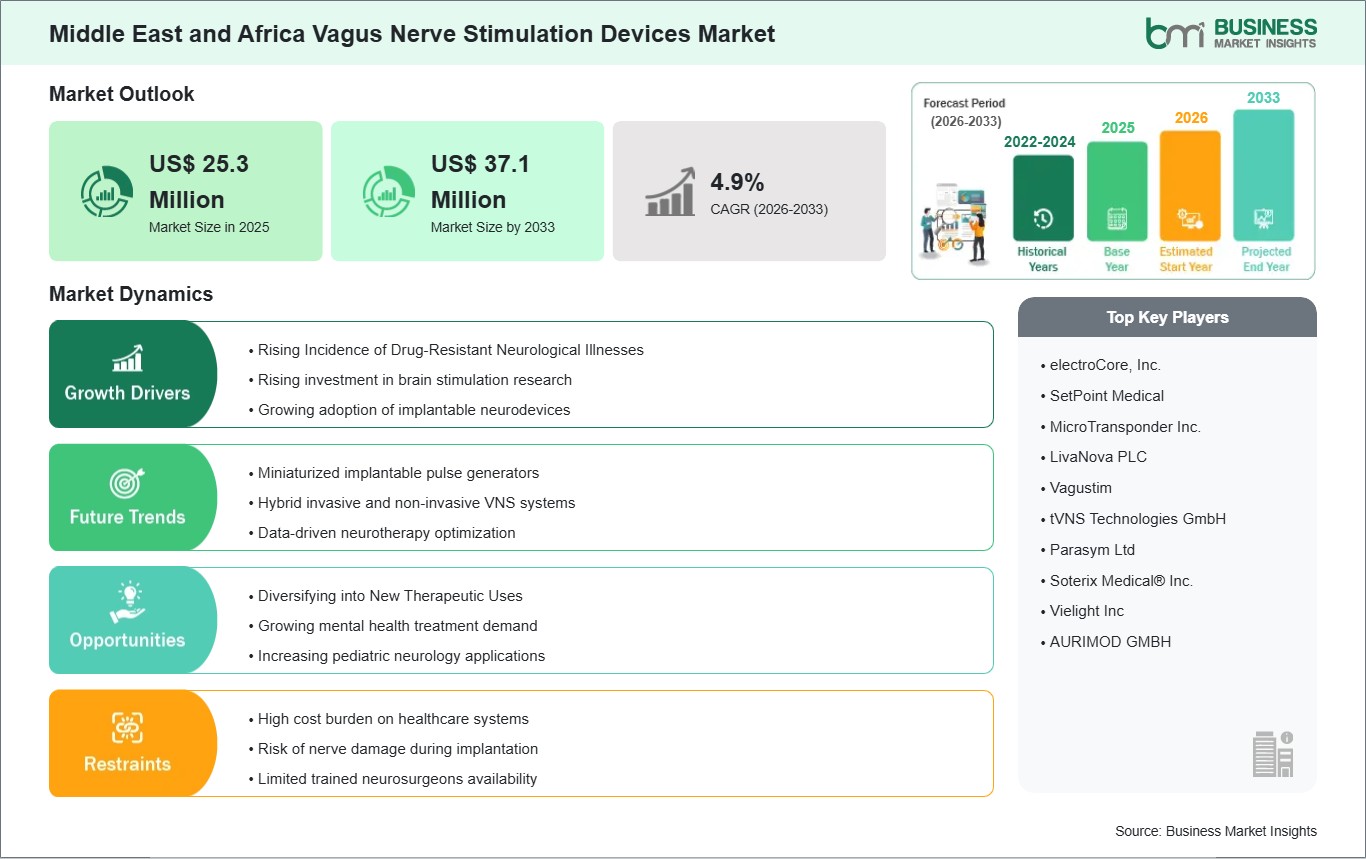
The Middle East and Africa vagus nerve stimulation devices market size is expected to reach US$ 37.1 million by 2033 from US$ 25.3 million in 2025. The market is estimated to record a CAGR of 4.9% from 2026 to 2033.
The MEA vagus nerve stimulation (VNS) devices market is developing in an extremely selective manner in which the adoption is taking place in a few healthcare systems that focus on neurology treatments and not by wide systemic adoption. The reason behind this is that in the MEA region, the use of VNS treatment is seen as a treatment modality that will only come into play when patients require last resort epilepsy management at specialist referral facilities. This development of the market is tied to the evolution of epileptic pathway treatment.
MEA is the growing importance of managing complex neurological cases in leading public hospitals, where governments are establishing centers of excellence for tertiary and quaternary care. In this setting, VNS is being offered together with sophisticated diagnostic instruments such as long-term electroencephalography monitoring and epilepsy surgical evaluation programs. Moreover, there is an ongoing, albeit slow, move towards neuropsychiatric care in MEA that allows for exploring neuromodulation therapies not only in epilepsy but also in treatment-refractory severe mood disorders through controlled clinical trials. Nevertheless, the adoption is constrained by the structural issue associated with the lack of care continuum infrastructure, especially with regard to the post-implantation follow-up and programming of the device required for optimal VNS treatment. In some African health care systems, neurological care remains acute care-oriented and prevents the development of long-term neuromodulation therapy treatment. Also, the differences in the density of specialists and neurosurgical expertise make the procedure scalable up to just a few centers of excellence in urban areas.

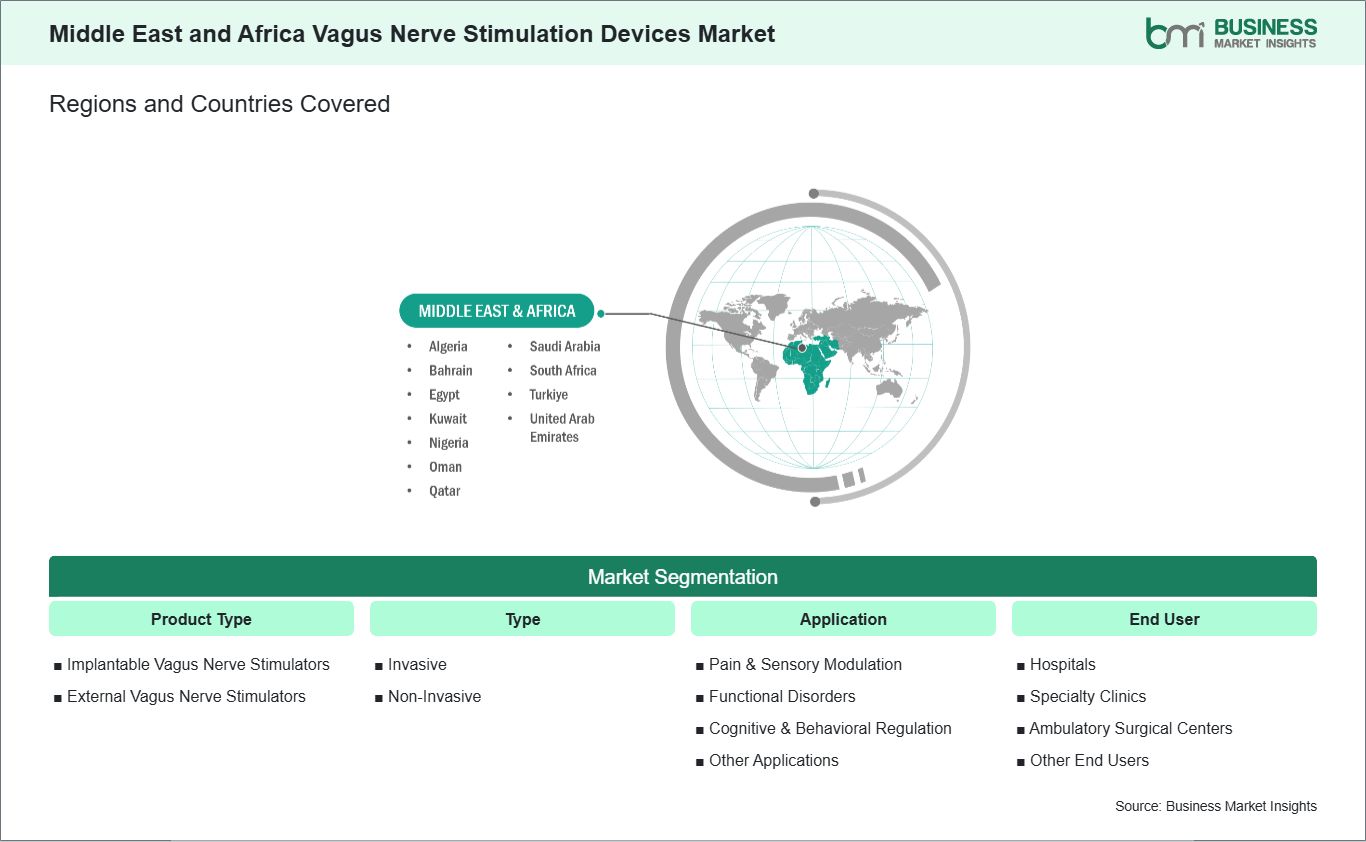
Key segments that contributed to the derivation of the Africa Vagus Nerve Stimulation Devices market analysis are product type, type, application, and end user.
An increasing prevalence of neurological disorders that are drug-resistant in nature has been observed in the MEA region, more notably epilepsy, thus creating interest in vagus nerve stimulation. In Gulf nations, Egypt, South Africa, and Nigeria, for example, advancements in diagnostics capabilities, along with greater awareness about neurological issues, have made it possible to identify many cases of refractory epilepsy in the region. Most such patients suffer from ongoing seizures even when they are receiving optimum drug treatment, thereby increasing the demand for vagus nerve stimulation.
The establishment of health care infrastructure is emerging as a significant factor behind increased access to novel neurological solutions in major MEA markets. Gulf nations, in particular, have been focusing on the development of neuroscience hospitals in order to improve patient access to neurostimulation. At the same time, in South Africa, as well as in selected North African countries, the establishment of tertiary care neurology departments is helping to increase physicians understanding of vagus nerve stimulation as an option.
At the same time, the region is experiencing an increasing burden of neurological complications linked to traumatic brain injuries, infectious diseases affecting the nervous system, and non-communicable conditions such as diabetes-related neuropathy. Urbanization, road traffic accidents, and limited early intervention in certain African healthcare systems contribute further to neurological morbidity. As a result, demand is gradually shifting toward advanced, non-pharmacological treatment options like vagus nerve stimulation to manage chronic and refractory neurological conditions.
The MEA market for vagus nerve stimulation (VNS) devices is slowly growing from being a niche in treating epilepsy towards more neurological and psychiatric conditions. Vagus nerve stimulation in the treatment of drug-resistant depression, anxiety, and migraines is currently being considered in the UAE, Saudi Arabia, and Israel in the Middle East region. Campaigns and policies that seek to increase mental well-being awareness are helping to propel neuromodulation therapy adoption in both public and private settings.
Non-surgical stimulation systems are popular in the MEA market because of their appropriateness for outpatient use. Non-invasive vagus nerve stimulators become an excellent option in places in Africa where surgical facilities and special neurology units might not be easily available in non-urban areas. This makes the treatment more convenient to deliver with fewer complications and hospitalization needs.
Additionally, ongoing clinical research collaborations and training initiatives are expanding the therapeutic scope of vagus nerve stimulation across the region. Academic medical centers in countries such as South Africa, Egypt, and the Gulf states are increasingly involved in neuromodulation research for applications including stroke rehabilitation, chronic pain management, and cognitive disorders. As physician awareness grows and international device manufacturers strengthen regional partnerships, the MEA market is expected to see gradual but sustained adoption across multiple therapeutic indications.

The Middle East and Africa Vagus Nerve Stimulation Devices market demonstrates steady growth, with size and share analysis highlighting evolving trends and competitive dynamics among key players. The report evaluates important subsegments categorized within product type, type, application, and end user, highlighting their respective contributions to overall market performance.
By product type, the implantable vagus nerve stimulators subsegment dominated the market in 2025, driven by their established clinical efficacy and widespread adoption in the treatment of neurological and psychiatric disorders such as epilepsy and treatment-resistant depression. These devices provide continuous and targeted nerve stimulation, making them a preferred long-term therapeutic option for chronic conditions.
Based on type, the invasive subsegment dominated the market in 2025, owing to its higher clinical effectiveness and stronger therapeutic outcomes in managing severe and refractory conditions. Invasive vagus nerve stimulation systems are widely preferred in hospital-based settings due to their proven long-term benefits and consistent symptom control.
In terms of application, the functional disorders subsegment dominated the market in 2025, propelled by the increasing prevalence of conditions such as epilepsy and depression, along with growing clinical adoption of vagus nerve stimulation as an adjunct therapy for patients who are unresponsive to conventional treatments.
On the basis of end user, the hospitals subsegment dominated the market in 2025 due to the availability of advanced neurology infrastructure, specialized neurosurgical expertise, and comprehensive postoperative care required for implantation and management of vagus nerve stimulation devices.
| Report Attribute | Details |
|---|---|
| Market size in 2025 | US$ 25.3 Million |
| Market Size by 2033 | US$ 37.1 Million |
| CAGR (2026 - 2033) | 4.9% |
| Historical Data | 2022-2024 |
| Forecast period | 2026-2033 |
| Segments Covered | By Product Type
|
|
Regions and Countries Covered
| |
| Middle East and Africa | Saudi Arabia, United Arab Emirates, Kuwait, Bahrain, Qatar, Oman, Turkiye, South Africa, Egypt, Nigeria, Algeria |
| Market leaders and key company profiles |
|
The "Middle East and Africa Vagus Nerve Stimulation Devices Market Size and Forecast (2022-2033)" report provides a detailed analysis of the market covering below areas:
The geographical scope of the Middle East and Africa Vagus Nerve Stimulation Devices market report is divided into: Saudi Arabia, the United Arab Emirates, Kuwait, Bahrain, Qatar, Oman, Turkiye, South Africa, Egypt, Nigeria, Algeria, and the Rest of MEA. Turkiye held the largest share in 2025.
Turkiye emerges as the leader in MEA VNS therapy devices on account of the unique strength of its integration of epilepsy surgical programs within government-funded university hospitals, with its well-defined referral process for difficult-to-treat neurological conditions. While VNS therapy usage remains intermittent across many local markets in the region, in Turkiye, neuromodulation has been integrated into clinical pathways for treatment of refractory epilepsy, complemented by the presence of a presurgical assessment unit that examines candidates for both resective surgery and neurostimulation procedures. One characteristic feature of the Turkish market is its high level of expertise in epilepsy care through its multi-disciplinary approach. Here, neurologists, neurosurgeons, and neurophysiologists work together within epilepsy centers that utilize prolonged monitoring and functional imaging to localize seizure origin areas.
Another crucial consideration is the capacity of the country‘s internal domestic system for acquisition and maintenance of hospital-based medical technology that allows consistent use of neuromodulation devices without relying too much on its fragmented external distribution network. Furthermore, there is also the academic presence in the field of neuromodulation, especially in pediatric epilepsy treatment, in the case of Turkey, which led to earlier use of VNS in patients in controlled clinical conditions. However, regional inequalities persist, especially between academic institutions and provincial hospitals; access to specialized neurological care is difficult. This creates a situation where VNS usage is highly localized within a few selected hospitals.

The Middle East and Africa Vagus Nerve Stimulation Devices market is evaluated by gathering qualitative and quantitative data post primary and secondary research, which includes important corporate publications, association data, and databases. A few of the key developments in the Middle East and Africa Vagus Nerve Stimulation Devices market are:
The Middle East and Africa Vagus Nerve Stimulation Devices Market is valued at US$ 25.3 Million in 2025, it is projected to reach US$ 37.1 Million by 2033.
As per our report Middle East and Africa Vagus Nerve Stimulation Devices Market, the market size is valued at US$ 25.3 Million in 2025, projecting it to reach US$ 37.1 Million by 2033. This translates to a CAGR of approximately 4.9% during the forecast period.
The Middle East and Africa Vagus Nerve Stimulation Devices Market report typically cover these key segments-
The historic period, base year, and forecast period can vary slightly depending on the specific market research report. However, for the Middle East and Africa Vagus Nerve Stimulation Devices Market report:
The Middle East and Africa Vagus Nerve Stimulation Devices Market is populated by several key players, each contributing to its growth and innovation. Some of the major players include:
The Middle East and Africa Vagus Nerve Stimulation Devices Market report is valuable for diverse stakeholders, including:
Essentially, anyone involved in or considering involvement in the Middle East and Africa Vagus Nerve Stimulation Devices Market value chain can benefit from the information contained in a comprehensive market report.
Please tell us your area of interest
(Market Segments/ Regions and Countries/ Companies)