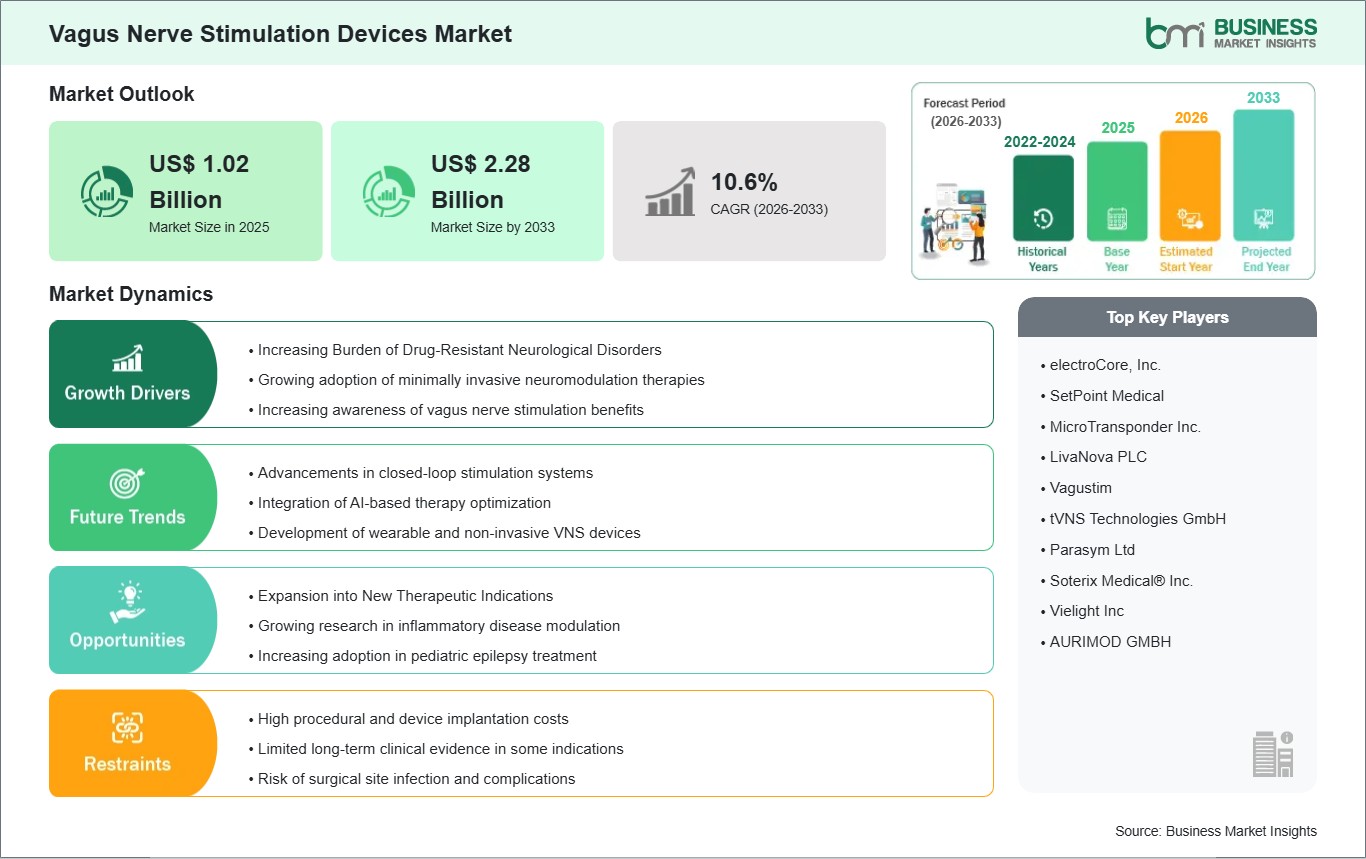
The vagus nerve stimulation devices market size is expected to reach US$ 2.28 billion by 2033 from US$ 1.02 billion in 2025. The market is estimated to record a CAGR of 10.6% from 2026 to 2033.
The vagus nerve stimulation devices market operates in the neuromodulation and bioelectronic medicine domain due to the growing acceptance of implantable and non-implantable stimulation devices for the treatment of neuro and psychological diseases. The growing incidence of cases involving treatment-resistant epilepsy, depression, migraine, and interest in stroke and inflammatory diseases drives the demand for these devices. Improvements in terms of miniature devices, closed-loop stimulators, and enhanced electrode design are aiding the adoption of clinical devices.
Increasing acceptance of neuromodulation as a complementary or alternative treatment modality for those cases where the effectiveness of pharmaceutical approaches is limited. Awareness of physicians and better reimbursement models are playing their part in increasing the market penetration rate. The development of noninvasive vagus nerve stimulation devices in research and development activities has expanded their applications into wellness. The cost factor related to procedures such as surgery and non-uniform results is acting as barriers to adoption. Noninvasive devices can have less appeal because of their lack of uniformity and inconsistent acceptance at the regulatory level.

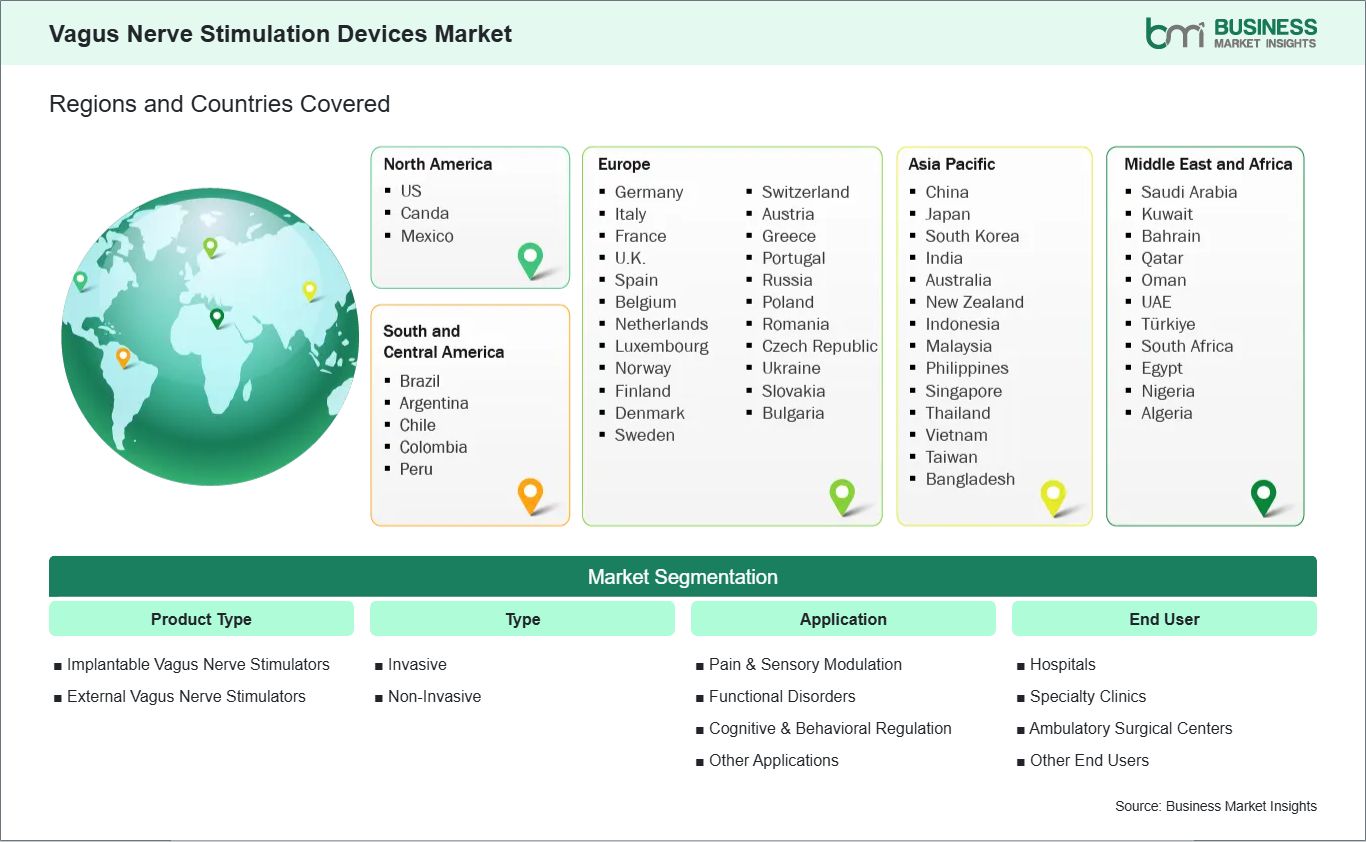
Key segments that contributed to the derivation of the vagus nerve stimulation devices market analysis are product type, type, application, and end user.
The increase in cases of neurological conditions that are resistant to drugs restrains the growth in the number of VNS systems. Neurological diseases, including epilepsy, are among the medical challenges that have defied effective pharmacological treatment, with many patients unable to attain control of their seizures despite being on several medications. This situation makes neuromodulation methods a potential solution for these patients.
In high-income healthcare systems across North America, Western Europe, and parts of East Asia, improved diagnostic capabilities have led to earlier and more frequent identification of treatment-resistant neurological cases. This has resulted in a growing patient pool eligible for device-based interventions. Aging populations are contributing to a higher incidence of neurological comorbidities, including seizure disorders and depression, which supports the clinical relevance of VNS therapies.
In developing and emerging healthcare systems, the burden is amplified by delayed diagnosis, limited access to advanced antiepileptic drugs, and inconsistent treatment adherence. As a result, patients are more likely to progress to chronic, drug-resistant stages of disease. This unmet clinical need is increasing awareness of VNS as an adjunct therapy option, particularly in specialized neurology hospitals and private healthcare networks.
Applications for vagus nerve stimulation, which include epilepsy and therapy-resistant depression, are investigated for their potential efficacy in other diseases, including chronic migraine and stroke recovery. Neurological and systemic disorders may be treated using vagus nerve stimulation due to advancements in knowledge regarding the interaction between the immune system and the brain and brain-to-body pathways.
In advanced healthcare regions, especially North America and parts of Europe, VNS is investigated as a supportive therapy for post-stroke motor recovery and cognitive rehabilitation. Rehabilitation specialists are integrating neuromodulation techniques into multidisciplinary treatment programs, aiming to enhance neuroplasticity and improve functional outcomes. This trend reflects a broader shift toward bioelectronic medicine approaches in clinical practice.
In Asia Pacific and Latin America, growing awareness of noninvasive and minimally invasive neuromodulation options is encouraging gradual adoption in broader therapeutic contexts. Physicians are considering VNS for patients with refractory migraine and complex psychiatric conditions where conventional therapies provide limited relief. This expanding clinical curiosity is expected to diversify the application landscape of VNS devices across global healthcare systems.

The vagus nerve stimulation devices market is experiencing steady growth, with market size and share analysis reflecting evolving treatment preferences and competitive dynamics among key players. The report evaluates important subsegments categorized within product type, type, application, and end user, highlighting their respective contributions to overall market performance.
By product type, the implantable vagus nerve stimulators subsegment dominated the market in 2025, driven by their established clinical efficacy and widespread adoption in the treatment of neurological and psychiatric disorders such as epilepsy and treatment-resistant depression. These devices provide continuous and targeted nerve stimulation, making them a preferred long-term therapeutic option for chronic conditions.
Based on type, the invasive subsegment dominated the market in 2025, owing to its higher clinical effectiveness and stronger therapeutic outcomes in managing severe and refractory conditions. Invasive vagus nerve stimulation systems are preferred in hospital-based settings due to their proven long-term benefits and consistent symptom control.
In terms of application, the functional disorders subsegment dominated the market in 2025, propelled by the increasing prevalence of conditions such as epilepsy and depression, along with growing clinical adoption of vagus nerve stimulation as an adjunct therapy for patients who are unresponsive to conventional treatments.
On the basis of end user, the hospitals subsegment dominated the market in 2025 due to the availability of advanced neurology infrastructure, specialized neurosurgical expertise, and comprehensive postoperative care required for implantation and management of vagus nerve stimulation devices.
| Report Attribute | Details |
|---|---|
| Market size in 2025 | US$ 1.02 Billion |
| Market Size by 2033 | US$ 2.28 Billion |
| Global CAGR (2026 - 2033) | 10.6% |
| Historical Data | 2022-2024 |
| Forecast period | 2026-2033 |
| Segments Covered | By Product Type
|
|
Regions and Countries Covered
| |
| North America | US, Canada, Mexico |
| Europe | Germany, Italy, France, U.K., Spain, Belgium, Netherlands, Luxembourg, Norway, Finland, Denmark, Sweden, Switzerland, Austria, Greece, Portugal, Russia, Poland, Romania, Czech Republic, Ukraine, Slovakia, Bulgaria |
| Asia-Pacific | China, Japan, South Korea, India, Australia, New Zealand, Indonesia, Malaysia, Philippines, Singapore, Thailand, Vietnam, Taiwan, Bangladesh |
| South and Central America | Brazil, Argentina, Chile, Colombia, Peru |
| Middle East and Africa | Saudi Arabia, United Arab Emirates, Kuwait, Bahrain, Qatar, Oman, Turkiye, South Africa, Egypt, Nigeria, Algeria |
| Market leaders and key company profiles |
|
The "Vagus Nerve Stimulation Devices Market Size and Forecast (2022-2033)" report provides a detailed analysis of the market covering below areas:
The geographical scope of the vagus nerve stimulation devices market report is divided into five regions: North America, Asia Pacific, Europe, Middle East & Africa, and South & Central America.
The global market of vagus nerve stimulation devices is undergoing changes as a specific niche of neuromodulation devices, addressing the needs of sufferers of chronic neurological diseases. The market structure is marked by a split between two product categories, namely, implantable and noninvasive devices, which address applications for clinical and consumer purposes. Implantable VNS devices represent a major contributor to total revenues as they demonstrate strong performance in treating epilepsy and intractable depression. Such devices are implanted through surgical procedures conducted in hospitals and are reliant on neurosurgery facilities. As for noninvasive VNS devices, they attract interest as devices that can be used on an outpatient basis.
There is growing use of digital health tools such as therapy monitoring apps and adaptive stimulation algorithms. All this is facilitating more personalized treatments, promoting higher patient compliance, and optimizing therapy. Research on autonomic regulation, inflammatory disorders management, neuroplasticity, and other has broadened the theory and practice behind VNS technologies. While technology continues to evolve rapidly, growth in the market is somewhat uneven because of regulatory and healthcare system differences. The advanced healthcare systems keep leading the adoption, and the emerging economies slowly incorporate neuromodulation in tertiary healthcare setups.

The vagus nerve stimulation devices market is evaluated by gathering qualitative and quantitative data post primary and secondary research, which includes important corporate publications, association data, and databases. A few of the key developments in the vagus nerve stimulation devices market are:
The Vagus Nerve Stimulation Devices Market is valued at US$ 1.02 Billion in 2025, it is projected to reach US$ 2.28 Billion by 2033.
As per our report Vagus Nerve Stimulation Devices Market, the market size is valued at US$ 1.02 Billion in 2025, projecting it to reach US$ 2.28 Billion by 2033. This translates to a CAGR of approximately 10.6% during the forecast period.
The Vagus Nerve Stimulation Devices Market report typically cover these key segments-
The historic period, base year, and forecast period can vary slightly depending on the specific market research report. However, for the Vagus Nerve Stimulation Devices Market report:
The Vagus Nerve Stimulation Devices Market is populated by several key players, each contributing to its growth and innovation. Some of the major players include:
The Vagus Nerve Stimulation Devices Market report is valuable for diverse stakeholders, including:
Essentially, anyone involved in or considering involvement in the Vagus Nerve Stimulation Devices Market value chain can benefit from the information contained in a comprehensive market report.
Please tell us your area of interest
(Market Segments/ Regions and Countries/ Companies)