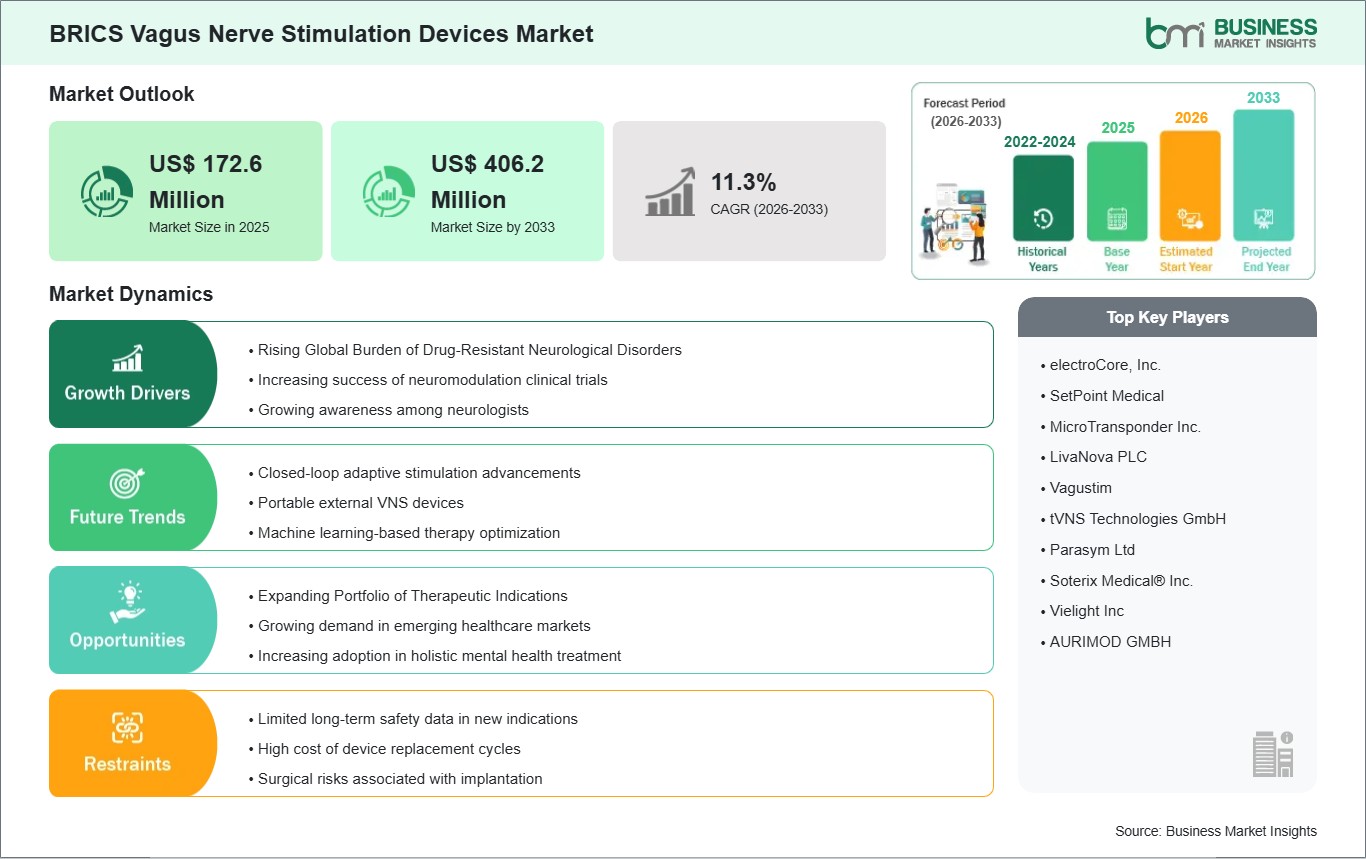
The BRICS vagus nerve stimulation devices market size is expected to reach US$ 406.2 million by 2033 from US$ 172.6 million in 2025. The market is estimated to record a CAGR of 11.3% from 2026 to 2033.
The VNS devices market in BRICS countries exhibits unbalanced yet rapidly increasing clinical integration based on the level of development of their health care systems, domestic capabilities in the manufacturing of equipment, and neurological disorders' awareness, but not equally advanced regulatory practices. VNS devices are increasingly becoming mainstream tools in epilepsy and psychiatry treatment protocols beyond tertiary-care settings. The key factors driving demand include growth in neurosurgery departments, an increased number of hospital admissions driven by health insurance programs, and greater readiness among medical professionals to investigate neuromodulation devices after drug treatments have failed.
An interesting factor in this geographic area is the existence of the dual-track innovation approach, whereby premium technology is imported, but there is development of a local manufacturing ecosystem, allowing a cost-based pricing model. This is pertinent more in relation to treatment modalities in public hospitals geared towards scalable options for many patients. Academic hospitals also tend to have a significant influence on adoption practices and tend to be early adopters. Nonetheless, limitations exist in the form of non-standardized treatment methods and a lack of standardized referral paths, leading to a delay in the identification of eligible patients. Additionally, regulatory inconsistencies from country-to-country lead to differences in terms of the availability of the products and the adoption rate. Despite these challenges, BRICS is becoming an attractive expansion target based on high adoption rates and modernization of health care rather than therapeutic substitution.

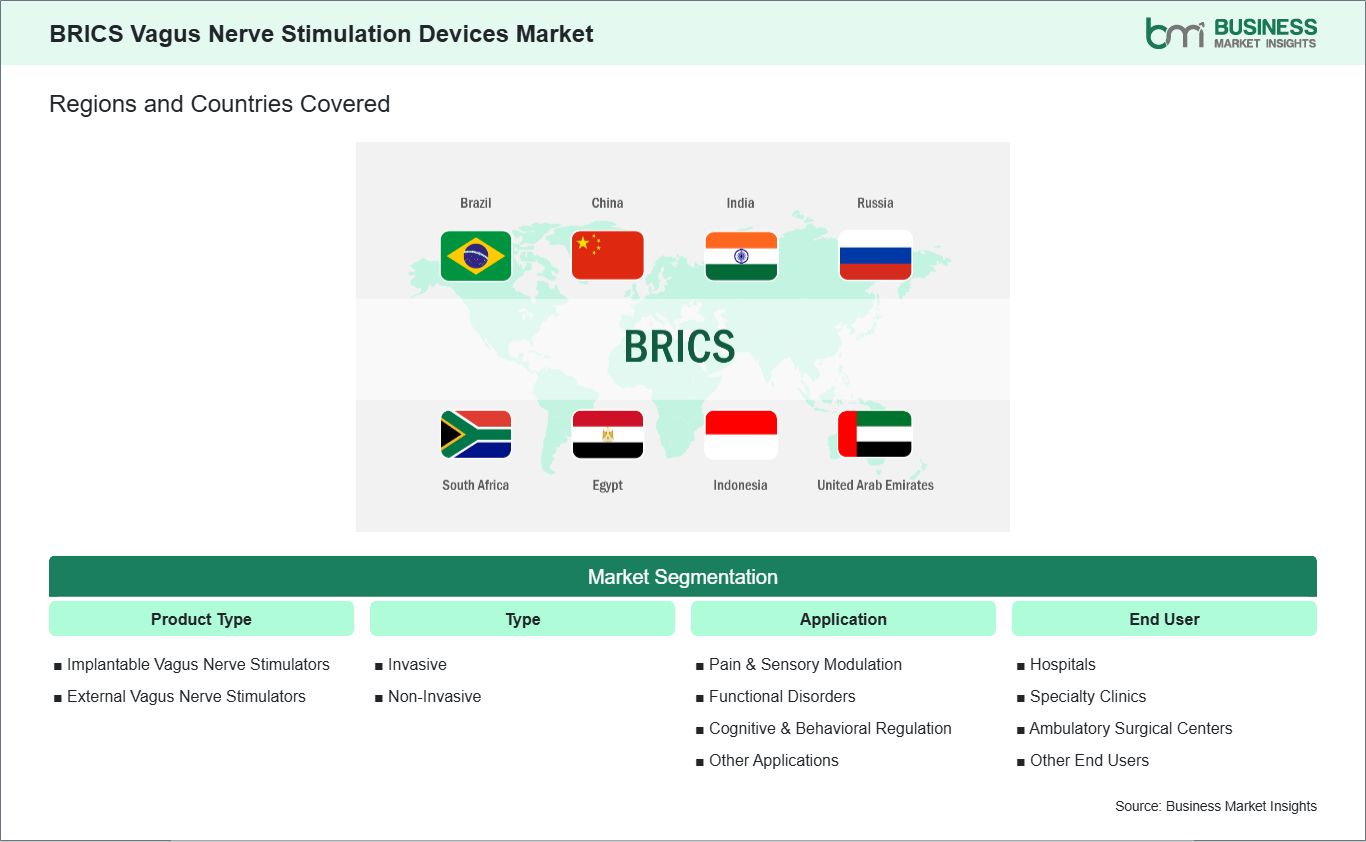
Key segments that contributed to the derivation of the BRICS vagus nerve stimulation devices market analysis are product type, type, application, and end user.
The vagus nerve stimulation (VNS) device market in the BRICS countries is significantly shaped by the increasing number of drug-resistant neurological diseases, especially those involving epilepsy and neuropsychiatric problems in Brazil, Russia, India, China and South Africa. In particular, owing to factors such as high population levels, poor rural health care provision and delayed neurological detection, a high percentage of individuals develop refractory stages of epilepsy, especially in the urban-based tertiary hospitals.
In Brazil and South Africa, disparities between public and private healthcare systems play a significant role in the management of chronic neurological diseases. Public hospitals often face constraints in long-term access to newer-generation anti-epileptic drugs, leading to higher rates of uncontrolled seizure disorders. In Russia, a growing burden of post-stroke neurological complications among aging populations is contributing to increased cases of secondary epilepsy and treatment-resistant neurological dysfunction, reinforcing the clinical need for alternative therapeutic modalities.
Across BRICS nations, traumatic brain injuries from road traffic accidents and occupational hazards also contribute significantly to long-term neurological complications. In China and India in particular, high incidence of head trauma cases results in a growing population of patients with chronic seizure disorders that are difficult to manage pharmacologically. This evolving neurological burden is gradually increasing clinical awareness of VNS as a supportive intervention in specialized neurology and neurosurgery centers.
In the BRICS region, vagus nerve stimulation is expanding beyond epilepsy management into a broader range of neurological, psychiatric, and systemic applications. In China and India, growing clinical interest in treatment-resistant depression is driving exploratory use of VNS in psychiatric care settings, particularly in urban mental health institutes where conventional antidepressant therapies show limited efficacy in severe cases.
As for stroke recovery experiments involving VNS technology, this field has recently appeared both in Brazil and in South Africa, where neurologists and rehabilitation specialists are experimenting with neuroplasticity and motor function restoration with the help of vagus nerve stimulation after stroke. As far as Russia goes, there has been quite a lot of academic activity in neuromodulatory rehabilitation in recent years.
Also, pain syndromes and migraines have emerged as some of the main therapeutic focal points for treatment in BRICS nations in metropolitan regions such as São Paulo, Moscow, Shanghai, and Mumbai. Due to rising cases of stress-induced disorders and urban life diseases, doctors are increasingly turning to neuromodulation therapy rather than the use of drugs. With time, there is an expectation that the use of VNS will expand even further into the realms of psychiatry and neurology.

The BRICS vagus nerve stimulation devices market demonstrates steady growth, with size and share analysis highlighting evolving trends and competitive dynamics among key players. The report evaluates important subsegments categorized within product type, type, application, and end user, highlighting their respective contributions to overall market performance.
By product type, the implantable vagus nerve stimulators subsegment dominated the market in 2025, driven by their established clinical efficacy and widespread adoption in the treatment of neurological and psychiatric disorders such as epilepsy and treatment-resistant depression. These devices provide continuous and targeted nerve stimulation, making them a preferred long-term therapeutic option for chronic conditions.
Based on type, the invasive subsegment dominated the market in 2025, owing to its higher clinical effectiveness and stronger therapeutic outcomes in managing severe and refractory conditions. Invasive vagus nerve stimulation systems are widely preferred in hospital-based settings due to their proven long-term benefits and consistent symptom control.
In terms of application, the functional disorders subsegment dominated the market in 2025, propelled by the increasing prevalence of conditions such as epilepsy and depression, along with growing clinical adoption of vagus nerve stimulation as an adjunct therapy for patients who are unresponsive to conventional treatments.
On the basis of end user, the hospitals subsegment dominated the market in 2025 due to the availability of advanced neurology infrastructure, specialized neurosurgical expertise, and comprehensive postoperative care required for implantation and management of vagus nerve stimulation devices.
| Report Attribute | Details |
|---|---|
| Market size in 2025 | US$ 172.6 Million |
| Market Size by 2033 | US$ 406.2 Million |
| CAGR (2026 - 2033) | 11.3% |
| Historical Data | 2022-2024 |
| Forecast period | 2026-2033 |
| Segments Covered | By Product Type
|
|
Regions and Countries Covered
| |
| BRICS | Russia, Brazil, South Africa, India, China, Egypt, Indonesia, Saudi Arabia, United Arab Emirates |
| Market leaders and key company profiles |
|
The "BRICS Vagus Nerve Stimulation Devices Market Size and Forecast (2022-2033)" report provides a detailed analysis of the market covering below areas:
The geographical scope of the BRICS vagus nerve stimulation devices market report is divided into: Russia, Brazil, South Africa, India, China, Egypt, Indonesia, Saudi Arabia, and the UAE. China held the largest share in 2025.
China dominates the market of BRICS VNS devices due to the country‘s highly concentrated environment of high-volume neurology hospitals and fast-developing production landscape of implantable devices. While all other BRICS countries experience import-oriented technology development, China shows hybrid tendencies, whereby domestic inventions become more common in conjunction with world technologies. As a result, faster purchasing processes are achieved in large chains of neurology hospitals.
The presence of vertically integrated systems of hospitals in which diagnosis, surgical insertion, and post-operative observation take place in one and the same neurology department is a distinguishing characteristic of China‘s market. As such, it helps in obtaining better continuity of procedures and in achieving more uniform results of VNS therapy. Besides, the presence of specialized teams of epilepsy surgeons in metropolitan hospitals has contributed to the early adoption of neuromodulation in the treatment algorithm of resistant cases. Another market characteristic refers to the fast expansion of the training programs for clinicians specializing in neurostimulation techniques, which have become more popular in recent years due to collaboration between hospitals in consortiums and universities. Gradually, it helps to reduce the dependence on the limited number of expert surgeons and increase the scope of procedures performed by expanding into other provinces. Nonetheless, adoption rates remain lower in the regions not part of large clusters of urban hospitals, as these regions continue to develop awareness and procedural competence.

The BRICS Vagus Nerve Stimulation Devices market is evaluated by gathering qualitative and quantitative data post primary and secondary research, which includes important corporate publications, association data, and databases. A few of the key developments in the BRICS Vagus Nerve Stimulation Devices market are:
The BRICS Vagus Nerve Stimulation Devices Market is valued at US$ 172.6 Million in 2025, it is projected to reach US$ 406.2 Million by 2033.
As per our report BRICS Vagus Nerve Stimulation Devices Market, the market size is valued at US$ 172.6 Million in 2025, projecting it to reach US$ 406.2 Million by 2033. This translates to a CAGR of approximately 11.3% during the forecast period.
The BRICS Vagus Nerve Stimulation Devices Market report typically cover these key segments-
The historic period, base year, and forecast period can vary slightly depending on the specific market research report. However, for the BRICS Vagus Nerve Stimulation Devices Market report:
The BRICS Vagus Nerve Stimulation Devices Market is populated by several key players, each contributing to its growth and innovation. Some of the major players include:
The BRICS Vagus Nerve Stimulation Devices Market report is valuable for diverse stakeholders, including:
Essentially, anyone involved in or considering involvement in the BRICS Vagus Nerve Stimulation Devices Market value chain can benefit from the information contained in a comprehensive market report.
Please tell us your area of interest
(Market Segments/ Regions and Countries/ Companies)