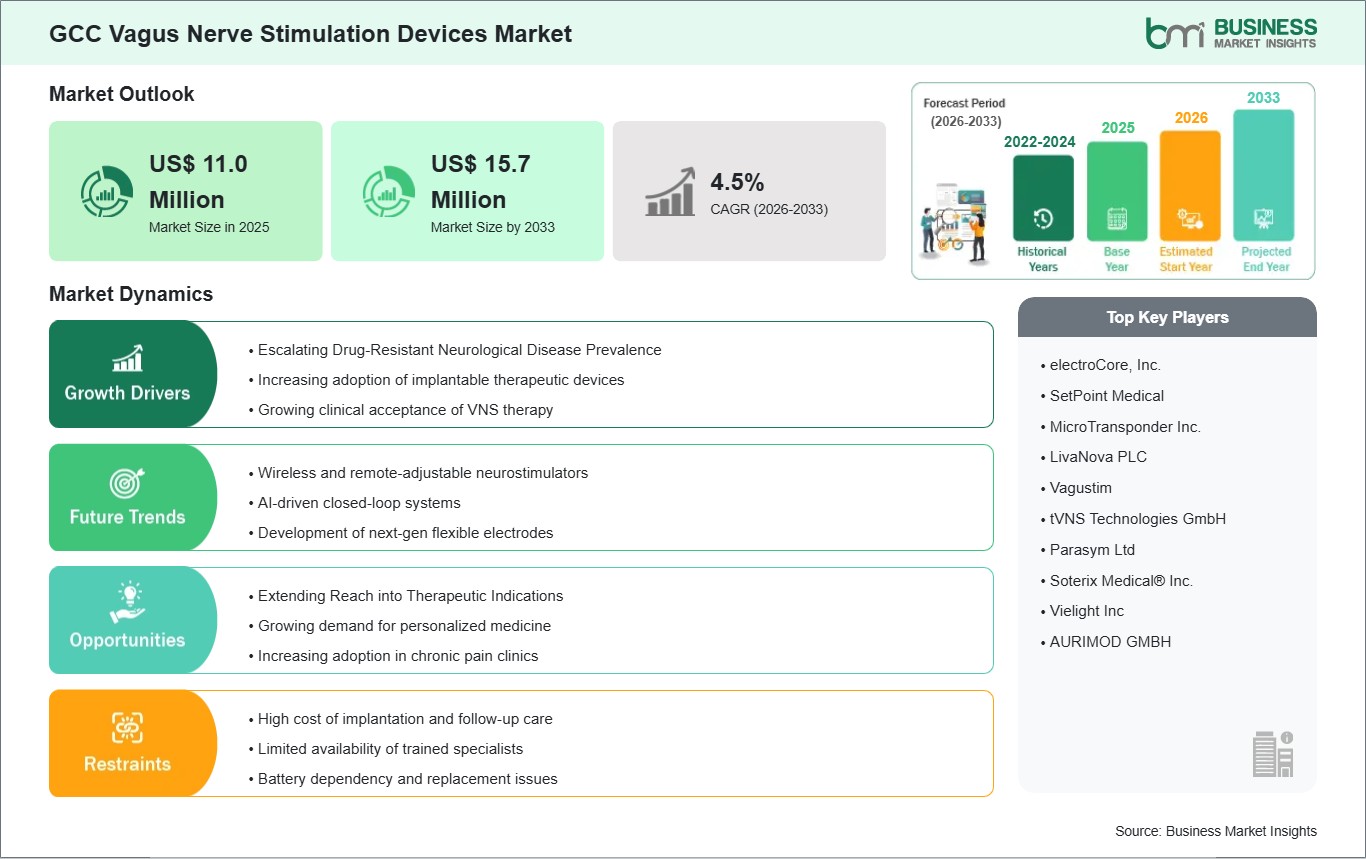
The GCC vagus nerve stimulation devices market size is expected to reach US$ 15.7 million by 2033 from US$ 11.0 million in 2025. The market is estimated to record a CAGR of 4.5% from 2026 to 2033.
The market for GCC Vagus Nerve Stimulation (VNS) Devices has been experiencing steady growth owing to the increasing attention in the region towards neurological care, the increasing diagnosis of drug-resistant epilepsy, and increased awareness about non-drug treatment for neurological and psychiatric diseases. There has been a lot of improvement in the health care systems of GCC countries through the introduction of national transformation plans, specialist hospital expansions, and development in neuro-rehabilitation services, which creates a conducive environment for the use of neurostimulation implants. Growth will be high among tertiary hospitals and neurological institutes that are experimenting with minimally invasive treatments of epileptic patients.
The market is also gaining advantage from the development of the medical technology import environment in the GCC, particularly in those countries that spend more money on healthcare and participate actively in the private healthcare sector. Collaborations between hospitals of the region and global suppliers of medical devices are promoting the training of doctors and boosting the adoption of new procedures. In addition to that, the rising incidence of neurological conditions linked to lifestyle and an increase in the proportion of elderly people in certain areas of the region will ensure a favorable outlook for the market in the years to come. Nevertheless, the market remains challenged by the expensive nature of implantation procedures as well as the lack of professionals specializing in neuromodulation in certain small countries of the GCC region.

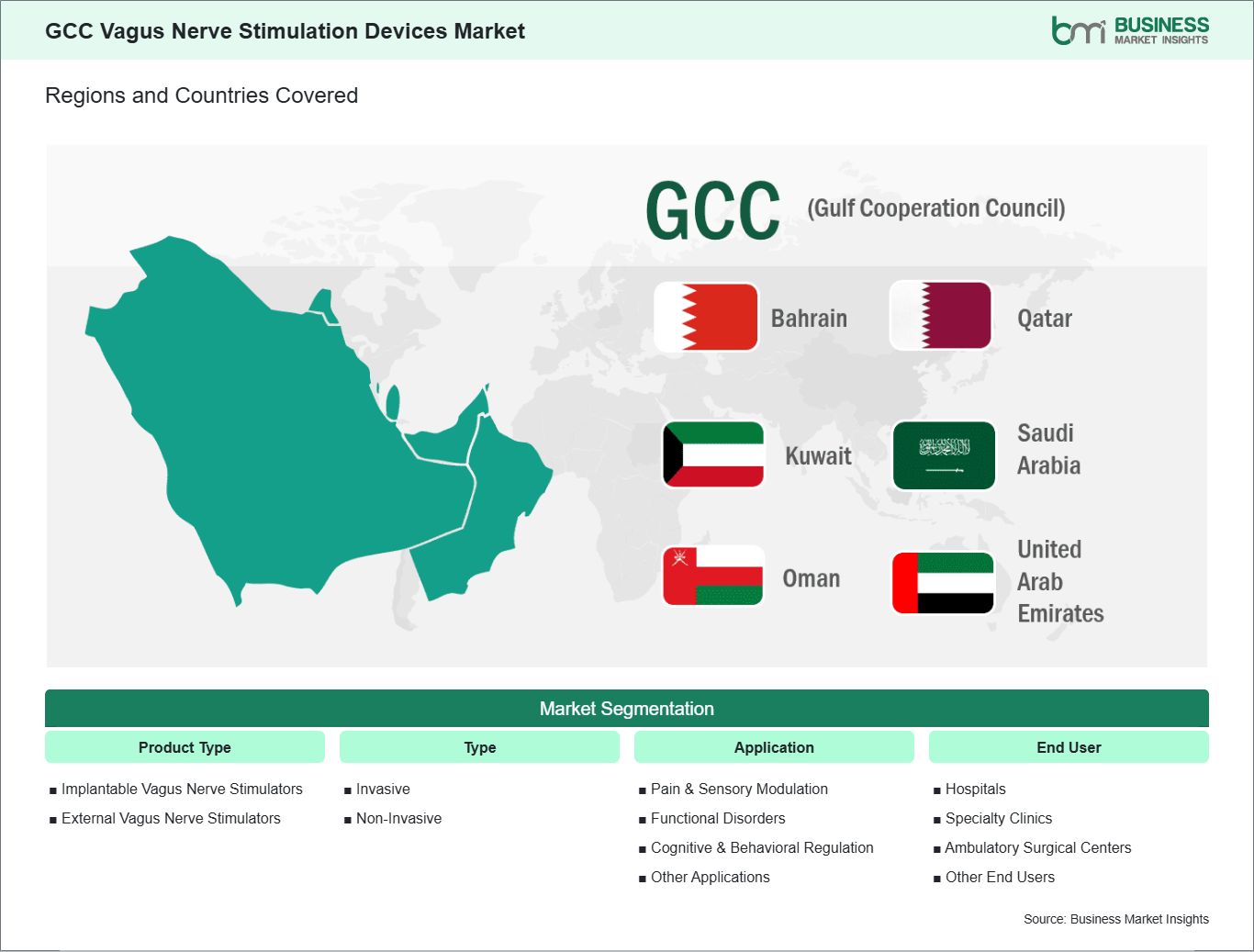
Key segments that contributed to the derivation of the GCC Vagus Nerve Stimulation Devices market analysis are product type, type, application, and end user.
With the high rates of drug-resistant neurological diseases in GCC member states, the vagus nerve stimulator is becoming increasingly demanded. For example, Epilepsy happens to be one of the most prevalent neurological diseases in the region, specifically Saudi Arabia and the United Arab Emirates, where there have been improvements in diagnostic measures to detect and distinguish refractory epilepsy. As a result, an increasing number of patients fail to respond to medication, and this encourages doctors to recommend neuromodulation procedures as a means of treatment.
The other factor that contributes to growth in this market is the establishment of advanced medical care infrastructure in relation to neurological diseases in the region. Some of the countries where this trend is being observed include Saudi Arabia, Qatar, and the UAE. Through such infrastructure, countries such as Saudi Arabia and the UAE have developed specialized centers and departments that deal with various chronic diseases and surgery related to them. In the process, vagus nerve stimulation procedure is gaining more popularity among patients unfit for surgery.
In addition to epilepsy, the growing burden of neurological and neuropsychiatric disorders linked to aging populations, lifestyle-related diseases, and stress-associated conditions is contributing to market expansion. Chronic migraine, depression, and neuropathic disorders are becoming increasingly prominent across urban populations in the Gulf region. As healthcare providers seek minimally invasive and long-term treatment alternatives that can reduce medication dependence and improve quality of life, vagus nerve stimulation devices are gaining attention as a complementary therapeutic option.
The GCC vagus nerve stimulation devices market is gradually expanding beyond epilepsy management into a wider range of therapeutic applications. Healthcare providers across the region are increasingly exploring the use of vagus nerve stimulation therapies for treatment-resistant depression, chronic pain disorders, and migraine management. Rising awareness regarding mental health conditions, particularly in the UAE and Saudi Arabia, is encouraging healthcare institutions to adopt innovative neuromodulation technologies capable of addressing complex neurological and psychiatric disorders.
Moreover, increased popularity and acceptance of patient-friendly methods of treatment, such as external vagus nerve stimulation, are promoting the use of vagus nerve stimulators in the GCC countries. The vagus nerve stimulators meet regional needs in terms of outpatient treatment, digital healthcare solutions, and personalized healthcare services. Hospitals and specialty clinics are increasingly looking into non-invasive neurostimulation solutions that provide alternative solutions in place of pharmaceutical treatments and invasive neurosurgery procedures.
Advances made in terms of neurosciences research and collaboration between healthcare providers will continue to make vagus nerve stimulation a relevant form of therapy in the Gulf countries. More academic hospitals and neurological specialty facilities in the region are increasingly getting involved in exploring emerging neuromodulation applications in rehabilitation and chronic disease management. It will make international suppliers and distributors of vagus nerve stimulators expand their presence within the region by training doctors and collaborating with local neurological specialists.

The GCC vagus nerve stimulation devices market demonstrates steady growth, with size and share analysis highlighting evolving trends and competitive dynamics among key players. The report evaluates important subsegments categorized within product type, type, application, and end user, highlighting their respective contributions to overall market performance.
By product type, the implantable vagus nerve stimulators subsegment dominated the market in 2025, driven by their established clinical efficacy and widespread adoption in the treatment of neurological and psychiatric disorders such as epilepsy and treatment-resistant depression. These devices provide continuous and targeted nerve stimulation, making them a preferred long-term therapeutic option for chronic conditions.
Based on type, the invasive subsegment dominated the market in 2025, owing to its higher clinical effectiveness and stronger therapeutic outcomes in managing severe and refractory conditions. Invasive vagus nerve stimulation systems are widely preferred in hospital-based settings due to their proven long-term benefits and consistent symptom control.
In terms of application, the functional disorders subsegment dominated the market in 2025, propelled by the increasing prevalence of conditions such as epilepsy and depression, along with growing clinical adoption of vagus nerve stimulation as an adjunct therapy for patients who are unresponsive to conventional treatments.
On the basis of end user, the hospitals subsegment dominated the market in 2025 due to the availability of advanced neurology infrastructure, specialized neurosurgical expertise, and comprehensive postoperative care required for implantation and management of vagus nerve stimulation devices.
| Report Attribute | Details |
|---|---|
| Market size in 2025 | US$ 11.0 Million |
| Market Size by 2033 | US$ 15.7 Million |
| CAGR (2026 - 2033) | 4.5% |
| Historical Data | 2022-2024 |
| Forecast period | 2026-2033 |
| Segments Covered | By Product Type
|
|
Regions and Countries Covered
| |
| GCC | UAE, Bahrain, Saudi Arabia, Oman, Qatar, Kuwait |
| Market leaders and key company profiles |
|
The "GCC Vagus Nerve Stimulation Devices Market Size and Forecast (2022-2033)" report provides a detailed analysis of the market covering below areas:
The geographical scope of the GCC Vagus Nerve Stimulation Devices market report is divided into: Saudi Arabia, the United Arab Emirates (UAE), Qatar, Kuwait, Bahrain, and Oman. Saudi Arabia held the largest share in 2025.
The Saudi Arabia country leads in the market share of vagus nerve stimulators across the GCC region owing to its highly developed healthcare infrastructure, heavy healthcare spending from its government, and growing interest in neurological diseases under healthcare reform programs at the national level. This country is recognized as a leading center of neurology and neurosurgery in the region, due to its availability of top tertiary care hospitals, specialized centers of neuroscience, and a growing number of private healthcare providers. Neurostimulators are widely used in various hospitals located in cities like Riyadh, Jeddah, and Dammam.
The increasing prevalence rate of nervous disorders, along with enhanced awareness by physicians about minimal neuromodulation procedures, is favoring the adoption of VNS systems in Saudi Arabia. Furthermore, the kingdom is seeing an increased presence of sophisticated technology as a result of collaboration between leading foreign medical device producers and distributors. Moreover, the digitization of healthcare, along with advances in diagnostics, has facilitated early detection of eligible cases for VNS treatment. Another factor that favors Saudi Arabia is its relatively higher number of neurosurgeons and epileptologists in comparison with its neighboring GCC nations. Medical tourism, along with increased investments in specialized rehabilitation and neurology centers are also helping boost the penetration rate. Nonetheless, limited reimbursements for some advanced neuromodulation treatments and reliance on imported technologies are affecting availability.

The GCC Vagus Nerve Stimulation Devices market is evaluated by gathering qualitative and quantitative data post primary and secondary research, which includes important corporate publications, association data, and databases. A few of the key developments in the GCC Vagus Nerve Stimulation Devices market are:
The GCC Vagus Nerve Stimulation Devices Market is valued at US$ 11.0 Million in 2025, it is projected to reach US$ 15.7 Million by 2033.
As per our report GCC Vagus Nerve Stimulation Devices Market, the market size is valued at US$ 11.0 Million in 2025, projecting it to reach US$ 15.7 Million by 2033. This translates to a CAGR of approximately 4.5% during the forecast period.
The GCC Vagus Nerve Stimulation Devices Market report typically cover these key segments-
The historic period, base year, and forecast period can vary slightly depending on the specific market research report. However, for the GCC Vagus Nerve Stimulation Devices Market report:
The GCC Vagus Nerve Stimulation Devices Market is populated by several key players, each contributing to its growth and innovation. Some of the major players include:
The GCC Vagus Nerve Stimulation Devices Market report is valuable for diverse stakeholders, including:
Essentially, anyone involved in or considering involvement in the GCC Vagus Nerve Stimulation Devices Market value chain can benefit from the information contained in a comprehensive market report.
Please tell us your area of interest
(Market Segments/ Regions and Countries/ Companies)