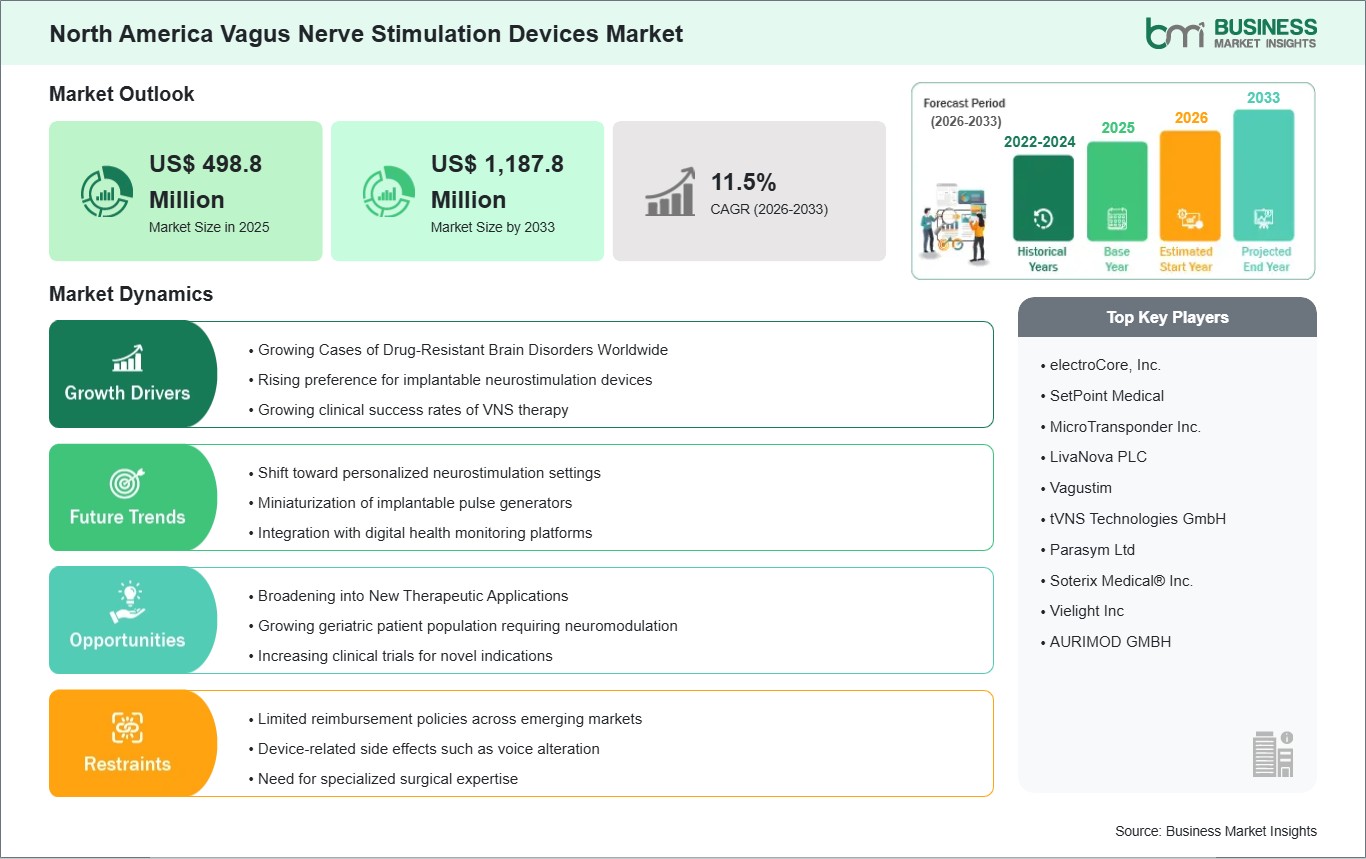
The North America vagus nerve stimulation devices market size is expected to reach US$ 1,187.8 million by 2033 from US$ 498.8 million in 2025. The market is estimated to record a CAGR of 11.5% from 2026 to 2033.
The North America market for vagus nerve stimulation (VNS) devices is influenced by the growing trend of precision-oriented neuromodulation and the rising recognition of the role of bioelectronic medicine in clinical settings for neurological and psychiatric disorders. In contrast to earlier stages of adoption that were concerned primarily with refractory epilepsy, VNS devices are now being used for neuropsychiatric disorders as a multimodal treatment option, especially when dealing with challenging, resistant diseases. This reflects a proactive approach adopted by hospitals using VNS, where conventional drug therapies have proved ineffective.
Among the factors fueling market growth include high correlation between innovative research and implementation in the health care system in terms of specialty networks of neurologists and integrated hospitals which fast track research discoveries into clinical practice. The other major factor is the increased emphasis on decreasing drug dependence in the case of chronic neurological conditions which prompts medical professionals to adopt alternative therapeutic approaches such as device usage. Another area of improvement that favors the adoption of devices for neuromodulation therapy is the increased number of outpatient follow-up programs after device implantation, ensuring continuous use. On the other hand, adoption is hampered by a lack of procedure experience in small surgical units and a lack of insurance cover for new indications beyond epilepsy and depression. Adoption decisions in early-stage use of devices for psychiatric problems still suffer from a lack of data regarding the comparative performance of these products against drugs.

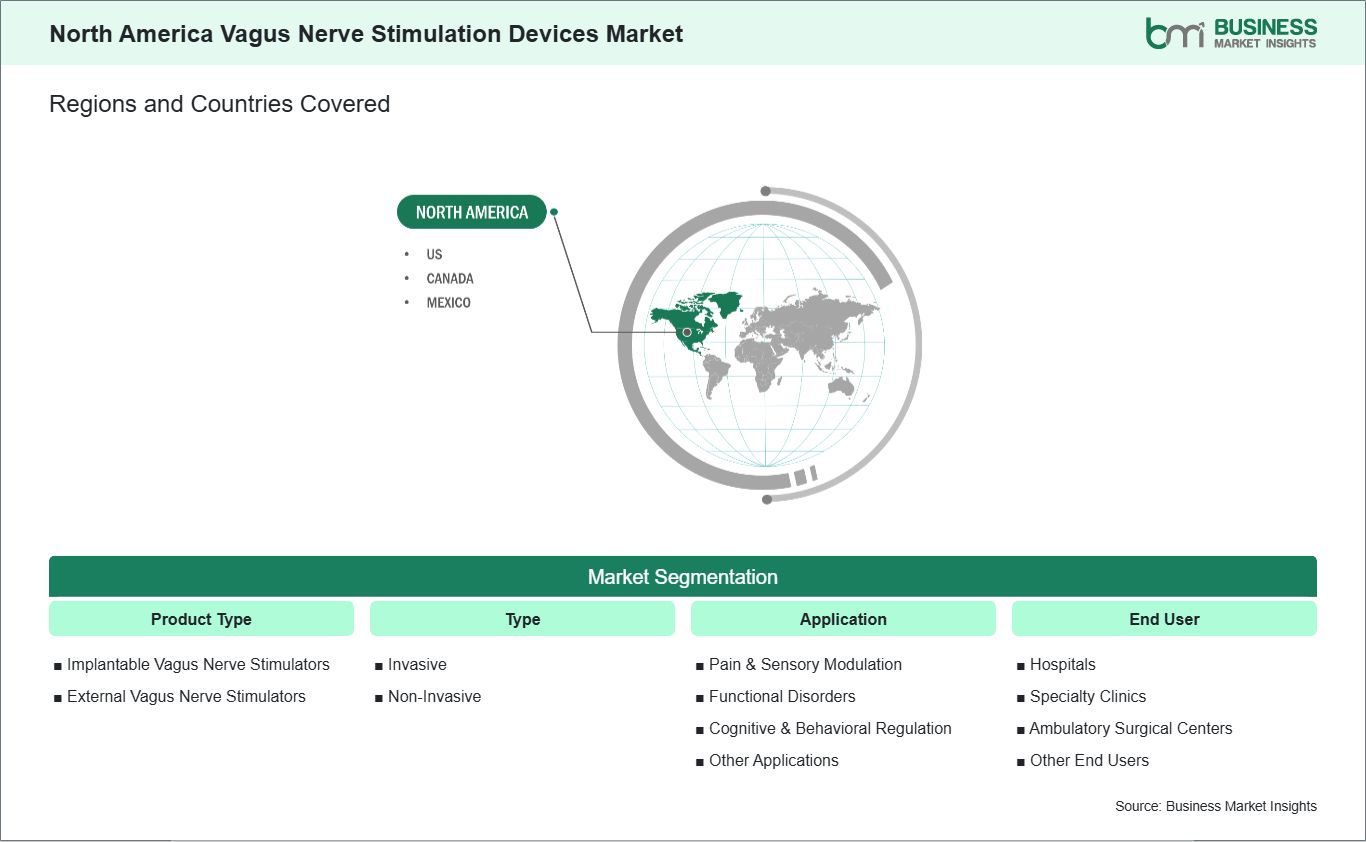
Key segments that contributed to the derivation of the North America Vagus Nerve Stimulation Devices market analysis are product type, type, application, and end user.
North America continues to face a rising clinical burden of drug-resistant neurological disorders, particularly refractory epilepsy, which remains a key driver for vagus nerve stimulation device adoption. In the United States, epilepsy affects millions of individuals, and a significant subset continues to experience seizures despite optimized anti-epileptic drug regimens. This persistent treatment gap has strengthened the role of neuromodulation therapies, including VNS, as an established option within advanced epilepsy management pathways.
The advanced healthcare infrastructure of the region facilitates an early diagnosis followed by stepwise treatment through medical devices. Amongst other things, the key role in identifying the candidates for the VNS therapy in North America belongs to the leading epilepsy centers operating in the United States and Canada (including the programs offered by top academic hospitals in North America). This task becomes possible due to clear clinical guidelines and referral systems that help promptly assess the eligibility for surgery and neuromodulation.
However, the rising incidence rate of neurological conditions in North America is not limited only to epilepsy. Chronic migraines, neurological problems associated with Parkinson‘s disease, and neurological dysfunction occurring as a consequence of stroke, are among the examples. Apart from the above reasons, growing pressure, age factors, and certain lifestyles are becoming the causes of neurobehavioral problems.
The North American vagus nerve stimulation devices market is rapidly expanding beyond epilepsy into a wide range of therapeutic applications. VNS therapy is increasingly being used for treatment-resistant depression, chronic migraine, and anxiety-related disorders, particularly in the United States, where mental health awareness and diagnosis rates are high. Clinical adoption is supported by established reimbursement pathways and growing physician familiarity with neuromodulation-based psychiatric care.
Moreover, non-invasive vagus nerve stimulation products have increasingly gained prominence within the region due to their applicability to an outpatient setting. The United States and Canada have seen the rising incorporation of neurostimulation wearable technology into telehealth and remote monitoring systems that ensure uninterrupted care delivery without requiring constant patient admission into hospitals. This follows the general trend of moving toward home-based treatments and personalized neurology care.
Further, increased research and development efforts within academic institutions and medical device firms are facilitating the rapid adoption of vagus nerve stimulation products. Clinical studies in North America have investigated the possibility of using VNS in treating inflammatory conditions, stroke recovery, and cognitive disorders. With leading centers of neuroscience research and considerable investments in neuromodulation innovation in place, VNS devices continue expanding their clinical applicability.

The North America Vagus Nerve Stimulation Devices market demonstrates steady growth, with size and share analysis highlighting evolving trends and competitive dynamics among key players. The report evaluates important subsegments categorized within product type, type, application, and end user, highlighting their respective contributions to overall market performance.
By product type, the implantable vagus nerve stimulators subsegment dominated the market in 2025, driven by their established clinical efficacy and widespread adoption in the treatment of neurological and psychiatric disorders such as epilepsy and treatment-resistant depression. These devices provide continuous and targeted nerve stimulation, making them a preferred long-term therapeutic option for chronic conditions.
Based on type, the invasive subsegment dominated the market in 2025, owing to its higher clinical effectiveness and stronger therapeutic outcomes in managing severe and refractory conditions. Invasive vagus nerve stimulation systems are widely preferred in hospital-based settings due to their proven long-term benefits and consistent symptom control.
In terms of application, the functional disorders subsegment dominated the market in 2025, propelled by the increasing prevalence of conditions such as epilepsy and depression, along with growing clinical adoption of vagus nerve stimulation as an adjunct therapy for patients who are unresponsive to conventional treatments.
On the basis of end user, the hospitals subsegment dominated the market in 2025 due to the availability of advanced neurology infrastructure, specialized neurosurgical expertise, and comprehensive postoperative care required for implantation and management of vagus nerve stimulation devices.
| Report Attribute | Details |
|---|---|
| Market size in 2025 | US$ 498.8 Million |
| Market Size by 2033 | US$ 1,187.8 Million |
| CAGR (2026 - 2033) | 11.5% |
| Historical Data | 2022-2024 |
| Forecast period | 2026-2033 |
| Segments Covered | By Product Type
|
|
Regions and Countries Covered
| |
| North America | US, Canada, Mexico |
| Market leaders and key company profiles |
|
The "North America Vagus Nerve Stimulation Devices Market Size and Forecast (2022-2033)" report provides a detailed analysis of the market covering below areas:
The geographical scope of the North America Vagus Nerve Stimulation Devices market report is divided into: The US, Canada, and Mexico. The US held the largest share in 2025.
The United States is leading the regional neuromodulation market owing to its highly fragmented but innovation-friendly ecosystem. Its competitive advantage is the presence of specialist epilepsy clinics, neurology departments in colleges, and integrated healthcare organizations that proactively contribute towards expanding applications for VNS treatment. Doctors in the US are more inclined to use stratified approaches to treatment, where VNS treatment is used on those patients who have not responded to other forms of treatment.
An interesting characteristic of the US market is the involvement of multi-disciplinary teams composed of neurologists, psychiatrists, and neurosurgeons, who make decisions collectively regarding a patient‘s candidacy for a VNS device. Moreover, there is an emerging trend of utilizing electronic monitoring devices in addition to implantable devices in order to maximize the therapeutic benefits of a procedure. Despite all this, there is great variability in VNS therapy adoption rates by different insurance and health delivery organizations. Although the level of skill and infrastructure for carrying out procedures is very high in the US, the availability of the treatment remains localized in certain parts of the country rather than spread throughout. Still, the US remains the leader when it comes to expanding the use of VNS therapies in North America.

The North America Vagus Nerve Stimulation Devices market is evaluated by gathering qualitative and quantitative data post primary and secondary research, which includes important corporate publications, association data, and databases. A few of the key developments in the North America Vagus Nerve Stimulation Devices market are:
The North America Vagus Nerve Stimulation Devices Market is valued at US$ 498.8 Million in 2025, it is projected to reach US$ 1,187.8 Million by 2033.
As per our report North America Vagus Nerve Stimulation Devices Market, the market size is valued at US$ 498.8 Million in 2025, projecting it to reach US$ 1,187.8 Million by 2033. This translates to a CAGR of approximately 11.5% during the forecast period.
The North America Vagus Nerve Stimulation Devices Market report typically cover these key segments-
The historic period, base year, and forecast period can vary slightly depending on the specific market research report. However, for the North America Vagus Nerve Stimulation Devices Market report:
The North America Vagus Nerve Stimulation Devices Market is populated by several key players, each contributing to its growth and innovation. Some of the major players include:
The North America Vagus Nerve Stimulation Devices Market report is valuable for diverse stakeholders, including:
Essentially, anyone involved in or considering involvement in the North America Vagus Nerve Stimulation Devices Market value chain can benefit from the information contained in a comprehensive market report.
Please tell us your area of interest
(Market Segments/ Regions and Countries/ Companies)