Latin America Vagus Nerve Stimulation Devices Market Outlook: Size, Share, Trends, Growth Analysis, Competitive Landscape & Forecast, 2026-2033

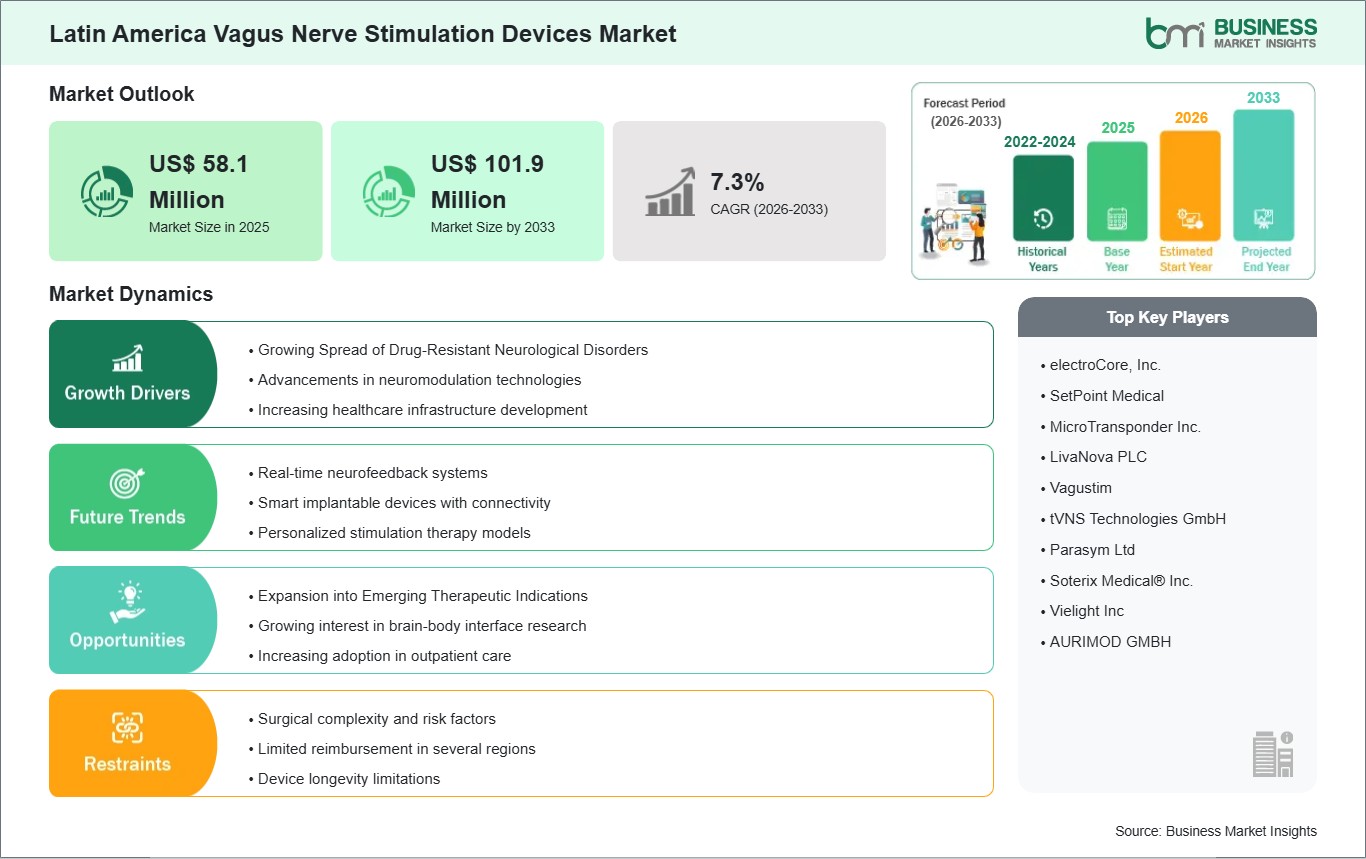
The Latin America vagus nerve stimulation devices market size is expected to reach US$ 101.9 million by 2033 from US$ 58.1 million in 2025. The market is estimated to record a CAGR of 7.3% from 2026 to 2033.

Report Coverage
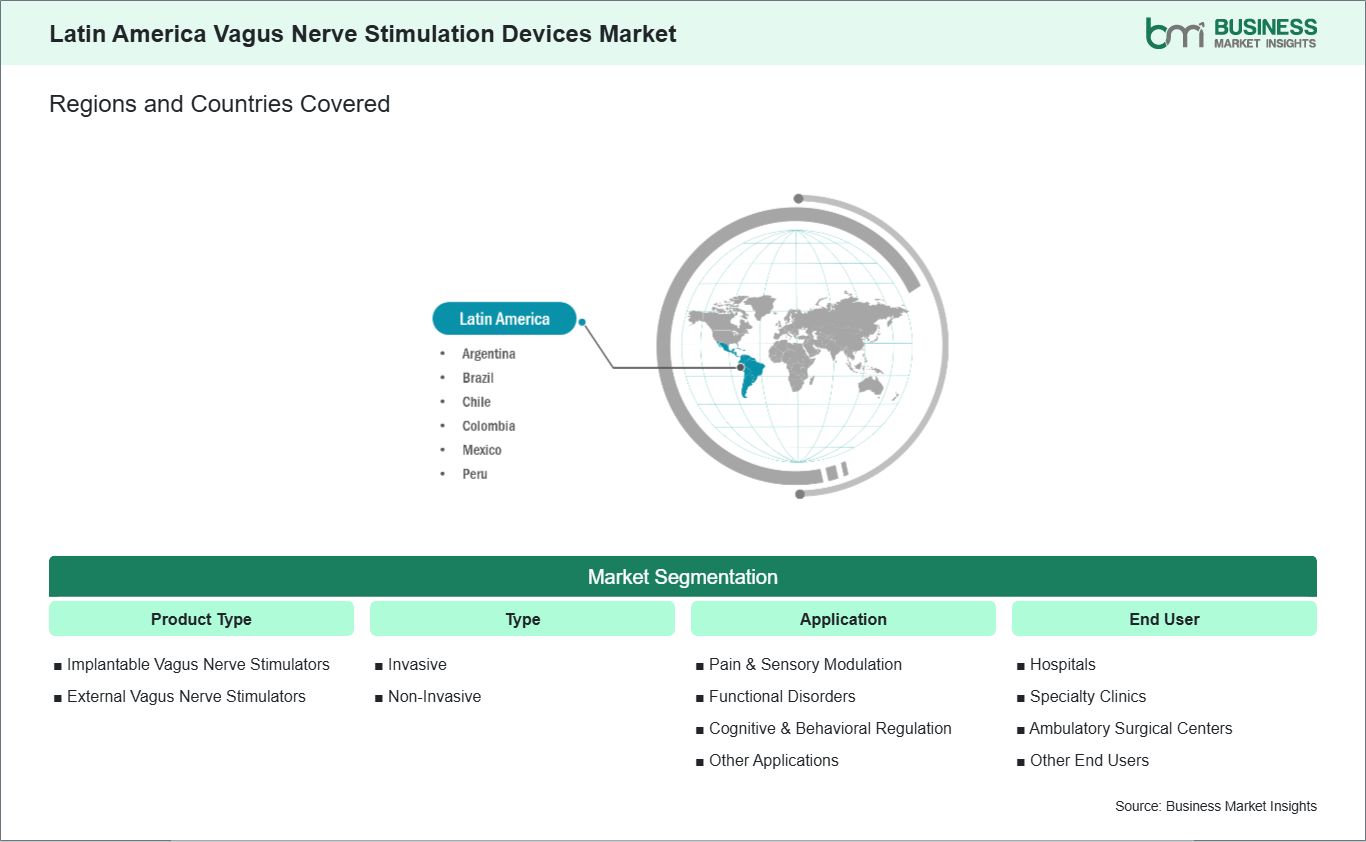
  • Product Type: Implantable Vagus Nerve Stimulators, External Vagus Nerve Stimulators
  • Type: Invasive, Non-Invasive
  • Application: Pain & Sensory Modulation, Functional Disorders, Cognitive & Behavioral Regulation, Other Applications
  • End User: Hospitals, Specialty Clinics, Ambulatory Surgical Centers, Other End Users
US$ 58.1 Mn Market size in 2025
US$ 101.9 Mn Market Size by 2033
7.3% CAGR, 2026 - 2033
2026-2033 Forecast Period

Market Summary

Executive Summary and Market Analysis

The vagus nerve stimulation devices market in Latin America can be described as being developed via a combination of elements such as neurological disease prevalence, urban healthcare advancements, and the rising need for alternative treatments amongst people who do not respond well to existing medications. Unlike other emerging healthcare markets, Latin America demonstrates pronounced concentration of vagus nerve stimulator utilization at epilepsy clinics and centers for neurology studies in major urban zones. Development of this market can be attributed to the rising prevalence of refractory epilepsy amongst young patients, along with increased use of neuromodulation treatments for psychiatric and trauma-related diseases.

The private hospital groups in Latin America have been making huge contributions towards the adoption of the latest neurostimulation technology through implantable devices within selected countries, owing to increasing medical tourism and border-crossing treatments within Latin America. Furthermore, there is also a rapid increase in the proficiency of neurosurgeons and exposure to North American treatment norms, which will contribute to procedural expertise in conducting the VNS implantations. The demand for VNS procedures will further be bolstered by patients' increased inclination towards the use of procedures for treating symptoms rather than relying on different antiepileptic drugs. The adoption process faces some headwinds due to fragmented healthcare infrastructure and varying reimbursement environments across selected countries in Latin America. The dependence on foreign companies for expensive devices will also increase competitive pressure. The inadequate availability of neurologists in secondary towns will constrain the procedure adoption rate.

Strategic Insights

Latin America Vagus Nerve Stimulation Devices Market: Strategic Insights

Latin America Vagus Nerve Stimulation Devices Market Strategic Framework
FREE PDF
Request your free sample
Request free sample
Segment Analysis

Latin America Vagus Nerve Stimulation Devices Market Segmentation

Key segments that contributed to the derivation of the Latin America Vagus Nerve Stimulation Devices market analysis are product type, type, application, and end user.

  • By product type, the vagus nerve stimulation devices market is segmented into implantable vagus nerve stimulators and external vagus nerve stimulators. The implantable vagus nerve stimulators segment dominated the market in 2025.
  • Based on type, the vagus nerve stimulation devices market is classified into invasive and non-invasive devices. The invasive segment dominated the market in 2025.
  • In terms of application, the vagus nerve stimulation devices market is categorized into pain & sensory modulation, functional disorders, cognitive & behavioral regulation, and other applications. The functional disorders segment dominated the market in 2025.
  • On the basis of end user, the vagus nerve stimulation devices market is segmented into hospitals, specialty clinics, ambulatory surgical centers, and other end users. The hospitals segment dominated the market in 2025.
Market Forces

Latin America Vagus Nerve Stimulation Devices Market Drivers and Opportunities

Growing Spread of Drug-Resistant Neurological Disorders

The rising incidence of drug-resistant neurological disorders across Latin America is contributing to increased demand for vagus nerve stimulation devices. Countries such as Brazil, Mexico, and Argentina are witnessing growing numbers of patients diagnosed with refractory epilepsy, particularly in urban populations where neurological diagnostic services are more accessible. Despite improvements in pharmaceutical treatment availability, a considerable portion of epilepsy patients continue to experience uncontrolled seizures, creating greater interest in neuromodulation therapies as an alternative long-term treatment approach.

Healthcare systems across the region are also strengthening specialized neurological care capabilities through the expansion of tertiary hospitals and epilepsy treatment centers. Brazil, in particular, has seen growing adoption of advanced neurostimulation procedures in major metropolitan healthcare institutions, while Mexico and Chile are increasing investments in neurological disease management programs. These developments are improving physician awareness regarding implantable stimulation therapies and encouraging broader integration of vagus nerve stimulation devices into comprehensive neurological treatment pathways.

In addition to epilepsy, Latin America is experiencing a rising burden of neurological and neuropsychiatric disorders associated with aging populations, traumatic injuries, chronic stress, and metabolic diseases. Depression, chronic migraine, and neuropathic pain disorders are becoming increasingly prevalent across several countries in the region, particularly in densely populated urban centers. As healthcare providers seek non-pharmacological therapies capable of reducing long-term medication dependence and improving patient quality of life, vagus nerve stimulation devices are gaining stronger clinical relevance throughout Latin American healthcare systems.

Expansion into Emerging Therapeutic Indications

The Latin America vagus nerve stimulation devices market is increasingly expanding beyond epilepsy treatment into a broader range of therapeutic applications. Healthcare providers across Brazil, Colombia, and Mexico are exploring the potential of vagus nerve stimulation therapies for treatment-resistant depression, anxiety disorders, chronic pain conditions, and migraine management. Growing public awareness surrounding mental health and neurological wellness is encouraging hospitals and specialty clinics to adopt advanced neuromodulation technologies capable of addressing complex chronic conditions.

An increased interest in neuromodulation technologies that allow vagus nerve stimulation without resorting to surgical interventions can be witnessed as well. Indeed, external vagus nerve stimulators are gaining popularity among healthcare specialists due to their cost-effective and non-invasive nature. The importance of this development should be viewed within the context of Latin American countries, in which healthcare organizations try to increase the availability of modern neurological procedures at reduced costs.

Collaboration between neurological institutions and foreign medical device manufacturers is an important factor that contributes to the growth rate of neuromodulation therapies in Latin America. The involvement of research centers and hospitals specializing in neurology in the evaluation of new applications of vagus nerve stimulation in rehab medicine and chronic condition treatment can serve to illustrate the point. An increasing number of physicians being involved in learning about the technologies can promote positive changes in the market in question as well.

Size and Share Analysis

Latin America Vagus Nerve Stimulation Devices Market Size and Share Analysis

The Latin America vagus nerve stimulation devices market demonstrates steady growth, with size and share analysis highlighting evolving trends and competitive dynamics among key players. The report evaluates important subsegments categorized within product type, type, application, and end user, highlighting their respective contributions to overall market performance.

By product type, the implantable vagus nerve stimulators subsegment dominated the market in 2025, driven by their established clinical efficacy and widespread adoption in the treatment of neurological and psychiatric disorders such as epilepsy and treatment-resistant depression. These devices provide continuous and targeted nerve stimulation, making them a preferred long-term therapeutic option for chronic conditions.

Based on type, the invasive subsegment dominated the market in 2025, owing to its higher clinical effectiveness and stronger therapeutic outcomes in managing severe and refractory conditions. Invasive vagus nerve stimulation systems are widely preferred in hospital-based settings due to their proven long-term benefits and consistent symptom control.

In terms of application, the functional disorders subsegment dominated the market in 2025, propelled by the increasing prevalence of conditions such as epilepsy and depression, along with growing clinical adoption of vagus nerve stimulation as an adjunct therapy for patients who are unresponsive to conventional treatments.

On the basis of end user, the hospitals subsegment dominated the market in 2025 due to the availability of advanced neurology infrastructure, specialized neurosurgical expertise, and comprehensive postoperative care required for implantation and management of vagus nerve stimulation devices.

Report Highlights

Latin America Vagus Nerve Stimulation Devices Market Report Highlights

Report Attribute Details
Market size in 2025 US$ 58.1 Million
Market Size by 2033 US$ 101.9 Million
CAGR (2026 - 2033)7.3%
Historical Data 2022-2024
Forecast period 2026-2033
Segments Covered By Product Type
  • Implantable Vagus Nerve Stimulators
  • External Vagus Nerve Stimulators
By Type
  • Invasive
  • Non-Invasive
By Application
  • Pain & Sensory Modulation
  • Functional Disorders
  • Cognitive & Behavioral Regulation
  • Other Applications
By End User
  • Hospitals
  • Specialty Clinics
  • Ambulatory Surgical Centers
  • Other End Users
Regions and Countries Covered
Latin America Mexico, Brazil, Argentina, Peru, Chile, Colombia
Market leaders and key company profiles
  • electroCore, Inc.
  • SetPoint Medical
  • MicroTransponder Inc.
  • LivaNova PLC
  • Vagustim
  • tVNS Technologies GmbH
  • Parasym Ltd
  • Soterix Medical® Inc.
  • Vielight Inc
  • AURIMOD GMBH
FREE PDF
Request your free sample
Request free sample
Report Coverage

Latin America Vagus Nerve Stimulation Devices Market Report Coverage and Deliverables

The "Latin America Vagus Nerve Stimulation Devices Market Size and Forecast (2022-2033)" report provides a detailed analysis of the market covering below areas:

  • Market size and forecast at regional and country levels for all market segments covered under the scope
  • Market trends, as well as drivers, restraints, and opportunities
  • Market analysis covering key trends, regional framework, major players, regulations, and recent developments
  • Market concentration, heat map analysis, prominent players, and recent developments for the Market
  • Detailed company profiles, including SWOT analysis
Geographic Insights

Latin America Vagus Nerve Stimulation Devices Market Geographic Insights

The geographical scope of the Latin America Vagus Nerve Stimulation Devices market report is divided into: Brazil, Mexico, Argentina, Colombia, Chile, and Peru. Mexico held the largest share in 2025.

Mexico is leading the Latin America Vagus Nerve Stimulation Devices market because of the high density of specialized neurological treatment centers in the country, the rising growth of the medical devices industry and the rising prevalence of specialized epilepsy care programs. Mexico has proved to be a very dynamic market for neuro modulation-based treatments in the Latin America region on account of the rise in adoption of neuroscience related techniques in private hospitals and university affiliated medical facilities in the country. Vagus nerve stimulation has been used extensively in patients with refractory epilepsy.

The Mexican market is experiencing an increased significance of the cross-border healthcare dynamics. Many patients residing in Latin America prefer traveling to Mexico for their advanced neurological procedures due to better procedure availability and greater expertise among physicians. This, in turn, has led to the development of stronger departments specializing in neurosurgery and investments into neurostimulator devices. Another advantage associated with the Mexican market concerns the fast delivery of the foreign-made neurostimulator devices due to the well-established system of delivering medical devices within Mexico. The country is also enjoying increasing cooperation of neurologists, psychiatrists, and therapists involved in the study of different uses of the VNS. Academic activities associated with neuromodulation and epileptic disorders also contribute to the increased interest in neurostimulators.

Global Market Geography
FREE PDF
Request your free sample
Request free sample
Report Guidance

Latin America Vagus Nerve Stimulation Devices Market Report Guidance

  • The report includes qualitative and quantitative data in the Latin America Vagus Nerve Stimulation Devices market across product type, type, application, end user, and geography.
  • The report starts with the key takeaways (chapter 2), highlighting the key trends and outlook of the Latin America Vagus Nerve Stimulation Devices market.
  • Chapter 3 focuses on the research methodology of the study.
  • Chapter 4 includes ecosystem analysis.
  • Chapter 5 highlights the major industry dynamics in the Latin America Vagus Nerve Stimulation Devices market, including factors that are driving the market, prevailing deterrents, potential opportunities, as well as future trends. Impact analysis of these drivers and restraints is also covered in this section.
  • Chapter 6 discusses the Latin America Vagus Nerve Stimulation Devices market scenario, in terms of historical market revenues, and forecast till the year 2033.
  • Chapters 7 to 11 cover Latin America Vagus Nerve Stimulation Devices market segments by product type, type, application, end user, and geography across Brazil, Mexico, Argentina, Colombia, Chile, and Peru. They cover the market revenue, forecast, and factors driving the market.
  • Chapter 12 describes the competitive analysis along with the heat map analysis for the key players operating in the market.
  • Chapter 13 describes the industry landscape analysis. It provides detailed descriptions of business activities such as market initiatives, new developments, mergers, and joint ventures globally, along with a competitive landscape.
  • Chapter 14 provides detailed profiles of the major companies operating in the Latin America Vagus Nerve Stimulation Devices market. Companies have been profiled on the basis of their key facts, business descriptions, products, financial overview, SWOT analysis, and key developments.
  • Chapter 15, i.e., the appendix, is inclusive of a brief overview of the company, list of abbreviations, and disclaimer.
Industry Activity

Recent Developments

The Latin America Vagus Nerve Stimulation Devices market is evaluated by gathering qualitative and quantitative data post primary and secondary research, which includes important corporate publications, association data, and databases. A few of the key developments in the Latin America Vagus Nerve Stimulation Devices market are:

  • In February 2023, LivaNova PLC announced the launch of its SenTiva DUO implantable pulse generator for VNS Therapy to support patients with drug-resistant epilepsy, strengthening the company‘s neuromodulation portfolio across Latin American markets including Brazil and Mexico.
  • In July 2024, Soterix Medical Inc. announced that it had received US FDA 510(k) clearance for its MEGA-IOM neurophysiologic monitoring system, supporting the company‘s expansion of advanced neuromodulation technologies into international markets including Latin America.
Trust & Transparency

Research Methodology

The market analysis combines proprietary research with secondary data from government agencies, company disclosures, regulatory filings, industry databases and expert interviews. Market estimates are validated through data triangulation, cross-market benchmarking and analyst review.

View Full Research Methodology

Key Sources Referred:

The World BankWorld Health Organization (WHO)Center for Disease Control and Prevention (CDC)Food and Drug Administration (FDA)European Database on Medical Devices (EUDAMED)American Association of Neurological Surgeons (AANS)American Academy of Neurology (AAN)Company WebsitesCompany Annual ReportsCompany Investor Presentations

Questions Answered

Frequently Asked Questions

How big is the Latin America Vagus Nerve Stimulation Devices Market?

The Latin America Vagus Nerve Stimulation Devices Market is valued at US$ 58.1 Million in 2025, it is projected to reach US$ 101.9 Million by 2033.

What is the CAGR for Latin America Vagus Nerve Stimulation Devices Market by (2026 - 2033)?

As per our report Latin America Vagus Nerve Stimulation Devices Market, the market size is valued at US$ 58.1 Million in 2025, projecting it to reach US$ 101.9 Million by 2033. This translates to a CAGR of approximately 7.3% during the forecast period.

What segments are covered in this report?

The Latin America Vagus Nerve Stimulation Devices Market report typically covers these key segments-

  • Product Type (Implantable Vagus Nerve Stimulators, External Vagus Nerve Stimulators)
  • Type (Invasive, Non-Invasive)
  • Application (Pain & Sensory Modulation, Functional Disorders, Cognitive & Behavioral Regulation, Other Applications)
  • End User (Hospitals, Specialty Clinics, Ambulatory Surgical Centers, Other End Users)

What is the historic period, base year, and forecast period taken for Latin America Vagus Nerve Stimulation Devices Market?

The historic period, base year, and forecast period can vary slightly depending on the specific market research report. However, for the Latin America Vagus Nerve Stimulation Devices Market report:

  • Historic Period : 2022-2024
  • Base Year : 2025
  • Forecast Period : 2026-2033
Who are the major players in Latin America Vagus Nerve Stimulation Devices Market?

The Latin America Vagus Nerve Stimulation Devices Market is populated by several key players, each contributing to its growth and innovation. Some of the major players include:

  • electroCore, Inc.
  • SetPoint Medical
  • MicroTransponder Inc.
  • LivaNova PLC
  • Vagustim
  • tVNS Technologies GmbH
  • Parasym Ltd
  • Soterix Medical® Inc.
  • Vielight Inc
  • AURIMOD GMBH
Who should buy this report?

The Latin America Vagus Nerve Stimulation Devices Market report is valuable for diverse stakeholders, including:

  • Investors: Provides insights for investment decisions pertaining to market growth, companies, or industry insights. Helps assess market attractiveness and potential returns.
  • Industry Players: Offers competitive intelligence, market sizing, and trend analysis to inform strategic planning, product development, and sales strategies.
  • Suppliers and Manufacturers: Helps understand market demand for components, materials, and services related to concerned industry.
  • Researchers and Consultants: Provides data and analysis for academic research, consulting projects, and market studies.
  • Financial Institutions: Helps assess risks and opportunities associated with financing or investing in the concerned market.

Essentially, anyone involved in or considering involvement in the Latin America Vagus Nerve Stimulation Devices Market value chain can benefit from the information contained in a comprehensive market report.

Access the Full Latin America Vagus Nerve Stimulation Devices Market Report

Get segment-level forecasts, regional estimates, competitive benchmarking, company profiles and downloadable Excel datasets.

Access the full Latin America Vagus Nerve Stimulation Devices Market Report
150 pages PDF & Excel | 2026-07-01