Market Summary
Executive Summary and Market Analysis
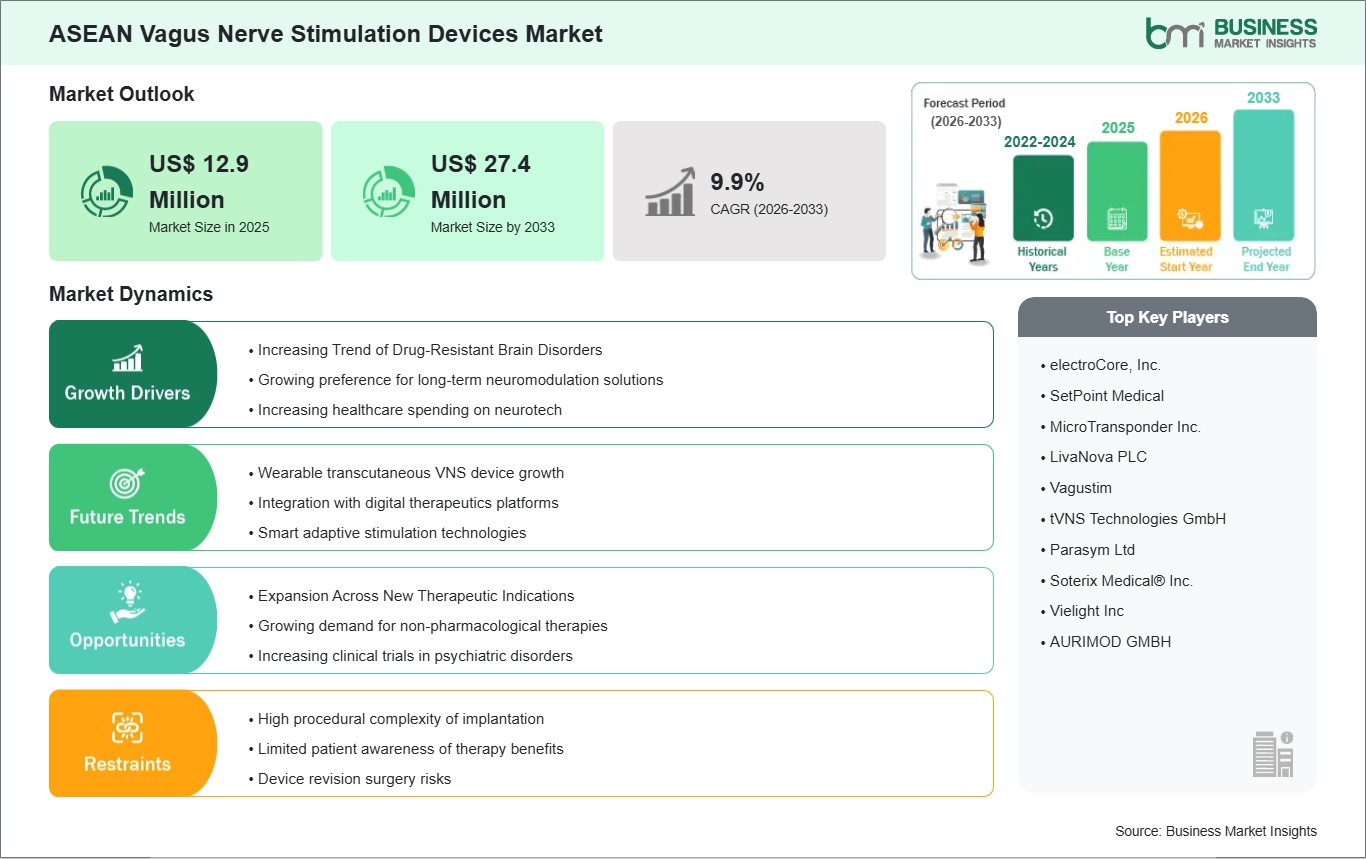
The ASEAN market for vagus nerve stimulation devices is changing as there is an increased focus on long-term treatment of neurological and autonomic disorders by regional health systems. In Southeast Asia, there is a rising tendency towards the use of devices that can help address the constraints faced from dependency on chronic drug therapy for treating neurological conditions. There is rising interest in vagus nerve stimulation devices in tertiary care hospitals and neuro-rehabilitation centers owing to the applications that these devices offer in cases of epilepsy, post-stroke rehabilitation, mental illnesses, and autonomic disorders.
The involvement of private groups in the provision of healthcare services and international medical networks offering specialized neurostimulation procedures will constitute an important trend in the ASEAN market. There is increased focus on investments in neuroscience departments, rehabilitation centers as well as neurological care services. This has provided a platform for the introduction of implantable and non-implantable vagus nerve stimulators in the market. Besides, the urban young population in ASEAN is increasingly adopting wearable health monitoring systems and alternative methods of treatment without pharmacotherapy for stress-induced neurological diseases and lifestyle diseases. Even so, the market remains constrained by issues associated with a fragmented regulatory environment and inconsistent clinical experience with vagus nerve stimulation therapy. The public health facilities in some of these countries prefer conventional forms of treatment, thus making it difficult for the uptake of neurostimulation devices in the management of neurological diseases. The lack of self-sufficiency in terms of production and maintenance of the devices poses challenges in implementing neurostimulation programs in the region.
Segment Analysis
ASEAN Vagus Nerve Stimulation Devices Market Segmentation
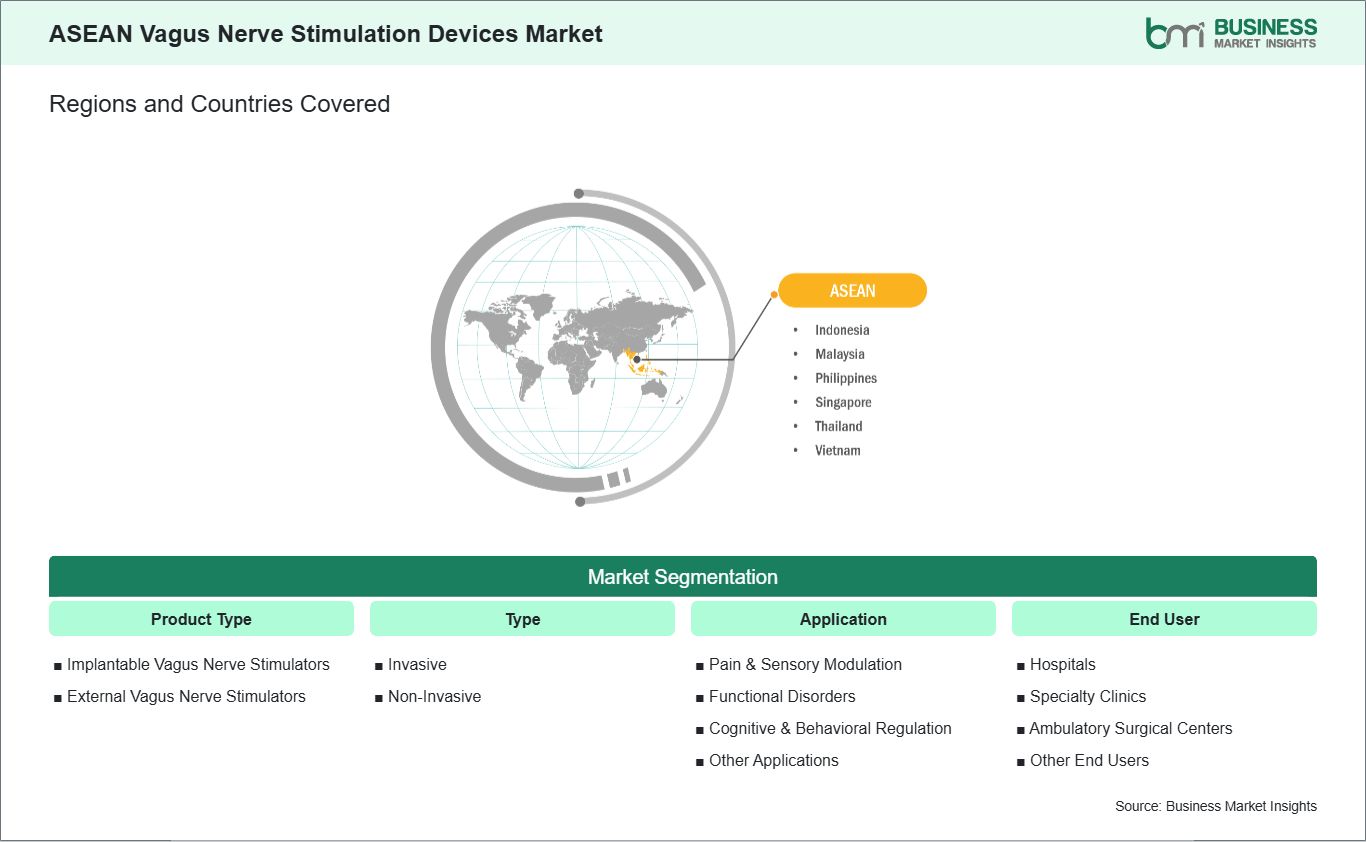
Key segments that contributed to the derivation of the ASEAN vagus nerve stimulation devices market analysis are product type, type, application, and end user.
- By product type, the vagus nerve stimulation devices market is segmented into implantable vagus nerve stimulators and external vagus nerve stimulators. The implantable vagus nerve stimulators segment dominated the market in 2025.
- Based on type, the vagus nerve stimulation devices market is classified into invasive and non-invasive devices. The invasive segment dominated the market in 2025.
- In terms of application, the vagus nerve stimulation devices market is categorized into pain & sensory modulation, functional disorders, cognitive & behavioral regulation, and other applications. The functional disorders segment dominated the market in 2025.
- On the basis of end user, the vagus nerve stimulation devices market is segmented into hospitals, specialty clinics, ambulatory surgical centers, and other end users. The hospitals segment dominated the market in 2025.
Market Forces
ASEAN Vagus Nerve Stimulation Devices Market Drivers and Opportunities
Increasing Trend of Drug-Resistant Brain Disorders
The ASEAN vagus nerve stimulation (VNS) devices market is increasingly influenced by the rising prevalence of drug-resistant neurological disorders, particularly epilepsy and complex seizure syndromes across countries such as Indonesia, Vietnam, Thailand, and the Philippines. Limited early screening programs and uneven access to long-term antiepileptic drug regimens often result in delayed treatment escalation, leading to higher proportions of patients progressing into refractory disease stages. This growing unmet need is gradually strengthening interest in neuromodulation therapies in tertiary hospitals across the region.
Within advanced healthcare infrastructure in ASEAN countries such as Singapore and Malaysia, better diagnostics and greater numbers of specialists have led to increased detection of patients with treatment-refractory epilepsy and psychiatric disorders. These countries are also seeing a rise in referrals to specialized neurosurgical units for the performance of neurosurgery procedures in cases where conventional drug treatments have proven ineffective. The additional rise in post-trauma neurological disorders from road traffic accidents in nations such as Thailand and Vietnam creates further demand.
Additionally, infectious neurological complications such as neurocysticercosis and meningitis-related seizure disorders remain more prevalent in parts of Southeast Asia, contributing to chronic and difficult-to-control epilepsy cases. This regional disease profile, combined with growing awareness among neurologists about neuromodulation therapies, is slowly positioning VNS devices as a complementary option in specialized neurocare settings. However, adoption remains concentrated in urban and private healthcare infrastructure due to cost and procedural complexity.
Expansion Across New Therapeutic Indications
The application of vagus nerve stimulation in ASEAN is expanding beyond epilepsy into broader neurological and psychiatric indications, driven by increasing clinical awareness and cross-border medical collaborations. Treatment-resistant depression is gaining attention in urban healthcare hubs such as Bangkok, Kuala Lumpur, and Singapore, where mental health services are more structured and exposure to global neuromodulation practices is higher. Clinicians are gradually exploring VNS as an adjunct option for patients who do not respond to conventional antidepressant therapies.
Another interesting avenue in terms of developing treatment technologies for neuro-rehabilitation within ASEAN nations includes that of stroke rehabilitation, especially among aging populations in nations like Thailand and Singapore, where the incidence rate of stroke is rising as a consequence of certain lifestyle factors. Neuromodulation is being considered as an avenue to explore in order to facilitate neuroplasticity and rehabilitation among stroke patients.
Moreover, rising awareness about conditions such as chronic migraines and those associated with anxiety in ASEAN urban populations is presenting a new area of application potential for VNS devices. Countries like Indonesia and the Philippines have been reporting a rising need for high-end neurology services at private hospitals. There is an increasing use of non-pharmacological methods in such countries as healthcare budgets increase, making VNS devices applicable for uses beyond just managing epileptic seizures.
Size and Share Analysis
ASEAN Vagus Nerve Stimulation Devices Market Size and Share Analysis
The ASEAN vagus nerve stimulation devices market is experiencing steady growth, with market size and share analysis reflecting evolving treatment preferences and competitive dynamics among key players. The report evaluates important subsegments categorized within product type, type, application, and end user, highlighting their respective contributions to overall market performance.
By product type, the implantable vagus nerve stimulators subsegment dominated the market in 2025, driven by their established clinical efficacy and widespread adoption in the treatment of neurological and psychiatric disorders such as epilepsy and treatment-resistant depression. These devices provide continuous and targeted nerve stimulation, making them a preferred long-term therapeutic option for chronic conditions.
Based on type, the invasive subsegment dominated the market in 2025, owing to its higher clinical effectiveness and stronger therapeutic outcomes in managing severe and refractory conditions. Invasive vagus nerve stimulation systems are widely preferred in hospital-based settings due to their proven long-term benefits and consistent symptom control.
In terms of application, the functional disorders subsegment dominated the market in 2025, propelled by the increasing prevalence of conditions such as epilepsy and depression, along with growing clinical adoption of vagus nerve stimulation as an adjunct therapy for patients who are unresponsive to conventional treatments.
On the basis of end user, the hospitals subsegment dominated the market in 2025 due to the availability of advanced neurology infrastructure, specialized neurosurgical expertise, and comprehensive postoperative care required for implantation and management of vagus nerve stimulation devices.
Report Coverage
ASEAN Vagus Nerve Stimulation Devices Market Report Coverage and Deliverables
The "ASEAN Vagus Nerve Stimulation Devices Market Size and Forecast (2022-2033)" report provides a detailed analysis of the market covering below areas:
- Market size and forecast at regional and country levels for all market segments covered under the scope
- Market trends, as well as drivers, restraints, and opportunities
- Market analysis covering key trends, regional framework, major players, regulations, and recent developments
- Market concentration, heat map analysis, prominent players, and recent developments for the Market
- Detailed company profiles, including SWOT analysis
Geographic Insights
ASEAN Vagus Nerve Stimulation Devices Market Geographic Insights
The geographical scope of the ASEAN vagus nerve stimulation devices market report is divided into: Indonesia, Malaysia, the Philippines, Singapore, Thailand, and Vietnam. Indonesia held the largest share in 2025.
In Indonesia, vagus nerve stimulation devices are dominating the ASEAN vagus nerve stimulation devices market, because the country is undergoing an expansion in its neurological healthcare sector. Cities such as Jakarta, Surabaya, and Medan have seen increased development of neuroscience centers that are capable of accommodating treatments based on neurostimulation. Healthcare institutions in Indonesia are increasingly embracing vagus nerve stimulation devices in treating complicated cases of neurological disorders when traditional treatments fail to yield results.
The growth of the middle-income population in the country, along with the increase in the use of private healthcare facilities, further contributes to the growth of the market. In addition, private hospital chains of Indonesia are constantly introducing innovative technologies for diagnosis and therapy in order to gain a competitive edge in the local healthcare system. This results in the increased adoption of minimally invasive solutions for neurological disorders, including vagus nerve stimulators, both implantable and external. At the same time, the growing interest of Indonesia in mental well-being and neuropsychiatry creates additional opportunities for non-pharmacological solutions in this segment. Furthermore, geographic peculiarities of Indonesia, which include thousands of islands, result in the growing demand for portable and wearable health tech. Disparities in healthcare infrastructure among urban and remote areas also influence the accessibility of innovative neurological interventions. Lack of specialists in secondary cities and price-sensitive procedures represent significant obstacle. Nevertheless, Indonesia remains ahead in the ASEAN market because of the developing ecosystem of specialists, growing focus on neurological conditions management, and the adoption of advanced medical technologies.
Industry Activity
Recent Developments
The ASEAN Vagus Nerve Stimulation Devices market is evaluated by gathering qualitative and quantitative data post primary and secondary research, which includes important corporate publications, association data, and databases. A few of the key developments in the ASEAN Vagus Nerve Stimulation Devices market are:
- In April 2023, electroCore, Inc. announced that it obtained product registration and import approval in Indonesia for gammaCore Sapphire, allowing the company to expand access to non-invasive vagus nerve stimulation therapy across Southeast Asia through local distributors.
- In February 2023, LivaNova PLC expanded its VNS Therapy platform (SenTiva DUO launch and broader indication support), reinforcing its leadership in implantable VNS systems.
Trust & Transparency
Research Methodology
The market analysis combines proprietary research with secondary data from government agencies, company disclosures, regulatory filings, industry databases and expert interviews. Market estimates are validated through data triangulation, cross-market benchmarking and analyst
review.
View Full Research Methodology
Key Sources Referred:
The World BankWorld Health Organization (WHO)Center for Disease Control and Prevention (CDC)Food and Drug Administration (FDA)European Database on Medical Devices (EUDAMED)American Association of Neurological Surgeons (AANS)American Academy of Neurology (AAN)Company WebsitesCompany Annual ReportsCompany Investor Presentations