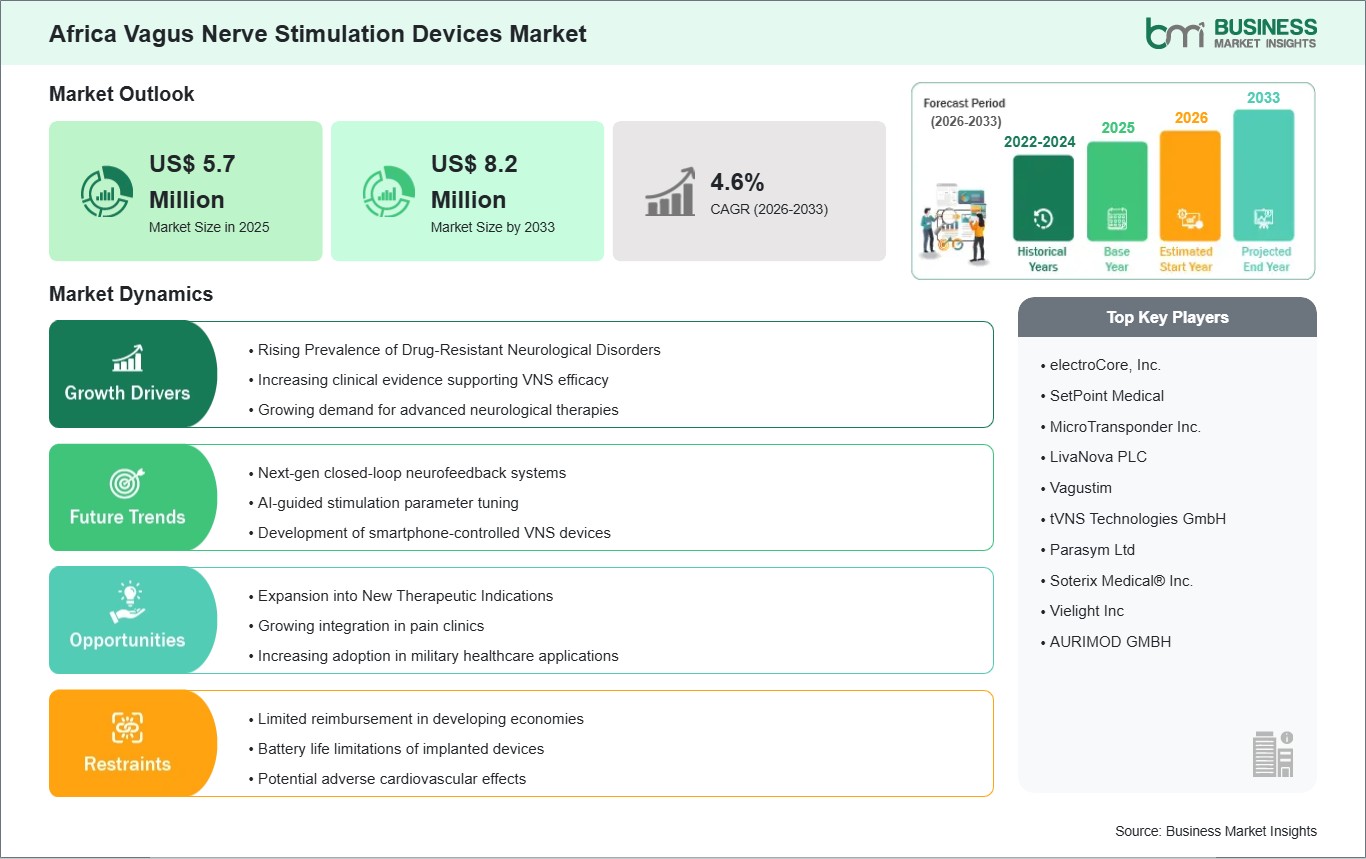
The Africa vagus nerve stimulation devices market size is expected to reach US$ 8.2 million by 2033 from US$ 5.7 million in 2025. The market is estimated to record a CAGR of 4.6% from 2026 to 2033.
The vagus nerve stimulation devices market in Africa is gaining momentum owing to the increasing concentration of healthcare systems toward the management of neurological and psychiatric conditions. The rising number of patients suffering from epilepsy, depression, chronic pain, and other forms of neurological disorders is motivating health professionals to opt for alternatives to traditional treatments, especially drugs. Vagus nerve stimulators are viewed as a means of treating intractable neurological disorders in specialty hospitals and urban centers. Awareness and availability of minimally invasive neuro-modulation treatments are contributing to the market's growth in various parts of Africa.
There is an increase in the market due to growing interest in neurostimulation technologies aimed at vagus nerve stimulation, which is used to treat migraines, stress disorders, rehabilitation therapy, and wellness programs. International players operating in the field of medical equipment are investing in Africa through hospital collaborations and specialty clinics, as well as private healthcare service providers. Also, there is slow healthcare modernization and investments in medical equipment that are improving the environment for neurostimulation treatments in the region. Lack of information about vagus nerve stimulation treatments, shortage of professionals specialized in neurology, and limited access to advanced surgery facilities have hindered the adoption process. Dependence on importing medical equipment and high costs have also acted as barriers, especially for low-income health care facilities.

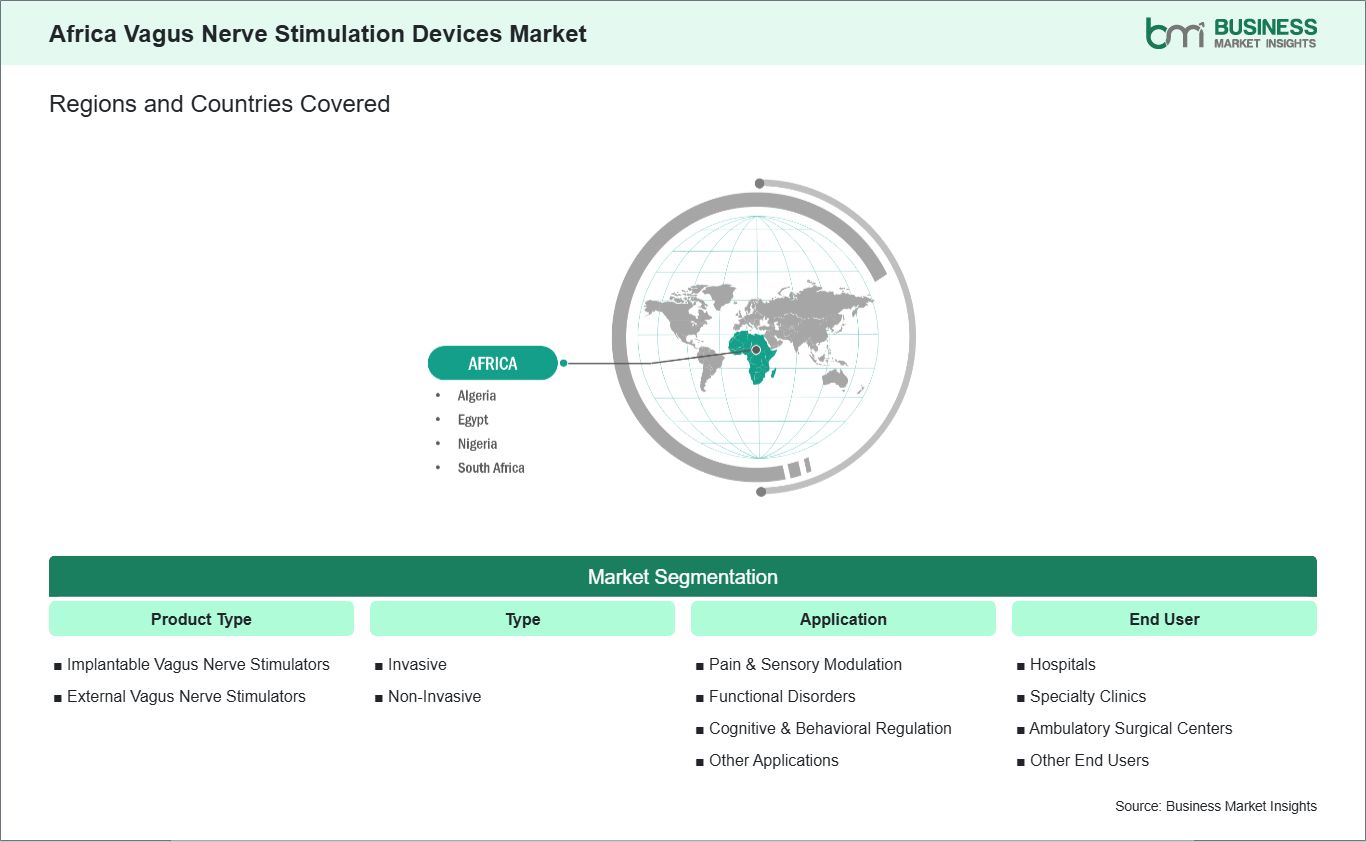
Key segments that contributed to the derivation of the Africa vagus nerve stimulation devices market analysis are product type, type, application, and end user.
The Africa vagus nerve stimulation (VNS) devices market is influenced by the growing burden of drug-resistant neurological disorders, particularly epilepsy, which remains prevalent across African countries. Limited access to early diagnosis, shortages of neurologists, and inconsistent availability of anti-seizure medications often result in poorly managed epilepsy cases progressing to refractory stages. This has increased the need for alternative treatment approaches such as VNS therapy, especially in urban tertiary healthcare facilities and specialized neuroscience centers.
Neurological treatment shortages exist in sub-Saharan African countries, especially in rural communities where health services are not well developed. In many African nations, such as Nigeria, Kenya, and South Africa, the poor provision of medical attention causes an increase in seizures and neurological disorders due to a lack of treatment. With the improvement in knowledge about neuro-modulation techniques among the medical practitioners, vagus nerve stimulation has emerged as another approach that can be used by patients who are refractory to medication.
The increasing incidence of neurological disorders linked to traumatic brain injuries, infections, and pediatric neurological conditions is also contributing to demand for advanced neurostimulation therapies across the region. In many African healthcare systems, long-term pharmacological management can be financially burdensome and difficult to sustain, encouraging interest in therapies that may help reduce seizure frequency and improve patient quality of life over time. This trend is expected to support the gradual adoption of VNS devices in selected high-capacity hospitals and private healthcare institutions.
The use of vagus nerve stimulators in Africa is moving from applications in epilepsy toward neurology and psychiatry uses. Health practitioners within advanced Africa health care sectors, such as those in South Africa and northern Africa, are considering vagus nerve stimulation to treat refractory depression and migraines. The growing exposure of African clinicians to foreign practices and partnerships with leading medical technology companies is driving this trend.
Neurological rehabilitation has also been identified as another promising field for the implementation of VNS within select African health care systems. Those hospitals that specialize in stroke rehabilitation and neurological recovery have demonstrated considerable interest in using neuromodulation to enhance motor and cognitive recovery. While VNS technology is in its early stages of adoption, the growth of specialized hospitals and neurological institutes will provide a platform for the implementation of VNS within Africa.
Rising mental health awareness across urban African populations is contributing to interest in alternative neuropsychiatric therapies. Countries such as Egypt, South Africa, and Morocco are witnessing gradual growth in specialized psychiatric and neurological services, encouraging exploration of nonpharmacological treatment modalities for complex psychiatric disorders. As regional healthcare systems continue modernizing and access to advanced medical technologies improves, the therapeutic landscape for VNS devices in Africa is expected to broaden steadily beyond traditional epilepsy management.

The African vagus nerve stimulation devices market is experiencing steady growth, with market size and share analysis reflecting evolving treatment preferences and competitive dynamics among key players. The report evaluates important subsegments categorized within product type, type, application, and end user, highlighting their respective contributions to overall market performance.
By product type, the implantable vagus nerve stimulators subsegment dominated the market in 2025, driven by their established clinical efficacy and widespread adoption in the treatment of neurological and psychiatric disorders such as epilepsy and treatment-resistant depression. These devices provide continuous and targeted nerve stimulation, making them a preferred long-term therapeutic option for chronic conditions.
Based on type, the invasive subsegment dominated the market in 2025, owing to its higher clinical effectiveness and stronger therapeutic outcomes in managing severe and refractory conditions. Invasive vagus nerve stimulation systems are preferred in hospital-based settings due to their proven long-term benefits and consistent symptom control.
In terms of application, the functional disorders subsegment dominated the market in 2025, propelled by the increasing prevalence of conditions such as epilepsy and depression, with growing clinical adoption of vagus nerve stimulation as an adjunct therapy for patients who are unresponsive to conventional treatments.
By user, the hospitals subsegment dominated the market in 2025 due to the availability of advanced neurology infrastructure, specialized neurosurgical expertise, and comprehensive postoperative care required for implantation and management of vagus nerve stimulation devices.
| Report Attribute | Details |
|---|---|
| Market size in 2025 | US$ 5.7 Million |
| Market Size by 2033 | US$ 8.2 Million |
| CAGR (2026 - 2033) | 4.6% |
| Historical Data | 2022-2024 |
| Forecast period | 2026-2033 |
| Segments Covered | By Product Type
|
|
Regions and Countries Covered
| |
| Africa | Egypt, South Africa, Nigeria, Algeria |
| Market leaders and key company profiles |
|
The "Africa Vagus Nerve Stimulation Devices Market Size and Forecast (2022-2033)" report provides a detailed analysis of the market covering below areas:
The geographical scope of the Africa vagus nerve stimulation devices market report is divided into Nigeria, Egypt, South Africa, and Algeria. South Africa held the largest share in 2025.
South Africa holds a strong position in the Africa vagus nerve stimulation devices market owing to its existing healthcare infrastructure, rising capacity to deliver neurological care services, and early acceptance of high-end healthcare technologies. South Africa possesses a reasonably good healthcare infrastructure of private hospitals, neurological clinics, and other specialized healthcare organizations, which promote the application of neuromodulation techniques for treating drug-resistant epilepsies, depression, and various chronic pain diseases. Rising awareness about alternative forms of treatment among healthcare professionals is contributing to market growth in South Africa.
Noninvasive vagus nerve stimulation products are also generating growing attention in the South African market, especially in the private healthcare and wellness facilities. Noninvasive devices are being considered for their potential use in migraine treatments, stress management, sleep disorders, and mental health care. Large cities such as Johannesburg, Cape Town, and Pretoria remain as centers for vagus nerve-stimulating technology adoption owing to greater healthcare investment power, access to specialty care doctors, and advanced technology access. South Africa remains an important market entry opportunity for foreign medical device firms seeking to enter the African healthcare market. Availability of regulation and a relatively organized medical distribution network facilitate the adoption of more advanced neuromodulation systems in the South African market. However, issues relating to accessibility, differences in healthcare access between public and private care, and the lack of availability of specialty care doctors in rural areas have continued to pose obstacles to greater penetration. South Africa will likely continue to dominate the adoption of vagus nerve-stimulating devices in Africa due to its continued investment in healthcare and neurological disease care.

The Africa vagus nerve stimulation devices market is evaluated by gathering qualitative and quantitative data post primary and secondary research, which includes important corporate publications, association data, and databases. A few of the key developments in the Africa vagus nerve stimulation devices market are:
The Africa Vagus Nerve Stimulation Devices Market is valued at US$ 5.7 Million in 2025, it is projected to reach US$ 8.2 Million by 2033.
As per our report Africa Vagus Nerve Stimulation Devices Market, the market size is valued at US$ 5.7 Million in 2025, projecting it to reach US$ 8.2 Million by 2033. This translates to a CAGR of approximately 4.6% during the forecast period.
The Africa Vagus Nerve Stimulation Devices Market report typically cover these key segments-
The historic period, base year, and forecast period can vary slightly depending on the specific market research report. However, for the Africa Vagus Nerve Stimulation Devices Market report:
The Africa Vagus Nerve Stimulation Devices Market is populated by several key players, each contributing to its growth and innovation. Some of the major players include:
The Africa Vagus Nerve Stimulation Devices Market report is valuable for diverse stakeholders, including:
Essentially, anyone involved in or considering involvement in the Africa Vagus Nerve Stimulation Devices Market value chain can benefit from the information contained in a comprehensive market report.
Please tell us your area of interest
(Market Segments/ Regions and Countries/ Companies)