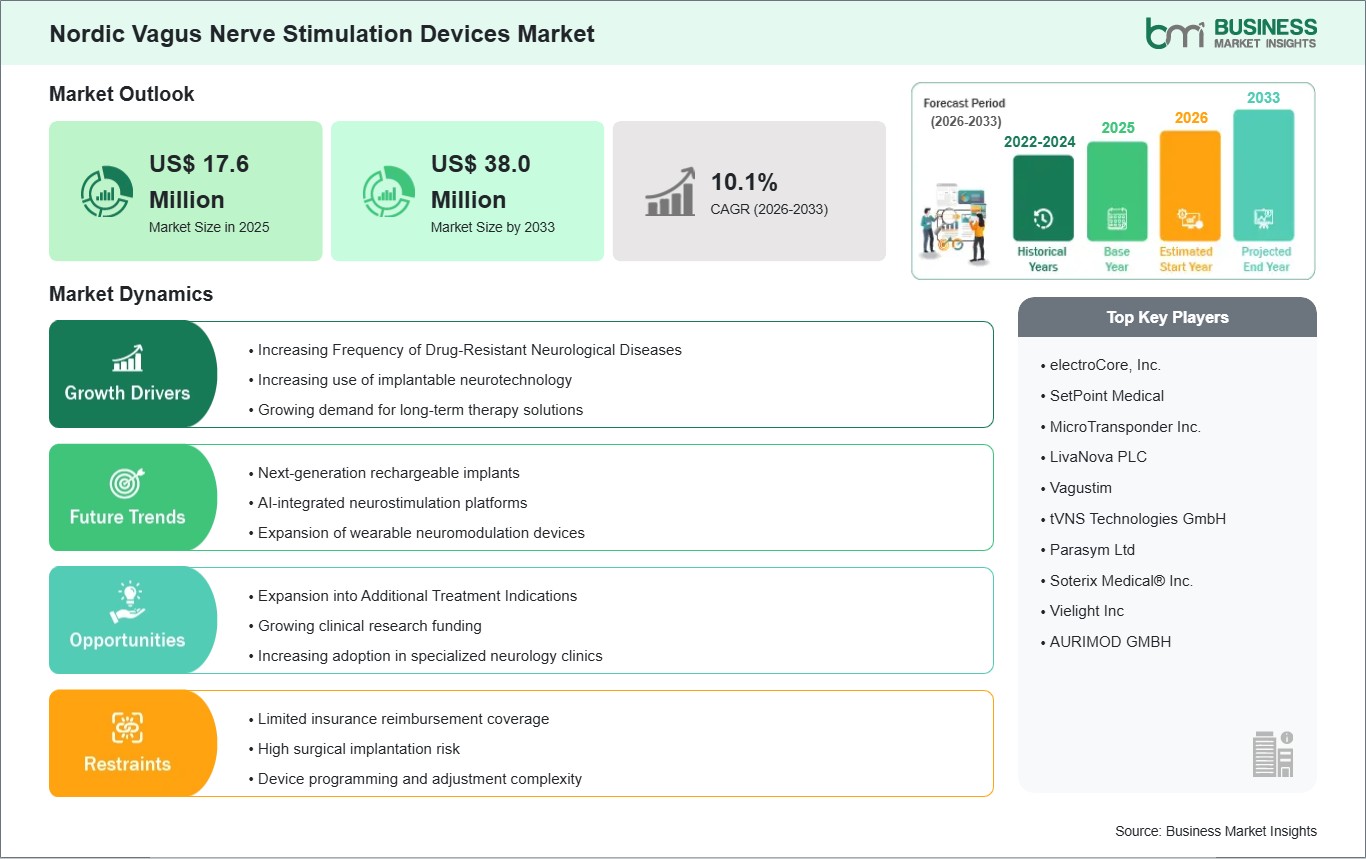
The Nordic vagus nerve stimulation devices market size is expected to reach US$ 38.0 million by 2033 from US$ 17.6 million in 2025. The market is estimated to record a CAGR of 10.1% from 2026 to 2033.
The Nordic markets for vagus nerve stimulation (VNS) devices feature a highly developed health care system, a high level of adoption of neuromodulation therapies, and a strong neurological care infrastructure. Innovation-friendly environment, coupled with the presence of early adopters of novel medical device technologies, especially to manage refractory epilepsy, resistant depression, and other emerging applications like chronic pain and inflammatory conditions, makes the region well-positioned to benefit from these medical innovations. Neurology and psychiatry specialists' high medical awareness along with effective reimbursement models in some Nordic countries, ensures good adoption rates.
The rising number of neurological disorders, supportive government policies to promote accessibility of healthcare, and constant funding for minimally invasive procedures and medical devices. Technologically advanced hospitals, as well as epileptic centers, will help to drive demand. There is also the increased interest in treatments of mental health issues through non-pharmacological means, making neuro-modulation devices more applicable in fields other than epilepsy treatment. The only drawback in the development of the VNS market in the region is the relatively high price associated with device implantation and therapy administration, limiting application in smaller healthcare institutions. Nevertheless, approval procedures for new technologies are efficient but still strict for the neuromodulation market.

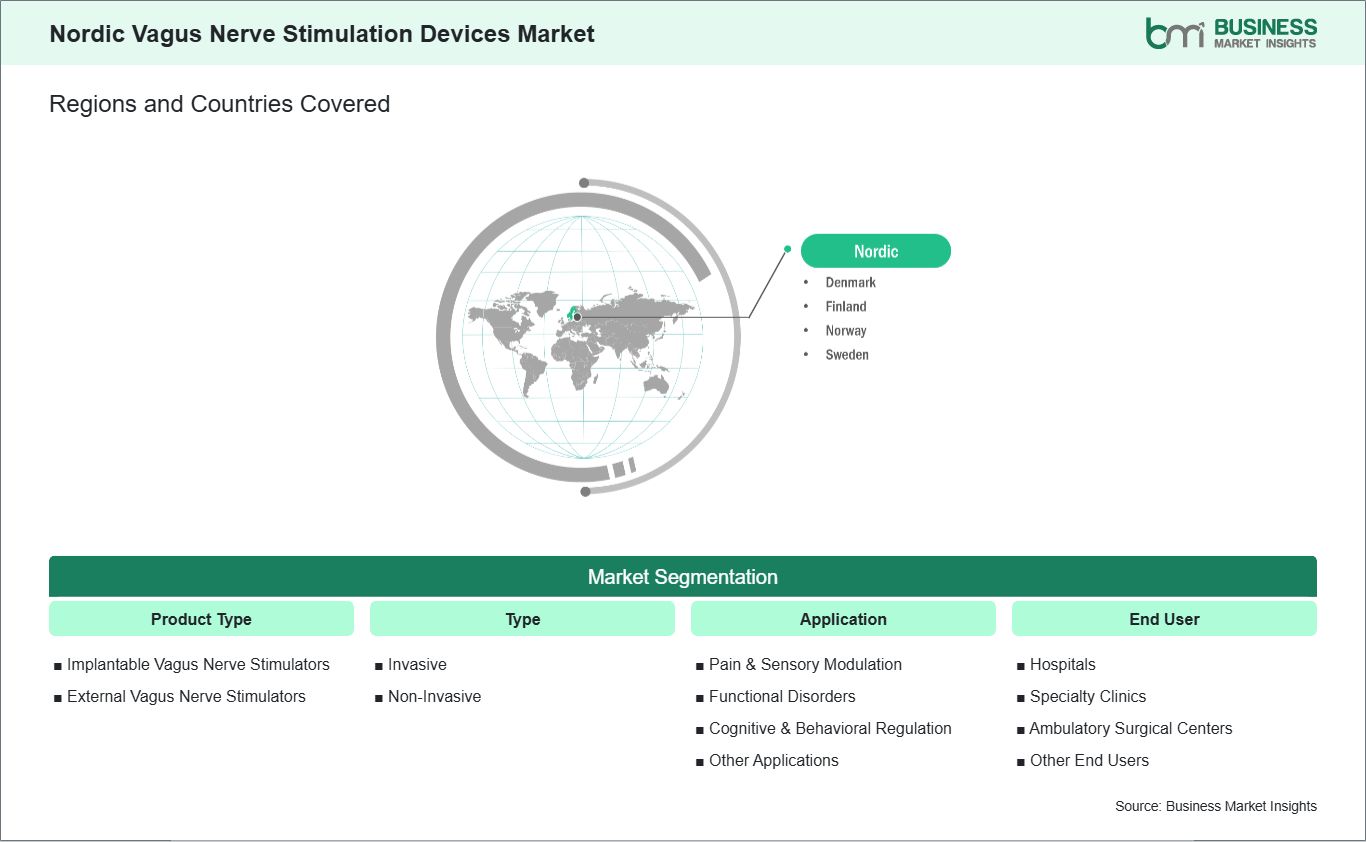
Key segments that contributed to the derivation of the Nordic vagus nerve stimulation devices market analysis are product type, type, application, and end user.
The Nordic area continues to report an increased incidence of drug-resistant nervous disorders such as refractory epilepsy, thus making vagus nerve stimulation technology more popular. There are many neurological registries in countries like Sweden, Norway, Denmark, and Finland that reveal the presence of a stable number of individuals who have remained refractory to the administration of optimum doses of anti-epileptic drugs. Prevalence of the condition among these populations is fairly low, but the percentage of the managed cases remains very high due to the special care provided.
Healthcare facilities in the Nordic area have a very organized referral network and universal health care coverage that allows for prompt diagnoses and systematic advancement to advanced treatments. Major centers of neurosurgical procedures and neuromodulatory techniques are based in university hospitals located in the cities of Stockholm, Oslo, Copenhagen, and Helsinki. The centralized health care system of these countries allows for quick identification of individuals suitable for vagus nerve stimulation, especially those under pediatric age.
In addition to epilepsy, the region is observing an increasing burden of neurological disorders associated with aging populations and chronic comorbidities such as stroke, multiple sclerosis, and neurodegenerative diseases. Chronic migraine and treatment-resistant depression are also being more frequently diagnosed due to strong mental health screening frameworks. As clinicians in the Nordic region emphasize evidence-based, non-pharmacological interventions, vagus nerve stimulation devices are gaining traction as part of multidisciplinary neurological care strategies.
The Nordic vagus nerve stimulation devices market is increasingly expanding beyond epilepsy into a wider range of neurological and psychiatric applications. Healthcare providers in Sweden, Denmark, and Finland are actively exploring vagus nerve stimulation for treatment-resistant depression, chronic migraine, and anxiety disorders, supported by strong mental health integration within national healthcare systems. The region‘s emphasis on early psychiatric intervention is encouraging neurologists and psychiatrists to collaborate more closely in evaluating neuromodulation-based therapies.
Technologies of non-invasive vagal nerve stimulation have shown considerable promise in Scandinavian countries as they fit well into the concept of patient-focused, digital healthcare delivery models. The aforementioned medical device is especially applicable to the outpatient setting that is commonly practiced in Scandinavia. With the growing popularity of telemedicine, stimulation devices may be increasingly applied in the treatment of chronic neurological and psychiatric illnesses without surgery.
In addition, the development of research ecosystems in Nordic universities and hospitals contributes significantly to conducting studies in neurostimulation. Research on the impact of neuromodulation therapy in stroke treatment, inflammation and other areas is conducted by centers located in Helsinki, Copenhagen, and Oslo. Clinical research activities carried out in the region enable expanding physicians' support of vagus nerve stimulation as an emerging therapy and help advance its gradual expansion in several areas of medicine.

The Nordic Vagus Nerve Stimulation Devices market demonstrates steady growth, with size and share analysis highlighting evolving trends and competitive dynamics among key players. The report evaluates important subsegments categorized within product type, type, application, and end user, highlighting their respective contributions to overall market performance.
By product type, the implantable vagus nerve stimulators subsegment dominated the market in 2025, driven by their established clinical efficacy and widespread adoption in the treatment of neurological and psychiatric disorders such as epilepsy and treatment-resistant depression. These devices provide continuous and targeted nerve stimulation, making them a preferred long-term therapeutic option for chronic conditions.
Based on type, the invasive subsegment dominated the market in 2025, owing to its higher clinical effectiveness and stronger therapeutic outcomes in managing severe and refractory conditions. Invasive vagus nerve stimulation systems are widely preferred in hospital-based settings due to their proven long-term benefits and consistent symptom control.
In terms of application, the functional disorders subsegment dominated the market in 2025, propelled by the increasing prevalence of conditions such as epilepsy and depression, along with growing clinical adoption of vagus nerve stimulation as an adjunct therapy for patients who are unresponsive to conventional treatments.
On the basis of end user, the hospitals subsegment dominated the market in 2025 due to the availability of advanced neurology infrastructure, specialized neurosurgical expertise, and comprehensive postoperative care required for implantation and management of vagus nerve stimulation devices.
| Report Attribute | Details |
|---|---|
| Market size in 2025 | US$ 17.6 Million |
| Market Size by 2033 | US$ 38.0 Million |
| CAGR (2026 - 2033) | 10.1% |
| Historical Data | 2022-2024 |
| Forecast period | 2026-2033 |
| Segments Covered | By Product Type
|
|
Regions and Countries Covered
| |
| Nordic | Sweden, Denmark, Norway, Finland |
| Market leaders and key company profiles |
|
The "Nordic Vagus Nerve Stimulation Devices Market Size and Forecast (2022-2033)" report provides a detailed analysis of the market covering below areas:
The geographical scope of the Nordic Vagus Nerve Stimulation Devices market report is divided into: Sweden, Norway, Denmark, and Finland. Sweden held the largest share in 2025.
Sweden is considered the main player in the field of VNS devices in the Nordics, owing to the advanced digital nature of the healthcare system and the extensive focus on neurological research and healthcare practices. This is largely due to the presence of an efficient chain of tertiary hospitals and dedicated neurology clinics in Sweden that embrace neuromodulation treatments such as VNS, particularly for psychiatric disorders and epilepsy.
The Swedish healthcare system provides incentives for the prompt application of cutting-edge medical technology, especially for technologies that enhance the quality of life for patients suffering from neurological conditions. The research efforts made in tandem by academic bodies and medical equipment manufacturers play an important role in increasing the awareness and application of VNS therapy. Besides, the emphasis laid on mental health in the country has increased the acceptance of VNS as an adjunct therapy in treating depression when medications fail to produce any significant results. However, despite all these incentives for adopting the technology, the cost factor and the requirement of skilled surgeons prevent its adoption on a large scale. Nevertheless, the country still leads in using the VNS devices in the Nordic region.

The Nordic Vagus Nerve Stimulation Devices market is evaluated by gathering qualitative and quantitative data post primary and secondary research, which includes important corporate publications, association data, and databases. A few of the key developments in the Nordic Vagus Nerve Stimulation Devices market are:
The Nordic Vagus Nerve Stimulation Devices Market is valued at US$ 17.6 Million in 2025, it is projected to reach US$ 38.0 Million by 2033.
As per our report Nordic Vagus Nerve Stimulation Devices Market, the market size is valued at US$ 17.6 Million in 2025, projecting it to reach US$ 38.0 Million by 2033. This translates to a CAGR of approximately 10.1% during the forecast period.
The Nordic Vagus Nerve Stimulation Devices Market report typically cover these key segments-
The historic period, base year, and forecast period can vary slightly depending on the specific market research report. However, for the Nordic Vagus Nerve Stimulation Devices Market report:
The Nordic Vagus Nerve Stimulation Devices Market is populated by several key players, each contributing to its growth and innovation. Some of the major players include:
The Nordic Vagus Nerve Stimulation Devices Market report is valuable for diverse stakeholders, including:
Essentially, anyone involved in or considering involvement in the Nordic Vagus Nerve Stimulation Devices Market value chain can benefit from the information contained in a comprehensive market report.
Please tell us your area of interest
(Market Segments/ Regions and Countries/ Companies)