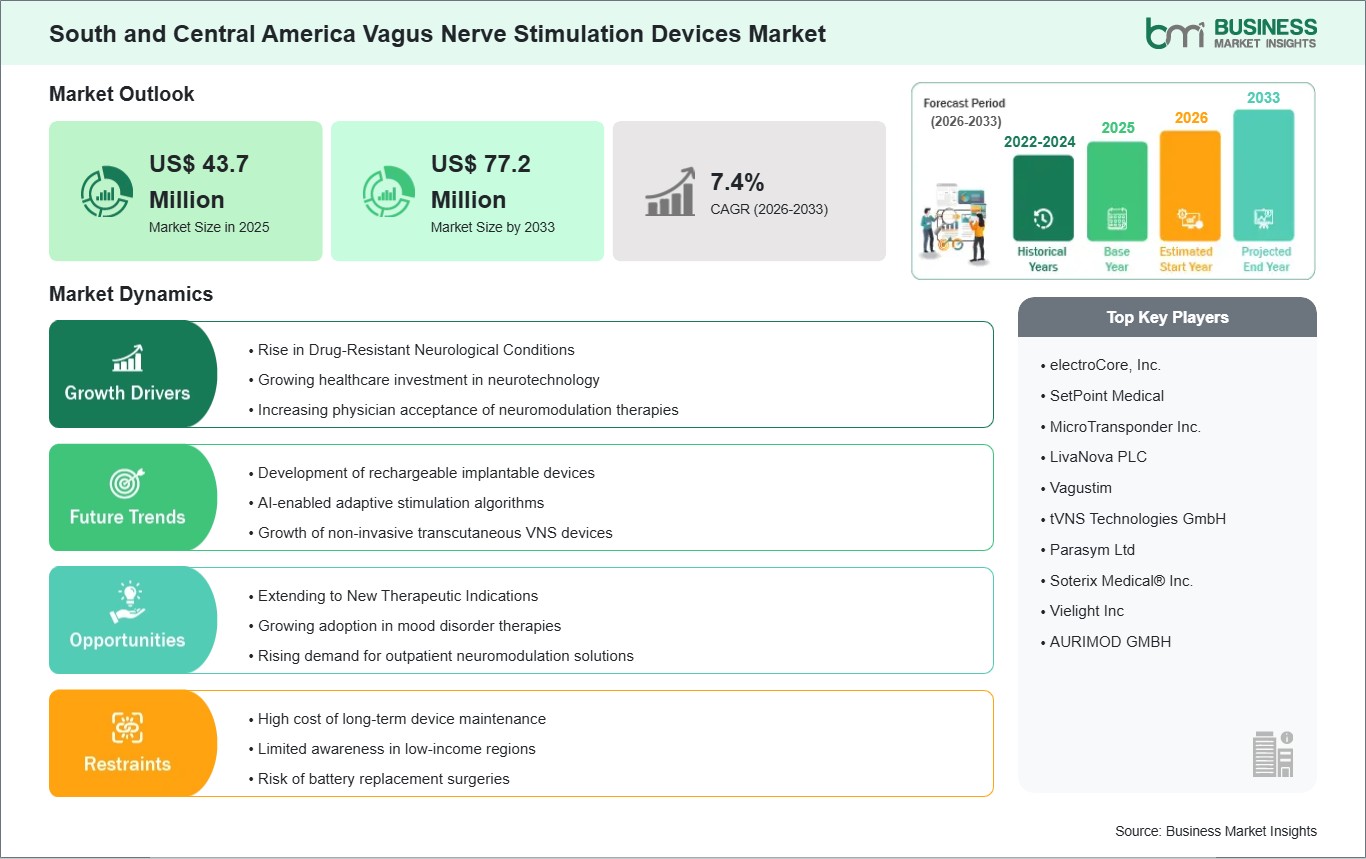
The South and Central America vagus nerve stimulation devices market size is expected to reach US$ 77.2 million by 2033 from US$ 43.7 million in 2025. The market is estimated to record a CAGR of 7.4% from 2026 to 2033.
The vagus nerve stimulation devices market in South & Central American countries still remains at an emerging phase. It involves slow acceptance through clinical practice as well as the availability of the neuromodulation devices only in a select few advanced urban healthcare settings. The current market is confined to major hospitals with their neurology departments starting to adopt VNS as a therapy for epilepsy, as well as severe forms of depression that fail to respond to traditional medicines. There is also varying awareness regarding neuromodulation in the geographies, which restricts wider adoption, among other things.
The improvement in the infrastructure for neurological care, especially in major cities where there is significant investment in advanced surgical and implantable devices by private hospital chains, has been one of the main factors favoring market growth. Another factor that promotes the adoption of VNS devices, despite the limited number of applications, has been the increasing awareness of the problems related to treatment-resistant epilepsy and rising interest in non-drug therapy options for neurological diseases. Partnerships between global device providers and local distributors have contributed to increasing the availability of education and experience in procedures, which is crucial for market growth. The current obstacles include not only relatively expensive procedures and a lack of reimbursement, but also the limited capabilities of local neurosurgeons to implement VNS technology. In addition, many public health care systems do not allocate funds for such sophisticated neuromodulation procedures.

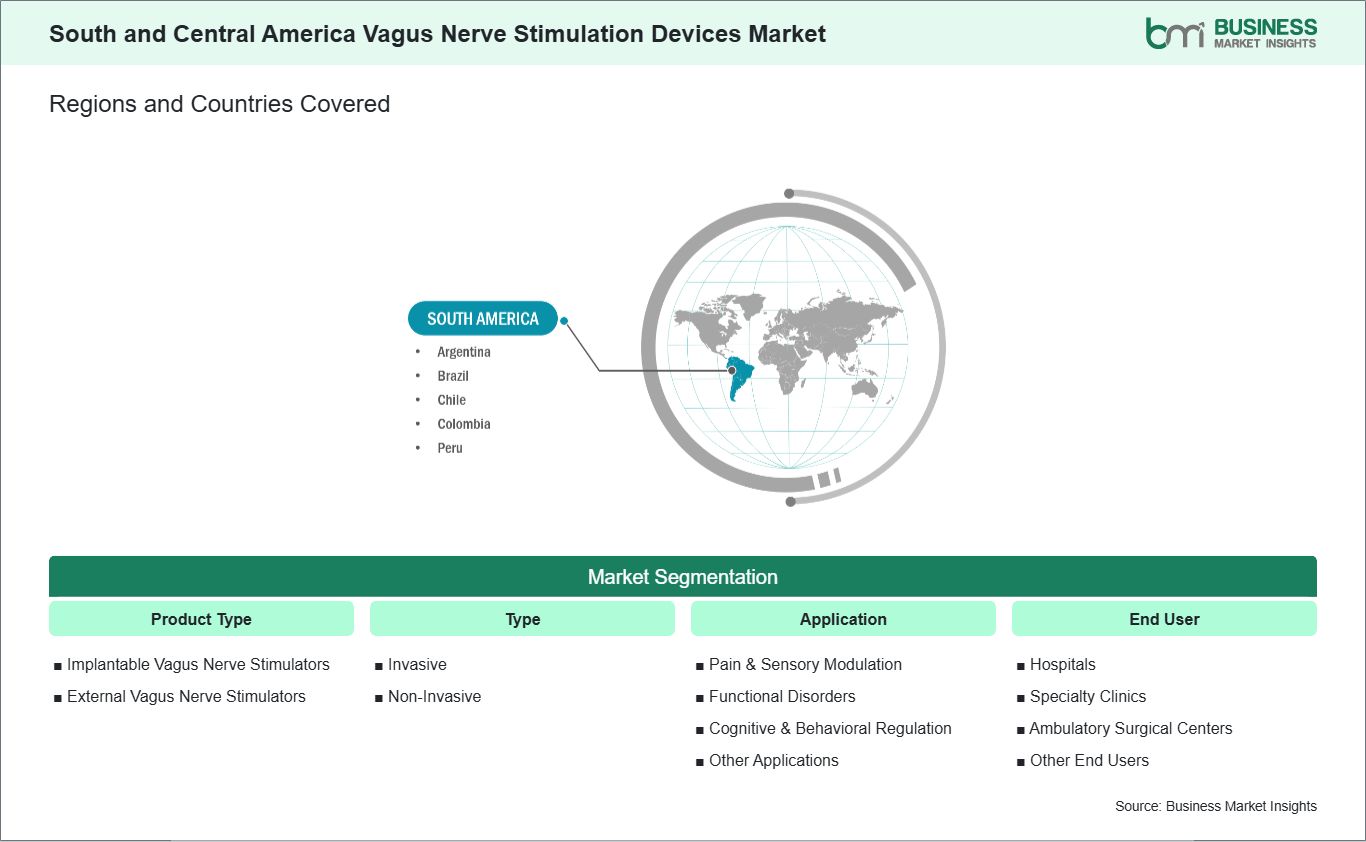
Key segments that contributed to the derivation of the South and Central America vagus nerve stimulation devices market analysis are product type, type, application, and end user.
An increase in the prevalence of drug-resistant neurological conditions, especially epilepsy, has been observed in South and Central America, and this is expected to play an increasingly influential role in shaping the clinical demand for vagus nerve stimulators. Countries such as Brazil, Argentina, Colombia, and Chile have seen rising levels of epilepsy diagnoses attributed to improvements in both diagnostic services and healthcare infrastructure. While the number of anticonvulsant drugs that are available increases, many people still struggle with epilepsy despite taking these medications, highlighting the need for neuromodulation treatment.
Countries in South and Central America are increasingly building capacity for complex neurological care by establishing tertiary hospitals and epilepsy clinics. In countries such as Brazil, where public hospitals make up the majority of the healthcare infrastructure, the trend toward complex neurological procedures has taken hold, specifically in cities such as São Paulo and Rio de Janeiro. Likewise, Chile and Colombia are expanding their scope of neurodiagnosis and making advances in public and private hospitals, identifying more candidates for vagus nerve stimulators.
In addition to epilepsy, the region is experiencing a rising incidence of neurological complications linked to traumatic brain injuries, infectious diseases affecting the nervous system, and chronic non-communicable conditions. Road traffic accidents in countries such as Peru and Brazil contribute significantly to long-term neurological disability, while metabolic disorders like diabetes are increasing neuropathy cases. These evolving disease patterns are encouraging clinicians to consider non-pharmacological, long-term neuromodulation approaches for managing refractory neurological conditions.
The South and Central America vagus nerve stimulation devices market is gradually expanding beyond epilepsy into a broader range of therapeutic applications. Healthcare providers in Brazil, Mexico (often considered part of broader Latin American market dynamics), and Argentina are increasingly evaluating vagus nerve stimulation for treatment-resistant depression, chronic migraine, and anxiety disorders. Growing awareness of mental health conditions and improving access to psychiatric services are supporting the integration of neuromodulation into multidisciplinary care models.
There is an increasing interest in adopting non-invasive vagus nerve stimulation devices in this region because of the feasibility of using such devices in an outpatient setting and within cost-effective health delivery setups. The use of external stimulators is very suitable in those countries where there is not much availability of neurosurgery facilities, except in big hospitals within urban areas.
Moreover, cooperation between the academic institutions in the region and international firms specializing in medical devices has helped spur the development of clinical trials in the field of vagus nerve stimulation for other applications. The universities and neuroscience facilities in Brazil and Chile have focused on developing the application for stroke recovery, chronic pain treatment, and cognitive impairment. With better training for physicians and the growing amount of clinical evidence, the gradual adoption of vagus nerve stimulation technology can be anticipated in the region.

The South and Central America Vagus Nerve Stimulation Devices market demonstrates steady growth, with size and share analysis highlighting evolving trends and competitive dynamics among key players. The report evaluates important subsegments categorized within product type, type, application, and end user, highlighting their respective contributions to overall market performance.
By product type, the implantable vagus nerve stimulators subsegment dominated the market in 2025, driven by their established clinical efficacy and widespread adoption in the treatment of neurological and psychiatric disorders such as epilepsy and treatment-resistant depression. These devices provide continuous and targeted nerve stimulation, making them a preferred long-term therapeutic option for chronic conditions.
Based on type, the invasive subsegment dominated the market in 2025, owing to its higher clinical effectiveness and stronger therapeutic outcomes in managing severe and refractory conditions. Invasive vagus nerve stimulation systems are widely preferred in hospital-based settings due to their proven long-term benefits and consistent symptom control.
In terms of application, the functional disorders subsegment dominated the market in 2025, propelled by the increasing prevalence of conditions such as epilepsy and depression, along with growing clinical adoption of vagus nerve stimulation as an adjunct therapy for patients who are unresponsive to conventional treatments.
On the basis of end user, the hospitals subsegment dominated the market in 2025 due to the availability of advanced neurology infrastructure, specialized neurosurgical expertise, and comprehensive postoperative care required for implantation and management of vagus nerve stimulation devices.
| Report Attribute | Details |
|---|---|
| Market size in 2025 | US$ 43.7 Million |
| Market Size by 2033 | US$ 77.2 Million |
| CAGR (2026 - 2033) | 7.4% |
| Historical Data | 2022-2024 |
| Forecast period | 2026-2033 |
| Segments Covered | By Product Type
|
|
Regions and Countries Covered
| |
| South and Central America | Brazil, Argentina, Chile, Colombia, Peru |
| Market leaders and key company profiles |
|
The "South and Central America Vagus Nerve Stimulation Devices Market Size and Forecast (2022-2033)" report provides a detailed analysis of the market covering below areas:
The geographical scope of the South and Central America Vagus Nerve Stimulation Devices market report is divided into: Brazil, Argentina, Chile, Colombia, Peru, and the Rest of South and Central America. Brazil held the largest share in 2025.
Brazil occupies a commanding position on account of the fairly developed private health care system and the presence of neurological centers in urban areas. The nation possesses an increasing number of tertiary hospitals with neurosurgical facilities, wherein VNS is gradually being investigated in patients suffering from refractory epilepsy not responding to antiepileptic drug therapy.
The Brazilian market‘s growth depends heavily on private healthcare, which allows implementing innovative medical technologies at a much faster pace than in the case of public healthcare systems. Some of the best-equipped hospitals in major urban areas begin adopting the use of neuromodulation treatments for epilepsy treatment in collaboration with international medical equipment providers who train them in the process. Access to the technologies still remains extremely uneven, with only certain metropolitan areas benefiting from the availability of the treatment, while smaller cities have little or no access to it because of costs and a lack of neurologists trained in the procedure. In spite of those limitations, VNS devices find the most traction in Brazil among Latin American countries due to the rapid growth of neurological infrastructure and the availability of experience in the area.

The South and Central America Vagus Nerve Stimulation Devices market is evaluated by gathering qualitative and quantitative data post primary and secondary research, which includes important corporate publications, association data, and databases. A few of the key developments in the South and Central America Vagus Nerve Stimulation Devices market are:
The South and Central America Vagus Nerve Stimulation Devices Market is valued at US$ 43.7 Million in 2025, it is projected to reach US$ 77.2 Million by 2033.
As per our report South and Central America Vagus Nerve Stimulation Devices Market, the market size is valued at US$ 43.7 Million in 2025, projecting it to reach US$ 77.2 Million by 2033. This translates to a CAGR of approximately 7.4% during the forecast period.
The South and Central America Vagus Nerve Stimulation Devices Market report typically cover these key segments-
The historic period, base year, and forecast period can vary slightly depending on the specific market research report. However, for the South and Central America Vagus Nerve Stimulation Devices Market report:
The South and Central America Vagus Nerve Stimulation Devices Market is populated by several key players, each contributing to its growth and innovation. Some of the major players include:
The South and Central America Vagus Nerve Stimulation Devices Market report is valuable for diverse stakeholders, including:
Essentially, anyone involved in or considering involvement in the South and Central America Vagus Nerve Stimulation Devices Market value chain can benefit from the information contained in a comprehensive market report.
Please tell us your area of interest
(Market Segments/ Regions and Countries/ Companies)