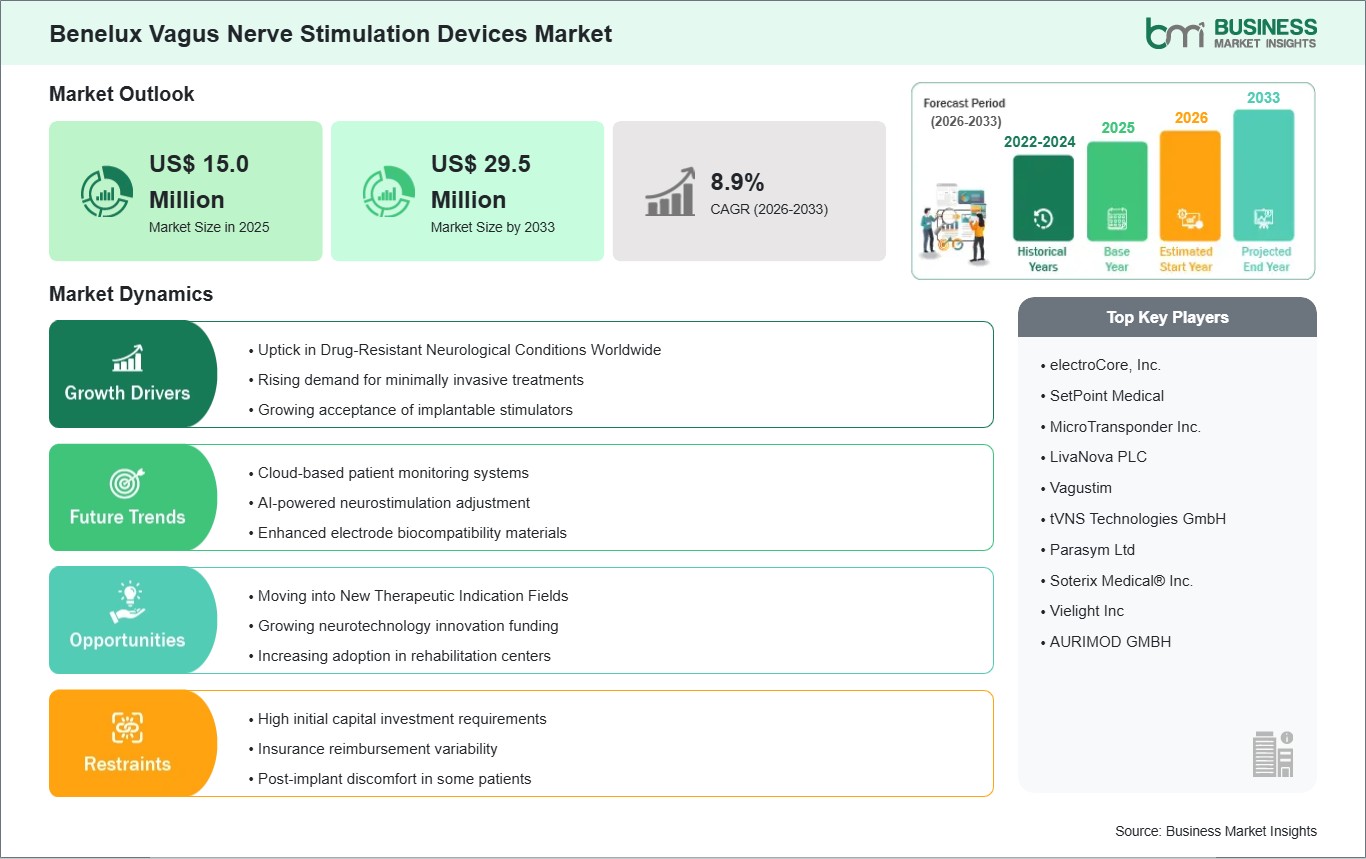
The Benelux vagus nerve stimulation devices market size is expected to reach US$ 29.5 million by 2033 from US$ 15.0 million in 2025. The market is estimated to record a CAGR of 8.9% from 2026 to 2033.
Benelux offers a well-developed but continuously developing environment for vagus nerve stimulation products due to the existing developed neurological care system and early adoption of modern neuromodulation treatment solutions. The demand within Benelux will be driven by the growing acceptance of VNS technology among healthcare professionals as an auxiliary treatment method for drug-resistant epilepsy and major depressive disorder, as well as expanding research activities to investigate the efficiency of VNS devices for the treatment of other neurological and inflammatory diseases. The existing reimbursement system and public health care system will provide access to the product line.
One of the most important factors contributing to the growth of Benelux is the focus of the region on minimally invasive technologies, which limit the need for prolonged medication and promote a higher level of quality of life for patients. Cooperation between academic hospitals and medtech companies also contributes to increasing the number of procedures performed due to increased awareness among specialists. Furthermore, the presence of many highly specialized physicians in combination with numerous facilities for tertiary healthcare in the region results in more effective access to medical care for all eligible patients. It should be noted, however, that the conservatism associated with treatment adoption at some clinics will favor only pharmacotherapy as the primary method.

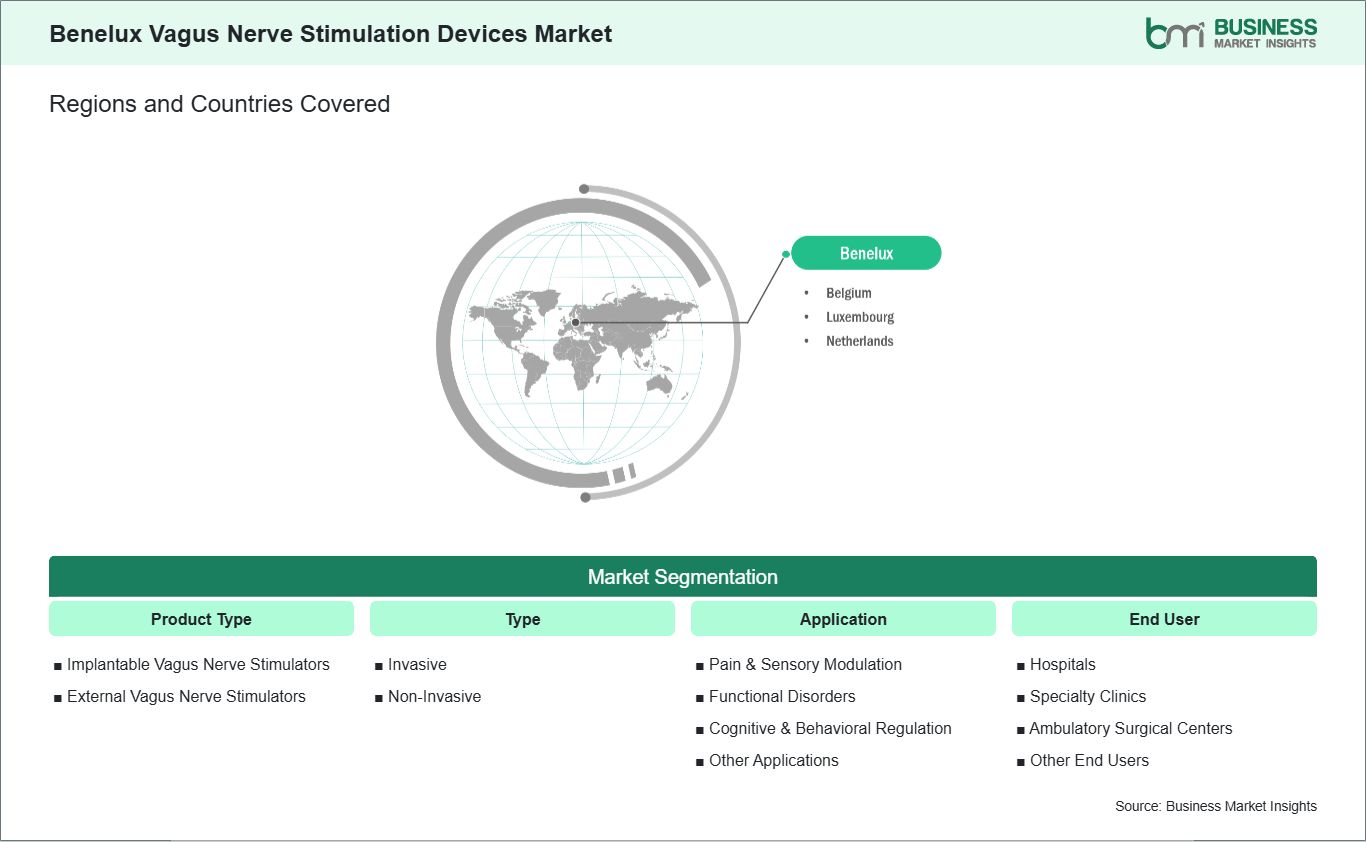
Key segments that contributed to the derivation of the Africa Vagus Nerve Stimulation Devices market analysis are product type, type, application, and end user.
The Benelux vagus nerve stimulation (VNS) devices market is influenced by a steady rise in drug-resistant neurological conditions, particularly epilepsy and complex mood disorders, within highly developed healthcare systems such as Belgium, the Netherlands, and Luxembourg. Despite strong pharmaceutical access and advanced neurological care pathways, a subset of patients continues to exhibit resistance to multi-line anti-epileptic therapies, creating a niche but clinically significant demand for neuromodulation-based interventions.
For example, the epilepsy cases that need a high level of intervention have started being managed through centralized treatment centers for epilepsy, including academic hospitals located in Utrecht and Amsterdam in the Netherlands. Belgium, being a country with a multilingual healthcare system, has established specialized neurology networks, within which epilepsy cases that are difficult to treat are referred to tertiary neurocare centers. Similarly, in Luxembourg, the small number of patients makes cross-border treatment possible due to neighboring countries.
Moreover, neurological problems occurring due to stroke in aging populations in the Benelux region are leading to an increasing number of patients with secondary epilepsy and other neurofunctional disabilities. With one of the fastest-growing populations in Western Europe, the region is experiencing a steady increase in patients with neurological disorders that cannot be adequately managed using conventional pharmaceutical methods. This is fueling research into alternative treatments like VNS.
In the Benelux countries, the use of vagal nerve stimulation technology is slowly gaining popularity from applications in epilepsy to other fields such as psychiatry and neurorehabilitation, thanks to robust clinical research facilities and collaborations among researchers across borders. Hospitals in the Netherlands and Belgium have been involved in the development of neuromodulation technologies used to address depression resistant to medication and psychotherapy.
Another area attracting attention in recent years is stroke rehabilitation, where there is an increasing focus by clinicians on the role of VNS in promoting neuroplasticity and recovery in patients after stroke. This is evident from several ongoing research efforts involving the integration of various approaches, such as physical and occupational therapy, within Dutch centers for neurorehabilitation.
In addition, chronic migraine and autonomic nervous system disorders are gaining attention in Benelux pain management clinics, where there is increasing openness to non-pharmacological treatment options. Luxembourg‘s cross-border patient access model also enables exposure to experimental neuromodulation therapies through collaborations with Belgian and German medical centers. This interconnected healthcare ecosystem is supporting gradual but steady diversification of VNS applications beyond traditional neurological indications.

The Benelux vagus nerve stimulation devices market demonstrates steady growth, with size and share analysis highlighting evolving trends and competitive dynamics among key players. The report evaluates important subsegments categorized within product type, type, application, and end user, highlighting their respective contributions to overall market performance.
By product type, the implantable vagus nerve stimulators subsegment dominated the market in 2025, driven by their established clinical efficacy and widespread adoption in the treatment of neurological and psychiatric disorders such as epilepsy and treatment-resistant depression. These devices provide continuous and targeted nerve stimulation, making them a preferred long-term therapeutic option for chronic conditions.
Based on type, the invasive subsegment dominated the market in 2025, owing to its higher clinical effectiveness and stronger therapeutic outcomes in managing severe and refractory conditions. Invasive vagus nerve stimulation systems are widely preferred in hospital-based settings due to their proven long-term benefits and consistent symptom control.
In terms of application, the functional disorders subsegment dominated the market in 2025, propelled by the increasing prevalence of conditions such as epilepsy and depression, along with growing clinical adoption of vagus nerve stimulation as an adjunct therapy for patients who are unresponsive to conventional treatments.
On the basis of end user, the hospitals subsegment dominated the market in 2025 due to the availability of advanced neurology infrastructure, specialized neurosurgical expertise, and comprehensive postoperative care required for implantation and management of vagus nerve stimulation devices.
| Report Attribute | Details |
|---|---|
| Market size in 2025 | US$ 15.0 Million |
| Market Size by 2033 | US$ 29.5 Million |
| CAGR (2026 - 2033) | 8.9% |
| Historical Data | 2022-2024 |
| Forecast period | 2026-2033 |
| Segments Covered | By Product Type
|
|
Regions and Countries Covered
| |
| Benelux | Belgium, Netherlands, Luxembourg |
| Market leaders and key company profiles |
|
The "Benelux Vagus Nerve Stimulation Devices Market Size and Forecast (2022-2033)" report provides a detailed analysis of the market covering below areas:
The geographical scope of the Benelux Vagus Nerve Stimulation Devices market report is divided into: Belgium, the Netherlands, and Luxembourg. The Netherlands held the largest share in 2025.
The Netherlands holds dominance in the use of VNS Devices in the Benelux region owing to the highly developed neurological care sector and an emphasis on evidence-based adoption of medical equipment in the country. The key players behind device adoption in the Netherlands include the Dutch Epilepsy Centers and University Hospitals. The reason for this includes the fact that VNS Device use is more predominant among those suffering from refractory epilepsy that cannot be managed using anti-seizure drugs.
One of the major strengths of the Netherlands market is that there is significant participation from hospitals in multiple-center studies of neuromodulation results. This helps enhance confidence among physicians and allows for slow expansion of the indication for use. Furthermore, having competent neurosurgeons and neurologists who have knowledge about neurostimulation implantable devices will help achieve consistency in treatment and reduce any adverse risks during procedures. The reimbursement landscape in the Netherlands market is quite encouraging, where there is proof of necessity. However, there is no widespread uptake outside large academic and tertiary hospitals owing to the need for central expertise. Nonetheless, the Netherlands market plays a key role as the main source of innovation and uptake of VNS devices in the Benelux countries, including Belgium and Luxembourg.

The Benelux Vagus Nerve Stimulation Devices market is evaluated by gathering qualitative and quantitative data post primary and secondary research, which includes important corporate publications, association data, and databases. A few of the key developments in the Benelux Vagus Nerve Stimulation Devices market are:
The Benelux Vagus Nerve Stimulation Devices Market is valued at US$ 15.0 Million in 2025, it is projected to reach US$ 29.5 Million by 2033.
As per our report Benelux Vagus Nerve Stimulation Devices Market, the market size is valued at US$ 15.0 Million in 2025, projecting it to reach US$ 29.5 Million by 2033. This translates to a CAGR of approximately 8.9% during the forecast period.
The Benelux Vagus Nerve Stimulation Devices Market report typically cover these key segments-
The historic period, base year, and forecast period can vary slightly depending on the specific market research report. However, for the Benelux Vagus Nerve Stimulation Devices Market report:
The Benelux Vagus Nerve Stimulation Devices Market is populated by several key players, each contributing to its growth and innovation. Some of the major players include:
The Benelux Vagus Nerve Stimulation Devices Market report is valuable for diverse stakeholders, including:
Essentially, anyone involved in or considering involvement in the Benelux Vagus Nerve Stimulation Devices Market value chain can benefit from the information contained in a comprehensive market report.
Please tell us your area of interest
(Market Segments/ Regions and Countries/ Companies)